Quick Verdict: The Efficiency Benchmark in a Midsize Sedan
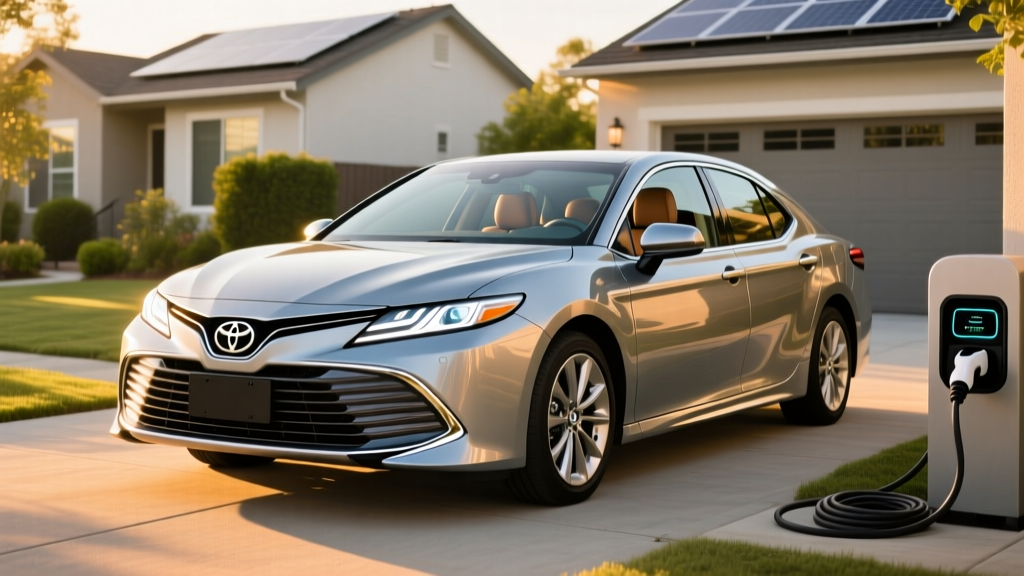
The 2025 Toyota Camry LE Hybrid is, for many buyers, the most rational midsize sedan on the market. With an EPA-estimated 51 MPG combined and a starting MSRP under $30,000, it bridges the gap between conventional gas sedans and full electric vehicles without requiring any change in driving habits — no plug, no range anxiety, no charging infrastructure dependency. For the 2025 model year, Toyota made a decisive move: every Camry is now a hybrid. The LE trim sits at the base of the lineup and delivers the best fuel economy of the entire range, making it the value-and-efficiency sweet spot for commuters, rideshare drivers, and cost-conscious families.
This guide covers everything a research-driven buyer needs: exact EPA MPG figures, real-world fuel economy expectations, the fifth-generation Toyota Hybrid System powertrain, battery longevity and warranty coverage, tax credit eligibility, and how the Camry LE Hybrid stacks up against plug-in hybrids and full EVs.
EPA Fuel Economy and Real-World MPG
The headline number for the 2025 Camry LE Hybrid is its EPA-estimated fuel economy. The LE trim, equipped with front-wheel drive, achieves the highest ratings in the Camry lineup:
| Metric | EPA Estimate | Real-World Expectation |
|---|---|---|
| City MPG | 51 MPG | 48–53 MPG (hybrids often exceed EPA in stop-and-go) |
| Highway MPG | 49 MPG | 44–48 MPG (sustained 70+ mph reduces regen benefit) |
| Combined MPG | 51 MPG | 46–50 MPG (mixed driving) |
| Fuel Tank Capacity | 13.2 gallons | — |
| Total Range | ~673 miles | ~600–660 miles (real-world) |
Source: EPA fueleconomy.gov.
For the AWD-equipped Camry Hybrid trims (available on SE, XLE, and XSE — not the LE), EPA ratings drop slightly to 50/46/48 city/highway/combined due to the additional drivetrain weight and friction.
Fifth-Generation Hybrid Powertrain: Specs and Performance
The 2025 Camry rides on Toyota's fifth-generation hybrid system, a significant evolution from the fourth-gen setup in the prior-generation Camry Hybrid. This system pairs a 2.5-liter four-cylinder Atkinson-cycle gasoline engine with two motor-generators and a lithium-ion hybrid battery pack.
| Specification | 2025 Camry LE Hybrid |
|---|---|
| Powertrain Type | Conventional Hybrid (HEV) — no plug-in |
| Gas Engine | 2.5L 4-cyl Atkinson-cycle (184 hp, 163 lb-ft) |
| Electric Motor | Permanent magnet synchronous (134 hp) |
| Combined Net Horsepower | 225 hp (FWD) |
| Transmission | eCVT (electronically controlled continuously variable) |
| Hybrid Battery | Lithium-ion, ~1.0 kWh (sealed, self-charging) |
| Drivetrain | Front-wheel drive (FWD) |
| 0–60 mph | ~7.2 seconds (estimated) |
| Curb Weight | ~3,595 lbs |
| Base MSRP | $29,495 (including $1,095 destination) |
The 225 combined horsepower represents a meaningful increase over the prior-generation Camry Hybrid's 208 hp, giving the 2025 model noticeably better passing power and highway merging confidence. The eCVT operates without traditional gear shifts, delivering smooth, linear acceleration — though some drivers accustomed to stepped automatics may notice the characteristic "rubber-band" feel under hard acceleration.
HEV vs PHEV vs EV: Which Powertrain Fits You?
The Camry LE is a conventional hybrid (HEV). It does not plug in. The battery recharges through regenerative braking and the gasoline engine. This is a critical distinction from plug-in hybrids (PHEVs) like the Toyota Prius Prime or full battery-electric vehicles (BEVs) like the Tesla Model 3.
| Factor | HEV (Camry LE Hybrid) | PHEV (e.g., Prius Prime) | BEV (e.g., Tesla Model 3) |
|---|---|---|---|
| Plug-in Required? | No | Yes (for EV range) | Yes |
| Electric-Only Range | ~1 mile at low speed | ~40–44 miles | 250–360+ miles |
| Total Range | ~673 miles | ~440+ miles | 250–360+ miles |
| Fuel/Charging Cost | Gas only (~$0.10/mi) | Gas + electricity (~$0.04–0.10/mi) | Electricity only (~$0.03–0.05/mi) |
| Home Charging Needed? | No | Recommended (Level 2) | Essential (Level 2) |
| Federal Tax Credit | Not eligible (§30D) | Up to $3,750* | Up to $7,500* |
| Upfront Price | Lowest | Moderate | Highest |
| Best For | No home charging, high mileage, simplicity | Short commute + home charger, road trips | Home charger, low running cost, tech-forward |
*Federal tax credit amounts depend on MSRP caps, buyer income limits, battery sourcing requirements, and point-of-sale transfer rules under IRS §30D. Verify eligibility at irs.gov.
- You don't have access to home or workplace charging
- You drive 15,000+ miles per year and want maximum fuel savings without infrastructure changes
- You want the lowest upfront cost with minimal maintenance complexity
- You take frequent long road trips and don't want to plan around charging stops
- Your daily commute is under 40 miles and you can install a Level 2 charger at home
- You want to drive on electricity most days but keep a gas engine for road trips
- You have reliable home Level 2 charging and want the lowest per-mile fuel cost
- You want zero tailpipe emissions and minimal drivetrain maintenance
Battery Longevity, Warranty, and Replacement Cost
Hybrid battery lifespan is consistently one of the top concerns for buyers considering their first hybrid. The 2025 Camry LE Hybrid uses a compact lithium-ion hybrid battery pack (approximately 1.0 kWh) that is far smaller than a PHEV or EV battery and operates within a narrow state-of-charge window — typically between 40% and 80% — which significantly reduces degradation stress.
- Coverage: 10 years / 150,000 miles (whichever comes first)
- Applies to: Hybrid battery pack, hybrid control module, inverter, and related hybrid system components
- Transferable: Yes, to subsequent owners
- Capacity threshold: Toyota warrants the battery against defects and abnormal loss of capacity; if the battery fails to hold sufficient charge to operate the hybrid system, it is covered
In practice, Toyota hybrid batteries have demonstrated exceptional longevity. Data from fleet operators and long-term owners shows that fourth- and fifth-generation Toyota hybrid batteries routinely exceed 200,000 miles without replacement. The Camry Hybrid's battery is not designed to be user-serviceable; if replacement is needed outside warranty, the cost typically ranges from $2,500 to $4,000 for a new OEM battery pack, including labor. Refurbished or reconditioned battery packs are available from third-party suppliers for $1,000–$2,000, though these may not carry the same longevity guarantees.
For context, this replacement cost is dramatically lower than EV battery replacements, which can run $8,000–$20,000+ due to the much larger battery capacity (60–100+ kWh vs. ~1 kWh). The Camry's small hybrid battery is simply less expensive to manufacture and replace.
Pricing, Trims, and Tax Credit Eligibility
The 2025 Camry lineup starts at $29,495 for the LE Hybrid (including $1,095 destination charge). This is a competitive price point for a midsize sedan with this level of standard equipment and fuel economy.
| Trim | Drivetrain | EPA Combined MPG | MSRP (incl. destination) |
|---|---|---|---|
| LE Hybrid | FWD | 51 MPG | $29,495 |
| SE Hybrid | FWD / AWD | 48–50 MPG | $31,095 |
| XLE Hybrid | FWD / AWD | 48–50 MPG | $34,095 |
| XSE Hybrid | FWD / AWD | 48–50 MPG | $35,495 |
Federal Tax Credit: The 2025 Camry LE Hybrid is a conventional hybrid (HEV) and does not qualify for the federal §30D Clean Vehicle Credit, which is reserved for plug-in electric vehicles (PHEVs and BEVs) with a minimum battery capacity of 7 kWh. The Camry's ~1.0 kWh hybrid battery does not meet this threshold.
State incentives: Some states offer rebates or reduced registration fees for hybrid vehicles, though these are less common than EV incentives. Check your state's energy or environmental agency for current programs.
Despite the lack of a federal tax credit, the Camry LE Hybrid's total cost of ownership remains compelling. At 51 MPG combined and a national average gas price of ~$3.20/gallon, the annual fuel cost for 15,000 miles of driving is approximately $941. A comparable gas-only midsize sedan averaging 30 MPG combined would cost roughly $1,600 per year — a difference of about $660 annually, or $3,300 over five years.
Ownership Costs: 5-Year Total Cost Breakdown
| Cost Category | 2025 Camry LE Hybrid | Gas Sedan Baseline (30 MPG) |
|---|---|---|
| Purchase Price (MSRP) | $29,495 | $28,000 |
| Federal Tax Credit | $0 | $0 |
| Fuel (5 yrs, 15k mi/yr, $3.20/gal) | ~$4,705 | ~$8,000 |
| Estimated Maintenance (5 yrs) | ~$2,200 | ~$2,800 |
| Insurance (5 yrs, avg) | ~$7,500 | ~$7,200 |
| Estimated Depreciation (5 yrs) | ~$13,000 | ~$13,500 |
| 5-Year Total (est.) | ~$30,400 | ~$32,500 |
| Cost per Mile | ~$0.41 | ~$0.43 |
The Camry Hybrid recoups its modest price premium within approximately 2–3 years through fuel savings alone, after which it costs less to operate than a comparable gas sedan. Toyota's strong resale values further support the ownership case. Depreciation estimates are based on historical Camry Hybrid retention rates tracked by automotive valuation services.
Pros, Cons, and Who Should Buy
- Class-leading 51 MPG combined — best in the midsize sedan segment
- 225 hp provides confident highway passing power
- No plug-in required — zero lifestyle change from a gas car
- 10-year/150,000-mile hybrid battery warranty
- Strong resale value and Toyota reliability reputation
- Standard Toyota Safety Sense 3.0 (adaptive cruise, lane keeping, automatic emergency braking)
- 600+ mile total range means fewer fuel stops on road trips
- No federal tax credit eligibility (HEV, not PHEV/BEV)
- AWD not available on the LE trim (must step up to SE or higher)
- eCVT can feel monotonous under hard acceleration
- Rear seat headroom slightly reduced vs. prior generation due to roofline
- No electric-only driving beyond very low-speed crawling
- Infotainment is functional but less polished than some competitors
Who should buy the 2025 Camry LE Hybrid: High-mileage commuters, rideshare drivers, budget-conscious families, and anyone who wants maximum fuel efficiency without dealing with charging infrastructure. If you live in an apartment without charging access, drive 15,000+ miles per year, or regularly take 400+ mile road trips, the Camry LE Hybrid offers the best combination of low running costs, reliability, and convenience in the midsize sedan class.
Frequently Asked Questions
How many MPG does the 2025 Toyota Camry LE Hybrid get?
The EPA rates the 2025 Camry LE Hybrid (FWD) at 51 city / 49 highway / 51 combined MPG. In real-world mixed driving, most owners report 47–50 MPG. City driving in warm weather can push above 52 MPG due to regenerative braking efficiency.
Does the 2025 Camry LE Hybrid need to be plugged in?
No. The Camry LE Hybrid is a conventional hybrid (HEV). Its small lithium-ion battery recharges automatically through regenerative braking and the gasoline engine. You never plug it in — you simply fill it with gas like a conventional car.
Is the Camry Hybrid battery expensive to replace?
Toyota hybrid batteries are designed to last the life of the vehicle. The battery is covered by a 10-year/150,000-mile warranty. If replacement is ever needed outside warranty, expect to pay $2,500–$4,000 for a new OEM battery with labor. Real-world data shows most Toyota hybrid batteries exceed 200,000 miles without failure.
Does the 2025 Camry Hybrid qualify for a federal tax credit?
No. The federal §30D Clean Vehicle Credit applies only to plug-in electric vehicles (PHEVs and BEVs) with at least 7 kWh of battery capacity. The Camry Hybrid's ~1.0 kWh battery does not qualify. Some states may offer separate hybrid incentives — check your state's energy agency.
How does the Camry LE Hybrid compare to the Camry SE and XLE Hybrid?
All 2025 Camry trims use the same 225 hp hybrid powertrain. The LE achieves the best fuel economy (51 MPG combined) because it is the lightest trim with the most aerodynamic wheel design. The SE, XLE, and XSE trims add weight from larger wheels, additional features, and available AWD, reducing fuel economy to 48–50 MPG combined. The LE also rides on 16-inch wheels with more sidewall, giving it a slightly softer ride than the sport-tuned SE and XSE.
Is the 2025 Camry Hybrid reliable?
Toyota's hybrid system has an extensive track record spanning over 25 years since the original Prius. The fifth-generation system in the 2025 Camry is an evolution of proven technology. Toyota's Safety Sense 3.0 suite is standard across all trims, and the Camry historically earns top marks from IIHS and NHTSA. Long-term reliability data from Consumer Reports and J.D. Power consistently places Toyota hybrids at or near the top of their segments.
Hybrid vs PHEV vs EV — which is right for me?
Choose the Camry LE Hybrid (HEV) if you lack home charging, drive high annual miles, and want simplicity. Choose a PHEV like the Prius Prime if you have a short commute with home charging and want electric-only daily driving plus gas flexibility. Choose a full EV if you have reliable Level 2 home charging, want the lowest per-mile cost (~$0.03–0.05/mi vs. ~$0.10/mi for the Camry Hybrid), and your daily driving is within the EV's range.