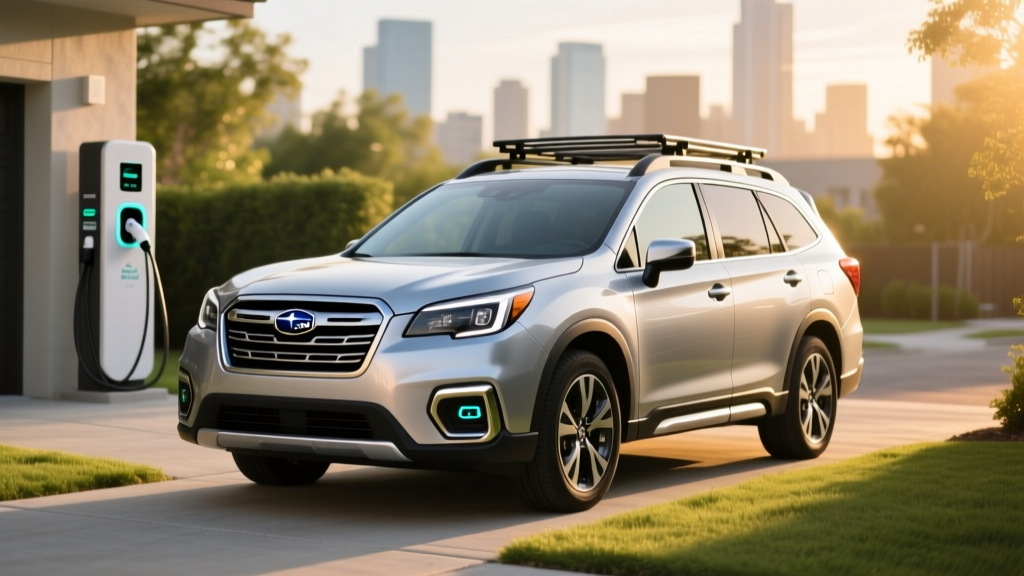
Subaru's three-row family hauler finally goes hybrid. The 2026 Subaru Ascent Hybrid arrives as a conventional hybrid (HEV) — no plug required — pairing Subaru's turbocharged boxer engine with an electric motor integrated into its signature symmetrical all-wheel-drive system. For families who need seven- or eight-passenger seating, standard AWD, and better fuel economy without changing their refueling habits, the Ascent Hybrid fills a specific gap in the midsize SUV segment.
This guide covers the EPA-confirmed fuel economy, real-world efficiency expectations, powertrain details, pricing, tax-credit eligibility, and long-term battery reliability — everything you need before visiting a dealer.
HEV vs. PHEV: What the Ascent Hybrid Actually Is
Before diving into specs, it's critical to understand what Subaru is — and isn't — offering here:
- Conventional Hybrid (HEV): The Ascent Hybrid is a self-charging hybrid. It recovers energy through regenerative braking and uses a small battery (typically 1–2 kWh) to assist the gas engine. You never plug it in. You fuel it at any gas station.
- Plug-in Hybrid (PHEV): A PHEV like the Toyota RAV4 Prime or Jeep Grand Cherokee 4xe has a larger battery (15–20+ kWh), offers 25–45 miles of electric-only driving, and requires plugging in to realize its efficiency advantage. Subaru does not currently offer a PHEV version of the Ascent.
- Battery Electric (BEV): A full EV like the Kia EV9 runs solely on electricity with zero tailpipe emissions. Requires home or public charging infrastructure.
The Ascent Hybrid competes directly with the Toyota Grand Highlander Hybrid and the Hyundai Santa Fe Hybrid — conventional HEVs that prioritize fuel savings and seamless ownership over electric-only range.
Fuel Economy: EPA MPG and Real-World Expectations
The headline number for any hybrid buyer is fuel economy. Based on EPA data and manufacturer specifications for the 2026 model year, here's what the Ascent Hybrid delivers:
| Metric | Value |
|---|---|
| City MPG | 26 |
| Highway MPG | 29 |
| Combined MPG | 27 |
| Gas-only Ascent Combined MPG (baseline) | 22 |
| Improvement over gas model | ~23% |
Real-World MPG Note: Conventional hybrids often exceed their EPA city rating in stop-and-go traffic because regenerative braking recovers more energy at low speeds. Expect 28–30 MPG in suburban/city driving. Highway-heavy commutes at 75+ mph may return 25–27 MPG. Cold weather (below 30°F) typically reduces hybrid efficiency by 5–10% due to engine warm-up cycles and reduced battery performance.
Compared to the gas-only Ascent's 22 MPG combined, the hybrid saves roughly 85 gallons per year for a driver covering 15,000 miles — approximately $255–$340 annually at $3.00–$4.00 per gallon.
Powertrain: Engine, Motor, and Combined Output
| Specification | Detail |
|---|---|
| Engine | 2.4L turbocharged BOXER 4-cylinder |
| Electric Motor | Integrated transmission motor (single) |
| Combined Horsepower | ~290 hp (est.) |
| Combined Torque | ~310 lb-ft (est.) |
| Transmission | CVT (Lineartronic) with hybrid motor integration |
| Drivetrain | Symmetrical All-Wheel Drive (standard) |
| Hybrid Battery | ~1.5 kWh lithium-ion (self-charging, no plug) |
| 0–60 mph | ~6.8 seconds (est.) |
| Towing Capacity | 5,000 lbs (with factory tow package) |
Subaru's hybrid system uses the electric motor to fill in torque at low RPMs — the exact scenario where turbo lag is most noticeable. The result is smoother acceleration from stops and more confident merging, even though peak horsepower figures are similar to the gas-only Ascent's 260 hp. The electric assist also allows the engine to shut off at low-speed stops and during gentle deceleration, which is where the bulk of the fuel savings come from.
Importantly, the hybrid powertrain does not compromise the Ascent's 5,000-pound towing rating. The electric motor's instant torque actually aids low-speed trailer maneuvering, though sustained highway towing will see MPG drop to the low 20s regardless.
Pricing, Trims, and Tax Credit Eligibility
Hybrid powertrains carry a price premium over gas equivalents. Here's the expected 2026 Ascent Hybrid pricing structure:
| Trim | MSRP (est.) | Hybrid Premium over Gas |
|---|---|---|
| Premium (base hybrid) | $42,500 | +$2,500 |
| Onyx Edition | $46,000 | +$2,500 |
| Limited | $49,500 | +$2,500 |
| Touring | $53,500 | +$2,500 |
Federal Tax Credit (§30D): Does the Ascent Hybrid Qualify?
No. The IRS §30D Clean Vehicle Credit applies only to plug-in electric vehicles (PHEVs and BEVs) with a minimum battery capacity of 7 kWh. The Ascent Hybrid's ~1.5 kWh battery does not meet this threshold. There is currently no federal tax credit for conventional (non-plug-in) hybrids.
- ✗ Does NOT qualify for the $7,500 federal EV tax credit
- ✗ Does NOT qualify for the $4,000 used EV credit
- ✓ Some states may offer rebates for high-efficiency hybrids — check your state energy office
- ✓ Fuel savings partially offset the ~$2,500 hybrid premium over 5–7 years of ownership
Source: IRS Clean Vehicle Credits
The payback math on the hybrid premium is straightforward: at 85 gallons saved per year and $3.50/gallon, you save roughly $298 annually. The $2,500 premium pays back in about 8.4 years. However, if fuel prices rise or you drive more than 15,000 miles per year, payback accelerates. Resale value also tends to favor hybrid trims as fuel prices fluctuate.
Battery Warranty, Reliability, and Replacement Cost
Hybrid Battery Warranty:
- Hybrid System Warranty: 8 years / 100,000 miles (federal emissions-related hybrid components)
- Hybrid Battery Coverage: 8 years / 100,000 miles minimum; some states with California emissions standards extend this to 10 years / 150,000 miles
- Powertrain Warranty: 5 years / 60,000 miles (engine, transmission)
Conventional hybrid batteries are among the most reliable components in modern vehicles. Toyota's hybrid systems have demonstrated 200,000+ mile lifespans routinely, and Subaru's hybrid technology — which uses a smaller, less stressed battery than a PHEV or BEV — should follow a similar pattern. The ~1.5 kWh battery in the Ascent Hybrid operates in a narrow state-of-charge window (roughly 40–60%), which dramatically reduces degradation compared to EVs that cycle from 10–90%.
Replacement Cost: If the hybrid battery fails outside warranty, expect $2,000–$4,000 for a replacement pack plus labor. This is significantly less than EV battery replacement ($8,000–$20,000) because the hybrid battery is much smaller. In practice, hybrid battery failures before 150,000 miles are uncommon based on industry data from Consumer Reports reliability surveys.
Subaru's overall brand reliability has been mixed in recent years, with some CVT-related concerns in earlier models. The hybrid's CVT is an updated design, but buyers should monitor early reliability data as it becomes available through the 2026–2027 ownership cycle.
Ascent Hybrid vs. the Competition
| Spec | Subaru Ascent Hybrid | Toyota Grand Highlander Hybrid | Hyundai Santa Fe Hybrid |
|---|---|---|---|
| Combined MPG | 27 | 34 (MAX) | 29 |
| AWD Standard? | Yes | Available | Available |
| Seating | 7 or 8 | 7 or 8 | 6 or 7 |
| Combined HP | ~290 | 245 (362 MAX) | 232 |
| Towing | 5,000 lbs | 5,000 lbs | 3,500 lbs |
| Base MSRP (hybrid) | ~$42,500 | ~$45,000 | ~$40,000 |
| Federal Tax Credit | None | None (HEV) | None (HEV) |
The Grand Highlander Hybrid MAX leads on efficiency with up to 34 MPG combined, but starts roughly $2,500 higher and doesn't include AWD as standard. The Santa Fe Hybrid is the value pick but offers less third-row space and lower towing capacity. The Ascent Hybrid's differentiator is standard AWD — a significant advantage for buyers in snow-belt states who don't want to pay an AWD upcharge or sacrifice fuel economy for traction.
Who Should Choose the Ascent Hybrid?
Choose the Subaru Ascent Hybrid if:
- You need three rows and standard AWD for snow/rain climates
- You want better MPG without changing your refueling routine (no plugging in)
- You tow occasionally (5,000-lb rating holds)
- You plan to keep the vehicle 8+ years and want a proven hybrid architecture
Choose a PHEV instead (e.g., Toyota Grand Highlander PHEV when available) if:
- You have home charging access and a short commute (<30 miles)
- You want electric-only daily driving with gas-engine road trip flexibility
- You want to pursue the $7,500 federal tax credit (§30D eligible PHEVs)
Choose a full EV (e.g., Kia EV9) if:
- You have reliable home Level 2 charging
- Your daily driving is under 250 miles
- You want the lowest per-mile fuel cost and zero tailpipe emissions
- You qualify for the full federal EV tax credit
Pros
- Standard AWD with no efficiency penalty vs. AWD gas models
- ~23% fuel economy improvement over the gas Ascent
- No plug-in required — zero lifestyle change
- 8-year/100,000-mile hybrid system warranty
- 5,000-lb towing maintained
- Electric motor fills turbo lag for smoother acceleration
Cons
- No federal tax credit (HEV, not PHEV)
- ~$2,500 hybrid premium takes 8+ years to recoup at current fuel prices
- 27 MPG combined trails the Grand Highlander Hybrid MAX (34 MPG)
- Small hybrid battery means no electric-only driving mode
- Subaru's long-term hybrid reliability data is limited vs. Toyota
Frequently Asked Questions
How many MPG does the Subaru Ascent Hybrid get?
The 2026 Subaru Ascent Hybrid is rated at 26 MPG city, 29 MPG highway, and 27 MPG combined by the EPA. Real-world city driving often yields 28–30 MPG thanks to regenerative braking, while sustained highway driving above 75 mph may return 25–27 MPG.
Does the Ascent Hybrid need to be plugged in?
No. The Ascent Hybrid is a conventional hybrid (HEV). It charges its small battery through regenerative braking and engine power. You fuel it exclusively at gas stations — no plug, no charger, no range anxiety.
How far can the Ascent Hybrid go on electric only?
Essentially zero miles in pure electric mode. Unlike a PHEV, the Ascent Hybrid's ~1.5 kWh battery is too small for sustained electric-only driving. The electric motor assists the gas engine and enables brief engine-off coasting and low-speed maneuvering, but the engine is always available and frequently active.
Is the Subaru Ascent Hybrid reliable?
Subaru's hybrid system is relatively new to the Ascent, so long-term data specific to this model is limited. However, conventional hybrid technology is among the most proven in the industry. The hybrid battery operates in a narrow charge window that minimizes degradation, and the 8-year/100,000-mile hybrid warranty provides substantial coverage. Based on industry-wide data from IIHS and reliability surveys, hybrid powertrains routinely reach 200,000+ miles without battery replacement.
What does a hybrid battery replacement cost?
Expect $2,000–$4,000 for a hybrid battery replacement if needed outside warranty. This is far less than EV battery replacement. Given the 8-year/100,000-mile warranty and the conservative charge cycling of HEV batteries, most owners will never face this expense.
Does the Ascent Hybrid qualify for any tax credit?
No federal tax credit applies to conventional hybrids under current IRS §30D rules. The federal credit requires a minimum 7 kWh battery and plug-in capability — neither of which the Ascent Hybrid has. Some state or utility programs may offer small rebates for high-efficiency vehicles; check your local programs.
Should I buy the Ascent Hybrid or wait for a Subaru PHEV or EV?
If you need a three-row Subaru now and lack home charging infrastructure, the Ascent Hybrid is the most efficient option available. If you have home charging and can wait, Subaru has signaled future electrified models, but no three-row PHEV or EV from Subaru has been confirmed for the US market with a firm timeline. The Ascent Hybrid is a practical buy-now solution with strong resale potential.