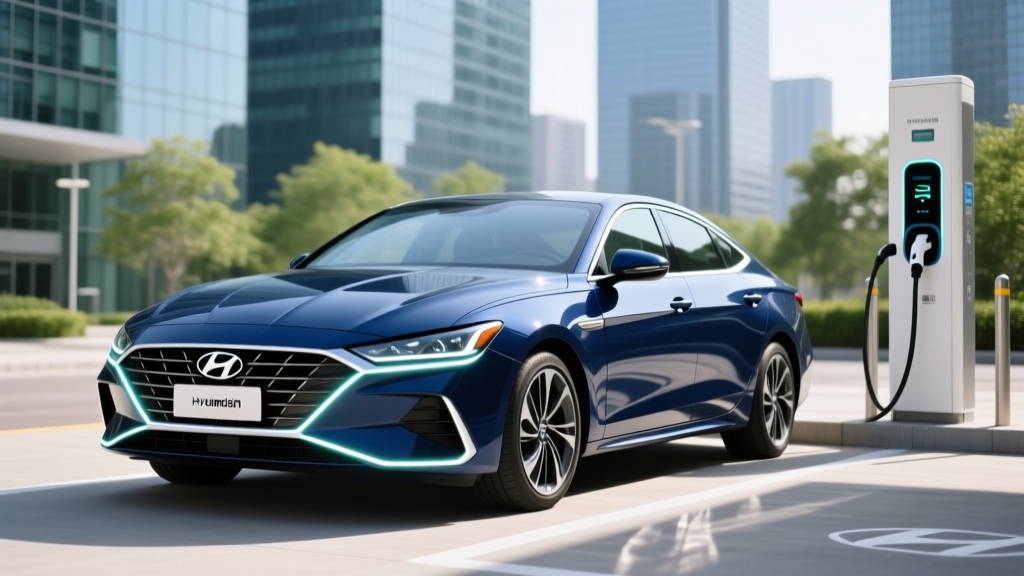
The Hyundai Sonata Hybrid occupies a practical middle ground: it sips fuel like a compact hybrid but offers the cabin space and highway comfort of a midsize sedan. For 2026, Hyundai continues the Sonata Hybrid with its proven parallel-hybrid powertrain and a focus on efficiency that routinely pushes real-world city driving above its EPA sticker. If you've been searching for sonata hybrid mpg data that goes beyond the brochure, this guide covers the exact numbers — EPA estimates, real-world expectations, powertrain specs, battery longevity, and total cost of ownership.
One clarification up front: the Sonata Hybrid is a conventional hybrid electric vehicle (HEV). It does not plug in. Hyundai discontinued the Sonata Plug-in Hybrid (PHEV) after the 2019 model year, so if you need electric-only range with a charging cord, you'll need to look at alternatives like the Toyota Prius Prime or Hyundai Tucson PHEV. We'll cover that comparison below.
Sonata Hybrid MPG: EPA Estimates vs. Real-World Results
The 2026 Sonata Hybrid carries forward the 2.0-liter inline-four and electric motor powertrain that debuted with this generation. Fuel economy varies slightly by trim due to wheel size and weight differences.
| Trim | City MPG | Highway MPG | Combined MPG |
|---|---|---|---|
| Blue (base) | 50 | 54 | 52 |
| SEL | 45 | 51 | 47 |
| Limited | 44 | 51 | 47 |
Source: fueleconomy.gov
The Sonata Hybrid's 52 MPG combined EPA figure is achieved primarily in city and suburban driving, where the electric motor handles low-speed propulsion and regenerative braking recaptures energy at every stop. On sustained highway trips at 70–80 mph, expect 42–46 MPG in the Blue trim and 38–42 MPG in the SEL/Limited. In cold weather (below 35°F), the gasoline engine runs more frequently to heat the cabin and maintain battery temperature, dropping observed economy by roughly 5–8 MPG across all trims. In warm-weather city driving, many owners report exceeding the EPA city estimate by 2–4 MPG thanks to frequent electric-only operation at low speeds.
For context, the gasoline-only 2026 Sonata with its 2.5-liter four-cylinder achieves 28 MPG combined (25 city / 33 highway). The hybrid nearly doubles city efficiency while adding only modest cost at purchase.
Powertrain Specs: Engine, Motor, and Combined Output
The Sonata Hybrid uses a parallel hybrid architecture — the gasoline engine and electric motor can drive the wheels independently or together. This is different from a series hybrid (like the old Chevy Volt's range-extended mode) where the engine only generates electricity.
| Specification | Value |
|---|---|
| Engine | 2.0L inline-4, Atkinson cycle |
| Engine output | 150 hp / 139 lb-ft torque |
| Electric motor | Permanent magnet synchronous, 39 kW (52 hp) |
| Combined system output | 192 hp |
| Transmission | 6-speed automatic (no CVT) |
| Hybrid battery | 1.62 kWh lithium-ion (non-plug-in) |
| 0–60 mph | ~7.6 seconds |
| Drivetrain | Front-wheel drive |
The 6-speed automatic is a deliberate choice. Hyundai avoids the CVT found in the Toyota Camry Hybrid, which gives smoother efficiency but a rubber-band feel under acceleration. The Sonata Hybrid shifts through fixed gears, providing more familiar acceleration feedback. The trade-off is marginally lower efficiency at steady-state cruising — but the difference is small enough that most drivers won't notice.
The 1.62 kWh battery is compact and self-charging. It captures energy from regenerative braking and the gasoline engine, then deploys it for electric-only driving at low speeds (typically up to 25–30 mph for short distances), torque assist during acceleration, and accessory load management. You never plug it in.
HEV vs. PHEV vs. EV: Which Powertrain Fits You?
Since Hyundai dropped the Sonata PHEV, buyers cross-shopping electrified sedans face a clear fork. Here's how to decide:
Conventional Hybrid (HEV)
Example: Sonata Hybrid
Fuel: Gasoline only, no plug
Best for: Drivers without home charging access, high-mileage commuters, apartment dwellers
Range: ~600+ miles per tank
Plug-in Hybrid (PHEV)
Example: Toyota Prius Prime
Fuel: Plug for 25–44 mi electric, then gasoline
Best for: Home chargers with short commutes who also road-trip
Range: ~40 mi electric + ~400 mi gas
Battery Electric (BEV)
Example: Tesla Model 3, Hyundai Ioniq 6
Fuel: Electricity only
Best for: Home charging, predictable routes, low operating cost priority
Range: 270–360+ mi per charge
Choose the Sonata Hybrid if: You don't have reliable access to a Level 2 home charger, you drive more than 15,000 miles per year in mixed conditions, and you want a midsize sedan without range planning. The hybrid eliminates charging logistics entirely while cutting fuel cost by roughly 40% compared to the gas-only Sonata.
Look at a PHEV instead if: You can install a 240V charger at home, your daily commute is under 35 miles round-trip, and you want some electric-only driving without committing fully to a BEV. The Prius Prime offers 44 miles of electric range and qualifies for the full §30D federal tax credit (up to $7,500, subject to income and sourcing rules).
Go full BEV if: You have home charging, your daily driving is under 250 miles, and you want the lowest per-mile energy cost. The Ioniq 6 offers 361 miles of EPA range and similar interior space to the Sonata.
Pricing, Trims, and Tax Credit Eligibility
| Trim | MSRP (incl. destination) | Federal Tax Credit |
|---|---|---|
| Blue | ~$30,250 | Not eligible |
| SEL | ~$32,750 | Not eligible |
| Limited | ~$37,400 | Not eligible |
The Sonata Hybrid is a conventional HEV — it does not qualify for the IRS §30D Clean Vehicle Credit. That credit applies only to plug-in vehicles (PHEVs and BEVs) with sufficient battery capacity. Conventional hybrids receive no federal purchase incentive. Some states and utilities offer rebates for hybrids, but these vary by jurisdiction — check your state energy office or local utility for current programs.
Despite lacking a tax credit, the Sonata Hybrid's fuel savings are meaningful. At $3.50/gallon and 15,000 miles/year, the Blue trim (52 MPG combined) costs approximately $1,010 annually in fuel. The gas-only Sonata (28 MPG combined) costs about $1,875 — a difference of roughly $865 per year, or $4,325 over five years.
Battery Longevity, Warranty, and Replacement Cost
Hyundai covers the Sonata Hybrid's lithium-ion battery pack for 10 years / 100,000 miles (whichever comes first) in all 50 states. This warranty guarantees the battery will maintain sufficient capacity for normal hybrid operation. If the battery fails or degrades below functional thresholds during the warranty period, Hyundai replaces it at no cost.
In California and states that adopt CARB emissions standards, the hybrid system warranty extends to 10 years / 150,000 miles.
Hybrid batteries have proven remarkably durable in real-world use. The Sonata Hybrid's 1.62 kWh pack operates within a conservative state-of-charge window — it never fully charges or fully depletes, which dramatically reduces degradation compared to a BEV battery that cycles through a wider range. Taxi fleets using Hyundai/Kia hybrid platforms have reported batteries lasting 200,000+ miles without replacement.
If replacement is needed out of warranty, expect to pay approximately $2,000–$3,500 for a new OEM battery pack, plus $300–$600 for labor. Aftermarket and refurbished packs are available for $1,200–$2,000. For comparison, a BEV battery replacement can cost $8,000–$20,000+.
Reliability, Safety, and Ownership Costs
The Sonata Hybrid benefits from a simpler powertrain than a conventional automatic: the electric motor supplements the engine, reducing load on mechanical components, and regenerative braking reduces wear on friction brake pads (many hybrid owners report original brake pads lasting 80,000+ miles).
The 2026 model carries forward strong safety credentials. The previous-generation Sonata earned the IIHS Top Safety Pick+ rating, and Hyundai's SmartSense suite — including forward collision-avoidance assist, blind-spot monitoring, lane-keeping assist, and adaptive cruise control — comes standard on all trims. Check iihs.org and NHTSA for updated 2026 crash-test results as they're published.
Insurance costs for the Sonata Hybrid are typically 5–10% higher than the gas-only version due to the higher replacement cost of hybrid-specific components, but this varies significantly by carrier, ZIP code, and driving record. Get quotes from at least three insurers before purchasing.
Pros and Cons at a Glance
Pros
- 52 MPG combined (Blue trim) — among the highest for any midsize sedan
- No plug-in required — zero charging logistics
- 10-year / 100,000-mile hybrid battery warranty
- Spacious rear seat and 16.0 cu-ft trunk (no battery intrusion)
- 6-speed automatic avoids CVT drone
- Comprehensive SmartSense safety suite standard
Cons
- No PHEV variant available — no electric-only commuting
- No federal tax credit (unlike plug-in competitors)
- Highway MPG drops noticeably above 75 mph
- Blue trim (highest MPG) has fewer features and smaller wheels
- Acceleration is adequate (7.6 sec to 60) but not quick
- AWD not available (unlike Toyota Camry Hybrid AWD)
Frequently Asked Questions
How many MPG does the Sonata Hybrid actually get?
The EPA rates the Blue trim at 50 city / 54 highway / 52 combined. The SEL and Limited trims are rated at 45 city / 51 highway / 47 combined. In real-world driving, city and suburban conditions often exceed the EPA city estimate by 2–4 MPG, while sustained highway driving at 75+ mph typically yields 42–46 MPG (Blue) or 38–42 MPG (SEL/Limited). Cold weather reduces all figures by roughly 5–8 MPG.
Does the Sonata Hybrid need to be plugged in?
No. The Sonata Hybrid is a conventional HEV. Its 1.62 kWh battery charges exclusively through regenerative braking and the gasoline engine. You fuel it like any other car — with gasoline at a gas station. There is no charging port.
Is there a Sonata Plug-in Hybrid (PHEV)?
Not for 2026. Hyundai discontinued the Sonata PHEV after the 2019 model year. If you want a Hyundai plug-in sedan, the closest alternative is the Hyundai Ioniq 6 (full BEV). For a PHEV sedan, the Toyota Prius Prime offers 44 miles of electric-only range and qualifies for the §30D federal tax credit.
How long will the hybrid battery last?
Hyundai warranties the hybrid battery for 10 years / 100,000 miles nationwide (10 years / 150,000 miles in CARB states). Real-world data from Hyundai/Kia hybrid taxis and high-mileage owners suggests these batteries routinely last 150,000–200,000+ miles. The small 1.62 kWh pack operates in a narrow charge window, minimizing degradation.
What does it cost to replace the hybrid battery?
Out-of-warranty replacement runs approximately $2,000–$3,500 for an OEM pack plus $300–$600 in labor. Refurbished or aftermarket packs are available for $1,200–$2,000. This is significantly less than a BEV battery replacement.
Is the Sonata Hybrid reliable?
The Sonata Hybrid's powertrain has demonstrated strong reliability in owner surveys and fleet use. The 6-speed automatic transmission is a proven design with fewer failure modes than a CVT. Hyundai's 10-year/100,000-mile powertrain warranty (covering the engine, motor, transmission, and hybrid components) provides additional peace of mind.
Does the Sonata Hybrid qualify for any tax credit?
No. The IRS §30D Clean Vehicle Credit applies only to plug-in vehicles (PHEVs and BEVs). The conventional Sonata Hybrid does not qualify for any federal purchase incentive. Check your state energy office for possible local hybrid rebates, as these vary by jurisdiction and change frequently.