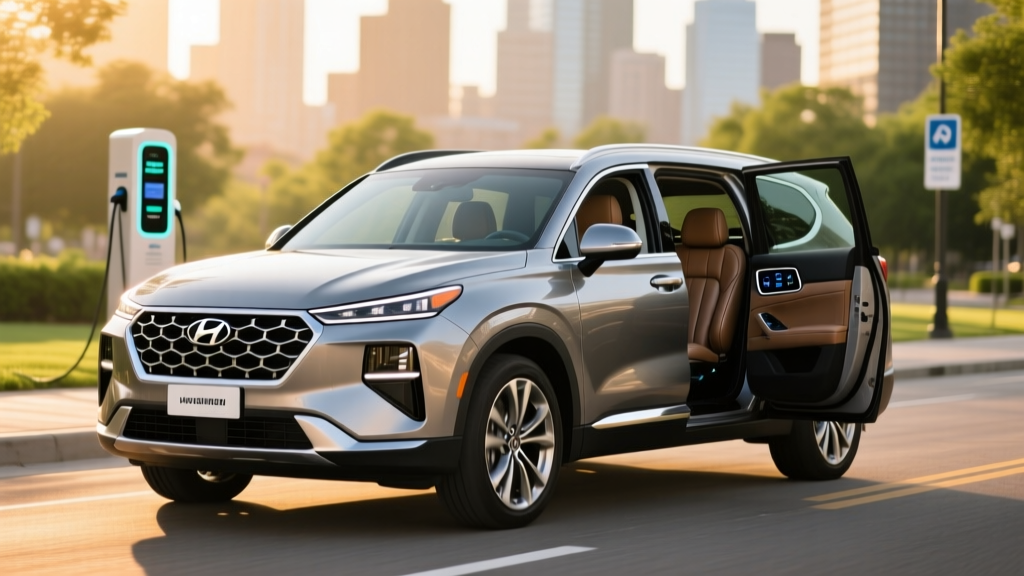
The Hyundai Santa Fe Hybrid occupies a specific niche in the midsize SUV segment: three-row family hauler that sips fuel without requiring a plug or lifestyle change. For 2026, Hyundai continues offering the Santa Fe in two electrified flavors — a conventional hybrid (HEV) and a plug-in hybrid (PHEV) — both built on the boxy, rugged-angled fifth-generation platform introduced for 2024. If you're researching the Santa Fe Hybrid, you likely want the cargo space and all-wheel-drive confidence of a midsize SUV but aren't ready to commit to a full battery-electric vehicle. This guide breaks down the exact MPG figures, powertrain specs, pricing, tax-credit eligibility, and real-world ownership considerations you need before visiting a dealer.
HEV vs PHEV: Which Santa Fe Hybrid Is Which?
Hyundai sells two distinct electrified Santa Fe models, and confusing them is the most common buyer mistake. Here's the fundamental difference:
Santa Fe Hybrid (HEV)
- No plug required. The battery charges through regenerative braking and the gasoline engine.
- Smaller battery: ~1.49 kWh lithium-ion pack — enough to assist the engine and enable brief low-speed electric-only driving, but not sustained EV mode.
- How you fuel it: Exactly like a gas car — fill up at any station. The hybrid system works invisibly in the background.
- Best for: Drivers who want better MPG with zero behavior change, apartment dwellers without charging access, or those who take frequent long road trips.
Santa Fe Plug-In Hybrid (PHEV)
- Plug-in capable. Features a much larger battery you charge from a wall outlet or public charger.
- Larger battery: 13.8 kWh usable capacity, enabling meaningful electric-only commuting.
- Electric-only range: EPA-rated 30 miles on battery alone before the gas engine kicks in.
- Best for: Households with home charging (Level 1 or Level 2) whose daily commute falls within 30 miles round-trip.
Both share the same 1.6-liter turbocharged four-cylinder engine and all-wheel-drive layout, but the PHEV pairs it with a more powerful electric motor and the larger battery. The driving experience diverges noticeably: the HEV feels like a refined gas SUV that happens to get great mileage, while the PHEV can operate as a quiet, torque-rich EV for daily errands before seamlessly reverting to hybrid mode on longer drives.
Fuel Economy: EPA MPG and Real-World Numbers
Fuel efficiency is the headline reason buyers cross-shop the Santa Fe Hybrid against the Toyota Highlander Hybrid, Kia Sorento Hybrid, and Mazda CX-70 PHEV. Here's what the EPA says, followed by what you'll actually see on the road.
| Model | City MPG | Highway MPG | Combined MPG | EPA Electric Range (PHEV) | Total Range |
|---|---|---|---|---|---|
| Santa Fe Hybrid (HEV) AWD | 35 | 37 | 36 | N/A | ~637 miles |
| Santa Fe Plug-In Hybrid AWD | 33 (hybrid mode) | 34 (hybrid mode) | 33 (hybrid mode) / 79 MPGe | 30 miles | ~430 miles total |
Source: fueleconomy.gov — EPA estimates. Your mileage will vary with driving style, terrain, and climate.
Real-World MPG vs. EPA Sticker
The Santa Fe HEV's 35/37/36 MPG rating is unusually honest for a midsize three-row SUV. In real-world mixed driving, most owners report 34–38 MPG combined, with city driving often exceeding the EPA estimate — a hallmark of hybrid powertrains that recapture energy during stop-and-go traffic. Highway cruising at 75+ MPH tends to pull efficiency down to 31–33 MPG due to the boxy aerodynamic profile and 4,300+ lb curb weight. In cold weather (below 30°F), expect a 5–10% efficiency drop as the engine runs more frequently to provide cabin heat.
For the PHEV, the 30-mile electric-only range holds up well in mild conditions, but drops to approximately 23–26 miles in freezing temperatures due to battery chemistry limitations and cabin heating demands. Once the battery is depleted, the PHEV operates as a conventional hybrid at roughly 33 MPG combined.
Powertrain Specs: Horsepower, Engine, and Motor
Both Santa Fe electrified models use Hyundai's Smartstream 1.6-liter turbocharged GDI four-cylinder, but the electric motor output and combined system power differ significantly.
| Specification | Santa Fe Hybrid (HEV) | Santa Fe Plug-In Hybrid |
|---|---|---|
| Engine | 1.6L Turbo GDI I-4 | 1.6L Turbo GDI I-4 |
| Engine Output | 178 hp / 195 lb-ft | 178 hp / 195 lb-ft |
| Electric Motor | 47.7 kW (64 hp) | 74.2 kW (99 hp) |
| Combined System Power | 232 hp | 268 hp |
| Transmission | 6-speed automatic | 6-speed automatic |
| Drivetrain | HTRAC AWD | HTRAC AWD |
| Battery Capacity | 1.49 kWh | 13.8 kWh |
| 0–60 MPH | ~7.5 seconds | ~6.8 seconds |
| Towing Capacity | 3,500 lbs | 3,500 lbs |
| Fuel Tank | 17.7 gallons | 13.7 gallons |
The PHEV's 268 combined horsepower gives it noticeably stronger acceleration, particularly in electric mode where the motor's 258 lb-ft of instant torque makes city driving effortless. The HEV's 232 hp is adequate for highway merging and loaded family hauling, but it doesn't feel quick — the 6-speed automatic (not a CVT) delivers smooth, predictable shifts without the drone common in competitor hybrids.
PHEV Charging: How Long and What You Need
If you're considering the Santa Fe Plug-In Hybrid, charging logistics matter. The 13.8 kWh battery is modest by full-EV standards, which actually works in your favor — it charges quickly on standard household power.
| Charging Level | Power | Time (0–100%) | Connector |
|---|---|---|---|
| Level 1 (120V household outlet) | ~1.4 kW | ~10–11 hours | Standard J1772 |
| Level 2 (240V home/public) | ~7.2 kW | ~2 hours | J1772 |
| DC Fast Charging | Not supported | N/A | N/A |
A key limitation: the Santa Fe PHEV does not support DC fast charging. This is standard for most PHEVs — the battery is small enough that Level 2 charging fills it quickly, and adding DC hardware would increase cost and weight for minimal benefit. For a 30-mile electric commute, overnight Level 1 charging from a standard 120V outlet is often sufficient. A Level 2 home charger completes a full charge in roughly two hours, making midday top-ups practical if you have workplace charging access.
Pricing, Trims, and Tax Credit Eligibility
The 2026 Santa Fe Hybrid lineup starts in the low-$40,000 range for the HEV and climbs into the upper-$40,000s for the PHEV. Here's the approximate MSRP breakdown by trim:
| Model / Trim | MSRP (approx.) | Key Features |
|---|---|---|
| Santa Fe Hybrid SEL Premium | $39,450 | Heated seats, power liftgate, 12.3" displays, HTRAC AWD |
| Santa Fe Hybrid Limited | $43,950 | Leather, ventilated front seats, dual-pane sunroof, premium audio |
| Santa Fe Hybrid Calligraphy | $47,250 | Nappa leather, head-up display, digital key, captain's chairs (6-seat) |
| Santa Fe PHEV SEL Premium | $44,500 | Same as HEV SEL Premium + PHEV powertrain, EV mode button |
| Santa Fe PHEV Limited | $48,750 | Same as HEV Limited + PHEV powertrain |
Prices are approximate MSRPs including destination. Confirm exact pricing with your dealer as they may vary by model year and market.
Does the Santa Fe Hybrid Qualify for a Federal Tax Credit?
Here's where the HEV and PHEV diverge sharply on incentives:
- Santa Fe Hybrid (HEV): Does not qualify for the federal §30D clean vehicle credit. Conventional hybrids are ineligible — the credit applies only to plug-in electric vehicles with sufficient battery capacity.
- Santa Fe Plug-In Hybrid: May qualify for up to $3,750 under the §30D credit, depending on battery component and critical-mineral sourcing requirements. The full $7,500 credit requires meeting both sourcing thresholds, and Hyundai's supply chain compliance has historically capped the Santa Fe PHEV at the partial credit amount. Verify current-year eligibility on IRS.gov before purchasing.
- Buyer income caps apply: Modified adjusted gross income must not exceed $150,000 (single), $225,000 (head of household), or $300,000 (joint).
- MSRP cap: SUVs must have an MSRP at or below $80,000 — all Santa Fe trims clear this easily.
- Point-of-sale transfer: As of 2024, you can transfer the credit to the dealer at purchase, reducing your out-of-pocket cost immediately rather than waiting for tax filing.
Several states offer additional rebates for PHEVs (California's CVRP, Colorado's state credit, and others), but these vary by jurisdiction and funding availability. Check your state energy office or department of revenue for current programs.
Battery Warranty, Reliability, and Replacement Costs
Battery longevity is the top concern for first-time hybrid buyers — and it's the area where Hyundai's coverage stands out most clearly.
Hyundai Hybrid Battery Warranty
- Hybrid/EV battery: 10 years / 100,000 miles (whichever comes first)
- Hybrid system components: 10 years / 100,000 miles (inverter, motor, generator)
- New vehicle limited warranty: 5 years / 60,000 miles
- Powertrain warranty: 10 years / 100,000 miles
Hyundai's 10-year hybrid battery warranty is among the longest in the industry, matched only by Kia and Genesis within the Hyundai Motor Group. The warranty covers capacity loss below a specified threshold (typically 70% state of health) and defects.
Real-world reliability: Hyundai's 1.6T hybrid powertrain has been in production since the 2020 model year across the Tucson, Sonata, and Santa Fe lineups. Large-scale failure data is limited, but the system has not appeared in NHTSA recall campaigns related to battery fires or catastrophic defects as of early 2026. The conventional HEV's 1.49 kWh battery is small and lightly stressed — it rarely cycles through full charge-discharge, which significantly extends cell life. Most hybrid batteries from major manufacturers last 150,000–200,000+ miles before meaningful degradation.
Replacement cost if out of warranty: A hybrid battery replacement for the Santa Fe HEV typically runs $2,000–$3,500 (parts and labor). The PHEV's larger 13.8 kWh pack is more expensive, estimated at $5,000–$8,000. However, these costs are rarely incurred during typical ownership — the vast majority of hybrid batteries outlast the vehicle's useful economic life.
Who Should Buy the Santa Fe Hybrid — and Who Shouldn't
The Santa Fe Hybrid isn't the right choice for everyone. Here's a decision framework based on driving patterns and priorities:
Choose the Santa Fe Hybrid (HEV) If:
- You want 3-row SUV space with 35+ MPG and no plug-in requirement
- You live in an apartment or lack reliable home/workplace charging
- You regularly take 400+ mile road trips and don't want to plan charging stops
- Your priority is lowering fuel costs without changing any driving habits
Choose the Santa Fe Plug-In Hybrid If:
- You have home charging (even a 120V outlet) and a commute under 30 miles round-trip
- You want to drive on electricity most weekdays but need gas flexibility for weekend trips
- You value the stronger 268 hp combined output and quieter electric-mode driving
- The partial federal tax credit (~$3,750) meaningfully reduces your purchase cost
Consider a Full EV Instead If:
- Your daily driving rarely exceeds 200 miles and you have reliable home Level 2 charging
- You want zero tailpipe emissions and the lowest per-mile fuel cost
- You're eligible for the full $7,500 federal credit on a qualifying EV (e.g., Hyundai Ioniq 5, Tesla Model Y)
- You want to eliminate oil changes and engine maintenance entirely
Pros and Cons at a Glance
Pros
- 36 MPG combined (HEV) is exceptional for a 3-row AWD SUV
- Class-leading 10-year/100,000-mile hybrid battery warranty
- Spacious, well-finished interior with standard 12.3" infotainment
- PHEV offers 30-mile electric-only range for gas-free commuting
- No range anxiety — fill up at any gas station in 3 minutes
- 3,500-lb towing capacity (both HEV and PHEV)
- HTRAC AWD standard on all trims
Cons
- HEV does not qualify for any federal tax credit
- PHEV lacks DC fast charging capability
- Boxy styling creates highway wind noise above 70 MPH
- Third row is tight for adults — best for children on short trips
- PHEV's smaller 13.7-gallon fuel tank reduces total range vs. HEV
- Acceleration is adequate but not quick (7.5s 0–60 for HEV)
- Dealer markups on hybrid trims remain common in some markets
Frequently Asked Questions
How many MPG does the Santa Fe Hybrid get in real-world driving?
The EPA rates the 2026 Santa Fe Hybrid AWD at 35 city / 37 highway / 36 combined. In real-world mixed driving, owners typically see 34–38 MPG combined. City driving often exceeds the EPA estimate thanks to regenerative braking, while sustained highway speeds above 75 MPH can reduce efficiency to 31–33 MPG. Cold weather (below 30°F) typically costs 5–10% efficiency due to increased engine operation for cabin heating.
How far can the Santa Fe Plug-In Hybrid go on electric power alone?
The EPA rates the Santa Fe PHEV at 30 miles of electric-only range. In mild weather (50–80°F), expect 28–32 miles in real-world mixed driving. In freezing conditions, that drops to approximately 23–26 miles due to battery chemistry limitations and electric cabin heating demands. Once the battery depletes, the vehicle seamlessly switches to hybrid mode at approximately 33 MPG combined.
Does the Santa Fe Hybrid need to be plugged in?
No — the conventional Santa Fe Hybrid (HEV) never needs to be plugged in. Its small 1.49 kWh battery charges entirely through regenerative braking and the gasoline engine. You fuel it exactly like a standard gas car. Only the Santa Fe Plug-In Hybrid (PHEV) benefits from being plugged in, and even the PHEV operates as a normal hybrid if you never charge it.
Does the Santa Fe Hybrid qualify for a federal tax credit?
The conventional Santa Fe Hybrid (HEV) does not qualify for any federal tax credit — §30D applies only to plug-in vehicles. The Santa Fe Plug-In Hybrid may qualify for up to $3,750 depending on current-year battery sourcing compliance, buyer income limits ($150K single / $300K joint), and the $80,000 SUV MSRP cap. Always verify eligibility on IRS.gov and with your tax professional before purchasing.
Is the Santa Fe Hybrid reliable? What if the battery fails?
Hyundai covers the hybrid battery and system components for 10 years / 100,000 miles — one of the longest warranties in the industry. The 1.6T hybrid powertrain has been in production since 2020 with no widespread failure patterns reported. If the battery does require replacement outside of warranty, expect approximately $2,000–$3,500 for the HEV and $5,000–$8,000 for the PHEV. Most hybrid batteries outlast 150,000 miles without significant issues.
How does the Santa Fe Hybrid compare to the Toyota Highlander Hybrid?
The Toyota Highlander Hybrid achieves 35 MPG combined (slightly less than the Santa Fe's 36) and offers a marginally more usable third row. However, the Santa Fe Hybrid provides a more modern interior design, standard 12.3-inch displays, and Hyundai's longer 10-year powertrain warranty (Toyota covers the hybrid battery for 10 years/150,000 miles but the general powertrain for 5 years/60,000 miles). The Santa Fe PHEV has no direct Highlander equivalent, as Toyota discontinued the RAV4 Prime–style PHEV in the Highlander lineup. If plug-in electric commuting matters, the Santa Fe PHEV is the stronger choice in this segment.
Can the Santa Fe Hybrid tow?
Yes. Both the Santa Fe Hybrid and Plug-In Hybrid are rated for 3,500 pounds of towing capacity when properly equipped with the factory tow package. That's sufficient for a small boat, utility trailer, or a pair of jet skis, but below the 5,000-lb rating of some V6-powered competitors.