Quick Verdict: The BMW 530e Plug-In Hybrid in 2026
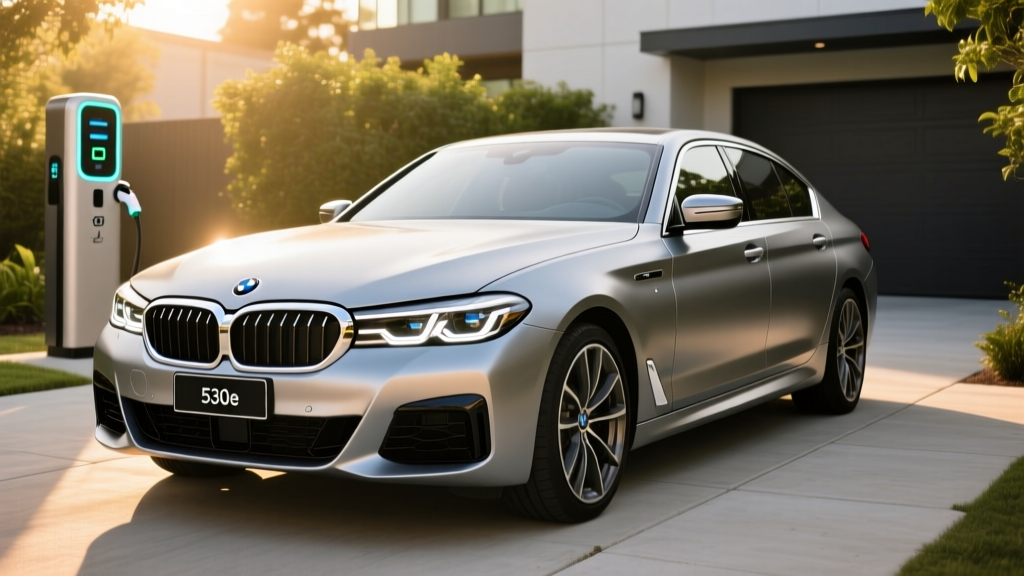
The BMW 530e plug-in hybrid occupies a precise niche: a midsize luxury sedan that handles short commutes on electricity alone while eliminating range anxiety on longer trips. For the 2026 model year, the 530e pairs a 2.0-liter turbocharged four-cylinder with an electric motor integrated into its eight-speed automatic transmission, delivering a combined 299 horsepower and an EPA-estimated 35 miles of electric-only driving. With a starting MSRP of $59,875 (including destination), it targets buyers who want luxury sedan refinement, daily electric commuting, and the freedom of a gas engine for road trips — without committing fully to a battery-electric vehicle.
This guide breaks down the real-world fuel economy, charging logistics, powertrain specs, battery longevity, and federal tax credit eligibility you need to evaluate whether the BMW 530e plug-in hybrid fits your garage.
HEV vs PHEV: Where the 530e Fits
Conventional Hybrid (HEV): A standard hybrid like the Toyota Camry Hybrid uses a small battery (typically 1–2 kWh) that recharges exclusively through regenerative braking and the gasoline engine. You never plug it in. It improves fuel economy modestly — often 40–50 MPG combined — but offers zero electric-only range.
Plug-In Hybrid (PHEV): The BMW 530e is a PHEV. It carries a substantially larger battery pack (22.0 kWh usable capacity in the 2026 model) that you can recharge from a wall outlet or charging station. This enables genuine electric-only driving — up to 35 EPA-estimated miles — before the gasoline engine engages. Once the battery depletes, the car operates as a conventional hybrid, blending engine and motor for efficient driving.
Why it matters: If your daily commute is under 35 miles round-trip and you can charge at home overnight, the 530e can run almost entirely on electricity on weekdays. On weekends or road trips, the gas engine takes over seamlessly, giving you a total combined range exceeding 430 miles.
Fuel Economy and Electric Range: The Numbers
| Metric | EPA Estimate | Real-World Expectation |
|---|---|---|
| Electric-only range | 35 miles | 28–33 miles (highway/cold weather) |
| Combined MPGe (electric + gas) | 64 MPGe | Varies with charging frequency |
| Gas-only combined MPG | 28 MPG combined | 26–30 MPG (city/highway mix) |
| City MPG (gas-only, hybrid mode) | 27 MPG | 28–32 MPG (regen assists in stop-and-go) |
| Highway MPG (gas-only, hybrid mode) | 29 MPG | 25–28 MPG (sustained 70+ mph) |
| Total combined range | ~430 miles | ~390–440 miles depending on conditions |
The EPA's MPGe figure (miles per gallon-equivalent) measures efficiency when the battery is charged and the car operates in blended electric-gas mode. In practice, MPGe is highly dependent on how often you plug in. Charge nightly and drive 30 miles a day, and you may use gasoline only on long trips — effectively achieving well over 100 MPGe on average. Never plug in, and the 530e operates as a heavy conventional hybrid, returning roughly 28 MPG combined. The plug-in advantage only materializes if you actually plug it in.
Real-world range note: The EPA's 35-mile electric estimate assumes moderate temperatures and mixed driving. In freezing weather (below 32°F), expect 20–25% range loss from the battery — bringing real electric range to approximately 26–28 miles. Highway driving at sustained 75+ mph also reduces electric range due to aerodynamic drag. For city commuting at 25–45 mph, you may match or slightly exceed the EPA figure thanks to regenerative braking recapturing energy.
Powertrain: Engine, Motor, and Combined Output
The 2026 BMW 530e xDrive — the sole US trim — uses BMW's fifth-generation eDrive plug-in hybrid architecture:
| Specification | Detail |
|---|---|
| Engine | 2.0L turbocharged inline-4 (184 hp, 258 lb-ft) |
| Electric motor | Integrated into transmission (184 hp, 207 lb-ft) |
| Combined system output | 299 hp, 331 lb-ft torque |
| Transmission | 8-speed automatic (ZF) |
| Drivetrain | xDrive all-wheel drive (standard) |
| 0–60 mph | 5.8 seconds |
| Battery (usable) | 22.0 kWh lithium-ion (NMC chemistry) |
| Top speed (electric only) | 87 mph |
| Fuel tank | 13.5 gallons (premium required) |
The combined 299 hp output is lower than the sum of individual engine and motor ratings because peak outputs don't occur at the same RPM. Still, 331 lb-ft of torque — available near-instantly from the electric motor — gives the 530e strong off-the-line acceleration. The 5.8-second 0–60 time places it comfortably ahead of four-cylinder competitors and in the territory of six-cylinder luxury sedans.
The xDrive all-wheel system is standard on the US-market 530e, adding roughly 100 lbs but improving traction in rain and light snow. Rear-wheel drive is not offered in the United States for this model year.
Charging: How to Refill the 22 kWh Battery
Charging the 530e is straightforward, but it's important to understand the power limitations. The onboard charger determines how quickly the battery accepts AC power from a wall outlet or Level 2 station. The 2026 530e supports up to 7.4 kW AC charging (single-phase, 32 amps).
| Charging Level | Power (kW) | 0–100% Time | Typical Source |
|---|---|---|---|
| Level 1 (120V household) | ~1.4 kW | ~16 hours | Standard outlet (included adapter) |
| Level 2 (240V, 32A) | 7.4 kW | ~3 hours | Home wallbox or public Level 2 |
| DC Fast Charge | Not supported | N/A | N/A |
Critical note: The BMW 530e does not support DC fast charging. This is typical for plug-in hybrids in this class — the smaller battery makes DCFC infrastructure less necessary, and it keeps vehicle cost and weight down. You'll recharge exclusively via AC power (Level 1 or Level 2).
For most owners, a Level 2 home charger is the practical choice. A 240V/32A wallbox installed in your garage will fully replenish the battery in about 3 hours, meaning an overnight charge easily covers a full electric commute the next day. Level 1 (standard 120V) works in a pinch but requires roughly 16 hours for a full charge — adequate if you drive fewer than 20 miles daily and can leave the car plugged in for extended periods.
Public Level 2 chargers (found at workplaces, shopping centers, and parking garages) can top up the battery while you're parked, extending your electric-only miles for the return trip. The 530e uses the standard J1772 connector for AC charging, compatible with virtually all public Level 2 stations in North America.
Pricing, Tax Credits, and Total Cost
The 2026 BMW 530e xDrive starts at a base MSRP of $59,875, including the $995 destination charge. Key options include the Premium Package ($3,400), Executive Package ($4,050), and M Sport Package ($4,600). A well-equipped 530e typically lands between $64,000 and $70,000 before incentives.
Federal §30D Tax Credit Eligibility (2026 rules):
- Vehicle MSRP cap: Sedans must be priced at or below $55,000 MSRP. The 530e's $59,875 starting price exceeds this cap.
- Result: The BMW 530e does NOT qualify for the $7,500 federal §30D new EV/PHEV tax credit.
- Buyer income limits: Even if MSRP qualified, adjusted gross income must not exceed $150,000 (single) / $300,000 (joint). See IRS §30D guidelines.
- Battery sourcing requirements: Critical mineral and battery component sourcing thresholds apply to qualifying vehicles.
The 530e's MSRP places it above the sedan cap, eliminating federal credit eligibility. However, some states offer their own PHEV incentives — California's Clean Fuel Reward and New York's Drive Clean Rebate are examples, though amounts and availability vary. Check your state's energy or DMV website for current programs. Consult a tax professional for personalized guidance.
Battery Longevity, Warranty, and Replacement Cost
BMW High-Voltage Battery Warranty:
- Coverage period: 8 years or 80,000 miles (whichever comes first)
- Capacity retention threshold: BMW warrants the battery against dropping below 70% of original capacity during the warranty period
- What's covered: Defects, excessive degradation beyond the 70% threshold, and module-level repairs
This warranty is mandated in part by California Air Resources Board (CARB) requirements, which BMW applies nationwide. It covers the high-voltage traction battery — not the 12V auxiliary battery.
Battery degradation in PHEVs is generally manageable because the battery is smaller and operates within a narrower state-of-charge window (the car's software maintains a buffer, preventing full 0% or 100% states that accelerate wear). Based on real-world data from BMW's earlier PHEV generations (such as the G30 530e from 2018–2023), owners typically see 5–10% capacity loss over the first five years. The 22.0 kWh pack should still deliver roughly 30+ miles of electric range after eight years of normal use.
Out-of-warranty replacement cost: If the high-voltage battery requires full replacement after the warranty expires, expect a dealer-quoted price between $8,000 and $12,000 (parts and labor). BMW's modular battery design allows individual module replacement in some cases, which can reduce costs to $2,000–$4,000 if only one or two modules are degraded. Independent EV shops may offer refurbished battery options at lower cost. According to fueleconomy.gov, PHEV battery replacement remains relatively rare within the first 10–12 years of ownership.
Reliability: BMW's B48 2.0L turbo engine has a strong reliability track record in both conventional and plug-in applications. The ZF 8-speed transmission is widely regarded as one of the most durable automatics on the market. The primary ownership risk is electronics complexity rather than mechanical failure — the 530e integrates high-voltage systems, thermal management, and software that require BMW-specialist diagnostics. Extended warranty coverage is worth considering if you plan to keep the car beyond the factory 4-year/50,000-mile bumper-to-bumper period.
Who Should Buy the BMW 530e — And Who Shouldn't
Pros
- 35-mile electric range covers most daily commutes gas-free
- 430+ mile total range eliminates road-trip range anxiety
- 299 hp and 5.8s 0–60 provide genuine performance
- Level 2 charging in ~3 hours is practical for overnight use
- xDrive AWD standard — strong all-weather capability
- BMW's luxury interior, iDrive 8.5, and driver-assistance suite
- 8-year/80,000-mile battery warranty
Cons
- No DC fast charging — public charging limited to Level 2
- $59,875 MSRP exceeds $55,000 federal tax credit cap for sedans
- Electric range drops to ~26–28 miles in freezing weather
- Premium fuel required — adds to operating cost vs. EVs
- Complex powertrain means higher long-term maintenance risk
- Trunk space reduced slightly vs. gas-only 5 Series (~14.4 cu ft)
The Decision Framework
Choose the BMW 530e plug-in hybrid if:
- Your daily commute is 20–35 miles and you can charge at home (Level 2)
- You want electric daily driving but take road trips of 300+ miles regularly
- You value luxury sedan refinement and don't want to compromise on a crossover
- You live in a region with cold winters where EV range loss is a concern
Choose a full BEV (like the BMW i5) if:
- You can charge at home and your longest regular trip is under 250 miles
- You want to eliminate oil changes, spark plugs, and gas-engine maintenance entirely
- You prioritize lowest per-mile energy cost (electricity is typically $0.04–0.06/mile vs. $0.12–0.18/mile for premium gas)
Choose a conventional HEV (like the Lexus ES 300h) if:
- You cannot charge at home or at work (apartment, street parking)
- You want hybrid efficiency without ever thinking about plugging in
- You want a lower purchase price — conventional hybrids start $15,000–$20,000 less
Frequently Asked Questions
How many MPG does the BMW 530e get?
When the battery is depleted and the car operates as a conventional hybrid, the EPA rates the 2026 530e at 27 MPG city, 29 MPG highway, and 28 MPG combined. In real-world city driving, regenerative braking often pushes actual mileage to 28–32 MPG. Highway driving at sustained high speeds typically yields 25–28 MPG. When you factor in regular plug-in charging, the effective MPGe can exceed 64 MPGe — but only if you charge consistently.
How far can the BMW 530e go on electric only?
The EPA estimates 35 miles of electric-only range. Real-world results vary: expect 28–33 miles in moderate temperatures with mixed driving, and as low as 26 miles in freezing cold or sustained highway speeds above 70 mph. The electric motor can propel the car up to 87 mph in EV mode, so highway merging is not an issue — though range depletes faster at higher speeds.
Does the BMW 530e qualify for a federal tax credit?
No. Under current IRS §30D rules, new sedans must have an MSRP at or below $55,000 to qualify for the up-to-$7,500 federal clean vehicle credit. The 530e starts at $59,875, exceeding this cap. State-level incentives may still apply depending on your jurisdiction — check your state energy office or DMV for current programs.
Is the BMW 530e reliable, and what does battery replacement cost?
The B48 engine and ZF 8-speed transmission have strong reliability records. The high-voltage battery is covered by an 8-year/80,000-mile warranty with a 70% capacity retention guarantee. Real-world data suggests 5–10% degradation over five years. Out-of-warranty full battery replacement costs approximately $8,000–$12,000 at a dealer, though module-level repair can reduce this to $2,000–$4,000. Full battery replacement within the first decade is uncommon.
Hybrid vs PHEV vs EV — which should I choose?
If you can charge at home and commute under 35 miles daily but need long-range flexibility, the 530e PHEV is ideal. If you never want to plug in and simply want better fuel economy, a conventional HEV (like a Camry Hybrid or Lexus ES 300h) is simpler and cheaper. If you can charge at home, rarely drive more than 250 miles in a day, and want the lowest operating cost, a full BEV like the BMW i5 eDrive40 eliminates gasoline entirely. The PHEV is the bridge option — best for drivers transitioning to electric who aren't ready to go all-in.
Can I charge the 530e at a public DC fast charger?
No. The 530e does not have a DC fast-charge port. It charges exclusively via AC power (Level 1 at 120V or Level 2 at 240V) using the J1772 connector. This is standard for most plug-in hybrids. For a full DC fast-charge experience, you'd need a full battery-electric vehicle like the BMW i5.