The Acura RLX Sport Hybrid: A Flagship Sedan That Punched Above Its Weight
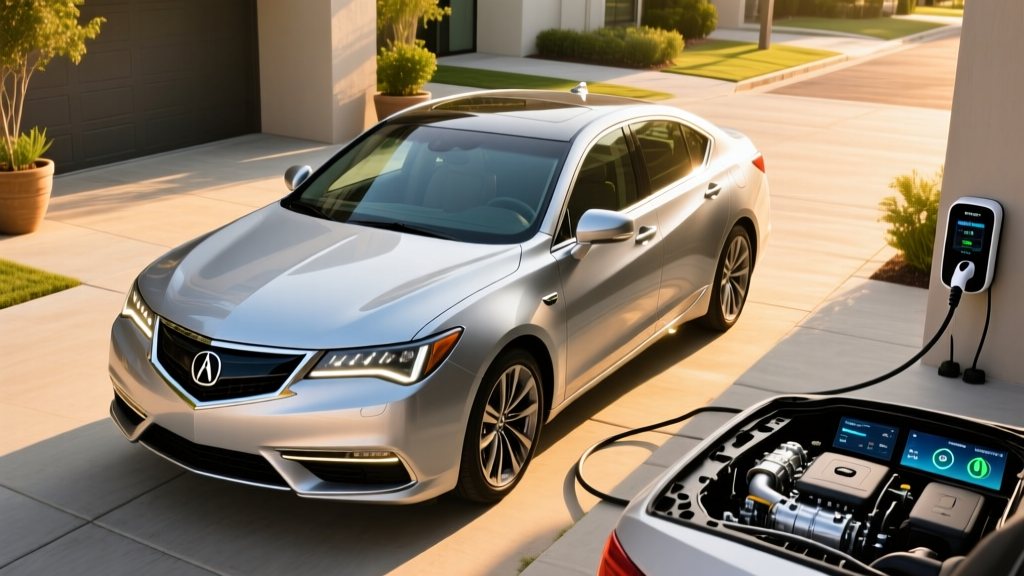
The Acura RLX Sport Hybrid SH-AWD arrived as Honda's luxury division attempted something ambitious: pair a 3.5-liter V6 with three electric motors to create a 377-horsepower all-wheel-drive sedan that still returned nearly 30 MPG. While the RLX line was discontinued after the 2020 model year, it remains a compelling used hybrid option for buyers who want luxury, all-weather traction, and V6 smoothness without the fuel penalty of a conventional performance sedan.
This guide covers the RLX Sport Hybrid's powertrain, real-world fuel economy, battery longevity, and whether it still makes sense as a used hybrid purchase in 2026 — especially compared to modern PHEVs and full EVs.
HEV vs PHEV: Where the RLX Sport Hybrid Fits
The Acura RLX Sport Hybrid is a conventional hybrid (HEV), not a plug-in hybrid. This is a critical distinction that affects how you own and operate the car:
- HEV (RLX Sport Hybrid): The battery recharges through regenerative braking and the gasoline engine. You never plug it in. There is no electric-only driving range — the motors assist the engine continuously but cannot propel the car on electricity alone at meaningful speeds.
- PHEV (e.g., Toyota RAV4 Prime, Chrysler Pacifica Hybrid): Larger battery (typically 15–20 kWh) that you plug in to recharge, offering 25–45 miles of electric-only driving before the gas engine engages.
- BEV (e.g., Tesla Model S, Lucid Air): Fully electric, no gasoline engine. 250–500+ miles of range, requires home or public charging infrastructure.
If you're searching for an "RLX Acura hybrid" expecting plug-in capability, the RLX does not offer it. Acura never produced a plug-in version of the RLX. The Sport Hybrid system is designed for seamless power delivery and efficiency gains, not electric-only commuting.
Powertrain Specs: 377 HP With Three Electric Motors
The RLX Sport Hybrid's powertrain is one of the most sophisticated hybrid setups Acura has ever built. Here's the full breakdown:
| Specification | Detail |
|---|---|
| Engine | 3.5L V6 i-VTEC (310 hp, 272 lb-ft) |
| Front Electric Motor | 47 hp (integrated into 7-speed DCT) |
| Rear Electric Motors | 2 × 36 hp (one per rear wheel, SH-AWD) |
| Combined System Output | 377 hp |
| Transmission | 7-speed dual-clutch automatic (front) |
| Drivetrain | Sport Hybrid SH-AWD (torque-vectoring rear axle) |
| Hybrid Battery | 1.3 kWh lithium-ion (located behind rear seats) |
| 0–60 mph | ~5.1 seconds |
| Curb Weight | ~4,380 lbs |
The twin rear motors are the headline feature. They don't just add all-wheel-drive traction — they enable torque vectoring, actively overdriving the outside rear wheel in corners. This gives the RLX Sport Hybrid handling dynamics that feel more like a sports sedan than a 4,380-pound luxury car. The system can send up to 70% of available torque to the rear axle and distribute it side-to-side as needed.
Fuel Economy: EPA Ratings and Real-World MPG
| Driving Cycle | EPA Rating | Real-World Expectation |
|---|---|---|
| City | 28 MPG | 27–30 MPG |
| Highway | 29 MPG | 26–28 MPG |
| Combined | 28 MPG | 26–29 MPG |
Source: EPA Fuel Economy
The RLX Sport Hybrid's 28 MPG combined is respectable for a 377-hp V6 AWD sedan, but context matters. The non-hybrid RLX with front-wheel drive rated 20 city / 29 highway / 23 combined — so the hybrid system delivers a meaningful 5 MPG improvement in combined driving while adding 67 horsepower and all-wheel drive.
Real-world notes: Hybrids typically exceed EPA city estimates in stop-and-go traffic where regenerative braking recaptures energy most effectively. Highway driving at 75+ mph reduces the hybrid advantage because the electric motors contribute less at sustained high speeds. Expect 26–27 MPG on long highway trips and 29–30 MPG in urban commuting. Cold weather (below 35°F) typically costs 2–3 MPG as the engine runs more frequently for cabin heat and battery warming.
For comparison, a 2026 BMW 530i xDrive (mild-hybrid 4-cylinder) achieves 27 MPG combined with 255 hp. The RLX Sport Hybrid delivers more power, more torque, and slightly better fuel economy — though in a heavier, older-platform package.
Battery Longevity, Warranty, and Replacement Costs
Acura Hybrid Battery Warranty (Original): 8 years / 100,000 miles (10 years / 150,000 miles in CARB states including California, New York, Massachusetts, and others adopting California emissions standards).
Battery Chemistry: Lithium-ion (1.3 kWh total capacity)
Replacement Cost (2026 estimate): $2,000–$4,000 for a refurbished or new hybrid battery pack, plus $500–$800 labor.
Because the RLX Sport Hybrid uses a relatively small 1.3 kWh battery that never operates at extreme states of charge (the system maintains a buffer, typically cycling between roughly 40% and 80% state of charge), degradation is minimal compared to larger EV or PHEV batteries. Most Honda/Acura hybrid batteries from this era (2014–2020) show less than 10% capacity loss after 100,000 miles.
The RLX's hybrid battery is located behind the rear seats, which slightly reduces trunk capacity (from 15.3 cu ft on the non-hybrid to 11.6 cu ft on the Sport Hybrid). This is a trade-off worth noting if cargo space is a priority.
Reliability track record: Honda's hybrid systems have proven durable. The RLX Sport Hybrid's 7-speed dual-clutch transmission is the more common source of complaints than the hybrid battery itself. Some owners report shuddering or hesitation during low-speed DCT operation — a known characteristic of early dual-clutch designs rather than a hybrid-specific issue. The IIHS gave the RLX good ratings in most crash tests, though headlight ratings varied by trim.
Pricing in 2026: Used Market Value and Tax Credit Eligibility
Since the Acura RLX was discontinued after the 2020 model year, there are no new RLX Sport Hybrids available. Here's what the used market looks like in 2026:
- 2019–2020 RLX Sport Hybrid (30,000–60,000 miles): $25,000–$33,000 depending on condition, mileage, and trim (Technology Package vs. Advance Package)
- 2017–2018 RLX Sport Hybrid (60,000–100,000 miles): $18,000–$25,000
- Original MSRP (2020): $56,925 (Technology) / $62,925 (Advance)
Federal tax credit status: The RLX Sport Hybrid does not qualify for the federal §30D new clean vehicle credit because it is a conventional hybrid (HEV), not a plug-in vehicle. The IRS §30D credit applies only to battery electric vehicles (BEVs) and plug-in hybrids (PHEVs) with a minimum battery capacity of 7 kWh. The RLX's 1.3 kWh battery falls far below this threshold.
For the Used Clean Vehicle Credit (§25E), which offers up to $4,000 or 30% of the sale price (whichever is lower) on qualifying used EVs and PHEVs priced under $25,000, the RLX also does not qualify — again because it is a conventional hybrid, not a plug-in vehicle.
Who Should Buy the RLX Sport Hybrid vs. a PHEV or EV
Reasons to Choose the RLX Sport Hybrid
- You want a luxury V6 AWD sedan with strong acceleration (5.1s 0–60) and 28 MPG without ever plugging in
- You live in a cold climate where AWD and SH-AWD torque vectoring provide real handling benefits
- You don't have access to home or workplace charging, making a PHEV or EV impractical
- You want a depreciated luxury sedan at a fraction of its original $57,000–$63,000 MSRP
- You value the smooth, quiet V6 character that a 4-cylinder turbo or EV can't replicate
Reasons to Look Elsewhere
- You want electric-only commuting (you need a PHEV like the Toyota RAV4 Prime or a BEV)
- Cargo space matters — the hybrid battery reduces trunk volume to 11.6 cu ft
- You want the latest infotainment, ADAS, and connectivity (the 2020 RLX's tech feels dated in 2026)
- You prefer a current-production vehicle with full factory warranty remaining
- Fuel economy is your top priority — a 2026 Toyota Camry Hybrid achieves 52 MPG combined for under $30,000
The decision framework:
- Choose the RLX Sport Hybrid if: You want a used luxury performance sedan with AWD and reasonable fuel economy, you can't charge at home, and you're comfortable with a discontinued model.
- Choose a PHEV (e.g., BMW 330e, Toyota RAV4 Prime) if: You have home charging and want 25–40 miles of electric-only commuting with a gas backup for road trips.
- Choose a BEV (e.g., Tesla Model 3, Hyundai Ioniq 6) if: You have reliable charging access, want minimal maintenance, and are ready to go fully electric.
RLX Sport Hybrid vs. Modern Alternatives: How It Stacks Up
| Vehicle | Type | Combined MPG / MPGe | HP | 0–60 | Price Range (2026) |
|---|---|---|---|---|---|
| Acura RLX Sport Hybrid (2019–2020) | HEV | 28 MPG | 377 | 5.1s | $18,000–$33,000 (used) |
| Toyota Camry Hybrid (2026) | HEV | 52 MPG | 225 | 7.2s | $29,000–$36,000 (new) |
| BMW 330e xDrive (2026) | PHEV | 28 MPG + 23 mi electric | 288 | 5.6s | $47,000–$55,000 (new) |
| Tesla Model 3 Long Range AWD (2026) | BEV | 132 MPGe / 341 mi range | 346 | 4.2s | $42,000–$48,000 (new) |
| Lexus ES 300h (2026) | HEV | 44 MPG | 215 | 7.3s | $44,000–$52,000 (new) |
The RLX Sport Hybrid occupies a unique niche: it's the most powerful vehicle in this comparison while matching the BMW 330e's combined MPG (when the BMW is operating as a hybrid with a depleted battery). But it's also the oldest platform, with the least advanced infotainment and driver-assistance features. If performance-per-dollar in a luxury hybrid is your priority, the used RLX is hard to beat. If you want modern tech, warranty coverage, or electric-only driving, the alternatives above make more sense.
Frequently Asked Questions
How many MPG does the Acura RLX Sport Hybrid get?
The EPA rates the RLX Sport Hybrid SH-AWD at 28 MPG city / 29 MPG highway / 28 MPG combined. In real-world driving, expect 29–30 MPG in city traffic (where regenerative braking is most effective) and 26–27 MPG on sustained highway trips above 70 mph.
Can the RLX Sport Hybrid drive on electric power only?
Not in any practical sense. The RLX is a conventional hybrid (HEV), not a plug-in. Its electric motors assist the V6 engine but cannot propel the car at meaningful speeds on electricity alone. If electric-only commuting is important, you need a PHEV or BEV.
Is the Acura RLX hybrid battery expensive to replace?
A replacement hybrid battery for the RLX Sport Hybrid costs approximately $2,000–$4,000 for the part, plus $500–$800 in labor. However, Honda/Acura hybrid batteries from this generation rarely need replacement before 150,000+ miles due to conservative state-of-charge management. The original warranty covered 8 years/100,000 miles (10 years/150,000 miles in CARB states).
Does the RLX Sport Hybrid qualify for any federal tax credit?
No. The RLX Sport Hybrid is a conventional hybrid (HEV) and does not qualify for the federal §30D new vehicle credit or the §25E used vehicle credit. Both credits require plug-in capability and a minimum battery capacity (7 kWh for §30D, 7 kWh for §25E). The RLX's 1.3 kWh battery does not meet these thresholds. Always verify current rules at IRS.gov.
Is the RLX Sport Hybrid SH-AWD system reliable?
The SH-AWD system and hybrid powertrain have proven reliable in long-term ownership. The most common complaints relate to the 7-speed dual-clutch transmission, which can exhibit low-speed shuddering — a characteristic of early DCT designs. The hybrid battery, rear electric motors, and torque-vectoring rear differential have not been widespread failure points. Regular maintenance (transmission fluid changes, inverter coolant service) is important for longevity.
How does the RLX Sport Hybrid compare to the Lexus GS 450h?
The Lexus GS 450h (discontinued after 2020) offered 338 hp, 31 MPG combined, and a more traditional CVT-based hybrid system. The RLX has more power (377 hp) and a more sophisticated AWD system, but the Lexus achieves better fuel economy and has a more refined interior. Both are strong used luxury hybrid options, with the RLX favoring performance and the GS favoring efficiency.