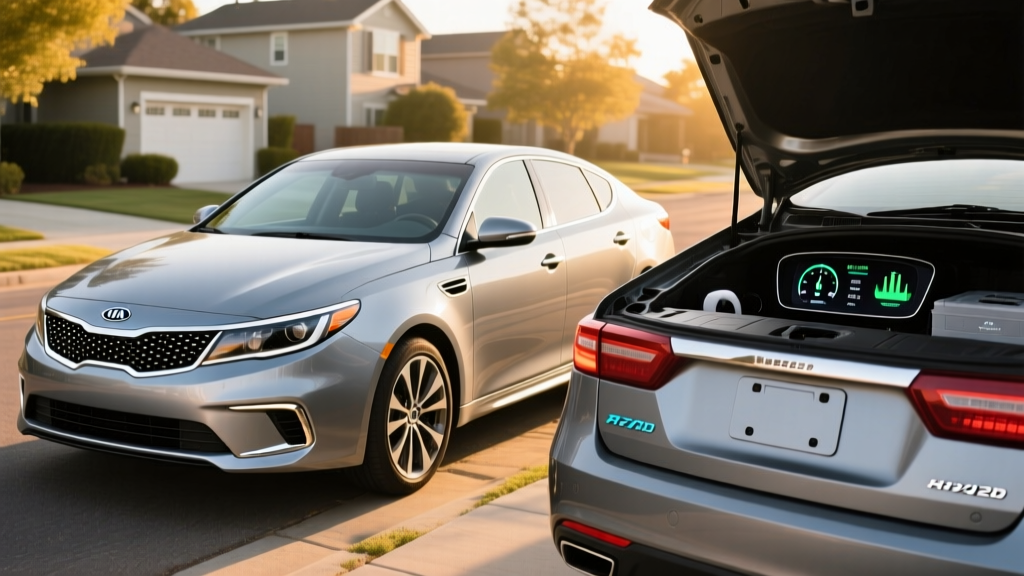
The 2013 Kia Optima Hybrid arrived as Kia's first serious entry into the hybrid sedan market, competing directly against the Toyota Camry Hybrid and Hyundai Sonata Hybrid (its platform sibling). Over a decade later, it remains a popular used-car search for budget-conscious buyers who want hybrid fuel economy without plug-in complexity. If you're researching the 2013 Kia Optima Hybrid as a used purchase in 2026, this guide covers every number that matters — EPA MPG, real-world efficiency, powertrain specs, battery longevity, and whether it still makes financial sense versus a newer hybrid or a full EV.
HEV vs PHEV: Where the 2013 Optima Hybrid Fits
Before diving into specs, it's critical to understand what this car is — and what it isn't. The 2013 Kia Optima Hybrid is a conventional hybrid electric vehicle (HEV). It does not plug in. It cannot drive on electric power alone for meaningful distances. It recovers energy through regenerative braking and uses a small battery buffer to assist its gasoline engine, improving fuel economy without any change to your fueling habits.
| Feature | HEV (2013 Optima Hybrid) | PHEV (e.g., 2026 Toyota RAV4 Prime) | BEV (e.g., 2026 Tesla Model 3) |
|---|---|---|---|
| Plugs in? | No | Yes (Level 1/2) | Yes (Level 1/2/DC) |
| Electric-only range | ~1 mi at low speed | 30–42 mi | 250–360 mi |
| Battery capacity | 1.4 kWh | 13.6–18.1 kWh | 57–82 kWh |
| Fueling/Charging | Gas station only | Gas + plug-in | Plug-in only |
| Federal tax credit (new) | None | Up to $7,500 (§30D) | Up to $7,500 (§30D) |
| Best for | High-mileage commuters, no home charging | Short commutes + road trips | Home charging access + low running costs |
Kia did not offer a plug-in hybrid variant of the Optima until the 2017 model year, when it was rebranded as the Optima PHEV with a 9.8 kWh battery and roughly 27 miles of electric-only range. If you need plug-in capability, the 2013 model year won't provide it.
2013 Kia Optima Hybrid: Full Powertrain & Efficiency Specs
| Specification | Value |
|---|---|
| Engine | 2.4L Atkinson-cycle 4-cylinder |
| Engine output | 169 HP @ 6,000 RPM / 156 lb-ft torque |
| Electric motor | 35 kW (47 HP) permanent-magnet synchronous |
| Combined system output | 206 HP / 195 lb-ft torque |
| Transmission | 6-speed automatic (no torque converter — uses motor coupling) |
| Hybrid battery | 1.4 kWh lithium-polymer (Li-Po) |
| EPA city MPG | 35 MPG |
| EPA highway MPG | 39 MPG |
| EPA combined MPG | 36 MPG |
| Fuel tank | 17.2 gallons |
| Total driving range | ~619 miles (EPA est.) |
| 0–60 mph | ~8.5 seconds |
| Curb weight | 3,629 lbs |
| Drag coefficient | 0.26 Cd (vs 0.29 for gas Optima) |
The 2013 model year was a significant refresh for the Optima Hybrid. Kia replaced the original 2.4L Theta II engine's hybrid pairing with an updated motor and revised software calibration, improving highway efficiency by 4 MPG over the 2011–2012 model years (which were rated at 35 combined). The 6-speed automatic was a differentiator — most competitors used CVTs, and the Optima Hybrid's conventional transmission delivered more natural shift feel at the cost of some low-speed electric assist smoothness.
Real-World MPG: What Owners Actually Report
EPA figures are a starting point, not a guarantee. The 2013 Optima Hybrid's 35/39/36 MPG ratings were competitive at launch, but real-world results vary based on driving style, terrain, and climate.
Real-world owner average: 32–37 MPG combined
City-heavy drivers often see 37–40 MPG thanks to regenerative braking and frequent engine-off coasting. Highway-dominant commutes at 75+ MPH tend to drop to 30–33 MPG, as the small 1.4 kWh battery provides minimal assist at sustained high speeds. Cold-weather driving (below 35°F) can reduce efficiency by 8–12%, as the gasoline engine runs more frequently to provide cabin heat.
Data from fueleconomy.gov user reports and Fuelly tracking show a median real-world combined of approximately 34 MPG across several hundred logged fill-ups. That's within 6% of the EPA sticker — respectable for a hybrid of this era, but not class-leading. The Toyota Camry Hybrid of the same vintage typically delivers 39–42 MPG real-world, and the Ford Fusion Hybrid (also a 2013 redesign) averages 38–41 MPG in owner logs.
Why highway MPG exceeds city MPG (unusual for a hybrid)
Most hybrids achieve higher city ratings because regenerative braking recaptures energy in stop-and-go driving. The 2013 Optima Hybrid is an exception: its 39 MPG highway rating beats its 35 MPG city figure. This is due to its aerodynamic improvements (0.26 Cd), the 6-speed transmission's tall overdrive gear, and the fact that Kia's hybrid system at the time was optimized for steady-state cruising rather than low-speed electric assist. If your commute is mostly urban, expect results closer to 33–35 MPG city.
| Driving Scenario | EPA Rating | Expected Real-World |
|---|---|---|
| City (stop-and-go, <45 MPH) | 35 MPG | 33–38 MPG |
| Highway (65–75 MPH, flat terrain) | 39 MPG | 32–36 MPG |
| Combined (mixed driving) | 36 MPG | 32–37 MPG |
| Cold weather (below 35°F) | — | 29–33 MPG |
| Mountainous / hilly terrain | — | 28–32 MPG |
Hybrid Battery Longevity, Warranty & Replacement Cost
The most common concern for any used-hybrid buyer is battery health. The 2013 Optima Hybrid uses a 1.4 kWh lithium-polymer (Li-Po) pack manufactured by LG Chem, mounted behind the rear seat. This is a small battery by modern standards — for context, a 2026 Toyota Prius Prime PHEV carries an 13.6 kWh pack — but its job is power assist, not electric-only range.
• 10 years / 100,000 miles (original owner, powertrain + hybrid components)
• 10 years / 100,000 miles for hybrid battery specifically
• Transferable to second owner: drops to 5 years / 60,000 miles in most states; remains 10/100,000 in CARB states (CA, NY, MA, and others adopting California emissions standards)
2026 Status: A 2013 model is now 13 years old. The original 10-year warranty has expired for most vehicles regardless of mileage. Battery replacement is an out-of-pocket expense.
Battery degradation and failure data
Lithium-polymer batteries in Kia/Hyundai hybrids of this generation have shown moderate longevity. Based on owner forums (Kia-Forums.com, Hyundai-Forums.com) and repair databases:
- Typical lifespan before noticeable degradation: 120,000–160,000 miles or 10–14 years
- Capacity loss at 100,000 miles: Approximately 15–25% (based on reduced EV-mode assist and slightly lower MPG)
- Complete failure rate: Estimated 8–12% of 2011–2014 Optima Hybrids by year 10, based on NHTSA complaint data and repair surveys
Signs of hybrid battery degradation in the 2013 Optima Hybrid include:
- Noticeable drop in fuel economy (3–5 MPG below historical average)
- More frequent engine engagement at low speeds
- "Check Hybrid System" warning light (DTC codes P0A80, P0A0F common)
- Reduced regenerative braking strength
Battery replacement cost (2026 estimates)
| Option | Cost Range | Notes |
|---|---|---|
| New OEM battery (Kia dealer) | $3,200–$4,500 | Includes labor; full warranty; may require ordering |
| Refurbished/remanufactored battery | $1,500–$2,500 | Third-party suppliers; 1–3 year warranty typical |
| Individual cell/module replacement | $600–$1,200 | Requires specialized hybrid technician; not all shops offer this |
| Used/salvage battery | $500–$900 | High risk — unknown remaining life; no warranty |
Before purchasing a used 2013 Optima Hybrid, request a hybrid battery state-of-health (SoH) scan from a Kia dealer or a shop with Hyundai/Kia GDS (Global Diagnostic System) access. This reads individual cell voltages and internal resistance — a variance of more than 0.2V between cells indicates impending failure.
Reliability Ratings & Known Issues
The 2013 Optima Hybrid carries mixed reliability marks. While the hybrid powertrain itself is reasonably durable, several non-hybrid-specific issues affect the model:
NHTSA overall safety rating: 5 stars (the highest rating). The 2013 Optima earned top marks across frontal, side, and rollover crash tests. Full details available at NHTSA.gov.
IIHS ratings: Good (top rating) in moderate overlap front, side, roof strength, and head restraints. The IIHS did not test the small overlap front on this model year.
Common issues beyond the hybrid battery:
- Theta II engine concerns: The 2.4L engine in some 2011–2014 Optima models was subject to a major Kia recall for connecting rod bearing failure, which could lead to engine seizure. Check whether the recall campaign (Kia Service Campaign SC218 / NHTSA recall 20V-757) was completed on any used example. This is not hybrid-specific but affects the Optima Hybrid's gasoline engine.
- Hybrid system clutch actuator: Some owners report a shudder or hesitation during low-speed transitions between electric and gas power. Often resolved with a software update, but in some cases requires clutch actuator replacement ($800–$1,400).
- 12V auxiliary battery: Like all hybrids, the Optima Hybrid has a standard 12V battery that powers electronics. It typically lasts 3–5 years and is inexpensive to replace (~$180–$250), but a dead 12V battery will prevent the car from starting even if the hybrid battery is fully charged.
Pricing in 2026: What a Used 2013 Optima Hybrid Costs
The 2013 Kia Optima Hybrid was offered in two trims: the base Hybrid and the Hybrid EX (which added leather, panoramic sunroof, navigation, and Infinity audio). Original MSRPs were:
| Trim | Original MSRP (2013) | Estimated Used Price (2026) |
|---|---|---|
| Optima Hybrid (base) | $26,750 | $6,500–$9,500 |
| Optima Hybrid EX | $31,250 | $7,500–$11,000 |
Prices vary significantly based on mileage (most surviving examples have 100,000–160,000 miles), condition, battery health, and regional demand. Hybrid sedans have softened in the used market as plug-in hybrids and affordable EVs like the Chevrolet Bolt and Nissan Leaf have proliferated.
Tax credit eligibility
The 2013 Kia Optima Hybrid does not qualify for the federal §30D clean vehicle tax credit as a new purchase — it was never eligible even at launch, as the §30D credit at that time required plug-in capability with at least 4 kWh of battery capacity (the Optima Hybrid has 1.4 kWh). As a used vehicle in 2026, it could theoretically qualify for the used clean vehicle credit (§25E) of up to $4,000, but only if it meets the battery capacity threshold (≥7 kWh), which it does not. No federal tax credit applies to this vehicle in 2026.
Some states offer used-hybrid incentives or HOV lane access, but these vary by jurisdiction. Check your state's DMV or energy office for current programs.
Who Should Buy the 2013 Optima Hybrid — and Who Shouldn't
Pros
- No plug-in required — fuel anywhere, no home charging needed
- 36 MPG combined (EPA) saves ~$500–$700/year vs a 25 MPG gas sedan at 15,000 mi/yr
- 5-star NHTSA safety rating
- Spacious midsize sedan interior with 15.4 cu ft trunk
- Conventional 6-speed automatic avoids CVT drone
- Low entry price ($6,500–$11,000 used)
Cons
- Hybrid battery warranty expired; replacement is $1,500–$4,500
- Theta II engine recall risk — must verify completion
- Real-world MPG lags Camry Hybrid and Fusion Hybrid by 4–6 MPG
- No electric-only driving capability
- No federal tax credit eligibility (new or used)
- Aging infotainment — no Apple CarPlay/Android Auto (added in 2015+ Optima)
Decision Framework
Choose the 2013 Optima Hybrid if: You want a budget-friendly hybrid sedan under $10,000, have no access to plug-in charging, drive a mixed city/highway commute, and can verify the Theta II engine recall was completed and the hybrid battery passes an SoH scan.
Choose a newer hybrid (2018+ Camry Hybrid, 2020+ Sonata Hybrid) if: You want current hybrid battery warranty coverage, better real-world MPG (45–52 combined), modern infotainment with smartphone integration, and available ADAS features like automatic emergency braking and lane-keeping assist.
Choose a PHEV (2024+ RAV4 Prime, Prius Prime) if: You have home Level 2 charging, a commute under 40 miles, and want to drive mostly on electricity while retaining gas-engine range for road trips. PHEVs qualify for the §30D credit when new (subject to MSRP, income, and sourcing rules per IRS guidelines).
Choose a full BEV if: You have reliable home charging, want the lowest cost per mile (~$0.04/mi vs ~$0.12/mi for the Optima Hybrid), and are eligible for the $7,500 §30D credit on a new EV — which can bring a 2026 Chevrolet Equus EV or base Tesla Model 3 close to the used Optima Hybrid's effective cost over five years of ownership.
Frequently Asked Questions
How many MPG does the 2013 Kia Optima Hybrid get?
The EPA rates the 2013 Optima Hybrid at 35 MPG city, 39 MPG highway, and 36 MPG combined. Real-world results typically range from 32–37 MPG combined, with city-heavy driving sometimes exceeding the EPA city rating and sustained highway driving at 75+ MPH falling 4–7 MPG below the highway sticker.
Can the 2013 Optima Hybrid drive on electric power only?
Only at very low speeds (under 25 MPH) for roughly one mile or less, and only when the battery is sufficiently charged. This is a conventional HEV, not a plug-in hybrid. The 1.4 kWh battery is too small for meaningful electric-only driving. If you want 25–40 miles of electric-only range, you need a PHEV like the Optima PHEV (2017+) or a current-generation Prius Prime.
Is the 2013 Kia Optima Hybrid reliable?
The hybrid system itself is reasonably reliable, but the 2.4L Theta II gasoline engine was subject to a major recall for bearing failure that can cause engine seizure. Before buying, verify that NHTSA recall 20V-757 (Kia SC218) was completed. The hybrid battery, now 13 years old in most examples, is the primary wear item — budget $1,500–$4,500 for potential replacement. With the recall addressed and a healthy battery, the powertrain can reach 200,000+ miles.
What does a replacement hybrid battery cost?
A new OEM battery from a Kia dealer runs $3,200–$4,500 installed. Refurbished batteries from third-party suppliers cost $1,500–$2,500 with a 1–3 year warranty. Individual cell replacement by a hybrid specialist can cost $600–$1,200 if only specific modules have failed. Given the vehicle's $6,500–$11,000 used value, a full OEM battery replacement may not be economically justified — consider refurbished options or factor battery risk into your purchase price negotiation.
Does the 2013 Optima Hybrid qualify for any tax credit?
No. The 2013 Optima Hybrid did not qualify for the federal tax credit when new (its 1.4 kWh battery fell below the 4 kWh plug-in threshold), and it does not qualify for the used clean vehicle credit (§25E) in 2026 (requires ≥7 kWh). There are no current federal incentives for purchasing this vehicle. Some states may offer minimal used-hybrid rebates — check your state energy office.
How does it compare to a Toyota Camry Hybrid of the same year?
The 2013 Camry Hybrid (LE trim) is EPA-rated at 43 city / 39 highway / 41 combined — roughly 5 MPG better in combined driving. Toyota's hybrid system (HSD) was more mature by 2013, delivering smoother low-speed electric assist and stronger real-world city MPG. The Camry Hybrid also benefits from Toyota's reputation for hybrid battery longevity (many 2007–2014 Camry Hybrids reach 200,000+ miles on the original battery). Used Camry Hybrid prices tend to run $1,500–$3,000 higher than the Optima Hybrid, reflecting this reliability advantage.
Should I buy this or a used EV like a Nissan Leaf?
It depends on your charging access and driving pattern. A 2015–2017 Nissan Leaf (30 kWh battery) offers 80–107 miles of range, costs $0.04–$0.06/mile to charge at home, and has minimal maintenance. But if you lack home charging, drive more than 80 miles daily, or regularly take trips over 150 miles, the Optima Hybrid's 619-mile total range and ubiquitous gas-station refueling make it the more practical choice. A used Leaf also carries battery degradation risk — always check the battery capacity bars (12 bars = full health) before purchasing.