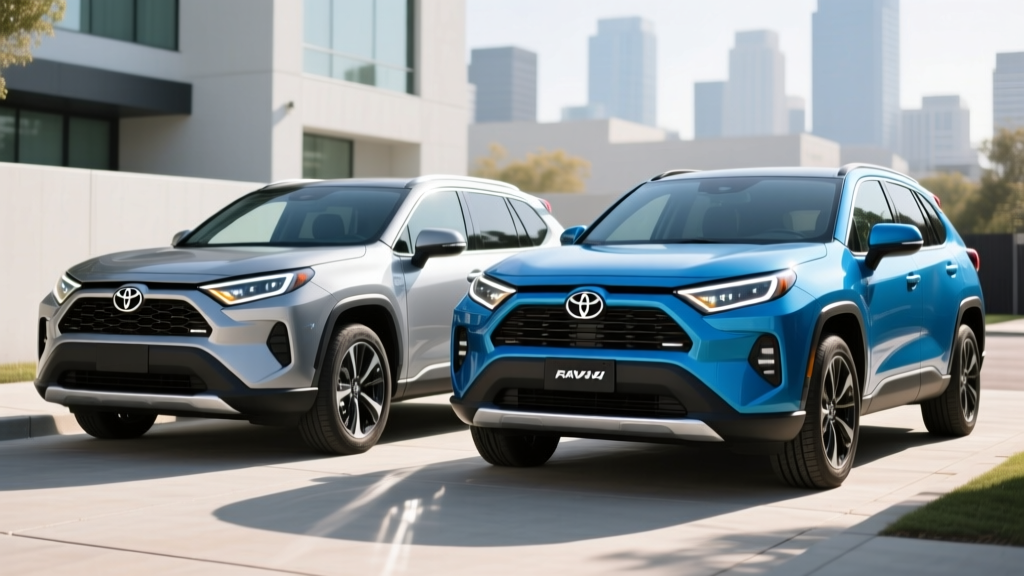
If you have narrowed your search to Toyota's compact SUV lineup but remain undecided between the conventional RAV4 Hybrid and the plug-in RAV4 Prime, the choice ultimately hinges on three variables: your daily commute distance, your access to Level 2 charging, and whether you can capture the federal tax credit. Both share the same 2.5-liter Dynamic Force four-cylinder architecture and Toyota's eAWD system, but the powertrain tuning, battery capacity, and ownership economics diverge sharply. Below is a spec-by-spec breakdown for the 2026 model year, with real-world MPG expectations, warranty data, and a decision framework to eliminate guesswork.
HEV vs PHEV: The Fundamental Architecture Difference
Before comparing trims, the distinction between a conventional hybrid (HEV) and a plug-in hybrid (PHEV) must be precise, because it dictates everything from fueling behavior to tax-credit eligibility.
Conventional Hybrid (RAV4 Hybrid / HEV)
- Does not plug in. The 1.6 kWh nickel-metal hydride (NiMH) traction battery recharges exclusively through regenerative braking and engine-driven generation.
- The gasoline engine and electric motor(s) work in tandem, with the motor handling low-speed propulsion and the engine covering highway cruising and heavy loads.
- There is no meaningful electric-only range — the EV mode, if engaged, sustains roughly 0.5–1 mile at speeds under 25 mph before the engine restarts.
- Fueling is identical to a gas car: fill the 14.5-gallon tank at any station.
Plug-In Hybrid (RAV4 Prime / PHEV)
- Plugs in to a 120V outlet (Level 1), 240V home charger (Level 2), or public Level 2 station to recharge the 18.1 kWh lithium-ion traction battery.
- Delivers a genuine electric-only driving range before the gasoline engine engages — functioning as a battery electric vehicle (BEV) for short commutes.
- Once the battery is depleted, the vehicle operates as a conventional hybrid, using the engine and regenerative braking. No range anxiety: the gas tank provides full backup.
- Eligible for the §30D federal tax credit if battery sourcing and buyer income requirements are met; the HEV is not eligible.
The common mistake is assuming the RAV4 Hybrid needs to be plugged in or that the RAV4 Prime cannot drive without charging. Neither is true. The HEV never plugs in; the PHEV can operate indefinitely on gasoline alone — you simply forfeit the electric-range advantage and the superior combined MPGe rating.
Fuel Economy: EPA MPG, MPGe, and Real-World Expectations
Toyota publishes EPA figures for both models, but hybrid fuel economy is highly sensitive to driving conditions. Unlike pure BEVs, which lose efficiency on the highway, hybrids typically exceed their EPA city rating in stop-and-go traffic, where regenerative braking recaptures kinetic energy and the engine shuts off at stops. Highway driving, by contrast, relies more on the gasoline engine and yields lower MPG than the combined figure suggests.
| Metric | RAV4 Hybrid (HEV) | RAV4 Prime (PHEV) |
|---|---|---|
| City MPG (gas only) | 41 MPG | 40 MPG |
| Highway MPG (gas only) | 38 MPG | 36 MPG |
| Combined MPG (gas only) | 39 MPG | 38 MPG |
| Combined MPGe (charge-sustaining + electric) | N/A | 94 MPGe |
| Electric-only range | ~0.5 mi (low-speed EV mode) | 42 miles (EPA) |
| Total combined range | ~565 miles | ~600 miles (electric + gas) |
| Fuel tank capacity | 14.5 gal | 14.5 gal |
Real-world MPG reconciliation: In urban driving with frequent stops, the RAV4 Hybrid routinely returns 42–44 MPG, exceeding the EPA city estimate. On sustained 75-mph highway trips, expect 34–36 MPG. Cold weather (below 35°F) reduces both models by 5–10% due to cabin heating load and reduced regenerative braking efficiency. The RAV4 Prime, when charged nightly, can cover a 30–35 mile round-trip commute on zero gasoline, yielding effective fuel costs near zero for weekday driving — provided you plug in. According to fueleconomy.gov, the Prime's annual fuel cost is $650 when regularly charged versus $1,550 for the HEV, assuming 15,000 miles/year and current national averages for electricity and gasoline.
Powertrain, Battery, and Charging Specifications
Both models use Toyota's 2.5-liter inline-four paired with front and rear electric motors for electronic all-wheel drive (eAWD). The Prime's larger battery and higher-output motors deliver substantially more combined horsepower.
| Specification | RAV4 Hybrid (HEV) | RAV4 Prime (PHEV) |
|---|---|---|
| Engine | 2.5L I4 Atkinson-cycle | 2.5L I4 Atkinson-cycle |
| Combined system horsepower | 219 hp | 302 hp |
| 0–60 mph | 7.4 seconds | 5.7 seconds |
| Traction battery chemistry | NiMH, 1.6 kWh | Lithium-ion, 18.1 kWh usable |
| Drivetrain | eAWD (front + rear motor) | eAWD (front + rear motor, higher output) |
| Level 1 charging (120V, 12A) | N/A | ~10 hours (0–100%) |
| Level 2 charging (240V, 32A) | N/A | ~2.5 hours (0–100%) |
| DC fast charging | N/A | Not available |
| Towing capacity | 1,750 lbs | 2,500 lbs |
| Cargo volume (rear seats up) | 37.5 cu ft | 33.5 cu ft (battery packaging) |
A critical limitation of the RAV4 Prime: it does not support DC fast charging. The maximum charge rate is 6.6 kW on Level 2 AC power. This means public fast-charging networks (Electrify America, EVgo, Tesla Supercharger) are not usable for the Prime. If you lack access to overnight Level 2 charging at home or work, the Prime's 42-mile electric range becomes difficult to exploit consistently, and you may be better served by the lower-cost HEV.
Pricing, Trim Levels, and Federal Tax Credit Eligibility
The RAV4 Prime commands a significant price premium over the Hybrid, but the §30D federal tax credit can close much of that gap — if you qualify.
| Trim | RAV4 Hybrid MSRP | RAV4 Prime MSRP |
|---|---|---|
| LE / SE (base) | $34,025 | $44,590 (SE) |
| XLE / XSE (mid) | $36,575 | $47,590 (XSE) |
| Woodland / Limited (top) | $38,525 | $51,090 (XSE Premium) |
Federal tax credit (§30D) for the RAV4 Prime: The PHEV may qualify for up to $7,500 in federal tax credits, which can now be transferred to the dealer as a point-of-sale reduction under current IRS rules. However, eligibility depends on three gating criteria that change periodically:
- MSRP cap: The vehicle's MSRP must not exceed $80,000 for SUVs — the Prime clears this easily.
- Buyer income cap: Modified adjusted gross income must not exceed $150,000 (single), $225,000 (head of household), or $300,000 (joint filers).
- Battery sourcing requirements: A percentage of critical minerals and battery components must be sourced from the US or free-trade-agreement partners. This requirement tightens annually and has disqualified several previously eligible models. Verify current-year eligibility on irs.gov before purchasing.
The conventional RAV4 Hybrid does not qualify for the §30D new-vehicle credit. It may be eligible for certain state or utility incentives (check your local programs), but there is no federal tax credit for non-plug-in hybrids.
Effective price comparison: If you qualify for the full $7,500 credit, a RAV4 Prime SE drops to approximately $37,090 — nearly matching the RAV4 Hybrid XLE at $36,575. At that delta, the Prime's 302 hp, 42-mile electric range, and lower operating cost make it the stronger value. Without the credit, the $10,000+ premium is harder to justify unless your commute falls within the electric range and you charge reliably.
Battery Longevity, Warranty, and Replacement Cost
Hybrid battery degradation is the most common concern among prospective buyers, and Toyota's track record here is among the strongest in the industry. The RAV4 Hybrid's NiMH battery and the Prime's lithium-ion pack carry different warranties and expected lifespans.
Toyota Hybrid Battery Warranty (2026 Models)
- RAV4 Hybrid (NiMH): 10 years / 150,000 miles (whichever comes first) for hybrid battery and hybrid system components. California-emissions states extend to 10 years / 150,000 miles on the hybrid battery specifically.
- RAV4 Prime (Li-ion): 10 years / 150,000 miles for the plug-in hybrid battery, with a capacity retention guarantee of ≥70% during the warranty period.
- Standard powertrain warranty: 5 years / 60,000 miles for both models.
Real-world degradation data: Toyota's hybrid battery management system maintains a conservative state-of-charge buffer (roughly 40–80% for the HEV, preventing deep discharge or full saturation), which significantly extends cycle life. NiMH packs in the RAV4 Hybrid have demonstrated minimal measurable degradation at 150,000+ miles in long-term fleet data. The Prime's lithium-ion pack will experience gradual capacity loss — expect approximately 5–8% range reduction over 10 years under normal use, meaning the 42-mile electric range may decrease to 38–40 miles. This is within Toyota's 70% retention warranty threshold.
Battery replacement cost: If the hybrid battery fails outside warranty coverage, replacement costs are:
- RAV4 Hybrid NiMH pack: $3,000–$4,000 (parts and labor at a dealership).
- RAV4 Prime lithium-ion pack: $8,000–$10,000 (parts and labor).
Third-party refurbishment services offer NiMH replacements for $1,500–$2,500. Full out-of-warranty replacement is uncommon before 200,000 miles for Toyota's hybrid systems, based on NHTSA complaint data and long-term ownership surveys.
Reliability and Ownership Costs
Toyota's hybrid powertrains consistently rank at or near the top of long-term reliability studies. The RAV4 Hybrid and Prime share the A25A-FXS engine, which eliminates the alternator, starter motor, and conventional accessory belt — components that frequently fail in non-hybrid vehicles. Regenerative braking reduces wear on friction brake pads, with many owners reporting original brake pads at 80,000+ miles.
The Prime carries slightly higher maintenance complexity due to the larger lithium-ion pack and associated thermal management system, but Toyota's eCVT (planetary gearset, no traditional transmission bands or clutches) is shared between both models and has proven exceptionally durable.
| Cost Category | RAV4 Hybrid XLE | RAV4 Prime SE (with $7,500 credit) |
|---|---|---|
| Purchase price (after credit) | $36,575 | $37,090 |
| Fuel / electricity (5 yr) | $7,750 | $3,250 (assumes nightly charging) |
| Maintenance (5 yr) | $2,800 | $2,900 |
| Insurance (5 yr avg) | $7,500 | $8,200 |
| Estimated depreciation | $14,000 | $15,500 |
| Estimated 5-year total | $68,625 | $66,940 |
The Prime's fuel savings are substantial — roughly $4,500 over five years — but only if you charge consistently. If you never plug in, the Prime operates as a heavier, less efficient hybrid, and its TCO exceeds the HEV's due to the higher purchase price and insurance premium.
Hybrid vs PHEV vs Full EV: Which Fits Your Situation?
The decision between the RAV4 Hybrid, the RAV4 Prime, and a full battery-electric vehicle (such as the Tesla Model Y, Hyundai Ioniq 5, or Toyota bZ4X) depends on your charging access, commute pattern, and willingness to adapt fueling habits.
Choose the RAV4 Hybrid (HEV) if:
- You have no access to home or workplace charging (apartment, street parking, no 240V circuit).
- Your daily driving is variable — some days 10 miles, some days 300 — and you want zero planning overhead.
- You want the lowest upfront cost and do not qualify for the §30D credit (income above cap).
- You plan to keep the vehicle 10+ years and value Toyota's proven NiMH longevity.
Choose the RAV4 Prime (PHEV) if:
- You can install a Level 2 (240V) home charger and your round-trip commute is ≤40 miles.
- You qualify for the full or partial §30D credit, closing the price gap with the HEV.
- You want EV-like daily operating costs but need the gas engine for weekend road trips without charging-infrastructure planning.
- You value the 302 hp performance upgrade and 2,500-lb towing capacity.
Choose a Full BEV (Model Y, Ioniq 5, etc.) if:
- You have reliable home Level 2 charging and your typical trips fall within 250–300 miles (or you're willing to use DC fast charging on road trips).
- You want zero tailpipe emissions, minimal maintenance (no oil changes, no engine), and the lowest per-mile fuel cost.
- You qualify for the §30D credit on a BEV, which may offer up to $7,500 with fewer battery-sourcing restrictions than some PHEVs.
Pros and Cons at a Glance
RAV4 Hybrid (HEV) — Pros
- 39 MPG combined, routinely exceeds 42 MPG in city driving
- No charging required — fuel anywhere
- Lower base MSRP, strong resale value
- Proven NiMH battery longevity (200k+ miles common)
- 37.5 cu ft cargo volume (no battery intrusion)
RAV4 Hybrid (HEV) — Cons
- No federal tax credit eligibility
- 219 hp — adequate but not quick
- 1,750-lb towing limit
- Higher per-mile fuel cost than a charged PHEV
RAV4 Prime (PHEV) — Pros
- 42-mile electric-only range covers most commutes
- 302 hp, 5.7-second 0–60, 2,500-lb towing
- Up to $7,500 §30D credit (if eligible)
- 94 MPGe combined when regularly charged
- Full gas backup — no range anxiety
RAV4 Prime (PHEV) — Cons
- No DC fast charging — Level 2 only (6.6 kW max)
- Requires home/work Level 2 access to realize value
- 33.5 cu ft cargo (battery reduces rear space by 4 cu ft)
- Higher insurance premiums
- $8,000–$10,000 battery replacement cost out of warranty
Frequently Asked Questions
How many MPG does the RAV4 Hybrid actually get in real-world driving?
The EPA rates the 2026 RAV4 Hybrid at 41 city / 38 highway / 39 combined MPG. In real-world urban commuting with frequent stops, owners consistently report 42–44 MPG due to regenerative braking. Sustained highway driving at 70–75 mph typically yields 34–36 MPG. Cold weather reduces these figures by 5–10%.
How far can the RAV4 Prime drive on electric power alone?
The EPA rates the 2026 RAV4 Prime at 42 miles of electric-only range. In practice, expect 38–42 miles in mild weather at moderate speeds. Highway driving at 70+ mph or cold weather (below 35°F) can reduce this to 32–36 miles due to cabin heating demand and higher energy consumption. The gasoline engine engages automatically once the battery is depleted.
Does the RAV4 Hybrid or Prime qualify for a federal tax credit?
The conventional RAV4 Hybrid does not qualify for the §30D federal tax credit. The RAV4 Prime may qualify for up to $7,500, subject to buyer income limits ($150K single / $300K joint), MSRP caps (under $80K for SUVs), and battery critical-mineral sourcing requirements that tighten annually. Verify current eligibility at irs.gov before purchase. The credit can be transferred to the dealer as a point-of-sale price reduction.
How reliable is the hybrid battery, and what does replacement cost?
Toyota's hybrid batteries carry a 10-year / 150,000-mile warranty. The RAV4 Hybrid's NiMH pack rarely requires replacement before 200,000 miles; out-of-warranty replacement costs $3,000–$4,000. The Prime's lithium-ion pack costs $8,000–$10,000 out of warranty and typically retains 90–95% capacity at 100,000 miles. Toyota's conservative charge-buffer strategy (never fully charging or fully depleting the pack) is the primary reason for this longevity.
Do I need to plug in the RAV4 Hybrid?
No. The RAV4 Hybrid (HEV) never plugs in. Its small 1.6 kWh battery charges through regenerative braking and the gasoline engine. You fuel it exactly like a conventional gas car. Only the RAV4 Prime (PHEV) requires plugging in to access its 42-mile electric range.
Can the RAV4 Prime use DC fast chargers like Electrify America or Tesla Superchargers?
No. The RAV4 Prime supports only Level 1 (120V) and Level 2 (240V, up to 6.6 kW) AC charging. It cannot connect to DC fast-charging networks. A full charge on a 240V Level 2 charger takes approximately 2.5 hours. This is a deliberate design choice by Toyota to control cost and complexity, but it means the Prime's electric range is best exploited through overnight home charging rather than public fast-charging stops.
Which has more cargo space — the Hybrid or the Prime?
The RAV4 Hybrid offers 37.5 cubic feet behind the rear seats. The RAV4 Prime's larger 18.1 kWh battery pack reduces this to 33.5 cubic feet — a 4 cu ft reduction that primarily affects the under-floor cargo area. With rear seats folded, the difference narrows but the Prime still trails by approximately 2 cu ft.