RAV4 Hybrid vs RAV4 Prime: Towing Specs at a Glance
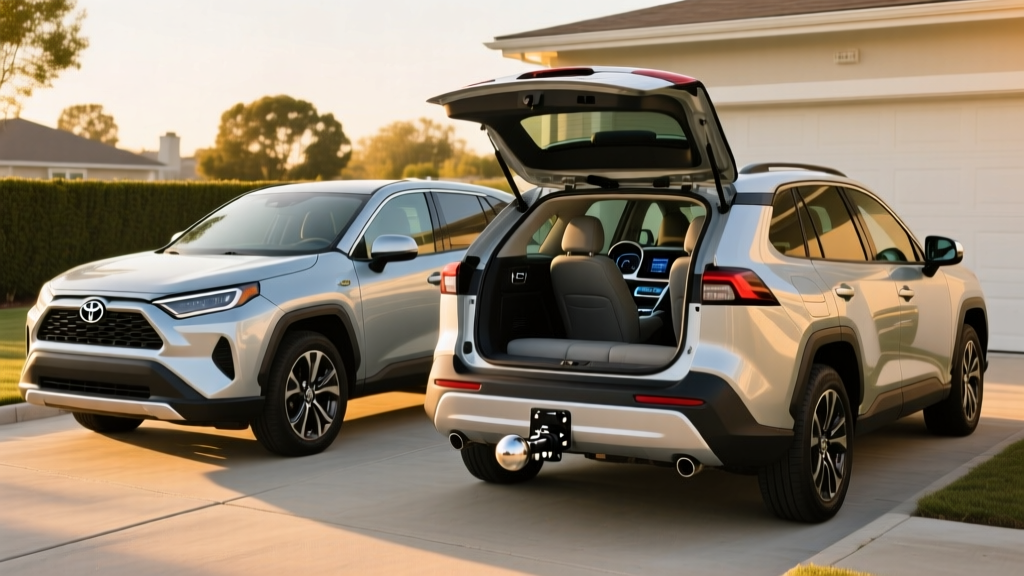
The Toyota RAV4 Hybrid and its plug-in sibling, the RAV4 Prime, share the same 1,500-pound maximum towing rating across all trims when properly equipped. That figure covers light-duty hauling — a small utility trailer, a pair of jet skis, or a lightweight camper — but falls well short of midsize truck territory. For buyers researching the towing capacity of Toyota RAV4 Hybrid models, the key takeaway is that electrification doesn't penalize the RAV4's tow rating, nor does it improve it.
| Spec | RAV4 Hybrid (HEV) | RAV4 Prime (PHEV) |
|---|---|---|
| Max Towing Capacity | 1,500 lbs | 1,500 lbs |
| Combined Horsepower | 219 hp | 302 hp |
| Engine | 2.5L 4-cyl + 3 electric motors (AWD) | 2.5L 4-cyl + 2 electric motors (AWD) |
| Drivetrain | Electronic AWD (e-AWD) | Electronic AWD (e-AWD) |
| EPA Combined MPG / MPGe | 39 MPG combined | 94 MPGe (EV mode) / 38 MPG (gas-only) |
| Electric-Only Range | N/A (self-charging) | 42 miles |
| Total Range | ~580 miles | ~600 miles (EV + gas) |
| Battery Capacity | 1.6 kWh (NiMH, buffer-limited) | 18.1 kWh usable (Li-ion) |
| 0–60 mph | 7.4 sec | 5.7 sec |
| Starting MSRP | ~$33,500 | ~$45,000 |
| Battery Warranty | 10 yr / 150,000 mi | 10 yr / 150,000 mi |
Both models use Toyota's electronic on-demand AWD system, where a rear-mounted electric motor powers the back axle without a mechanical driveshaft. This setup provides adequate traction for trailer starts on wet ramps but lacks the low-range gearing of a traditional 4WD system. Toyota requires the factory tow prep package (receiver hitch and wiring harness) to achieve the 1,500-lb rating; aftermarket hitches don't alter the manufacturer's certified limit.
How Many MPG Does the RAV4 Hybrid Get — And Does Towing Change It?
The conventional RAV4 Hybrid carries EPA ratings of 41 city / 38 highway / 39 combined MPG for most LE and XLE trims, according to fueleconomy.gov. Woodier trims (Adventure, TRD Off-Road) equipped with a different AWD tuning drop slightly to 36 MPG combined. The RAV4 Prime PHEV delivers 94 MPGe in electric mode and 38 MPG combined once the battery depletes.
| Model / Trim | City MPG | Highway MPG | Combined MPG | MPGe (EV Mode) |
|---|---|---|---|---|
| RAV4 Hybrid LE/XLE | 41 | 38 | 39 | N/A |
| RAV4 Hybrid Woodland Ed. | 38 | 35 | 36 | N/A |
| RAV4 Prime (all trims) | 40 (gas) | 36 (gas) | 38 (gas) | 94 |
Real-world note on towing: Expect fuel economy to drop 30–50% when pulling a loaded trailer near the 1,500-lb limit. Highway towing with a small utility trailer typically yields 22–28 MPG in the HEV and 25–30 MPG in the Prime (gas mode). The hybrid system recovers some efficiency through regenerative braking on downhill grades, but sustained highway pulls at 65+ mph keep the gasoline engine under continuous load. If your towing needs are frequent rather than occasional, a larger SUV or midsize truck remains the practical choice.
Real-world MPG without towing: In mixed suburban and city driving, the RAV4 Hybrid routinely exceeds its EPA rating. Owners regularly report 40–43 MPG in warm weather around town, where the electric motors handle low-speed propulsion and regenerative braking recaptures energy at every stop. Highway-only trips at 75 mph tend to settle around 34–36 MPG — hybrids shine in stop-and-go conditions, not sustained high-speed cruising.
HEV vs PHEV: Which RAV4 Fits Your Routine?
| Factor | RAV4 Hybrid (HEV) | RAV4 Prime (PHEV) |
|---|---|---|
| Plug in required? | No — self-charging via regen & engine | Yes — plug in for 42 mi EV range |
| Best for | No home charging; long highway commutes | Home charging; short daily commutes |
| Daily EV driving | 0 miles (engine always available) | 42 miles electric-only |
| Upfront cost | ~$33,500 starting | ~$45,000 starting |
| Federal tax credit (§30D) | Not eligible | Eligible — up to $7,500 (rules apply) |
| Maintenance complexity | Proven Toyota hybrid system | Added EV systems (charger, larger battery) |
| Towing capacity | 1,500 lbs | 1,500 lbs |
The conventional RAV4 Hybrid is a self-charging system. A small 1.6 kWh nickel-metal hydride battery buffers energy captured from regenerative braking and the gasoline engine. You never plug it in; you simply refuel at any gas station. The hybrid system seamlessly blends electric and gas power, delivering better city MPG than highway — the opposite of most gas-only vehicles.
The RAV4 Prime is a plug-in hybrid with a substantially larger 18.1 kWh lithium-ion battery. Plug into a standard 120V outlet (Level 1) and you'll fully recharge in roughly 12 hours. A 240V Level 2 home charger cuts that to about 2.5 hours. The Prime does not support DC fast charging — a deliberate Toyota engineering choice prioritizing battery longevity and packaging over rapid top-ups. For most PHEV owners, overnight Level 2 charging at home covers daily needs without ever visiting a public station.
RAV4 Prime Electric Range, Charging, and Battery Details
The RAV4 Prime's EPA-rated electric-only range stands at 42 miles, enough to cover the average American's round-trip commute (roughly 35 miles, per Census Bureau data) without burning a drop of gasoline. Once the battery depletes, the Prime operates as a conventional hybrid, returning 38 MPG combined with no range anxiety.
| Charging Level | Power | 0–100% Time | Where |
|---|---|---|---|
| Level 1 (120V) | ~1.4 kW | ~12 hours | Standard household outlet |
| Level 2 (240V) | ~6.6 kW | ~2.5 hours | Home wallbox or public L2 station |
| DC Fast Charge | N/A | N/A | Not supported |
If your daily driving stays under 40 miles and you charge at home nightly, you may go months between fill-ups. Toyota's hybrid synergy drive system handles the transition between EV and gas modes imperceptibly — most drivers notice only the silence at low speeds.
Pricing, Tax Credits, and Total Cost of Ownership
The 2026 RAV4 Hybrid starts around $33,500 (LE trim, including destination) and tops out near $42,000 for fully loaded Limited and Platinum trims. The RAV4 Prime begins at approximately $45,000 (SE trim) and reaches $51,000+ for the XSE with Premium package.
Federal Tax Credit — §30D Eligibility:
- RAV4 Hybrid (HEV): Not eligible for the §30D new clean vehicle credit. This credit applies only to plug-in vehicles (PHEVs and BEVs).
- RAV4 Prime (PHEV): Potentially eligible for up to $7,500, subject to current-year IRS rules including buyer income caps ($150K single / $300K joint), MSRP limits ($80K for SUVs), and critical mineral / battery component sourcing requirements. The credit may be applied as a point-of-sale discount at participating dealers. Always verify eligibility at irs.gov or with a tax professional before purchase, as sourcing rules tighten annually.
With the full $7,500 credit applied, the RAV4 Prime's effective starting price drops to roughly $37,500 — closing the gap with the higher-trim conventional Hybrid while adding 42 miles of daily electric driving and 302 hp. The math favors the Prime if you can charge at home and qualify for the credit.
Five-year ownership costs also tilt in the hybrid's favor versus a gas-only RAV4. At 15,000 miles/year and $3.50/gallon fuel, the Hybrid saves approximately $2,800 in fuel over the non-hybrid model, while the Prime — charged mostly on electricity — can save $4,500+ depending on your local electricity rate.
Battery Reliability, Warranty, and Replacement Costs
Toyota's hybrid battery warranty covers 10 years or 150,000 miles (whichever comes first) across all 50 states, a significant increase from the earlier 8-year/100,000-mile standard. This applies to both the RAV4 Hybrid's NiMH pack and the Prime's lithium-ion battery.
What the warranty covers: If the hybrid battery drops below a defined capacity threshold (typically ~60–70% of original capacity, depending on the diagnostic code), Toyota will repair or replace it at no cost. The warranty is fully transferable to subsequent owners.
Real-world longevity data from Toyota's two decades of hybrid production (dating to the 1997 Prius) shows most hybrid batteries outlast their warranty periods. Taxi fleets and high-mileage owners routinely report 200,000+ miles on original hybrid batteries. The RAV4 Hybrid's relatively small NiMH pack undergoes shallow charge-discharge cycles — it rarely depletes fully or charges to 100% — which dramatically extends cell life compared to a full EV battery cycled deeply every day.
Out-of-warranty replacement cost: If the hybrid battery does fail after warranty expiration, expect to pay $2,500–$4,500 for a new or remanufactured unit, including labor, depending on whether you choose a Toyota dealer or an independent hybrid specialist. The Prime's larger lithium-ion battery runs higher — approximately $6,000–$9,000 — reflecting its greater capacity and complexity. Third-party remanufactured options and individual module replacements are increasingly available and can reduce costs by 30–50%.
Who Should Choose the RAV4 Hybrid — And Who Shouldn't?
Reasons to Choose the RAV4 Hybrid / Prime
- Best-in-class fuel economy for a compact SUV with AWD
- Proven reliability with 10-year / 150,000-mile hybrid battery warranty
- No range anxiety — HEV runs on gas; Prime adds 42 mi EV buffer
- Strong resale value (Toyota hybrids hold premium on the used market)
- 302 hp on the Prime makes it the quickest RAV4 ever sold
- Eligible for up to $7,500 federal credit (Prime only, rules apply)
Reasons to Look Elsewhere
- 1,500-lb tow rating won't handle most travel trailers or boats
- Prime's lack of DC fast charging limits road-trip EV flexibility
- HEV not eligible for federal EV tax credits
- Interior materials and infotainment lag behind Hyundai Tucson Hybrid and Honda CR-V Hybrid
- High demand means dealer markups remain common on the Prime
Choose the RAV4 Hybrid if: You want maximum fuel savings without changing your refueling habits, you don't have access to home charging, or you want a lower purchase price. The HEV is the pragmatic, no-compromise choice for apartment dwellers and road-trippers alike.
Choose the RAV4 Prime if: You have Level 2 charging at home, your daily commute is under 40 miles, and you qualify for the §30D tax credit. The Prime effectively gives you an EV for daily driving and a hybrid for road trips — with 302 hp as a bonus.
Consider a full EV (like the Tesla Model Y or Hyundai Ioniq 5) if: You never tow, you want zero tailpipe emissions, and you have reliable home charging. Full EVs eliminate oil changes and offer lower per-mile energy costs, but sacrifice the gas-engine backup for long trips through charging deserts.
Look at a midsize SUV or truck if: Your towing needs exceed 1,500 lbs regularly. The Toyota Highlander Hybrid tows 3,500 lbs; the Ford Maverick Hybrid tows 2,000 lbs; a body-on-frame truck handles 5,000+ lbs.
Frequently Asked Questions
Can the Toyota RAV4 Hybrid tow a small camper or travel trailer?
The RAV4 Hybrid's 1,500-lb rating can handle teardrop trailers and pop-up campers that fall within that limit — many teardrops weigh 800–1,200 lbs loaded. However, most hard-sided travel trailers exceed 1,500 lbs dry weight. Always check your specific trailer's GVWR and keep total loaded weight (trailer + cargo) under 1,500 lbs. Use a weight-distributing hitch if recommended by the trailer manufacturer.
Does the RAV4 Prime tow more than the regular Hybrid?
No. Both the RAV4 Hybrid and RAV4 Prime share the same 1,500-lb maximum towing capacity. The Prime's additional 83 horsepower and larger battery do not increase the tow rating. Structural and cooling-system limitations, not power, set the towing ceiling.
Do I need to plug in the RAV4 Hybrid?
No. The conventional RAV4 Hybrid is a self-charging system. It regenerates energy during braking and coasting and uses the gasoline engine to maintain the small battery's charge. You refuel it exactly like a gas car. Only the RAV4 Prime requires (or benefits from) plug-in charging.
How long will the RAV4 Hybrid battery last?
Toyota warranties the hybrid battery for 10 years or 150,000 miles. In practice, Toyota's hybrid batteries routinely last 200,000+ miles based on two decades of fleet and owner data. The shallow charge-discharge cycles used in Toyota's hybrid system are far less stressful on battery cells than the deep cycles in a full EV.
Does the RAV4 Hybrid qualify for any tax credit?
The conventional RAV4 Hybrid does not qualify for the federal §30D clean vehicle credit, which is reserved for plug-in vehicles (PHEVs and BEVs). The RAV4 Prime PHEV may qualify for up to $7,500, subject to buyer income limits, MSRP caps, and battery sourcing requirements. Check IRS guidelines for current-year eligibility.
How does the RAV4 Hybrid compare to the Honda CR-V Hybrid for towing?
The Honda CR-V Hybrid is rated to tow 1,000 lbs — 500 lbs less than the RAV4 Hybrid. If towing is a priority in the compact hybrid SUV segment, the RAV4 Hybrid holds a clear advantage. The Hyundai Tucson Hybrid matches the RAV4 at 1,500 lbs, making it the closest competitor on tow rating.