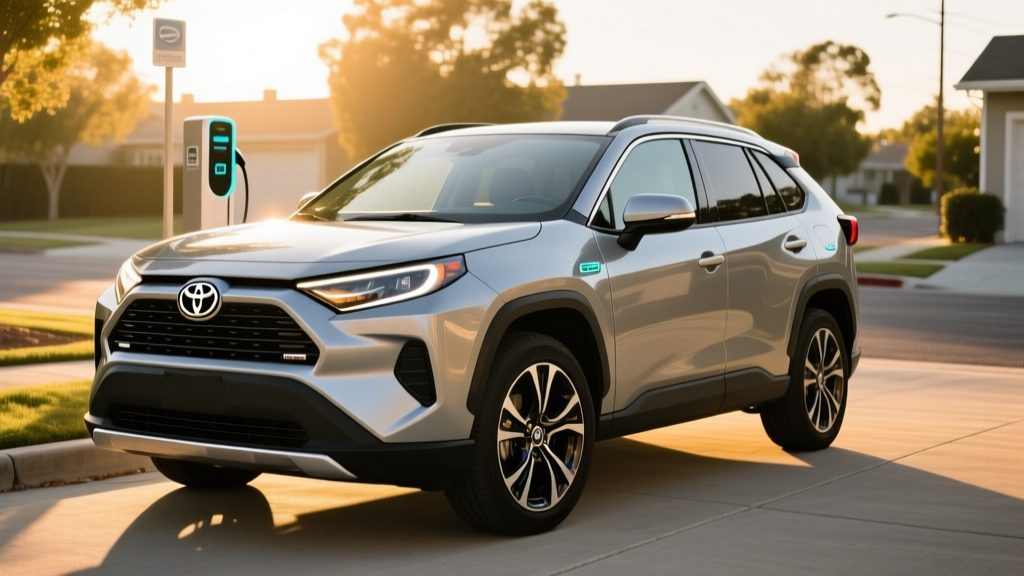
The Toyota RAV4 Hybrid LE has held its position as one of America's best-selling hybrid SUVs for good reason: it delivers genuine fuel savings without requiring you to change a single driving habit. No plugs, no charging apps, no range anxiety — just a conventional hybrid (HEV) that sips fuel and keeps going. For 2026, the RAV4 Hybrid LE remains the value-oriented entry point into Toyota's hybrid compact SUV lineup, and it's worth a close look if you're weighing hybrid against plug-in hybrid or full electric.
This guide covers everything a spec-driven buyer needs: exact EPA MPG figures, real-world fuel economy expectations, the hybrid powertrain breakdown, battery longevity data, pricing, and whether any tax credits apply. We'll also clarify how the RAV4 Hybrid LE (a conventional HEV) differs from the RAV4 Prime (a plug-in hybrid PHEV), because confusing the two is one of the most common mistakes shoppers make.
HEV vs PHEV: Which RAV4 Hybrid Are You Actually Looking At?
Before we get into specs, let's clear up a critical distinction. Toyota sells two electrified RAV4 variants, and they work very differently:
| Feature | RAV4 Hybrid (HEV) | RAV4 Prime (PHEV) |
|---|---|---|
| Powertrain Type | Conventional Hybrid (no plug) | Plug-in Hybrid (requires charging for EV mode) |
| Electric-Only Range | ~1 mile at low speed | 42 miles EPA (estimated) |
| Battery Capacity | 1.6 kWh (NiMH, self-charging) | 18.1 kWh (Li-ion, plug-in) |
| Combined Horsepower | 219 hp | 302 hp |
| EPA Combined MPG/MPGe | 39 MPG | 94 MPGe (EV) / 38 MPG (gas) |
| Requires Plug-In Charging? | No — regenerative braking charges battery | Yes — for electric-only driving benefit |
| Base MSRP (2026 est.) | ~$33,425 | ~$44,900 |
| Federal Tax Credit (§30D) | Not eligible | Up to $7,500 (eligibility varies) |
The bottom line: The RAV4 Hybrid LE is a self-charging conventional hybrid. You never plug it in. The RAV4 Prime is a plug-in hybrid with a larger battery that you charge at home or at public stations for up to 42 miles of electric-only driving. This article focuses on the RAV4 Hybrid LE (HEV). If you want the plug-in variant, look for our RAV4 Prime guide.
2026 RAV4 Hybrid LE Fuel Economy: EPA Numbers vs Real-World MPG
Fuel economy is the headline number for any hybrid buyer. Here's what the EPA rates the 2026 RAV4 Hybrid LE at, per fueleconomy.gov:
| Driving Condition | EPA Rating | Real-World Expectation |
|---|---|---|
| City | 41 MPG | 38–44 MPG |
| Highway | 38 MPG | 34–39 MPG |
| Combined | 39 MPG | 36–41 MPG |
Why city MPG beats highway in a hybrid: The RAV4 Hybrid LE's regenerative braking system recovers energy during stop-and-go driving, and the electric motor handles low-speed propulsion where gasoline engines are least efficient. On the highway, the 2.5-liter four-cylinder does most of the work with less electric assist, which is why highway numbers drop slightly.
Real-world factors that shift your MPG:
- Cold weather (below 35°F): Expect a 5–10% drop. The engine runs more often to heat the cabin and keep the catalytic converter warm, reducing electric-only operation.
- Aggressive acceleration: Hard throttle inputs force the gas engine to engage fully, bypassing the efficiency gains of electric assist.
- Hilly terrain: Sustained climbs reduce MPG; regenerative braking on descents partially recovers the loss.
- Summer A/C usage: Mild impact (~1–2 MPG reduction) since the RAV4 Hybrid uses an electric A/C compressor that doesn't directly load the engine.
In owner forums and long-term testing, many RAV4 Hybrid drivers report exceeding the EPA combined rating in mixed suburban driving — a rarity compared to most gas-only vehicles, which tend to fall short of their stickers.
Powertrain Specs: What's Under the Hood of the RAV4 Hybrid LE
| Specification | 2026 RAV4 Hybrid LE |
|---|---|
| Engine | 2.5L Dynamic Force 4-cylinder |
| Engine Output | 176 hp / 163 lb-ft torque |
| Front Electric Motor | 118 hp / 149 lb-ft |
| Rear Electric Motor (AWD) | 54 hp / 89 lb-ft |
| Combined Net Horsepower | 219 hp |
| Drivetrain | Electronic On-Demand AWD (standard) |
| Transmission | eCVT (planetary gearset, not belt-driven) |
| 0–60 mph | ~7.4 seconds |
| Hybrid Battery | 1.6 kWh NiMH (self-charging) |
| Towing Capacity | 1,750 lbs |
| Cargo Volume (behind rear seats) | 37.5 cu ft |
The RAV4 Hybrid LE comes standard with electronic all-wheel drive — there's no mechanical driveshaft to the rear wheels. Instead, a dedicated rear electric motor engages when the system detects slip or when extra traction is needed. This setup adds minimal weight and doesn't compromise fuel economy the way traditional AWD systems do.
Toyota's eCVT is not a traditional continuously variable transmission with a rubber belt. It uses a planetary gearset that seamlessly blends engine and motor power. The result is smooth, linear acceleration with no shifting feel and exceptional long-term reliability — there are no clutch packs or belts to wear out.
Hybrid Battery Longevity: Warranty, Degradation, and Replacement Cost
Toyota Hybrid Battery Warranty: 10 years / 150,000 miles (whichever comes first) for 2020 and newer models. This covers battery capacity loss below a specified threshold and defects. Previous generations carried an 8-year/100,000-mile warranty.
The RAV4 Hybrid LE uses a nickel-metal hydride (NiMH) battery pack. While NiMH is older chemistry compared to the lithium-ion packs in full EVs, it has one major advantage for hybrid applications: extreme cycle-life durability. Because the hybrid system only uses a narrow band of the battery's total capacity (roughly 40–80% state of charge), the battery experiences shallow charge cycles that dramatically extend its lifespan.
What the data shows: Toyota's hybrid battery packs routinely last 150,000–200,000+ miles before significant degradation. Taxi fleets using Toyota hybrids have logged 300,000+ miles on original batteries. The 10-year/150,000-mile warranty reflects Toyota's confidence in this durability.
If replacement is ever needed: A new OEM RAV4 hybrid battery costs approximately $3,000–$4,000 installed at a dealership. Refurbished or reconditioned packs are available for $1,500–$2,500. Individual module replacement (only the degraded cells) can bring costs down to $500–$1,000 at a qualified hybrid specialist. Given the typical lifespan, most original owners will never face this expense.
2026 RAV4 Hybrid LE Pricing and Tax Credit Eligibility
The 2026 RAV4 Hybrid LE starts at an estimated MSRP of approximately $33,425 (including destination charge). This positions it roughly $1,500–$2,000 above the gas-only RAV4 LE, a premium you'll typically recoup in fuel savings within 2–4 years depending on annual mileage and local gas prices.
Federal tax credit status: The RAV4 Hybrid LE does not qualify for the IRS §30D federal clean vehicle tax credit. Under current IRS rules, conventional hybrids (HEVs) are excluded — the credit applies only to plug-in electric vehicles (BEVs and PHEVs) with a battery capacity of at least 7 kWh that meet critical mineral and battery component sourcing requirements.
If you want a RAV4 that qualifies for the federal credit, you'd need to look at the RAV4 Prime (PHEV), which may be eligible for up to $7,500 depending on your income, the vehicle's MSRP relative to the cap ($80,000 for SUVs), and battery sourcing compliance. However, the Prime's significantly higher base price (~$44,900) means your net savings after the credit may be comparable to the Hybrid LE's lower sticker. Always consult a tax professional and check current IRS guidance before making a purchase decision based on credits.
State-level incentives: Some states offer rebates or HOV lane access for conventional hybrids, though these programs have largely shifted focus to plug-in vehicles. Check your state's energy or environmental agency website for current programs.
RAV4 Hybrid LE vs RAV4 Prime vs Full EV: Which Is Right for You?
Choose the RAV4 Hybrid LE (HEV) if:
- You don't have access to home or workplace charging (apartment, street parking, no garage)
- You want maximum simplicity — no charging cables, no apps, no planning
- Your budget is under $35,000 and you want AWD as standard
- You drive 10,000–15,000 miles/year and want to cut fuel costs by ~40% vs a gas-only RAV4
- You plan to own the vehicle 8+ years and value Toyota's long-term reliability track record
Choose the RAV4 Prime (PHEV) if:
- You can install a Level 2 home charger and most daily trips are under 42 miles
- You want electric-only commuting with the gas engine as a backup for road trips
- You qualify for the $7,500 federal tax credit (income and sourcing rules apply)
- You value the 302 hp performance upgrade
Choose a full EV (e.g., Tesla Model Y, Hyundai Ioniq 5) if:
- You have reliable home Level 2 charging and your daily commute is under 250 miles
- You want zero tailpipe emissions and minimal maintenance (no oil changes, no gas engine)
- You want the full $7,500 federal tax credit and your income/vehicle qualifies
- You're comfortable with route planning on longer road trips using DC fast charging
The RAV4 Hybrid LE occupies a specific niche: it's the lowest-friction path to meaningful fuel savings. You trade nothing in convenience — you fuel up at the same gas stations, on the same schedule — but you gain roughly 40% better fuel economy than the gas-only RAV4. For buyers who can't charge at home or who regularly take long trips through areas with sparse charging infrastructure, it remains one of the most practical electrified vehicles on the market.
Pros and Cons: The Honest RAV4 Hybrid LE Assessment
Pros
- 39 MPG combined EPA — and many owners exceed it in suburban driving
- Standard AWD with no fuel economy penalty vs FWD
- 10-year/150,000-mile hybrid battery warranty
- No behavioral change required — no plugs, no apps, no charging planning
- Proven powertrain with exceptional long-term reliability data
- Competitive starting price for a hybrid AWD compact SUV
- 37.5 cu ft cargo space matches the gas-only RAV4
Cons
- No federal tax credit eligibility (HEV exclusion)
- Engine noise under hard acceleration (eCVT drone)
- 1,750-lb towing capacity — lower than some turbocharged gas competitors
- LE trim is basic: cloth seats, smaller infotainment screen vs higher trims
- No electric-only driving beyond very low-speed parking lot maneuvers
- Rear-seat legroom is adequate but not class-leading
Frequently Asked Questions
How many MPG does the 2026 RAV4 Hybrid LE get?
The EPA rates the RAV4 Hybrid LE at 41 MPG city, 38 MPG highway, and 39 MPG combined. Real-world results vary: expect 36–41 MPG combined in normal driving, with potential to exceed 41 MPG in warm-weather suburban conditions with moderate driving habits. Cold weather and sustained highway speeds above 75 mph will push numbers toward the lower end of the range.
Does the RAV4 Hybrid LE need to be plugged in?
No. The RAV4 Hybrid LE is a conventional hybrid (HEV), not a plug-in hybrid. Its 1.6 kWh battery charges entirely through regenerative braking and the gasoline engine. You never plug it in, and there is no charging port on the vehicle. If you want plug-in capability, look at the RAV4 Prime (PHEV).
Is the RAV4 Hybrid reliable, and what does battery replacement cost?
Toyota's hybrid system is among the most proven in the industry, with decades of data from millions of vehicles. The RAV4 Hybrid's NiMH battery is designed for shallow cycling and typically lasts 150,000–200,000+ miles. Toyota covers it with a 10-year/150,000-mile warranty. If replacement is needed outside warranty, expect $3,000–$4,000 for a new OEM pack or $1,500–$2,500 for a refurbished unit.
Does the RAV4 Hybrid LE qualify for any tax credit?
Not at the federal level. The IRS §30D clean vehicle credit applies only to plug-in vehicles (BEVs and PHEVs) with batteries of 7 kWh or more. The RAV4 Hybrid LE's 1.6 kWh battery and conventional hybrid powertrain make it ineligible. Some states may offer small hybrid incentives, but these vary by jurisdiction and change frequently — check your state's official energy or environmental agency for current programs.
How does the RAV4 Hybrid LE compare to a full EV like the Tesla Model Y?
They serve different buyers. The RAV4 Hybrid LE costs ~$10,000 less upfront, requires no charging infrastructure, and works identically to a gas car at the fuel pump — but it still burns gasoline. A Model Y offers zero tailpipe emissions, lower per-mile energy costs (if charging at home), and access to the $7,500 federal credit (if eligible), but requires home charging access and route planning for road trips over ~250 miles. The RAV4 Hybrid is the pragmatic choice for buyers without reliable charging access; the EV is the choice for those who can charge at home and want to eliminate gas entirely.
What's the difference between the RAV4 Hybrid LE and higher hybrid trims?
The LE is the base hybrid trim. Higher trims (XLE, XLE Premium, Woodland Edition, Limited) add features like a larger touchscreen, synthetic leather seats, heated front seats, a power liftgate, and upgraded driver-assist displays. The powertrain, MPG, AWD system, and battery are identical across all RAV4 Hybrid trims — you're paying for comfort and technology upgrades, not performance or efficiency gains.
Sources: EPA Fuel Economy Guide (fueleconomy.gov), IRS §30D Clean Vehicle Credit Rules, Toyota RAV4 Hybrid Official Specifications. Pricing and credit eligibility are based on current 2026 model-year data and may vary. Always verify with your dealer and tax professional before purchasing.