2026 Toyota RAV4 Hybrid: Powertrain, Horsepower, and Efficiency Breakdown
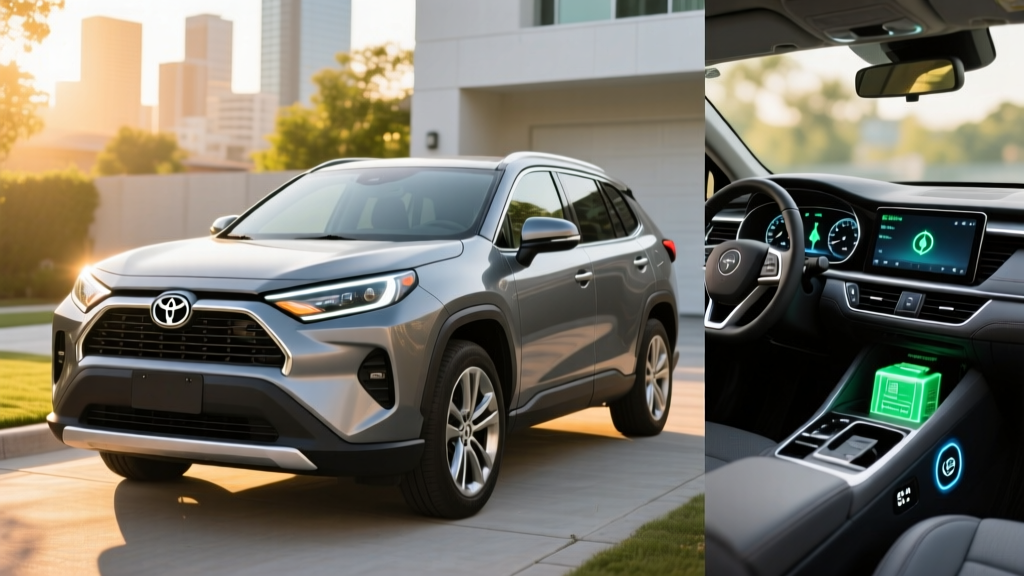
The Toyota RAV4 Hybrid remains one of the best-selling electrified vehicles in the United States, and for good reason: it pairs a proven hybrid powertrain with SUV practicality, all without requiring a plug. For buyers researching rav4 hybrid hp figures, fuel economy, and how the standard hybrid compares to the plug-in RAV4 Prime, this guide covers every spec that matters — from combined horsepower to real-world MPG, battery warranty coverage, and total cost of ownership.
For 2026, Toyota continues the fifth-generation RAV4 Hybrid lineup with its familiar 2.5-liter four-cylinder hybrid system. The standard RAV4 Hybrid (HEV) requires no plug-in charging and operates as a self-charging hybrid, while the RAV4 Prime (PHEV) adds a larger battery, more electric motors, and the ability to drive on electricity alone for over 40 miles. Understanding the difference is critical before you step into a dealership.
RAV4 Hybrid vs RAV4 Prime: HEV and PHEV Explained
Toyota sells two electrified RAV4 variants. They look nearly identical from the outside but differ substantially under the hood:
| Attribute | RAV4 Hybrid (HEV) | RAV4 Prime (PHEV) |
|---|---|---|
| Powertrain Type | Conventional Hybrid | Plug-In Hybrid |
| Plug-In Required? | No — self-charging via regen & engine | Yes — plug in for EV-only range |
| Combined Horsepower | 219 hp | 302 hp |
| Battery Capacity | ~1.6 kWh (NiMH/NMC buffer) | 18.1 kWh (NMC lithium-ion) |
| Electric-Only Range | N/A (EV mode limited to ~1 mi at low speed) | 42 miles (EPA) |
| Total Combined Range | ~580 miles | ~600 miles (EV + gas) |
| 0–60 mph | 7.4 seconds | 5.7 seconds |
| Drivetrain | AWD (standard on all trims) | AWD (standard on all trims) |
The RAV4 Hybrid uses a small battery that charges itself through regenerative braking and the gasoline engine. You never plug it in. The electric motors assist the gas engine during acceleration and enable brief low-speed EV driving, but the engine is always part of the equation.
The RAV4 Prime carries a much larger 18.1 kWh battery pack. Plug it into a Level 2 (240V) charger, and you can drive up to 42 miles on electricity alone before the gasoline engine kicks in. This makes it functionally an EV for most daily commutes, with a gas engine for longer trips — eliminating range anxiety entirely.
Rav4 Hybrid HP: How the 219-Horsepower Powertrain Works
The standard RAV4 Hybrid's combined output of 219 horsepower comes from a coordinated system, not a single source:
- 2.5L Dynamic Force inline-4 engine: 176 hp / 163 lb-ft torque (Atkinson cycle for efficiency)
- Front electric motor: 118 hp / 149 lb-ft
- Rear electric motor (AWD-i): 54 hp / 89 lb-ft
- Net system output: 219 hp (Toyota does not simply add motor + engine peaks; the combined figure reflects real-world simultaneous output)
The result is a 0–60 mph time of approximately 7.4 seconds — adequate for highway merging and confident passing. The electric motors provide instant torque off the line, which makes the RAV4 Hybrid feel quicker in city driving than the horsepower number alone suggests.
The RAV4 Prime steps things up significantly. Its uprated electric motors and larger battery deliver 302 combined horsepower and a 5.7-second 0–60 time, making it the quickest RAV4 Toyota sells — quicker, in fact, than many V6 midsize SUVs.
Fuel Economy: EPA MPG and Real-World Expectations
Fuel economy is where the RAV4 Hybrid earns its reputation. Here are the official EPA figures from fueleconomy.gov:
| Model | City MPG | Highway MPG | Combined MPG | MPGe (EV Mode, Prime only) |
|---|---|---|---|---|
| RAV4 Hybrid AWD (HEV) | 41 | 38 | 40 | N/A |
| RAV4 Prime AWD (PHEV, gas only) | 40 | 36 | 38 | 94 MPGe |
Real-World MPG: What Owners Actually See
Hybrids typically exceed their EPA city rating in real-world stop-and-go driving because regenerative braking recaptures energy that a gas car wastes as heat. Many RAV4 Hybrid owners report 42–45 MPG in city and suburban driving.
Highway driving tells a different story. At sustained 70–80 mph speeds, the electric motor contributes less and aerodynamic drag dominates. Expect 35–37 MPG on the highway — slightly below the EPA sticker. In cold weather (below 30°F), fuel economy drops 5–10% as the engine runs more frequently to provide cabin heat and maintain battery temperature.
Real-World Range Expectation: With a 14.5-gallon fuel tank and a real-world combined average of ~39 MPG, most RAV4 Hybrid owners can expect ~565 miles between fill-ups in mixed driving. Highway-heavy trips may yield closer to 510 miles; city-heavy commutes can push past 600 miles.
RAV4 Prime: Electric-Only Range and Charging Details
If you're considering the PHEV variant, here's what the 18.1 kWh battery delivers:
- EPA electric-only range: 42 miles
- Real-world EV range: 36–40 miles in mixed driving; 30–34 miles at sustained highway speeds or in cold weather
- Top EV-only speed: ~84 mph (the engine won't engage unless you floor it)
- Level 1 charging (120V household outlet): ~12 hours from empty to full
- Level 2 charging (240V, 3.3 kW onboard charger): ~5.5 hours from empty to full
- DC fast charging: Not available — the RAV4 Prime does not support DC fast charging
The RAV4 Prime's 3.3 kW onboard charger is relatively slow by PHEV standards. This isn't a dealbreaker — most PHEV owners charge overnight at home on Level 2 — but it means opportunistic top-ups at public chargers are less practical. If you need fast charging capability, you're looking at a full BEV, not a PHEV.
For a 42-mile EV range to be meaningful, you need access to home or workplace charging. If you can plug in nightly, the Prime effectively operates as a short-range EV for daily driving, with the gas engine available for road trips. Without regular plug-in access, the Prime functions as a heavier (and more expensive) conventional hybrid — you'd be better off saving money with the standard RAV4 Hybrid.
Pricing, Trims, and Tax Credit Eligibility
Here's where the 2026 lineup stands at MSRP (destination charges included):
| Model / Trim | MSRP (approx.) | Key Features |
|---|---|---|
| RAV4 Hybrid LE | $34,500 | AWD, Toyota Safety Sense 2.5+, 8" touchscreen |
| RAV4 Hybrid XLE | $36,000 | Blind-spot monitor, dual-zone climate, smart key |
| RAV4 Hybrid Woodland Edition | $37,500 | TRD-tuned suspension, all-terrain tires, roof rack |
| RAV4 Hybrid Limited | $40,500 | SofTex seats, 12.3" display, panoramic roof |
| RAV4 Prime SE | $45,500 | 302 hp, 42-mi EV range, sport-tuned suspension |
| RAV4 Prime XSE | $48,500 | Premium audio, heated seats, head-up display |
Federal Tax Credit: What Qualifies?
Under current IRS §30D rules, only the RAV4 Prime (PHEV) may qualify for a federal tax credit — the standard RAV4 Hybrid (HEV) does not qualify for the §30D new vehicle credit because it lacks sufficient battery capacity and plug-in capability.
§30D Credit Requirements (RAV4 Prime):
- Vehicle MSRP must be under $80,000 (SUV cap) — RAV4 Prime qualifies ✓
- Buyer AGI must not exceed $150,000 (single) / $300,000 (joint) — verify with your tax professional
- Battery must meet critical mineral and component sourcing thresholds — Toyota's supply chain compliance varies by model year; confirm with dealer at purchase
- Credit can be applied as a point-of-sale reduction (transfer to dealer) or claimed on your tax return
- Credit amount: up to $7,500, split between critical minerals ($3,750) and battery components ($3,750) — partial credit possible if only one threshold is met
Important caveat: Battery sourcing requirements under the Inflation Reduction Act have tightened annually. The RAV4 Prime's credit eligibility may be reduced to $3,750 or eliminated depending on current-year sourcing rules. Always verify with the IRS's official list and a qualified tax professional before assuming the full $7,500.
Battery Warranty, Reliability, and Replacement Cost
Hybrid battery longevity is consistently the top concern among first-time hybrid buyers. Toyota's track record here is among the best in the industry.
Toyota Hybrid Battery Warranty:
- Hybrid battery: 10 years / 150,000 miles (whichever comes first) — covers capacity loss below a defined threshold and defects
- Hybrid system components (inverter, motor, control module): 8 years / 100,000 miles
- Bumper-to-bumper: 3 years / 36,000 miles
- Powertrain (engine + transmission): 5 years / 60,000 miles
How Long Do RAV4 Hybrid Batteries Actually Last?
Toyota's hybrid battery packs are designed to last the life of the vehicle. The standard RAV4 Hybrid uses a small ~1.6 kWh battery that operates in a narrow state-of-charge window (roughly 40–80%), which dramatically reduces degradation stress. Data from Toyota's two-decade hybrid history (dating back to the 2001 Prius) shows most hybrid batteries outlast 200,000 miles with minimal capacity loss.
The RAV4 Prime's larger 18.1 kWh NMC lithium-ion pack faces more cycling stress due to deeper discharge cycles in EV mode, but Toyota still warranties it for 10 years/150,000 miles.
Battery Replacement Cost
If replacement is needed out of warranty:
- RAV4 Hybrid (HEV) battery: $2,000–$4,000 (parts + labor at a Toyota dealer; refurbished units available for less)
- RAV4 Prime (PHEV) battery: $6,000–$9,000 (larger lithium-ion pack; pricing varies by market)
In practice, widespread hybrid battery failures within the first 15 years are rare. Toyota's hybrid reliability ratings from IIHS and consumer surveys consistently place the RAV4 Hybrid near the top of compact SUV depend rankings.
RAV4 Hybrid vs Prime vs Full EV: Which Should You Choose?
Choose the RAV4 Hybrid (HEV) if:
- You don't have access to home or workplace charging
- You want maximum MPG without changing your fueling habits
- You want a lower purchase price ($34,500–$40,500)
- You drive more than 15,000 miles per year and want proven long-term reliability
Choose the RAV4 Prime (PHEV) if:
- You can charge at home (Level 2 strongly recommended)
- Your daily commute is under 40 miles round-trip
- You want EV-like operating costs for daily driving but gas flexibility for road trips
- You want 302 hp and 5.7-second 0–60 performance
- You may qualify for the §30D federal tax credit, narrowing the price gap with the HEV
Choose a full EV (like the Toyota bZ4X or Tesla Model Y) if:
- You have reliable home charging and access to DC fast chargers for road trips
- You want zero tailpipe emissions and the lowest per-mile fuel cost
- You want to eliminate oil changes and engine maintenance entirely
- You're comfortable planning charging stops on longer trips
Pros and Cons at a Glance
Pros — RAV4 Hybrid (HEV)
- 40 MPG combined — among the best in any compact SUV
- Standard AWD on every trim
- No plug-in charging needed — zero infrastructure requirement
- 10-year/150,000-mile hybrid battery warranty
- Strong resale value and reliability reputation
- Over 565 miles of real-world range per tank
Cons — RAV4 Hybrid (HEV)
- No federal §30D tax credit eligibility
- 219 hp is adequate but not quick — 7.4s to 60 mph
- Highway MPG drops below EPA sticker at 75+ mph
- No EV-only driving beyond parking-lot speeds
- Cabin noise under hard acceleration (CVT drone)
Pros — RAV4 Prime (PHEV)
- 42 miles EV-only — covers most commutes without gas
- 302 hp / 5.7s 0–60 — quickest RAV4 available
- May qualify for up to $7,500 federal tax credit
- 94 MPGe in EV mode — extremely low operating cost
- 600+ miles total range (EV + gas)
Cons — RAV4 Prime (PHEV)
- $11,000+ premium over the standard Hybrid LE
- No DC fast charging — Level 2 only
- 3.3 kW onboard charger is slow for public Level 2 stops
- Heavier curb weight reduces handling agility
- Tax credit eligibility uncertain due to sourcing rules
Frequently Asked Questions
How many MPG does the RAV4 Hybrid get?
The EPA rates the 2026 RAV4 Hybrid AWD at 41 city / 38 highway / 40 combined MPG. In real-world city driving, many owners report 42–45 MPG thanks to regenerative braking. Highway-heavy trips at 75+ mph typically yield 35–37 MPG.
How far can the RAV4 Prime go on electric only?
The EPA rates the RAV4 Prime at 42 miles of electric-only range. In real-world mixed driving, expect 36–40 miles. At sustained highway speeds or in cold weather, that drops to approximately 30–34 miles before the gas engine engages.
Does the RAV4 Hybrid qualify for a tax credit?
The standard RAV4 Hybrid (HEV) does not qualify for the federal §30D tax credit — it is not a plug-in vehicle. The RAV4 Prime (PHEV) may qualify for up to $7,500, but eligibility depends on battery sourcing requirements, buyer income, and MSRP caps. Always verify current-year rules at IRS.gov.
Is the RAV4 Hybrid reliable, and what does a battery replacement cost?
Toyota's hybrid system has a two-decade reliability track record. The hybrid battery is warrantied for 10 years/150,000 miles. Out-of-warranty replacement for the standard RAV4 Hybrid battery typically costs $2,000–$4,000. The RAV4 Prime's larger battery runs $6,000–$9,000. In practice, most Toyota hybrid batteries exceed 200,000 miles without replacement.
Do I need to plug in the RAV4 Hybrid?
No. The standard RAV4 Hybrid (HEV) is a self-charging hybrid. Its small battery is charged by the gasoline engine and regenerative braking. You fuel it like a normal gas car at any gas station. Only the RAV4 Prime (PHEV) requires plugging in to access its electric-only range.
Is the RAV4 Hybrid AWD?
Yes. Every 2026 RAV4 Hybrid and RAV4 Prime comes with all-wheel drive as standard equipment. The rear wheels are driven by a dedicated electric motor (AWD-i), eliminating the need for a mechanical driveshaft and improving efficiency.