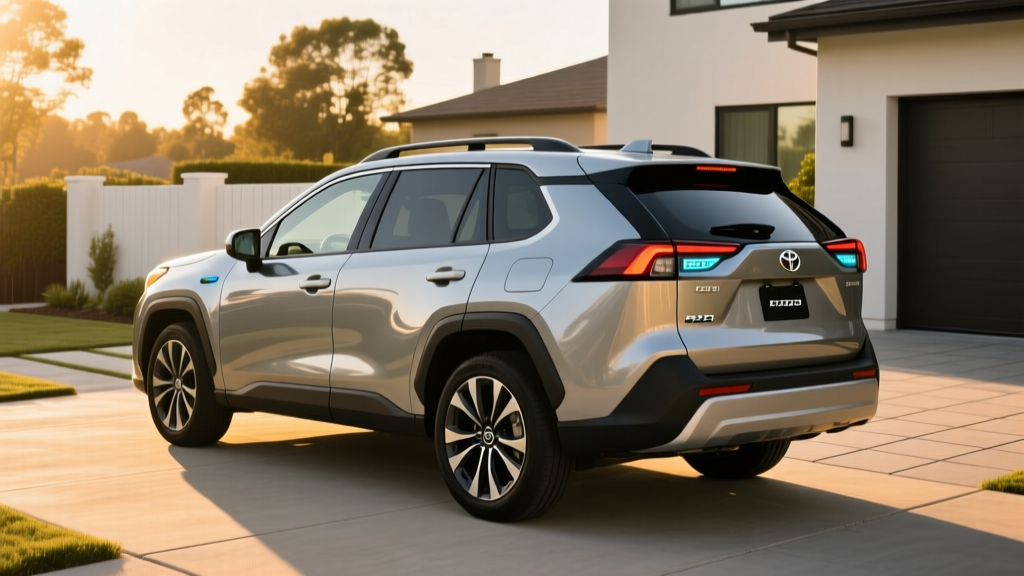
If you've searched for a rav4 awd hybrid and found yourself drowning in trim levels, MPG numbers, and the HEV-vs-PHEV question, you're not alone. The Toyota RAV4 Hybrid remains one of the best-selling electrified vehicles in the United States for a reason: it delivers all-wheel drive, strong fuel economy, and Toyota's reputation for hybrid reliability without requiring a charging cord. For 2026, Toyota continues to refine the formula, but the real question for buyers is whether the conventional hybrid (HEV) or the plug-in RAV4 Prime (PHEV) is the right call for their driving habits and budget.
This guide breaks down the 2026 RAV4 AWD Hybrid lineup with exact EPA figures, real-world efficiency expectations, powertrain specs, battery warranty details, tax credit eligibility, and a practical decision framework to help you choose.
RAV4 Hybrid (HEV) vs. RAV4 Prime (PHEV): What's the Difference?
Toyota sells two electrified RAV4 variants, and confusing them is the single most common buyer mistake. Here's the critical distinction:
Conventional Hybrid (RAV4 Hybrid AWD)
- No plug required. The battery recharges via regenerative braking and the gasoline engine.
- Small battery (~1.6 kWh) — too small to drive on electric power alone for meaningful distances.
- Always has gasoline in the loop. The electric motors assist the engine; they don't replace it.
- No federal tax credit under current IRS §30D rules (the credit applies only to plug-in vehicles with ≥7 kWh battery capacity).
Plug-in Hybrid (RAV4 Prime AWD)
- Plugs in to charge. Uses a Level 1 (120V) or Level 2 (240V) charger.
- Larger battery (18.1 kWh) enabling 42 miles of EPA-rated electric-only range.
- Can drive on electricity alone for daily commutes, then operates as a conventional hybrid once the battery depletes.
- May qualify for a federal tax credit depending on income, MSRP caps, and battery-sourcing requirements.
If you don't have access to a home charger or a reliable Level 2 outlet, the conventional RAV4 Hybrid is almost certainly the better choice. The Prime's advantages only materialize if you can plug in regularly.
Fuel Economy: EPA Ratings and Real-World MPG
The headline number for the 2026 RAV4 Hybrid AWD is its EPA-estimated combined fuel economy. According to fueleconomy.gov, the ratings break down as follows:
| Trim | City MPG | Highway MPG | Combined MPG |
|---|---|---|---|
| LE / XLE | 41 | 38 | 39 |
| XLE Premium / SE | 41 | 38 | 39 |
| XSE / Limited | 41 | 38 | 39 |
For the RAV4 Prime PHEV, the EPA rates it at 42 miles of electric-only range, a combined 94 MPGe when operating on battery power, and 38 MPG combined once the battery is depleted and it functions as a conventional hybrid.
Real-World MPG: What Owners Actually See
Toyota's hybrid system excels in stop-and-go city driving, where regenerative braking constantly recaptures energy. Many owners report exceeding the EPA city figure of 41 MPG in urban conditions — 43–45 MPG is common in warm weather with moderate acceleration.
Highway driving tells a different story. At sustained 70–80 MPH speeds, expect 34–37 MPG — the aerodynamic drag of a compact SUV works against the hybrid system's advantages. In cold weather (below 30°F), the engine runs more frequently for cabin heat and battery conditioning, dropping combined real-world MPG to roughly 33–36 MPG until the cabin warms up.
Real-World Range Expectation: With a 14.5-gallon fuel tank and a realistic combined MPG of 37–40, expect 535–580 miles per tank in mixed driving. Highway-only road trips in winter may drop this to ~490 miles. The RAV4 Prime adds 42 electric miles on top of its gasoline range when fully charged.
Powertrain Specs: Engine, Motors, and Horsepower
| Specification | RAV4 Hybrid AWD (HEV) | RAV4 Prime AWD (PHEV) |
|---|---|---|
| Engine | 2.5L 4-cylinder Atkinson cycle | 2.5L 4-cylinder Atkinson cycle |
| Front Electric Motor | 88 kW (118 hp) | 134 kW (180 hp) |
| Rear Electric Motor (AWD) | 40 kW (54 hp) | 40 kW (54 hp) |
| Combined Net Horsepower | 219 hp | 302 hp |
| 0–60 MPH | 7.4 seconds | 5.7 seconds |
| Drivetrain | Electronic AWD (eAWD) | Electronic AWD (eAWD) |
| Transmission | eCVT | eCVT |
| Towing Capacity | 1,750 lbs | 1,750 lbs |
Toyota's eAWD system uses a dedicated rear electric motor to power the rear axle when slip is detected or during hard acceleration. This is not a mechanical driveshaft system — the rear wheels are driven purely by the electric motor, which means the AWD engages seamlessly and only when needed, preserving fuel economy during steady-state cruising.
The Prime's 302 combined horsepower makes it the quickest RAV4 Toyota sells, and one of the quickest compact SUVs in its class. That performance comes from the larger front motor and the ability to dump battery energy into both motors simultaneously.
RAV4 Prime Battery, Charging, and Electric Range
If you're considering the RAV4 Prime, the battery and charging logistics matter enormously:
| Specification | Detail |
|---|---|
| Battery Capacity | 18.1 kWh (total) / ~14.5 kWh usable |
| Battery Chemistry | Lithium-ion (NMC) |
| EPA Electric-Only Range | 42 miles |
| Total Range (Electric + Gas) | ~600 miles |
| Level 1 Charging (120V, 12A) | ~12 hours (0–100%) |
| Level 2 Charging (240V, 32A) | ~2.5 hours (0–100%) |
| DC Fast Charging | Not supported |
The RAV4 Prime does not support DC fast charging. This is typical for PHEVs — the battery is small enough that Level 2 charging replenishes it in a few hours, which covers overnight home charging and destination charging adequately. However, if you were hoping to top up at a highway DC fast charger during a road trip, that's not an option.
For the conventional RAV4 Hybrid, the ~1.6 kWh battery charges entirely through regenerative braking and engine operation. You never plug it in, and there's no electric-only range to manage.
Pricing, Trims, and Tax Credit Eligibility
The 2026 RAV4 Hybrid AWD lineup starts in the low $30,000s (MSRP, before destination charges), with higher trims pushing toward $40,000:
| Trim | Estimated MSRP |
|---|---|
| LE | ~$33,000 |
| XLE | ~$34,500 |
| XLE Premium | ~$36,000 |
| XSE | ~$37,500 |
| Limited | ~$40,000 |
The RAV4 Prime starts significantly higher, typically around $44,000–$45,000 for the SE trim and approaching $48,000 for the XSE Premium.
Federal Tax Credit: What Qualifies?
Under current IRS §30D rules, the conventional RAV4 Hybrid does not qualify for the federal clean vehicle tax credit. The credit requires a minimum battery capacity of 7 kWh and plug-in capability — criteria only the RAV4 Prime meets.
For the RAV4 Prime, eligibility for up to $7,500 in federal tax credits depends on several conditions that change periodically:
- MSRP cap: SUVs must have an MSRP at or below $80,000 (the Prime qualifies).
- Buyer income cap: Modified AGI must not exceed $150,000 (single), $225,000 (head of household), or $300,000 (joint).
- Battery sourcing: Critical minerals and battery components must meet phased-in domestic-content thresholds that tighten annually. Check the latest IRS guidance at irs.gov before purchasing.
- Point-of-sale transfer: Eligible buyers can transfer the credit to the dealer at purchase, reducing the upfront price rather than waiting for a tax refund.
Important: Battery sourcing requirements have disqualified several PHEVs in recent years. Always verify the RAV4 Prime's current eligibility on the IRS clean vehicle credit page before committing to a purchase. Your tax professional can confirm your personal eligibility.
Battery Warranty, Reliability, and Replacement Cost
Toyota Hybrid Battery Warranty
Duration: 10 years / 150,000 miles (whichever comes first), transferable to subsequent owners.
Coverage: Toyota warrants the hybrid battery against defects and capacity loss below a specified threshold (typically 60–70% of original capacity). If the battery falls below the warranted capacity within the coverage period, Toyota will repair or replace it at no cost.
Source: Toyota Warranty Guide
Real-World Reliability
Toyota's hybrid system is among the most proven in the industry. The company has been refining its Hybrid Synergy Drive since the original Prius in 1997. Real-world data from owner communities and fleet operators shows RAV4 Hybrid batteries routinely lasting 200,000–300,000 miles before any significant degradation.
The eCVT transmission (really a planetary gearset, not a belt-driven CVT) has no friction clutches or bands to wear out, contributing to the powertrain's longevity. The IIHS has consistently rated the RAV4 highly for safety, which matters for family-oriented buyers.
Battery Replacement Cost
If the hybrid battery does eventually need replacement outside of warranty, expect the following:
- RAV4 Hybrid (HEV): $3,000–$5,000 for a new OEM battery pack, plus ~$500–$1,000 in labor.
- RAV4 Prime (PHEV): $6,000–$9,000 for the larger battery pack, plus labor.
- Refurbished/third-party options: Available for $1,500–$3,000 for the HEV battery, though with shorter warranties.
For context, most conventional vehicles need a transmission replacement ($4,000–$7,000) at similar mileages — the hybrid battery is a comparable long-term maintenance item, not an unusual liability.
Who Should Buy the RAV4 AWD Hybrid?
Pros
- 39 MPG combined EPA — real-world city driving often exceeds 41 MPG
- Standard eAWD on every hybrid trim — no FWD-only compromise
- 219 hp (HEV) / 302 hp (Prime) — genuinely quick for the class
- 10-year/150,000-mile hybrid battery warranty
- No charging infrastructure needed (HEV)
- Strong resale value — RAV4 Hybrids hold value well
- Toyota Safety Sense 2.5+ standard across trims
Cons
- Highway MPG drops to ~34-37 at 75+ MPH
- Cold weather reduces efficiency noticeably (~33-36 MPG combined)
- RAV4 Prime carries a $10,000+ price premium over the HEV
- Prime does not support DC fast charging
- Towing limited to 1,750 lbs (insufficient for most trailers)
- No federal tax credit for the conventional hybrid
- Cargo space slightly reduced vs. gas-only RAV4 (battery placement)
Decision Framework: RAV4 Hybrid vs. Prime vs. Full EV
Choose the RAV4 Hybrid (HEV) if:
- You don't have reliable access to a home charger or Level 2 outlet.
- Your budget is $33,000–$40,000.
- You want maximum simplicity — no plugs, no charging apps, no range management.
- You drive a mix of city and highway and want strong MPG in both.
Choose the RAV4 Prime (PHEV) if:
- You can install a Level 2 charger at home (or have one already).
- Your daily commute is under 40 miles round-trip — you'll rarely burn gas.
- You want 302 hp and 5.7-second 0–60 performance.
- You qualify for the federal tax credit, narrowing the price gap with the HEV.
- You take occasional long road trips and don't want EV range limitations.
Choose a Full EV (like the Toyota bZ4X or Tesla Model Y) if:
- You want zero tailpipe emissions and the lowest per-mile fuel cost.
- You have reliable home charging and access to DC fast chargers for road trips.
- You're ready to forgo gasoline entirely and accept charging logistics.
- You qualify for the full $7,500 federal tax credit on a qualifying BEV.
Frequently Asked Questions
How many MPG does the 2026 RAV4 AWD Hybrid get?
The EPA rates the RAV4 Hybrid AWD at 41 city / 38 highway / 39 combined MPG. In real-world city driving, many owners see 43–45 MPG. Highway cruising at 75+ MPH typically yields 34–37 MPG. Cold weather reduces combined figures to roughly 33–36 MPG.
How far can the RAV4 Prime go on electric only?
The EPA rates the RAV4 Prime at 42 miles of electric-only range. In warm weather with gentle acceleration, some owners report 44–48 miles. Cold weather and aggressive driving can reduce this to 32–36 miles. Once the battery depletes, the Prime operates as a conventional hybrid rated at 38 MPG combined.
Does the RAV4 Hybrid need to be plugged in?
No. The conventional RAV4 Hybrid (HEV) charges its small battery entirely through regenerative braking and the gasoline engine. You never plug it in. Only the RAV4 Prime (PHEV) requires plugging in to access its electric-only range.
Is the RAV4 Hybrid reliable, and what does a battery replacement cost?
Toyota's hybrid system has an exceptional reliability track record spanning over 25 years. The hybrid battery is warranted for 10 years / 150,000 miles. Real-world data shows batteries lasting 200,000–300,000 miles. If replacement is needed out of warranty, expect $3,000–$5,000 for the HEV battery and $6,000–$9,000 for the Prime's larger pack.
Does the RAV4 Hybrid qualify for a federal tax credit?
The conventional RAV4 Hybrid (HEV) does not qualify for the federal §30D clean vehicle tax credit — it's not a plug-in vehicle. The RAV4 Prime (PHEV) may qualify for up to $7,500, but eligibility depends on current-year battery sourcing rules, buyer income limits, and MSRP caps. Always verify on irs.gov before purchasing.
How does the RAV4 Hybrid AWD system work?
Toyota's eAWD uses a dedicated 40 kW electric motor on the rear axle. There is no mechanical driveshaft connecting the engine to the rear wheels. The rear motor engages automatically when the system detects front-wheel slip, during hard acceleration, or when cornering — providing AWD traction without the fuel economy penalty of a traditional mechanical AWD system.
Should I buy the RAV4 Hybrid or a full EV?
If you lack home charging access, frequently drive in areas with sparse charging infrastructure, or regularly take long road trips where charging stops would be inconvenient, the RAV4 Hybrid is the practical choice. If you can charge at home, have a short commute, and want the lowest per-mile energy cost, a full EV like the Model Y or Hyundai Ioniq 5 may save more over 5 years despite a higher purchase price.
The 2026 RAV4 AWD Hybrid occupies a pragmatic sweet spot: genuine fuel savings, standard all-wheel drive, and Toyota's proven hybrid reliability — all without changing how you refuel. Whether you choose the 39 MPG HEV or the 42-mile electric-range Prime depends on your charging access, budget, and whether that federal tax credit lands in your tax year. Either way, you're getting one of the most thoroughly validated electrified powertrains on the road.