Quick Verdict: The Prius Plug-In Hits the Sweet Spot
If your daily commute is under 40 miles and you want to drive on electricity most days without ever worrying about range on road trips, the 2026 Toyota Prius Plug-In Hybrid (technically badged as the Prius Prime) remains one of the most practical electrified vehicles on the market. It delivers 44 miles of EPA-rated electric-only range, then seamlessly transitions to a hybrid powertrain achieving 52 MPG combined. With a starting MSRP around $33,445 (SE trim) and potential eligibility for a federal tax credit of up to $3,750 under current IRS §30D rules, it occupies a compelling middle ground between a conventional hybrid and a full battery-electric vehicle.
The fifth-generation Prius Prime's redesign shed its dowdy image, pairing a sleek fastback silhouette with a 220-horsepower plug-in hybrid powertrain that genuinely surprises at the stoplight. But how does it stack up in real-world use, and who should choose it over a pure EV or a standard Prius HEV?
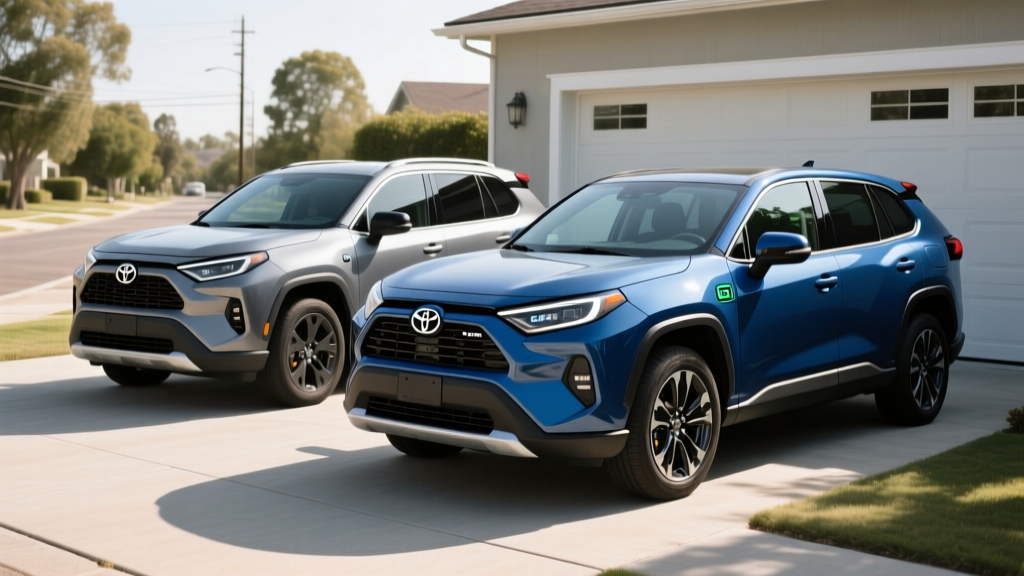
HEV vs PHEV: Understanding the Two Prius Variants
Toyota sells two fundamentally different Prius models, and confusing them is a common buyer mistake:
Conventional Hybrid (HEV) — Prius
- No plug — charges itself via regenerative braking and the gasoline engine
- Small battery (~1.0 kWh usable) provides electric assist only
- 57 MPG combined EPA (LE FWD)
- No electric-only driving beyond very low-speed creep
- Lower starting price (~$28,345)
- No federal tax credit eligibility
Plug-In Hybrid (PHEV) — Prius Prime
- Plugs in to charge a larger 13.6 kWh battery
- 44 miles of true electric-only driving at highway speeds
- 52 MPG combined (hybrid mode after battery depletes) / 127 MPGe combined
- Can operate as a full EV for daily commutes
- Higher starting price (~$33,445)
- May qualify for federal tax credit (up to $3,750 under current rules)
The conventional Prius HEV is ideal if you lack home charging access. The Prius Prime (plug-in) rewards those who can charge at home overnight, letting them drive most weekdays without burning a drop of gasoline.
Electric-Only Range and Total Driving Range
| Specification | 2026 Prius Prime (PHEV) |
|---|---|
| Battery Capacity | 13.6 kWh (lithium-ion) |
| EPA Electric-Only Range | 44 miles (SE); 40 miles (XSE/XSE Premium) |
| EPA Gasoline-Only Range | ~460 miles (after battery depletion) |
| Total Combined Range | ~500+ miles |
| Electric Top Speed | 84 mph (EV mode) |
| MPGe (EV Mode) | 127 MPGe combined |
Real-World Range Expectations: The EPA rates the Prius Prime SE at 44 electric miles. In real-world testing during mild weather (60–75°F) with moderate acceleration, expect 38–45 miles before the gasoline engine engages. In cold weather (below 35°F), cabin heating and battery chemistry reduce electric range to approximately 30–36 miles. Highway driving at 70+ mph also reduces electric range due to aerodynamic drag. The heavier XSE and XSE Premium trims (larger wheels, more equipment) lose about 4 miles of rated range.
For most commuters driving under 35 miles round-trip, the Prius Prime operates as a de facto EV Monday through Friday, with the hybrid system available for weekend road trips where charging infrastructure is sparse.
Fuel Economy: EPA Ratings vs Real-World MPG
| Mode | City | Highway | Combined |
|---|---|---|---|
| Hybrid Mode (battery depleted) | 50 MPG | 47 MPG | 52 MPG (SE) |
| XSE / XSE Premium Hybrid Mode | 50 MPG | 47 MPG | 50 MPG |
| EV Mode (electricity) | 127 MPGe combined | ||
Real-World MPG Note: Toyota hybrids, including the Prius Prime in hybrid mode, frequently exceed their EPA ratings in city driving. Regenerative braking recaptures energy at every stop, and the engine shuts off frequently in stop-and-go traffic. Many owners report 54–58 MPG in urban commutes. Highway driving at sustained 75+ mph tends to drop to 44–48 MPG as aerodynamic drag dominates and regenerative opportunities diminish.
Over a full year, a Prius Prime owner who charges nightly and commutes 30 miles round-trip might use gasoline only on weekends — potentially burning fewer than 200 gallons annually versus 400+ gallons for a 30 MPG gas sedan covering the same 12,000 miles.
Powertrain, Performance, and Charging
The 2026 Prius Prime pairs a 2.0-liter four-cylinder Atkinson-cycle engine with two motor-generators and a 13.6 kWh lithium-ion traction battery. Combined output is 220 horsepower — a dramatic upgrade from the previous generation's 121 hp.
| Powertrain Spec | Value |
|---|---|
| Engine | 2.0L 4-cylinder Atkinson-cycle |
| Combined System Output | 220 hp |
| 0–60 mph | 6.6 seconds |
| Drivetrain | Front-wheel drive (eCVT) |
| Drive Modes | EV, HV, Auto EV/HV, EV Priority |
Charging: Level 1 and Level 2 Only — No DC Fast Charging
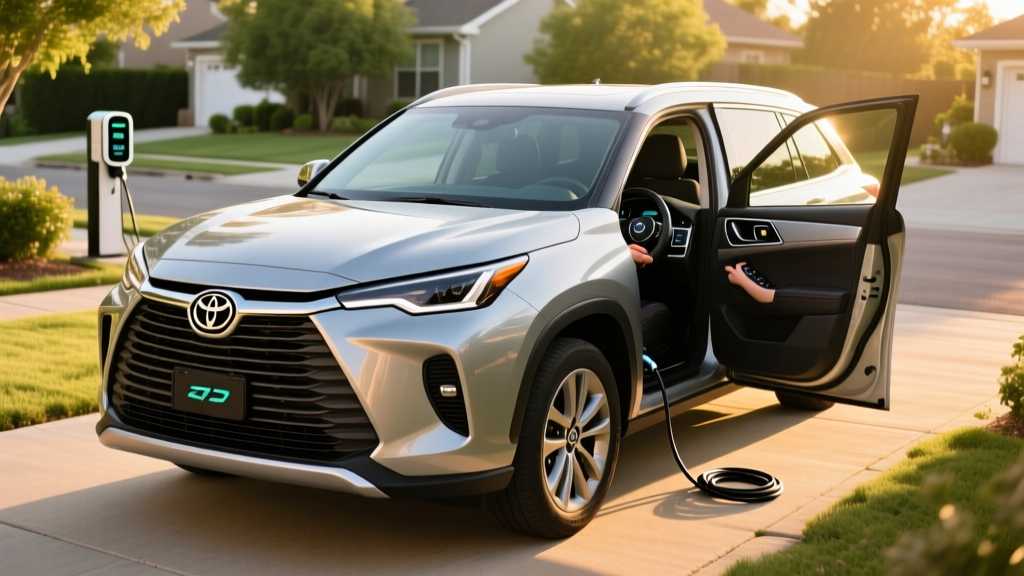
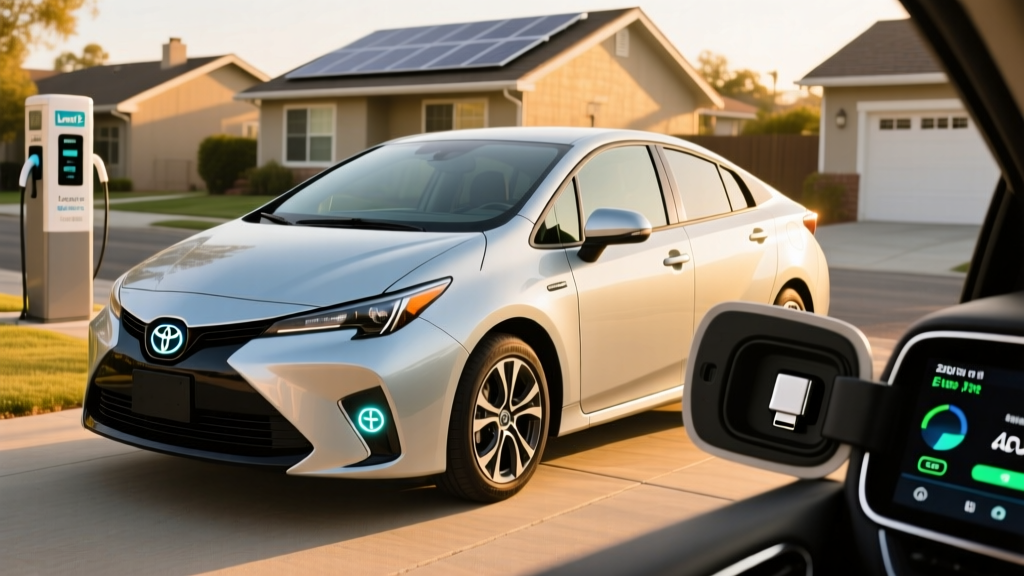
The Prius Prime uses a J1772 connector for AC charging. It does not support DC fast charging — a deliberate engineering choice, since the 13.6 kWh battery is small enough that overnight Level 2 charging is sufficient for most owners.
| Charging Level | Power | Time (0–100%) | Typical Location |
|---|---|---|---|
| Level 1 (120V household outlet) | ~1.4 kW | ~11 hours | Standard outlet, garage |
| Level 2 (240V home/public) | ~3.3 kW (onboard charger limit) | ~4 hours | Home wallbox, workplace, public AC stations |
| DC Fast Charging | Not supported | ||
The onboard AC charger is limited to 3.3 kW, meaning even a 7.2 kW or 11.5 kW Level 2 home station will charge the Prius Prime at 3.3 kW. For a 13.6 kWh battery, this is perfectly adequate — four hours from empty covers overnight needs easily. A standard 120V outlet in the garage works for owners who park for 11+ hours nightly.
Pricing, Trims, and Tax Credit Eligibility
| Trim | MSRP (2026 est.) | Key Features |
|---|---|---|
| SE | $33,445 | 44 mi EV range, 19" alloys, 8" touchscreen, TSS 3.0 |
| XSE | $36,795 | 40 mi EV range, heated front seats, SofTex, 12.3" display |
| XSE Premium | $39,995 | Panoramic roof, premium audio, digital rearview mirror |
Federal Tax Credit: Up to $3,750 Under §30D
Under current IRS §30D rules, the Prius Prime may qualify for a federal tax credit of up to $3,750. This partial credit reflects the vehicle's battery sourcing and critical-minerals compliance. Full $7,500 credit eligibility depends on meeting both the critical-minerals and battery-component sourcing thresholds, which shift annually.
- MSRP Cap: The Prius Prime (a sedan) must have an MSRP at or below $55,000 — all trims qualify.
- Income Cap: Buyer AGI must not exceed $150,000 (single), $225,000 (head of household), or $300,000 (joint).
- Battery Sourcing: Partial or full credit depends on the percentage of critical minerals and battery components sourced from the U.S. or FTA-partner countries. Verify current-year compliance on the IRS clean vehicle credit page.
- Point-of-Sale Transfer: Eligible buyers can transfer the credit to the dealer at purchase, reducing the out-of-pocket price immediately rather than waiting for a tax refund.
Important: Tax credit eligibility rules change frequently. Consult a tax professional and check fueleconomy.gov for the latest qualifying vehicle list before purchasing.
Battery Warranty, Reliability, and Long-Term Costs
Toyota Hybrid Battery Warranty
Coverage: 10 years or 150,000 miles (whichever comes first) for the hybrid/EV traction battery.
What's Covered: Defects in materials or workmanship, and capacity loss below a defined threshold (typically ~70% state of health).
Transferability: The warranty transfers to subsequent owners, which supports resale value.
Toyota's hybrid battery track record is among the best in the industry. The original Prius (launched in the U.S. in 2000) demonstrated that nickel-metal hydride and later lithium-ion hybrid batteries can last well beyond 200,000 miles with minimal degradation. The Prius Prime's 13.6 kWh lithium-ion pack is modest in size and operates within a conservative state-of-charge window (it never fully charges or fully discharges), which significantly reduces cell stress.
Battery Replacement Cost: If the traction battery does require replacement outside of warranty, expect a cost between $3,500 and $6,000 (parts and labor) at a Toyota dealer. Independent hybrid-battery specialists often offer refurbished or reconditioned packs for $2,000–$3,500. Given the 10-year/150,000-mile warranty and Toyota's reliability history, most owners will never face this expense.
Toyota's Safety Sense 3.0 suite (standard on all trims) includes adaptive cruise control, lane-keeping assist, pre-collision braking with pedestrian detection, and road-sign assist. The Prius Prime earns strong marks from IIHS and NHTSA in crash testing.
Who Should Buy the Prius Plug-In vs a Full EV or Gas Car?
Choose the Prius Prime (PHEV) if:
- Your daily round-trip commute is under 40 miles and you can charge at home overnight
- You take regular road trips beyond reliable charging infrastructure
- You live in a cold climate where EV range loss (20–40%) is a concern
- You want EV-like daily driving without committing to a full BEV
- Your household has one vehicle and needs maximum flexibility
Choose a Full EV (BEV) if:
- You have reliable home Level 2 charging and your daily drive is under 250 miles
- You want zero tailpipe emissions and minimal maintenance (no oil changes, no engine)
- You want access to the full $7,500 federal credit (on qualifying BEVs)
- You rarely take trips beyond 250 miles without overnight stops
Choose the Conventional Prius (HEV) if:
- You lack home or workplace charging access
- You want the lowest purchase price and simplest ownership
- Your commute is long and mostly highway (where PHEV electric-range advantage diminishes)
Pros
- 44 miles electric covers most daily commutes
- 500+ total range eliminates range anxiety
- 220 hp makes it genuinely quick (6.6s 0–60)
- 52 MPG hybrid mode is best-in-class
- 10-year/150k-mile battery warranty
- Charges on standard 120V outlet overnight
- Strong resale value and reliability record
Cons
- Only 3.3 kW AC charging — slow at public Level 2 stations
- No DC fast charging option
- Rear headroom is tight due to fastback roofline
- Cargo space (20.3 cu ft) is modest for the class
- XSE trims lose 4 miles of EV range
- Partial tax credit ($3,750) vs $7,500 on some BEVs
Frequently Asked Questions
How many MPG does the Prius Plug-In get?
Once the battery is depleted, the 2026 Prius Prime SE achieves 50 city / 47 highway / 52 combined MPG in hybrid mode. The XSE and XSE Premium trims rate at 50 combined MPG. In electric mode, efficiency is rated at 127 MPGe. Real-world city driving often yields 54–58 MPG thanks to aggressive regenerative braking.
How far can the Prius Plug-In go on electric only?
The EPA rates the SE trim at 44 miles of electric-only range and the XSE/XSE Premium at 40 miles. Real-world range varies from 30 miles (cold highway driving) to 45 miles (mild city conditions). The gasoline engine seamlessly starts when the battery depletes — there is no range cliff.
Does the Prius Plug-In qualify for a tax credit?
Under current IRS §30D rules, the Prius Prime may qualify for up to $3,750 in federal tax credits, subject to buyer income limits, MSRP caps, and battery-sourcing requirements. The credit can be transferred to the dealer at the point of sale. State incentives (such as California's CVRP or Colorado's tax credit) may stack on top. Always verify eligibility on irs.gov before purchasing.
Is the Prius Prime reliable and what does battery replacement cost?
Toyota's hybrid systems have a two-decade reliability track record, and the Prius Prime's traction battery is warrantied for 10 years / 150,000 miles. Out-of-warranty battery replacement costs $3,500–$6,000 at a dealer, though refurbished options exist for less. Most owners will never need a replacement.
Do I need to install a Level 2 charger at home for the Prius Prime?
No — a standard 120V household outlet (Level 1) will fully charge the 13.6 kWh battery in about 11 hours, which works for owners who park overnight. A 240V Level 2 station reduces this to about 4 hours. Since the onboard charger is limited to 3.3 kW, investing in a high-power (7.2 kW+) home charger won't speed up Prius Prime charging, though it would benefit a future full EV.
Hybrid vs PHEV vs EV — which is right for me?
If you can charge at home and your daily driving is under 40 miles, the Prius Prime (PHEV) lets you drive electric most days while retaining a gasoline engine for long trips. If you charge at home and rarely exceed 250 miles, a full EV (like the Tesla Model 3 or Hyundai Ioniq 6) offers lower maintenance and potentially larger tax credits. If you can't charge at home, the conventional Prius HEV delivers excellent MPG with zero lifestyle change.