Quick Verdict: Two Hybrids, Two Very Different Ownership Experiences
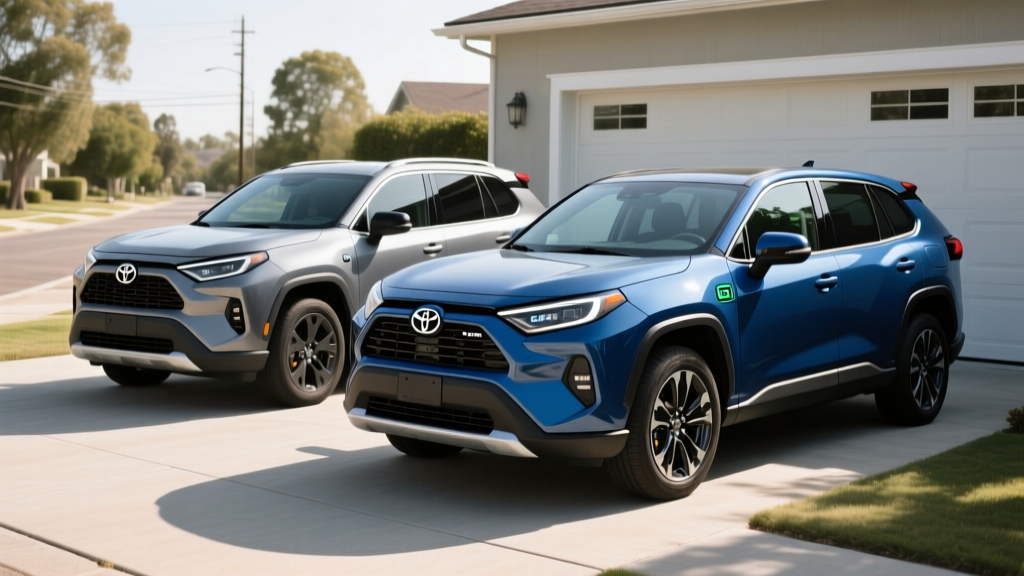
The 2024 Toyota RAV4 lineup offers two distinct hybrid paths. The conventional RAV4 Hybrid (HEV) delivers up to 41 MPG city without ever plugging in, starting at $32,345. The RAV4 Prime (PHEV) adds 42 miles of electric-only driving, 302 combined horsepower, and qualifies for a federal tax credit — but starts at $44,440 and remains one of the most allocated-constrained vehicles in Toyota's lineup.
Both share Toyota's proven hybrid synergy architecture, but the powertrain specs, daily driving experience, and total cost of ownership diverge sharply. This guide breaks down every number that matters for a purchase decision.
HEV vs PHEV: Understanding the Two RAV4 Hybrid Powertrains
Before comparing specs, it's critical to distinguish these two systems — they serve different buyers entirely.
| Attribute | RAV4 Hybrid (HEV) | RAV4 Prime (PHEV) |
|---|---|---|
| Plug-in required? | No — self-charging via engine & regenerative braking | Yes — for full electric range & tax credit benefit |
| Battery capacity | 1.6 kWh (nickel-metal hydride) | 18.1 kWh usable (lithium-ion) |
| Electric-only driving | Low-speed assist only (~1 mi, rare) | 42 miles EPA (EV mode) |
| Combined horsepower | 219 hp | 302 hp |
| Drivetrain | AWD (electronic rear motor) | AWD (more powerful rear motor) |
| Federal tax credit | Not eligible (§30D requires plug-in) | Eligible — up to $7,500 (see rules below) |
| Base MSRP (2024) | $32,345 (LE) | $44,440 (SE) |
The HEV is a drop-in replacement for a gas car: you refuel at gas stations, the hybrid system handles energy recuperation automatically, and there's zero behavioral change. The PHEV rewards owners who can charge at home — if your daily commute falls under 42 miles, you may go weeks without burning fuel.
Fuel Economy: EPA MPG and Real-World Expectations
| Model / Trim | City MPG | Highway MPG | Combined MPG | MPGe (EV mode) |
|---|---|---|---|---|
| RAV4 Hybrid (LE) | 41 | 38 | 40 | N/A |
| RAV4 Hybrid (XLE, XSE, Limited) | 41 | 38 | 40 | N/A |
| RAV4 Prime (SE, XSE) | 40 (hybrid mode) | 36 (hybrid mode) | 38 (hybrid mode) | 94 MPGe |
Source: EPA fueleconomy.gov
Real-World MPG: What Owners Actually See
Toyota's hybrid system excels in stop-and-go traffic, where regenerative braking and electric motor assist reduce engine load. In real-world city driving, many RAV4 Hybrid owners report 42–45 MPG — exceeding the EPA city estimate. Highway driving at 70+ MPH tends to return 34–37 MPG, slightly below the sticker, as the aerodynamic penalty of the RAV4's crossover profile outweighs the hybrid advantage at sustained speed.
For the RAV4 Prime, once the 42-mile battery buffer depletes, the vehicle operates as a conventional hybrid returning approximately 36–38 MPG combined — slightly lower than the HEV due to the heavier lithium-ion battery pack (the Prime weighs roughly 300 lbs more).
RAV4 Prime: Electric-Only Range, Charging, and Battery Specs
The RAV4 Prime's 18.1 kWh lithium-ion battery pack (approximately 14.9 kWh usable to preserve longevity via buffer) enables its headline 42-mile EPA electric range. Here's what charging looks like:
| Charging Method | Power | 0–100% Time | Notes |
|---|---|---|---|
| Level 1 (120V household outlet) | ~1.4 kW | ~12 hours | Included cord; overnight for low-mileage drivers |
| Level 2 (240V, 16A) | 3.3 kW (SE trim) | ~5.5 hours | SE trim onboard charger limit |
| Level 2 (240V, 32A) | 6.6 kW (XSE trim) | ~2.5 hours | XSE trim; requires 32A+ home charger |
| DC Fast Charging | Not supported | N/A | No CCS or CHAdeMO port on Prime |
Critical trim distinction: The SE trim's 3.3 kW onboard charger is the RAV4 Prime's biggest ownership gotcha. If you commute 40+ miles daily and need a midday top-up, the SE's slower charging is a real limitation. The XSE's 6.6 kW charger cuts recharge time in half — worth the trim upgrade for high-mileage PHEV users.
The Prime does not support DC fast charging. This is common for PHEVs — the battery is small enough that Level 2 fully replenishes it in a few hours, and adding DC hardware would increase cost, weight, and packaging complexity.
Powertrain Performance: 219 HP vs 302 HP
Both models use Toyota's 2.5-liter inline-four Atkinson-cycle engine paired with electric motors, but the output difference is substantial.
| Spec | RAV4 Hybrid | RAV4 Prime |
|---|---|---|
| Engine | 2.5L I4 Atkinson (176 hp) | 2.5L I4 Atkinson (177 hp) |
| Front electric motor | 118 hp | 180 hp |
| Rear electric motor | 54 hp | 54 hp |
| Combined system output | 219 hp | 302 hp |
| 0–60 MPH | 7.4 seconds | 5.7 seconds |
| Towing capacity | 1,750 lbs | 2,500 lbs |
The Prime's 5.7-second 0–60 time makes it the quickest RAV4 Toyota has ever produced and genuinely quick for a compact crossover. The HEV's 7.4 seconds is adequate for daily driving and highway merging but noticeably less eager. Both use Toyota's eCVT (planetary gearset), which provides smooth, stepless acceleration without the rubber-band feel of belt-driven CVTs.
Pricing, Trims, and Tax Credit Eligibility
2024 RAV4 Hybrid (HEV) Pricing
- LE: $32,345
- XLE: $34,055
- Woodland Edition: $35,675
- XSE: $36,490
- SE: $36,090
- Limited: $39,075
2024 RAV4 Prime (PHEV) Pricing
- SE: $44,440
- XSE: $48,605
All prices include destination charge. Source: Toyota.com
Federal Tax Credit: §30D Eligibility for the RAV4 Prime
The RAV4 Hybrid (HEV) does not qualify for the federal §30D tax credit — that credit applies only to plug-in electric vehicles. The RAV4 Prime does qualify, but eligibility depends on multiple IRS rules that change periodically:
- Credit amount: Up to $7,500 for the RAV4 Prime (battery capacity exceeds 7 kWh threshold)
- Buyer income cap: AGI must not exceed $150,000 (single), $225,000 (head of household), or $300,000 (joint) — per IRS §30D guidelines
- MSRP cap: SUVs/vans capped at $80,000 — the Prime clears this easily
- Battery sourcing: Critical minerals and battery component requirements phase in annually; verify current-year compliance at purchase
- Point-of-sale transfer: As of 2024, buyers can transfer the credit to the dealer for an immediate price reduction at purchase
- Assembly: Must be assembled in North America (the RAV4 Prime is built in Japan — verify current eligibility with your dealer before purchase)
Important caveat: The RAV4 Prime is manufactured at Toyota's Tahara plant in Japan. Under §30D's North American final assembly requirement, this has periodically affected eligibility. Always confirm current credit status with your dealer and cross-reference the fueleconomy.gov tax credit database before signing paperwork. Tax rules shift — consult a tax professional for your specific situation.
Battery Warranty, Reliability, and Replacement Cost
- Hybrid battery: 10 years / 150,000 miles (whichever comes first)
- Hybrid system components: 8 years / 100,000 miles
- Applies to: Both RAV4 Hybrid (NiMH) and RAV4 Prime (Li-ion)
- Transferable: Yes — warranty transfers to subsequent owners
Longevity Track Record
Toyota's hybrid battery durability is among the best-documented in the industry. The company has been shipping hybrid powertrains since the 1997 Prius, and real-world data shows most Toyota hybrid batteries last well beyond the warranty period. It's common to see Prius and Camry Hybrid units reaching 200,000+ miles on the original battery pack.
The RAV4 Hybrid's nickel-metal hydride (NiMH) pack is chemically conservative — it has lower energy density than lithium-ion but offers exceptional cycle stability. The RAV4 Prime's lithium-ion pack is larger and more stressed, but Toyota's thermal management system and conservative buffer (keeping the battery between roughly 15–85% state of charge) protect long-term health.
Battery Replacement Cost
If a hybrid battery does fail outside warranty:
- RAV4 Hybrid (NiMH): Approximately $3,000–$4,500 for a new OEM replacement, including labor
- RAV4 Prime (Li-ion): Approximately $6,000–$9,000 due to the larger, more complex pack
- Refurbished/remanufactured options: Available from third-party shops for $1,500–$3,000 (HEV)
Given the 10-year/150,000-mile warranty and Toyota's reliability history, unplanned battery replacement is rare. According to Consumer Reports reliability data, the RAV4 Hybrid consistently earns above-average predicted reliability scores.
Who Should Buy the RAV4 Hybrid, the Prime, or a Full EV?
- You don't have access to home or workplace charging
- You want maximum MPG with zero behavior change
- Your budget is $32,000–$39,000
- You drive 12,000–15,000 miles/year in mixed city/highway conditions
- You want proven reliability with minimal maintenance
- You can install a Level 2 charger at home (240V)
- Your daily commute is under 40 miles round-trip
- You want electric daily driving but gas flexibility for road trips
- You qualify for the federal tax credit (effectively bringing the SE to ~$37,000)
- You value the 302 hp performance upgrade
- You have reliable home Level 2 charging
- Your typical trips stay within 250–300 miles (or you're comfortable with DC fast charging on road trips)
- You want to eliminate gasoline entirely and minimize maintenance (no oil changes, no engine)
- You want access to the full $7,500 federal credit without PHEV sourcing complications
RAV4 Hybrid (HEV) — Pros & Cons
Pros:
- 40 MPG combined — real-world often 42+ in city
- No plug-in required; zero lifestyle change
- Standard AWD across all trims
- Strong resale value and reliability record
- Affordable starting price at $32,345
Cons:
RAV4 Prime (PHEV) — Pros & Cons
Pros:
- 42 miles electric-only covers most commutes
- 302 hp — genuinely quick (5.7s 0–60)
- Federal tax credit potential (up to $7,500)
- 520+ miles total range when charged and fueled
- 2,500-lb towing capacity
Cons:
- $44,440+ starting price before credit
- Limited dealer allocation — long waitlists common
- SE trim limited to 3.3 kW charging
- Japan-built — verify §30D assembly eligibility
- 300 lbs heavier affects handling feel
Frequently Asked Questions
How many MPG does the 2024 RAV4 Hybrid get?
The EPA rates the 2024 RAV4 Hybrid at 41 city / 38 highway / 40 combined MPG. In real-world city driving with frequent stops, owners commonly see 42–45 MPG. Highway cruising at 70+ MPH typically returns 34–37 MPG.
How far can the RAV4 Prime go on electric only?
The EPA rates the RAV4 Prime at 42 miles of electric-only range in EV mode. Real-world results vary: gentle city driving in mild weather can yield 44–47 miles, while cold weather (below 30°F) or aggressive highway driving can reduce this to 32–36 miles. The gasoline engine provides an additional ~480 miles of range once the battery depletes.
Does the RAV4 Hybrid need to be plugged in?
No. The conventional RAV4 Hybrid (HEV) charges its small battery entirely through regenerative braking and the gasoline engine. You never plug it in. Only the RAV4 Prime (PHEV) benefits from plug-in charging.
Is the RAV4 Hybrid reliable, and what does battery replacement cost?
Toyota's hybrid system has a 25+ year track record with exceptional reliability. The hybrid battery is warrantied for 10 years / 150,000 miles. Out-of-warranty replacement costs approximately $3,000–$4,500 for the HEV and $6,000–$9,000 for the Prime, though failures before 200,000 miles are uncommon.
Does the 2024 RAV4 Hybrid or Prime qualify for a tax credit?
The conventional RAV4 Hybrid (HEV) does not qualify for the federal §30D tax credit because it is not a plug-in vehicle. The RAV4 Prime (PHEV) may qualify for up to $7,500, but eligibility depends on the buyer's income, the vehicle's battery sourcing compliance, and North American final assembly requirements. Because the Prime is built in Japan, always verify current eligibility on fueleconomy.gov and with your dealer before purchase.
Hybrid vs PHEV vs full EV — which is right for me?
If you lack home charging access, the HEV is the clear choice — no infrastructure needed. If you can charge at home and commute under 42 miles, the Prime lets you drive electric daily while keeping gas for road trips. If you have home charging, mostly drive under 250 miles between stops, and want zero gasoline, a full BEV like the Model Y or Ioniq 5 eliminates fuel stops entirely and has lower maintenance costs.
Can the RAV4 Prime DC fast charge?
No. The RAV4 Prime only accepts AC charging — Level 1 (120V) or Level 2 (240V). There is no DC fast charge port. This is typical for PHEVs: the 18.1 kWh battery charges fully in 2.5–5.5 hours on Level 2, making DC hardware unnecessary for the use case.