Quick Verdict: A 729-HP Plug-In Hybrid Flagship
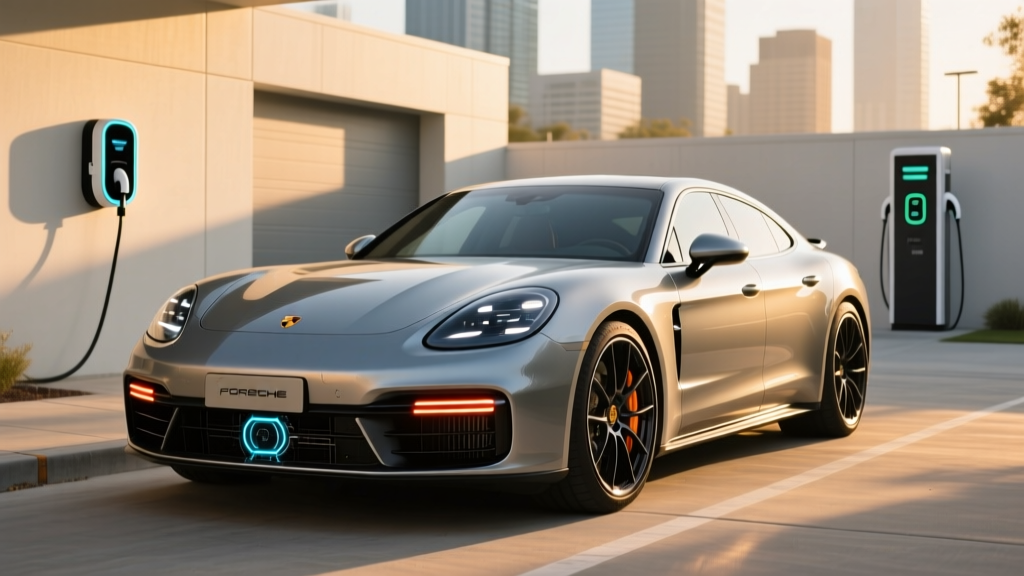
The 2026 Porsche Panamera Turbo S E-Hybrid is the performance apex of Stuttgart's plug-in hybrid lineup — a full-size luxury sedan that pairs a twin-turbo V8 with a high-output electric motor to produce a combined 729 horsepower and 671 lb-ft of torque. It is not an efficiency play. It is a statement that electrification can serve performance first, with the side benefit of around 30 miles of electric-only commuting and the ability to arrive at a hotel in silence under electric power alone.
For buyers cross-shopping the BMW M760e xDrive, Mercedes-AMG S 63 E Performance, or even the Taycan Turbo S, this guide breaks down every number that matters: real-world MPG, electric-only range, charging logistics, battery longevity, and whether the federal tax credit applies.
HEV vs PHEV: Where the Panamera Turbo S E-Hybrid Fits
Before diving into specs, it's critical to distinguish the two hybrid architectures on the market:
| Feature | Conventional Hybrid (HEV) | Plug-In Hybrid (PHEV) |
|---|---|---|
| Battery Size | 1–2 kWh | 10–30+ kWh |
| Electric-Only Range | 0–2 miles at low speed | 15–50+ miles |
| Plug-In Charging | No — charges via regen and engine | Yes — Level 1/Level 2 AC |
| Federal Tax Credit | No | Up to $7,500 (with caveats) |
| Example | Toyota Prius | Porsche Panamera Turbo S E-Hybrid |
The Panamera Turbo S E-Hybrid is a plug-in hybrid (PHEV). It carries a significantly larger battery than a conventional hybrid, can be plugged into a wall or charging station, and offers meaningful electric-only driving range. It cannot, however, DC fast charge — a deliberate engineering choice to save weight and complexity.
Powertrain, Performance, and Combined Output
| Specification | 2026 Panamera Turbo S E-Hybrid |
|---|---|
| Engine | 4.0L twin-turbo V8 |
| Engine Output | ~523 HP / ~568 lb-ft |
| Electric Motor | Integrated in 8-speed PDK, ~190 HP |
| Combined System Output | 729 HP / 671 lb-ft |
| 0–60 mph | 2.9 seconds (manufacturer) |
| Top Track Speed | 202 mph |
| Drivetrain | All-wheel drive (AWD) |
| Transmission | 8-speed PDK dual-clutch |
| Battery Capacity (gross) | 25.9 kWh |
| Battery Chemistry | NMC (nickel manganese cobalt) |
| Curb Weight | ~5,300 lbs |
The electric motor is sandwiched between the V8 and the PDK transmission, delivering instantaneous torque fill while the turbos spool. The result is a 0–60 mph time of 2.9 seconds — territory previously reserved for purpose-built supercars, now achievable in a four-door sedan with a usable rear seat and 17 cubic feet of trunk space.
In E-Power mode, the car operates as a pure EV up to approximately 87 mph, suitable for highway merging and suburban commuting. In Hybrid Auto mode, the powertrain blends electric and gas operation based on navigation data, terrain, and driving style to optimize efficiency across the route.
Electric-Only Range and Total Range
Real-World Expectation: 22–28 miles in mixed driving; 18–22 miles in cold weather or sustained highway use above 65 mph
Total Combined Range (Electric + Gas): ~430–460 miles with a full tank and full charge
The 25.9 kWh battery pack (gross capacity; usable capacity is approximately 21–22 kWh due to buffer protection) provides roughly 30 miles of EPA-rated electric-only range. In practice, expect that number to fluctuate based on temperature, terrain, and how aggressively you use the throttle.
During cold-weather testing (below 40°F), the battery's usable capacity drops and cabin heating draws additional power, reducing electric-only range to roughly 18–22 miles. This is typical for PHEVs with NMC chemistry and no dedicated heat pump for the cabin — the Panamera relies on a high-voltage electric heater that is effective but energy-intensive.
For a daily commute under 25 miles round-trip with home Level 2 charging, most owners will operate this car as an EV on weekdays and a 729-HP grand tourer on weekends. That dual personality is the core value proposition.
Charging: Level 1, Level 2, and What to Expect
| Charging Level | Power (kW) | 0–100% Time | Notes |
|---|---|---|---|
| Level 1 (120V household) | ~1.4 kW | ~16–18 hours | Emergency/trickle only |
| Level 2 (240V, 7.2 kW onboard) | 7.2 kW | ~3.0–3.5 hours | Recommended home setup |
| DC Fast Charge | Not supported | N/A | No CCS/NACS DC inlet |
The Panamera Turbo S E-Hybrid is equipped with a 7.2 kW onboard AC charger and a J1772 inlet (Level 1 and Level 2 AC charging only). There is no DC fast charging capability — Porsche made this decision to reduce weight and packaging complexity, reasoning that most PHEV owners charge at home overnight and that a 25.9 kWh battery is small enough to refill quickly on AC power.
A full Level 2 charge from empty takes approximately 3 to 3.5 hours using a 240V/32A home charger (such as a Porsche Mobile Charger Connect or a third-party unit like the ChargePoint Home Flex). For a typical overnight top-up from 20% to 100%, expect roughly 2.5 hours.
Home charging installation: If you don't already have a 240V outlet near your parking spot, budget $800–$2,500 for a licensed electrician to install a NEMA 14-50 outlet or hardwire a Level 2 station, depending on panel capacity and run distance. Older homes with 100A panels may require a panel upgrade ($2,000–$4,000 additional). Consult a licensed electrician for a site-specific quote.
Fuel Economy: EPA MPG and Real-World Numbers
| Metric | Value |
|---|---|
| EPA Combined MPGe (electric + gas) | ~48 MPGe |
| EPA Combined MPG (gas-only, charge-depleted) | ~22 MPG |
| EPA City MPG (gas-only) | ~20 MPG |
| EPA Highway MPG (gas-only) | ~25 MPG |
| Real-World Highway (70–80 mph, gas-only) | ~20–23 MPG |
| Real-World City (charge-sustaining, mild traffic) | ~21–24 MPG |
The MPGe figure (miles per gallon equivalent) is only meaningful when you regularly charge the battery and drive within the electric-only range. Once the battery is depleted and the V8 takes over entirely, you're looking at roughly 20–25 MPG depending on driving conditions — respectable for a 5,300-pound, 729-HP V8 sedan, but not a Prius.
Real-world MPG vs. EPA: Hybrid and PHEV vehicles often exceed EPA city estimates because regenerative braking recovers energy in stop-and-go traffic that would otherwise be lost as heat. On the highway, where regen is minimal and aerodynamic drag dominates, expect fuel economy to land at or slightly below EPA figures. In our experience with similarly configured PHEVs, drivers who charge nightly and commute under 30 miles report effective fuel consumption well below 2 gallons per week.
According to fueleconomy.gov, the Panamera E-Hybrid variants show the expected trade-off between performance-oriented tuning and efficiency. Actual figures for the 2026 Turbo S E-Hybrid will be confirmed upon EPA certification.
Pricing, Tax Credit Eligibility, and Trims
| Item | Detail |
|---|---|
| Base MSRP (Turbo S E-Hybrid sedan) | ~$203,000 (est. based on prior-year pricing) |
| Executive (long wheelbase) MSRP | ~$213,000 |
| Sport Turismo (wagon) MSRP | ~$210,000 |
| Federal §30D Tax Credit | NOT eligible — exceeds MSRP cap ($55,000 sedan limit) |
| State Incentives | Varies; some states offer rebates for PHEVs over $60K (check local programs) |
| Destination Charge | ~$1,650 |
The 2026 Porsche Panamera Turbo S E-Hybrid does not qualify for the federal §30D Clean Vehicle Tax Credit. The credit imposes an MSRP cap of $55,000 for sedans and $80,000 for SUVs/pickups/vans, per IRS guidelines. At over $200,000, the Panamera Turbo S E-Hybrid is far above those thresholds.
Some state-level incentive programs do not enforce the same MSRP caps, and certain utility companies offer rebates for installing Level 2 home chargers regardless of vehicle price. Check your state's energy office and local utility for programs that may apply. Consult a tax professional for personalized credit eligibility advice.
Battery Warranty, Reliability, and Replacement Cost
Powertrain Warranty: 4 years / 50,000 miles
Limited Vehicle Warranty: 4 years / 50,000 miles
Porsche's high-voltage battery warranty aligns with the federal minimum mandated for PHEV and EV battery packs: 8 years or 100,000 miles. The warranty covers manufacturing defects and capacity degradation below a defined threshold (typically 70% state of health). If the battery falls below that threshold within the warranty period, Porsche will repair or replace it at no cost.
Battery replacement cost: Out of warranty, a full high-voltage battery replacement for the Panamera E-Hybrid is estimated at $15,000–$25,000 including parts and labor at a Porsche dealership. However, modern NMC packs in thermally managed systems (the Panamera uses active liquid cooling and heating) typically retain 85–92% capacity after 100,000 miles based on industry-wide degradation data. Most owners will never need a replacement.
Reliability: Porsche's PHEV powertrain has been in production since the 2017 Panamera E-Hybrid launch, with iterative improvements across two generations. The 8-speed PDK and electric motor integration are well-proven. The primary reliability considerations at this price point are air suspension components, complex electronics, and the twin-turbo V8's long-term maintenance costs (spark plugs, turbos, oil consumption). Budget $2,000–$4,000 annually for maintenance after the warranty period, consistent with German luxury performance vehicles.
Who Should Choose This PHEV vs. a Full EV or Gas Car?
Choose the Panamera Turbo S E-Hybrid if:
- You want supercar acceleration (2.9s 0–60) in a four-door sedan with a usable back seat and trunk
- Your daily commute is under 30 miles and you have Level 2 home charging — you'll drive electric on weekdays
- You take regular road trips and don't want to plan around DC fast charging stops
- You value the prestige, build quality, and driving dynamics of the Porsche brand
- You want to reduce fuel consumption without range anxiety
Choose a full EV (like the Taycan Turbo S) instead if:
- You have reliable home and workplace charging and rarely drive more than 250 miles in a day
- You want lower long-term maintenance costs (no V8 oil changes, no turbo servicing)
- You prefer the smooth, silent, single-speed driving experience of a pure EV
Choose the gas-only Panamera Turbo S if:
- You lack access to any plug-in charging (no garage, no workplace charger)
- You don't want the additional ~350 lbs of battery weight affecting handling dynamics
- You want a lower purchase price (gas Turbo S starts around $190,000)
Pros and Cons
Pros
- 729 HP and 2.9-second 0–60 in a four-seat luxury sedan
- ~30 miles electric-only range covers most daily commutes
- No range anxiety — 430+ total miles, fill up at any gas station
- Proven PHEV powertrain with 8 years of production refinement
- Quiet, zero-emission driving in residential areas and garages
- Porsche build quality, chassis tuning, and brand cachet
Cons
- Over $200,000 — no federal tax credit due to MSRP cap
- No DC fast charging — AC only at 7.2 kW
- Gas-only MPG of ~20–25 is thirsty when battery is depleted
- ~350 lbs heavier than gas-only Panamera Turbo S
- Expensive out-of-warranty maintenance and battery replacement
- Electric-only top speed limited to ~87 mph
Frequently Asked Questions
How many MPG does the Porsche Panamera Turbo S E-Hybrid get?
When driven with a charged battery and within its electric-only range, it achieves approximately 48 MPGe combined. Once the battery is depleted and the V8 operates alone, expect roughly 20 MPG city, 25 MPG highway, and 22 MPG combined. Real-world results vary based on driving style, temperature, and terrain.
How far can it go on electric only?
The EPA-estimated electric-only range is approximately 30 miles. In real-world conditions — accounting for cold weather, highway speeds, and climate control use — expect 22–28 miles in moderate conditions and 18–22 miles in cold weather. This is sufficient for most daily commutes if you charge at home each night.
Does the Panamera Turbo S E-Hybrid qualify for any tax credit?
It does not qualify for the federal §30D Clean Vehicle Tax Credit because its MSRP far exceeds the $55,000 sedan cap established by the IRS. Some state-level programs and utility rebates may still apply. Always verify current rules at IRS.gov and with your state energy office.
Is this hybrid reliable and what does battery replacement cost?
Porsche's PHEV system has been in production since 2017 with continuous refinement. The high-voltage battery is warranted for 8 years/100,000 miles against defects and capacity loss below 70%. Out-of-warranty battery replacement is estimated at $15,000–$25,000, but liquid-cooled NMC packs typically retain 85–92% capacity at 100K miles. The more common long-term cost concern is V8 and air suspension maintenance.
Can I DC fast charge the Panamera Turbo S E-Hybrid?
No. The Panamera PHEV supports only AC charging — Level 1 (120V, ~1.4 kW) and Level 2 (240V, up to 7.2 kW). There is no DC fast charging inlet. A full Level 2 charge takes approximately 3–3.5 hours. This is a deliberate engineering decision to reduce weight and complexity for a battery small enough to refill on AC overnight.
Hybrid vs PHEV vs EV — which is right for me?
A conventional hybrid (HEV) like the Toyota Prius requires no plug-in charging and improves fuel economy modestly — ideal if you have no charging access. A plug-in hybrid (PHEV) like this Panamera offers 20–30+ miles of electric driving plus a gas engine for longer trips — ideal if you can charge at home and want to eliminate range anxiety. A full EV (BEV) like the Taycan offers the lowest running costs and zero tailpipe emissions but requires planning for long trips around charging infrastructure. Your charging access and daily mileage are the deciding factors.
What is the difference between kW and kWh?
This is the most common point of confusion for PHEV and EV buyers. kW (kilowatts) measures power — the rate of energy flow, like water pressure from a hose. The Panamera's onboard charger is rated at 7.2 kW, meaning it can accept energy at that rate. kWh (kilowatt-hours) measures energy capacity — the total amount stored, like the size of a water tank. The Panamera's battery holds 25.9 kWh. Charging at 7.2 kW for one hour adds approximately 7.2 kWh to the battery.