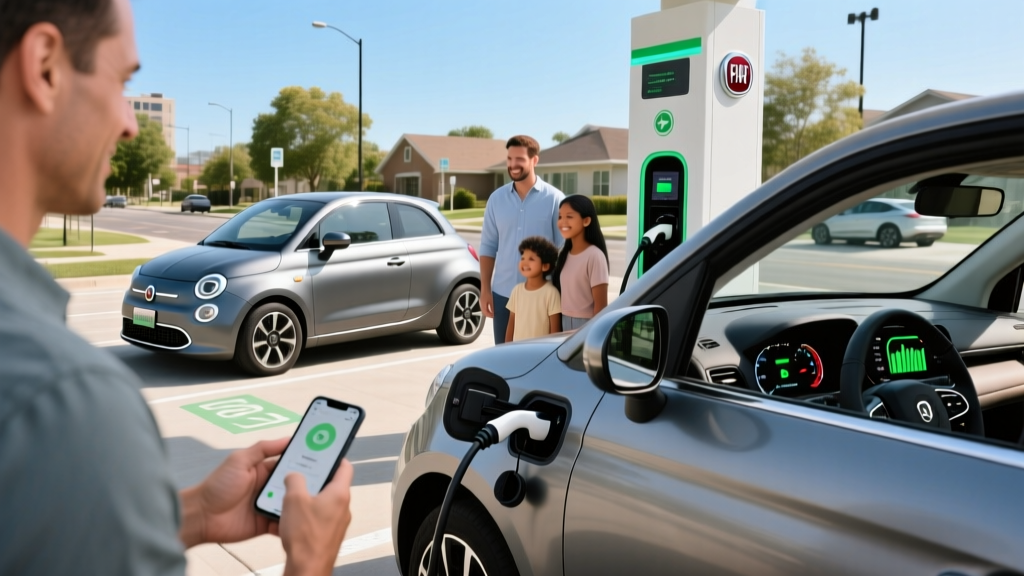
Fiat's electrification strategy looks very different depending on which side of the Atlantic you're shopping from. In Europe, the brand sells the Fiat 500 Hybrid (a mild-hybrid system on the classic 500 hatchback) and the fully electric 500e. In the United States, Fiat's footprint remains narrow, and buyers searching for Fiat hybrid cars will find that the options are limited — but worth understanding if you're considering the brand.
This guide breaks down every Fiat model with any form of electrification available or announced for the 2026 model year, with exact MPG figures, battery specs, powertrain details, and honest US-market availability assessments. Whether you've spotted a Fiat 500e on a dealer lot or you're cross-shopping subcompact hybrids, here's what you need to know.
Fiat's Electrified Lineup: HEV, PHEV, and BEV Explained
Before diving into specific models, it's critical to understand the three types of electrified powertrains Fiat uses — because marketing materials don't always make the distinction clear.
Hybrid Types at a Glance
| Type | Abbreviation | Plug-In Required? | Electric-Only Driving? | Typical Use Case |
|---|---|---|---|---|
| Conventional Hybrid | HEV | No — charges via regenerative braking and engine | Very limited (low-speed assist only) | City fuel economy boost without behavior change |
| Mild Hybrid | MHEV | No | No — motor assists engine but cannot drive alone | Stop-start smoothing, slight efficiency gain |
| Plug-In Hybrid | PHEV | Yes — plug in to maximize value | Yes, typically 20-40 miles | Short EV commutes with gas backup for longer trips |
| Battery Electric | BEV | Yes — sole energy source | 100% electric, all the time | Full electric driving, zero tailpipe emissions |
Fiat currently uses mild-hybrid (MHEV) technology on models like the 500 Hybrid and Panda Hybrid sold in Europe, and battery-electric (BEV) technology on the 500e. As of early 2026, Fiat does not offer a plug-in hybrid (PHEV) in any market. This is a significant gap if you were hoping for a Fiat with 25-30 miles of electric-only range and a gas tank for road trips — that product simply doesn't exist in the lineup.
Fiat 500 Hybrid (Mild Hybrid): Specs, MPG, and Availability
The Fiat 500 Hybrid is the model most shoppers think of when searching for "Fiat hybrid cars." It pairs Fiat's 1.0-liter three-cylinder FireFly engine with a belt-integrated starter-generator (BISG) and a small lithium-ion battery. This is a mild-hybrid system, not a full hybrid like a Toyota Prius.
| Specification | Value |
|---|---|
| Powertrain | 1.0L 3-cylinder + BISG mild-hybrid system |
| Combined Horsepower | 70 hp (51 kW) |
| Electric Motor Output | ~3.6 kW (assist only, no EV mode) |
| Battery | ~0.13 kWh lithium-ion (not plug-in) |
| EPA Combined MPG | Not EPA-rated (not sold in US) |
| WLTP Combined | ~53 MPG (5.3 L/100 km) |
| 0-62 mph | ~13.8 seconds |
| Transmission | 6-speed manual |
| Starting Price (Europe) | ~€16,500 (~$18,000 USD) |
What the Mild-Hybrid System Actually Does
The BISG motor in the 500 Hybrid cannot propel the car on electricity alone. Instead, it provides three functions:
- Engine stop-start smoothing: The engine shuts off more seamlessly at stops and restarts quickly, reducing idle fuel burn.
- Torque assist: Under acceleration, the electric motor adds a small torque boost to reduce engine load, marginally improving fuel economy.
- Regenerative braking: Kinetic energy during deceleration recharges the small battery — no plug required.
The real-world fuel economy benefit over a conventional gas-only 500 is roughly 5-8% in mixed driving. In city traffic with frequent stops, the benefit is more pronounced. On the highway, the mild-hybrid system contributes almost nothing.
⚠️ US Availability: Not Currently Sold
Fiat discontinued the 500 (non-e) in the United States after the 2019 model year. As of 2026, the Fiat 500 Hybrid is not available through US dealerships and has no EPA certification. American buyers cannot purchase this model new. Grey-market imports are not practical due to emissions and safety homologation requirements.
Fiat 500e: The Electric Fiat Americans Can Actually Buy
If you want an electrified Fiat in the United States, the Fiat 500e is currently the only option. Reintroduced for the 2024 model year and continuing into 2026, the 500e is a fully battery-electric subcompact hatchback — not a hybrid. It's included here because many shoppers searching for "Fiat hybrid cars" are actually looking for any electrified Fiat, and the 500e is what's on dealer lots.
| Specification | Value |
|---|---|
| Powertrain | Single front-mounted electric motor |
| Horsepower | 118 hp (87 kW) |
| Torque | 162 lb-ft |
| Battery Capacity | 42 kWh (gross), ~37.3 kWh usable, NMC chemistry |
| EPA Range | 149 miles |
| Real-World Range | ~120-135 mi highway; ~100-115 mi in cold weather (below 32°F) |
| MPGe (Combined) | 110 MPGe (per fueleconomy.gov) |
| DC Fast Charge (Peak) | 85 kW (CCS connector) |
| 10-80% DC Charge Time | ~30 minutes |
| Level 2 AC Charge Rate | 11 kW onboard charger |
| Level 2 0-100% Time | ~4.5 hours |
| 0-60 mph | ~8.5 seconds |
| Base MSRP (Red Edition) | $36,500 (before incentives) |
EPA Range vs. Real-World Expectations
The 500e's EPA-rated 149 miles assumes a mix of city and highway driving at moderate temperatures. In practice:
- City driving (moderate climate): 140-155 miles — regenerative braking helps significantly
- Highway driving (70+ mph): 115-130 miles — aerodynamic drag dominates at speed
- Cold weather (below freezing): 100-120 miles — battery chemistry and cabin heating reduce range 20-30%
For a daily commuter with a sub-40-mile round trip and home charging, the 500e is practical. For road trips beyond 100 miles, you'll need to plan charging stops carefully given the 85 kW peak charge rate and CCS connector (Tesla Supercharger access requires an adapter).
Fiat 500e Tax Credit Eligibility
The 500e is assembled in Italy, which affects its federal tax credit status under IRS §30D rules. Here's where it stands for 2026:
- Final assembly: Italy — does not meet the North American final assembly requirement for the new-vehicle §30D credit
- Federal new-EV credit: Not eligible for the $7,500 point-of-sale credit
- Used EV credit (§25E): If purchased used from a dealer for $25,000 or less, buyers may qualify for up to $4,000 (30% of sale price), subject to income caps ($75K single / $150K joint). Verify current rules at irs.gov.
- State incentives: Varies by jurisdiction — check your state's EV rebate program for potential savings
The lack of the $7,500 federal credit is the 500e's biggest competitive disadvantage against US-assembled rivals like the Chevrolet Bolt EV (when available) or Tesla Model 3.
Fiat Panda Hybrid: Europe's Budget Electrified Option
The Fiat Panda Hybrid, sold exclusively in Europe and other international markets, uses the same 1.0L FireFly mild-hybrid powertrain as the 500 Hybrid. It's relevant to mention because it frequently appears in global Fiat hybrid coverage, but it has never been sold in the United States and there are no announced plans to bring it stateside.
| Specification | Fiat Panda Hybrid (2026 EU) |
|---|---|
| Powertrain | 1.0L 3-cyl mild hybrid (BISG) |
| Horsepower | 70 hp |
| WLTP Combined | ~51 MPG (5.5 L/100 km) |
| Battery | ~0.13 kWh lithium-ion (self-charging only) |
| US Availability | Not available — no US homologation |
If Fiat were to re-enter the US market with a budget subcompact, the Panda would be a logical candidate. But as of 2026, this remains speculation.
Hybrid vs. PHEV vs. EV: Which Fiat (or Alternative) Fits You?
Since Fiat's US electrified lineup consists solely of the 500e (a BEV), buyers cross-shopping Fiat hybrid cars need a decision framework. Here's how to think about it:
Choose the Fiat 500e (BEV) if:
- Your daily round-trip commute is under 60 miles
- You have reliable home Level 2 charging
- You want zero tailpipe emissions and minimal maintenance
- You value style and city maneuverability over range
- You don't need to regularly drive 200+ miles without stopping
Look at a competitor's hybrid (HEV) if:
- You can't charge at home or work
- You want 500+ miles of total range without planning charging stops
- You frequently drive in areas with sparse charging infrastructure
- Consider: Toyota Prius (57 MPG combined), Hyundai Elantra Hybrid (54 MPG combined)
Look at a competitor's PHEV if:
- You have a short commute (under 30 miles) and home charging, but also take longer road trips
- You want electric-only daily driving with a gas engine for weekend trips
- Consider: Toyota Prius Prime (44 mi electric-only, 48 MPG combined after battery depletes), Hyundai Tucson PHEV (33 mi electric-only)
Battery Warranty, Reliability, and Replacement Costs
Electrified vehicle buyers are right to ask about battery longevity. Here's what Fiat covers:
| Model | Battery Warranty | Capacity Retention Threshold | Estimated Replacement Cost |
|---|---|---|---|
| 500e (BEV, US) | 8 years / 100,000 miles | 70% of original capacity | $8,000-$12,000 (estimated, full pack replacement) |
| 500 Hybrid (MHEV, EU) | 8 years / 100,000 km (EU standard) | N/A — very small battery, low stress | $500-$1,500 (BISG battery is small and inexpensive) |
The 500e's 8-year/100,000-mile battery warranty aligns with the industry standard for EVs and meets the minimum required by the EPA for emissions-related component coverage. The 70% capacity retention threshold is typical — if the battery degrades below 70% of its original 42 kWh capacity within the warranty period, Fiat will repair or replace it.
For the mild-hybrid 500 Hybrid (if you're reading from outside the US), the BISG system uses a very small lithium-ion pack under minimal stress. Degradation is rarely an issue, and replacement costs are a fraction of a full EV battery.
Real-World Reliability Data
Fiat as a brand has historically scored below average in long-term reliability surveys from Consumer Reports and J.D. Power. However, the 500e's powertrain is simpler than a gas car — fewer moving parts, no transmission, no exhaust system. The main reliability concerns center on build quality, electronics, and infotainment rather than the electric drivetrain itself. The mild-hybrid FireFly engine in the European 500 Hybrid has proven durable in European fleet use.
Pricing and Value: What Fiat Electrified Cars Actually Cost
| Model | Base MSRP | Federal Tax Credit | Effective Price (After Credit) | US Availability |
|---|---|---|---|---|
| Fiat 500e Red Edition | $36,500 | $0 (not eligible) | $36,500 | Yes |
| Fiat 500e (Inspiration) — announced | ~$39,500 (est.) | $0 | ~$39,500 | Limited |
| Fiat 500 Hybrid (EU) | ~€16,500 (~$18,000) | N/A | N/A | No |
| Fiat Panda Hybrid (EU) | ~€14,500 (~$15,800) | N/A | N/A | No |
At $36,500 without federal incentive support, the 500e competes in a tough price bracket. The Hyundai Kona Electric starts around $33,000 with 261 miles of range, and a used Tesla Model 3 can be found in the $25,000-$30,000 range with significantly more range and Supercharger network access. The 500e's value proposition leans heavily on its design, brand cachet, and urban charm rather than spec-sheet dominance.
Pros: Fiat 500e
- Distinctive Italian design — stands out in a segment of look-alike crossovers
- Excellent city maneuverability (147.4 inches long, tight turning radius)
- 11 kW Level 2 onboard charger is fast for the segment
- Low running costs — ~$0.04-$0.06/mile on average electricity rates
- Quiet, smooth electric drivetrain with adequate city acceleration
Cons: Fiat 500e
- 149-mile EPA range is below most competitors in 2026
- No federal $7,500 tax credit (assembled in Italy)
- 85 kW peak DC charge rate is slow by current standards
- Limited dealer network in the US for sales and service
- Rear seat and cargo space are minimal (7.2 cu ft trunk)
- CCS connector — requires adapter for Tesla Supercharger access
Frequently Asked Questions About Fiat Hybrid Cars
Does Fiat make a hybrid car in 2026?
Yes, but only in Europe and international markets. The Fiat 500 Hybrid and Fiat Panda Hybrid use mild-hybrid systems that cannot drive on electricity alone. In the United States, Fiat does not sell any hybrid model — only the fully electric 500e.
How many MPG does the Fiat 500 Hybrid get?
The European-spec Fiat 500 Hybrid achieves approximately 53 MPG combined under the WLTP testing cycle (~5.3 L/100 km). It is not EPA-rated because it is not sold in the US. Real-world results vary — expect roughly 45-50 MPG in mixed driving and higher in city traffic where the mild-hybrid stop-start system provides the most benefit.
Can I buy a Fiat plug-in hybrid (PHEV)?
No. As of 2026, Fiat does not produce any plug-in hybrid vehicle in any market. The brand's electrification strategy jumps from mild hybrids directly to full battery electric. If you want a PHEV, you'll need to look at competitors like Toyota, Hyundai, Ford, or Chrysler (whose Pacifica PHEV shares parent company Stellantis with Fiat).
How far can the Fiat 500e go on a full charge?
The EPA rates the 5026 Fiat 500e at 149 miles of combined range. In real-world driving, expect 120-135 miles on the highway and 100-115 miles in cold winter conditions. City driving with regenerative braking can stretch range to 140-155 miles in mild weather.
Is the Fiat 500e eligible for the $7,500 federal tax credit?
No. The 500e is assembled in Turin, Italy, and does not meet the North American final assembly requirement under IRS §30D. It is not eligible for the $7,500 new clean vehicle credit. However, if purchased used for $25,000 or less from a licensed dealer, it may qualify for the used clean vehicle credit of up to $4,000, subject to income limits.
Is a Fiat hybrid reliable?
The mild-hybrid FireFly powertrain in the European 500 Hybrid is mechanically simple and has proven reliable in fleet use. The 500e's electric drivetrain has fewer wear items than a gas car. Fiat's overall brand reliability scores remain below the industry average, primarily due to electronics and build-quality issues rather than powertrain failures. Battery coverage is 8 years/100,000 miles for the 500e.
How much does it cost to replace a Fiat 500e battery?
A full battery pack replacement for the 500e is estimated at $8,000-$12,000 out of warranty. However, NMC lithium-ion batteries in modern EVs typically retain 85-90% of capacity after 100,000 miles when properly maintained (avoiding frequent 100% charges and prolonged high-heat exposure). Most owners will never need a full replacement.
Hybrid vs. PHEV vs. EV — which Fiat is right for me?
If you live in the US, your only electrified Fiat option is the 500e (a BEV). It works well as a city commuter and second car if you can charge at home. If you need more range, can't charge at home, or want a gas backup, you'll need to look at hybrid or PHEV alternatives from Toyota, Hyundai, or other brands. Fiat does not offer an HEV or PHEV in the US market.
For the latest on Fiat's US product plans and official specifications, check Fiat USA's official site and fueleconomy.gov for EPA-certified range and efficiency data.