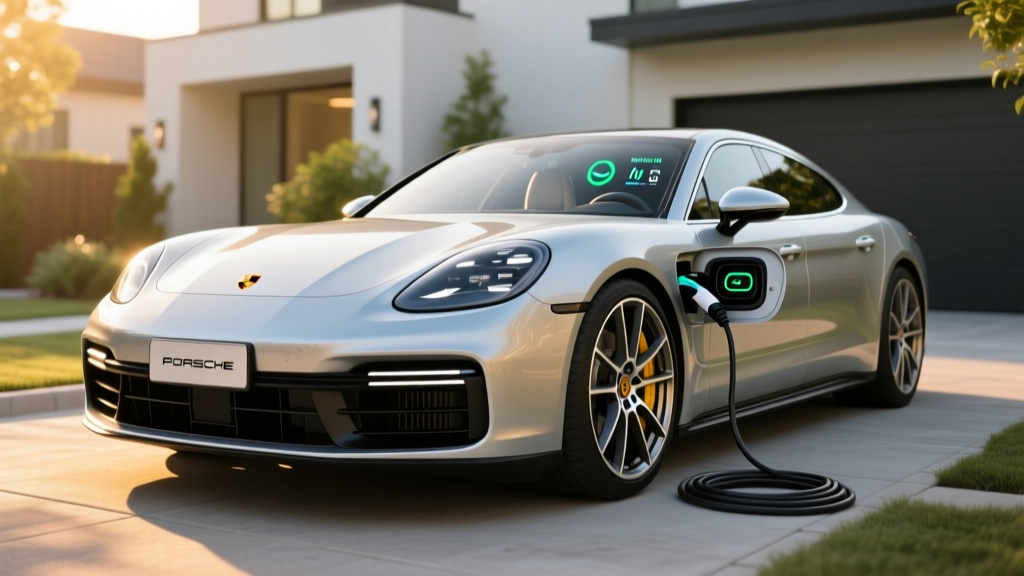
The 2026 Porsche Panamera 4 E-Hybrid occupies a rare niche: a luxury performance sedan that can silently commute on electric power during the week and unleash a twin-turbo V6 on canyon roads when you want it. But with a starting price north of $110,000 and a plug-in hybrid powertrain that demands specific ownership habits to maximize value, buyers need clear data before signing. This guide covers the real-world MPG, electric-only range, charging logistics, and tax-credit reality for Porsche's electrified executive express.
HEV vs PHEV: What the Panamera 4 E-Hybrid Actually Is
Before examining specs, it's critical to distinguish the two hybrid categories, because the Panamera 4 E-Hybrid is firmly a plug-in hybrid (PHEV), not a conventional hybrid (HEV).
Conventional Hybrid (HEV)
- Small battery (~1-2 kWh), recharged only by regenerative braking and the engine
- No plug — never needs external charging
- Electric motor assists the gas engine; cannot drive on electric power alone for meaningful distances
- Examples: Toyota Prius, Honda Accord Hybrid
Plug-in Hybrid (PHEV)
- Larger battery (typically 15-30 kWh), charged via plug or regen
- Can drive 20-50 miles on electric-only power before the gas engine engages
- Requires regular plugging in to realize fuel-economy benefits
- Examples: Porsche Panamera 4 E-Hybrid, Toyota RAV4 Prime, Jeep Wrangler 4xe
The Panamera 4 E-Hybrid pairs a high-voltage traction battery with an electric motor integrated into the transmission, plus a 2.9-liter twin-turbo V6. You can plug it in at home or at a public Level 2 charger to refill the battery and unlock its electric-only driving capability. If you never plug it in, it functions as a heavy, less-efficient conventional hybrid — defeating the purpose of the premium you paid.
Powertrain Specs: Horsepower, Engine, and Electric Motor
| Specification | 2026 Panamera 4 E-Hybrid |
|---|---|
| Gas Engine | 2.9L Twin-Turbo V6 |
| Engine Output | 300 hp / 309 lb-ft torque |
| Electric Motor | Integrated in 8-speed PDK transmission |
| Motor Output | ~140 kW (188 hp) |
| Combined System Output | ~390 hp / 516 lb-ft torque |
| 0-60 mph | 4.7 seconds (manufacturer est.) |
| Top Track Speed | 174 mph |
| Drivetrain | All-wheel drive (AWD) |
| Transmission | 8-speed PDK dual-clutch automatic |
Porsche's hybrid strategy prioritizes performance fill-in rather than maximum efficiency. The electric motor eliminates turbo lag and provides instant torque from a stop, while the V6 delivers sustained highway power. The combined 390 hp figure doesn't make it the fastest Panamera — the E-Hybrid Sport Turismo and Turbo S E-Hybrid variants push well beyond 500 hp — but it's more than adequate for a sedan that also needs to serve as a daily commuter.
Battery, Electric-Only Range, and Charging
The 2026 Panamera 4 E-Hybrid carries a 25.9 kWh battery pack (gross capacity), with approximately 21-22 kWh usable. This is one of the larger PHEV batteries on the market, and it translates to meaningful electric-only driving distance.
Electric-Only Range
EPA Estimated: ~30-33 miles (electric only)
Real-World Expectation: 25-30 miles in mixed driving; as low as 20-22 miles at sustained highway speeds (70+ mph) or in cold weather below 40°F. Short city commutes with frequent regen braking can push toward the upper end of the EPA estimate.
| Charging Level | Power | Time (0-100%) | Notes |
|---|---|---|---|
| Level 1 (120V household) | ~1.4 kW | ~16-18 hours | Emergency/trickle only; not practical for daily use |
| Level 2 (240V home/public) | Up to 7.2 kW (onboard charger limit) | ~3-3.5 hours | Standard home wall-box or public Level 2; ideal for overnight charging |
| DC Fast Charge | Not supported | N/A | The Panamera 4 E-Hybrid cannot accept DC fast charging — Level 2 is the maximum |
The lack of DC fast charging is typical for PHEVs. The battery is small enough that Level 2 refills it in a few hours, and Porsche has not equipped the onboard charger to accept high-power DC input. For most PHEV owners who charge at home overnight or at the office during the workday, this is not a practical limitation. But if you were hoping to top up at a highway Electrify America or Tesla Supercharger station during a road trip, that's not an option here.
Charging connector: The Panamera 4 E-Hybrid uses a J1772 connector for Level 1 and Level 2 AC charging. If you have a home Level 2 charger with a J1772 plug (the vast majority of non-Tesla chargers), it will connect directly. A J1772-to-NACS adapter is available if you need to use a Tesla Wall Connector or destination charger.
EPA Fuel Economy: MPG and MPGe Breakdown
| Metric | Value |
|---|---|
| MPGe (combined, with charge) | ~52 MPGe |
| Gas-only MPG (combined) | ~24 MPG combined |
| Gas-only MPG (city) | ~21 MPG city |
| Gas-only MPG (highway) | ~28 MPG highway |
| Total Combined Range | ~430-450 miles (electric + gas) |
| Fuel Tank Capacity | ~21.1 gallons |
Understanding these numbers requires context. The MPGe (miles per gallon equivalent) figure of ~52 applies only when you're driving within the electric-only range on a full charge. Once the battery depletes, the car reverts to gas-only operation at roughly 24 MPG combined.
Real-world MPG vs. EPA: Plug-in hybrids are uniquely sensitive to owner behavior. If your daily commute is under 30 miles round-trip and you charge every night, you may burn almost no gasoline for months — effectively achieving hundreds of MPGe. If you never plug in and drive it like a conventional gas car, expect 22-25 MPG combined, which is unremarkable for a 5,000+ lb luxury sedan with a twin-turbo V6. The EPA numbers assume a blend of charged and depleted driving; your actual results depend entirely on your charging discipline.
In city driving on gas alone, regenerative braking helps recapture energy, so you may see slightly better-than-EPA city figures in stop-and-go traffic. Highway driving at 75-80 mph will push fuel economy toward the lower end, around 25-26 MPG.
Pricing, Tax Credits, and Ownership Economics
The 2026 Porsche Panamera 4 E-Hybrid starts at an MSRP of approximately $111,650 (including destination charge). Well-optioned examples with Premium Plus packages, adaptive air suspension upgrades, and sport exhaust can easily reach $130,000-$140,000.
Federal §30D Tax Credit Eligibility
The Panamera 4 E-Hybrid's tax-credit status requires careful attention under current IRS §30D rules:
- MSRP Cap: Sedans must be under $55,000 MSRP to qualify. The Panamera 4 E-Hybrid at ~$111,650 does not qualify for the new-vehicle federal tax credit.
- Battery Sourcing Requirements: Even if the price were within limits, critical-mineral and battery-component sourcing rules apply. Porsche's supply chain does not currently meet these thresholds for the full $7,500 credit.
- Buyer Income Cap: AGI limits of $150,000 (single) / $300,000 (joint) also apply, though this is moot given the MSRP disqualification.
- Point-of-Sale Transfer: Available for qualifying vehicles — but again, the Panamera does not qualify.
State incentives: Some states offer their own rebates or HOV-lane access for PHEVs regardless of price. Check your state's energy or DMV website for current programs. California's Clean Vehicle Rebate Project (CVRP) and similar programs have income and price caps that typically exclude vehicles in this price range, but HOV-lane stickers may still be available in certain states.
Total cost of ownership reality: The Panamera 4 E-Hybrid is not a cost-saving purchase. You're paying a substantial premium for the Porsche badge, the performance, and the ability to drive electric for short distances. Compared to a fully electric luxury sedan like the Tesla Model S or Lucid Air, the Panamera will cost more in fuel (when the gas engine runs), more in maintenance (oil changes, spark plugs, transmission fluid), and offers no federal tax credit offset. The value proposition is emotional and experiential, not economic.
Battery Warranty, Reliability, and Replacement Cost
High-Voltage Battery Warranty
Coverage: 8 years / 100,000 miles (whichever comes first)
Capacity Threshold: Porsche warrants the battery against defects and excessive capacity loss. Federal law mandates that emissions-related components (which includes the hybrid battery under EPA/CARB rules) carry an 8-year/100,000-mile warranty. If the battery degrades below approximately 70% of original capacity within this period, Porsche is obligated to repair or replace it.
Extended Warranty Option: Porsche offers extended warranty packages that can cover the hybrid system beyond the standard period, though at significant additional cost.
Reliability: Porsche's hybrid systems have proven reasonably robust since the second-generation Panamera E-Hybrid launched for the 2017 model year. The 8-speed PDK transmission with integrated electric motor is a complex assembly, and any failure involving the hybrid components can be expensive. However, major battery failures within the warranty period are uncommon based on owner reports and service bulletins.
Battery replacement cost: If the high-voltage battery requires replacement out of warranty, expect a cost in the range of $15,000-$22,000 for the battery pack alone, plus labor. This is a significant expense, though it's comparable to other luxury PHEVs and less than a full EV battery replacement. Module-level repair (replacing individual battery cells or modules rather than the entire pack) may be possible and less expensive, depending on the failure mode.
Long-term degradation: PHEV batteries experience less stress than full EV batteries because they operate in a narrower state-of-charge window (the car's software prevents full 0% or 100% use to protect longevity). Expect approximately 10-15% capacity loss over 8-10 years of normal use, which translates to a reduction from ~30 miles of EV range to ~25-27 miles — still usable for most short commutes.
Who Should Buy the Panamera 4 E-Hybrid (and Who Shouldn't)
Choose the Panamera 4 E-Hybrid If:
- You want a luxury performance sedan with the prestige of the Porsche crest and the ability to do short commutes emissions-free
- Your daily round-trip commute is under 30 miles and you have reliable home or workplace Level 2 charging
- You frequently take longer road trips where a pure EV's charging stops would be inconvenient
- You value the driving dynamics and build quality Porsche delivers and are willing to pay for it
- You want all-wheel-drive capability in a sport sedan
Look Elsewhere If:
- You cannot charge at home or work — without plugging in, this is an expensive, heavy gas car
- You're seeking maximum fuel savings — a Toyota Prius or a full EV will save far more on fuel
- You expected a federal tax credit — the MSRP disqualifies the Panamera entirely
- You want DC fast-charging capability for road-trip top-ups — PHEVs don't offer this
- You prioritize cargo space — the battery packaging reduces trunk volume compared to the gas-only Panamera
Hybrid vs PHEV vs EV: Which Fits You?
Choose a conventional hybrid (HEV) if you want better fuel economy with zero behavior change — no plugging in, no range planning. Best for: apartment dwellers without charging access, high-mileage drivers who want simplicity.
Choose a PHEV like the Panamera 4 E-Hybrid if you can charge daily and want electric commuting with gas-engine flexibility for longer trips. Best for: homeowners with a garage, commuters with predictable short drives who also road-trip.
Choose a full EV (BEV) if you want zero tailpipe emissions, minimal maintenance, the lowest per-mile fuel cost, and you have reliable charging access. Best for: most drivers with home charging who don't regularly drive 300+ miles in a single day. Consider the EPA's EV comparison tool to evaluate alternatives.
Frequently Asked Questions
How many MPG does the Porsche Panamera 4 E-Hybrid get?
When the battery is charged and you're driving within the electric range, it achieves approximately 52 MPGe. Once the battery depletes and the gas engine takes over, expect around 24 MPG combined (21 city / 28 highway). Your actual fuel consumption depends entirely on how often you plug in and how far you drive between charges.
How far can the Panamera 4 E-Hybrid go on electric power only?
The EPA estimates approximately 30-33 miles of electric-only range. In real-world driving, expect 25-30 miles in mixed conditions, dropping to 20-22 miles at sustained highway speeds or in cold weather. This is enough for most daily commutes if you charge every night.
Does the Panamera 4 E-Hybrid qualify for the $7,500 federal tax credit?
No. Under current IRS §30D rules, the federal new clean vehicle credit requires sedans to have an MSRP under $55,000. The Panamera 4 E-Hybrid starts at approximately $111,650, which far exceeds this cap. It also does not meet the battery-sourcing requirements. No federal tax credit is available. Check your state's incentive programs for any local rebates or HOV-lane perks.
Can the Panamera 4 E-Hybrid use DC fast chargers?
No. The Panamera 4 E-Hybrid supports only Level 1 (120V) and Level 2 (240V) AC charging, up to 7.2 kW. It cannot connect to DC fast-charging stations like Electrify America or Tesla Superchargers. This is standard for PHEVs — the battery is small enough that Level 2 charging refills it in about 3-3.5 hours.
Is the Panamera 4 E-Hybrid reliable, and what does a battery replacement cost?
Porsche's hybrid powertrain has shown reasonable reliability since the current-generation system launched. The high-voltage battery carries an 8-year/100,000-mile warranty against defects and excessive degradation. Out-of-warranty battery replacement costs an estimated $15,000-$22,000. Module-level repairs may be less expensive. Overall, the hybrid system adds complexity compared to a gas-only Panamera, but major failures within the warranty period are uncommon.
Should I buy the Panamera 4 E-Hybrid or a full EV like the Taycan?
If you have reliable home charging and rarely drive more than 250 miles in a single day, Porsche's own Taycan (full EV) offers lower running costs, instant performance, and a more futuristic driving experience. The Panamera 4 E-Hybrid makes sense only if you need the flexibility of a gas engine for long road trips, prefer a traditional luxury sedan interior, or want a vehicle that can serve as both an EV commuter and a grand tourer without range planning. For most buyers with charging access, the Taycan is the more forward-looking choice.