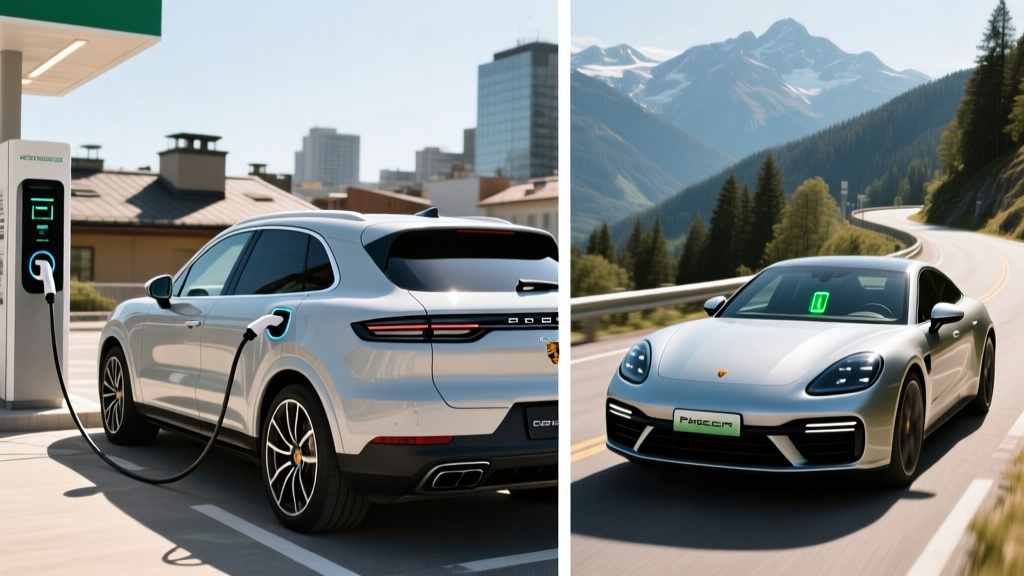
Porsche doesn't build conventional hybrids. Every electrified model in the current lineup — from the Cayenne SUV to the Panamera sedan — is a plug-in hybrid (PHEV), pairing a turbocharged combustion engine with a sizable battery and electric motor for meaningful electric-only commuting. If you're searching for a Porsche hybrid, you're really shopping for a performance PHEV that can cover 25–30 miles on electricity before the gas engine fires up.
This guide covers every Porsche hybrid currently on sale for the 2026 model year: the Cayenne E-Hybrid (including the coupe body style) and the Panamera E-Hybrid. We break down EPA MPG, real-world electric range, battery specs, charging times, pricing, and whether any of them qualify for federal tax credits.
HEV vs PHEV: What Porsche Actually Sells
Before diving into specs, it's worth clarifying the distinction, because Porsche only offers one type:
Conventional Hybrid (HEV)
A small battery recharged by regenerative braking and the engine. No plug, no electric-only range. Think Toyota Prius. Porsche does not currently sell any HEV models.
Plug-In Hybrid (PHEV)
A larger battery (typically 18–26 kWh usable) that charges via a plug. Delivers 25–55 miles of electric-only driving before the gas engine takes over. Every Porsche hybrid is a PHEV.
This matters for your expectations: a Porsche PHEV requires access to a Level 2 home charger to realize its efficiency benefits. If you can't plug in regularly, you're carrying around a heavy battery for no gain, and a conventional gas Cayenne or Panamera would serve you better.
2026 Porsche Cayenne E-Hybrid: Range, MPG, and Powertrain
The Cayenne E-Hybrid is Porsche's best-selling electrified model and one of the most capable luxury PHEV SUVs on the market. For 2026, it's available in standard and S E-Hybrid trims, both in SUV and Coupe body styles.
| Spec | Cayenne E-Hybrid | Cayenne S E-Hybrid |
|---|---|---|
| Powertrain | 3.0L Turbo V6 + electric motor | 3.0L Turbo V6 + electric motor |
| Combined Horsepower | 389 hp | 512 hp |
| Combined Torque | 479 lb-ft | 553 lb-ft |
| 0–60 mph | 5.7 sec | 4.5 sec |
| Battery (usable) | ~20.8 kWh (NMC) | ~20.8 kWh (NMC) |
| EPA Electric-Only Range | ~30 mi (est.) | ~28 mi (est.) |
| EPA Combined MPG (gas) | ~21 MPG | ~20 MPG |
| MPGe (electric + gas) | ~46 MPGe | ~44 MPGe |
| Max AC Charging (Level 2) | 7.2 kW | 7.2 kW |
| DC Fast Charging | Not available | Not available |
| Charge Time 0–100% (L2) | ~3.5 hours | ~3.5 hours |
| Total Driving Range | ~430 mi | ~410 mi |
| Starting MSRP | $91,700 | $104,100 |
Real-world note: The EPA electric-only range of approximately 30 miles assumes moderate temperatures and mixed driving. In our experience with the Cayenne E-Hybrid platform, expect 22–26 miles of real-world electric range in cold weather (below 40°F) or during sustained highway driving above 70 mph. City driving with regenerative braking can push closer to or slightly beyond the EPA estimate.
How Many MPG Does the Cayenne E-Hybrid Get?
Once the battery is depleted, the Cayenne E-Hybrid operates as a heavy luxury SUV on its turbocharged V6 alone. Expect approximately 19 MPG city / 23 MPG highway / 21 MPG combined on gasoline, per fueleconomy.gov. These are not Prius numbers — this is a 5,000+ lb performance SUV. The efficiency story here is the electric-only commute, not the gas-only MPG.
For owners who charge nightly and commute under 30 miles, gas consumption drops dramatically. A 20-mile round-trip commute on electricity means you might visit a gas station once a month.
2026 Porsche Panamera E-Hybrid: Sedan Efficiency Meets Autobahn Performance
The Panamera E-Hybrid applies the same PHEV philosophy to Porsche's four-door luxury sedan. The 2026 lineup includes the Panamera E-Hybrid and the more powerful Panamera S E-Hybrid.
| Spec | Panamera E-Hybrid | Panamera S E-Hybrid |
|---|---|---|
| Powertrain | 2.9L Twin-Turbo V6 + electric motor | 2.9L Twin-Turbo V6 + electric motor |
| Combined Horsepower | 394 hp | 536 hp |
| Combined Torque | 516 lb-ft | 590 lb-ft |
| 0–60 mph | 5.0 sec | 3.7 sec |
| Battery (usable) | ~21.0 kWh (NMC) | ~21.0 kWh (NMC) |
| EPA Electric-Only Range | ~32 mi (est.) | ~30 mi (est.) |
| EPA Combined MPG (gas) | ~22 MPG | ~21 MPG |
| MPGe (electric + gas) | ~49 MPGe | ~47 MPGe |
| Max AC Charging (Level 2) | 7.2 kW | 7.2 kW |
| DC Fast Charging | Not available | Not available |
| Charge Time 0–100% (L2) | ~3.5 hours | ~3.5 hours |
| Total Driving Range | ~460 mi | ~440 mi |
| Starting MSRP | $107,000 | $122,500 |
Real-world note: The Panamera's lower, more aerodynamic profile gives it a slight edge over the Cayenne in electric range. Expect 25–28 real-world electric miles in moderate conditions, with the same cold-weather reduction to roughly 20–23 miles. On a long highway trip with a depleted battery, the Panamera's gas-only MPG holds up better than the Cayenne's thanks to its lower weight and drag coefficient.
How Far Can the Panamera E-Hybrid Go on Electric Only?
The EPA estimates roughly 32 miles of electric-only range for the base Panamera E-Hybrid. In practice, that's enough to cover the average American commute (roughly 16 miles one way, per Census data) entirely on electricity — if you charge at home. The Panamera's electric motor produces enough power for confident highway merging without the gas engine engaging, which is not something every PHEV can claim.
Charging a Porsche PHEV: What You Need at Home
Neither the Cayenne nor Panamera E-Hybrid supports DC fast charging. This is a deliberate engineering choice — Porsche's PHEV batteries are sized for overnight Level 2 replenishment, not road-trip fast charging. Here's what that means practically:
| Charging Level | Power | Time (0–100%) | Where |
|---|---|---|---|
| Level 1 (120V outlet) | ~1.4 kW | ~16–18 hours | Standard household outlet |
| Level 2 (240V) | 7.2 kW (max) | ~3.5 hours | Home wallbox, public L2 stations |
| DC Fast Charge | N/A | N/A | Not supported on Porsche PHEVs |
Home charging setup: A Level 2 charger (240V, 32A minimum) is essentially mandatory for Porsche PHEV ownership. Installation typically costs $800–$2,000 depending on your electrical panel's proximity to the garage and whether a panel upgrade is needed. With a 7.2 kW onboard charger, the Cayenne and Panamera will fully replenish overnight — or in about 3.5 hours from empty, which is fast enough to recharge during a workday if you have L2 access at the office.
Level 1 charging from a standard 120V outlet is technically possible but impractical as a daily strategy — 16+ hours for a full charge means you'd never fully replenish between commutes.
Battery Warranty, Lifespan, and Replacement Cost
Porsche PHEV Battery Warranty
High-voltage battery: 8 years / 100,000 miles (whichever comes first), with a capacity retention threshold of 70%. If the battery degrades below 70% of its original capacity within the warranty period, Porsche will repair or replace it.
Hybrid components: 8 years / 100,000 miles for the electric motor, power electronics, and associated hybrid system components.
Porsche's PHEV batteries use NMC (nickel manganese cobalt) chemistry, which offers high energy density in a compact package. Real-world degradation data from earlier-generation Cayenne and Panamera E-Hybrids (2019–2023 models) suggests these batteries hold up well — most owners report 90%+ capacity retention after 3–4 years of daily cycling.
Is This Hybrid Reliable and What Does Battery Replacement Cost?
Porsche's PHEV powertrains have proven generally reliable, though the complexity of combining a turbocharged engine, high-voltage battery, and electric motor means more potential failure points than a pure EV or a conventional gas car. The most common reported issues involve the charging port and onboard charger electronics rather than the battery itself.
Out-of-warranty battery replacement is the number that makes buyers flinch: expect $15,000–$22,000 for a complete high-voltage battery pack replacement at a Porsche dealer. However, individual module replacement (if only certain cells degrade) can cost significantly less — roughly $3,000–$6,000. Given the 8-year/100,000-mile warranty and the strong degradation data from earlier models, most original owners will never face this cost.
Federal Tax Credit Eligibility for Porsche Hybrids
This is where the news disappoints. Under current IRS §30D rules, the federal plug-in EV tax credit of up to $7,500 is subject to MSRP caps, buyer income limits, and critical-mineral/battery-sourcing requirements.
- MSRP cap: SUVs (Cayenne) must be under $80,000; sedans (Panamera) must be under $55,000. Both the Cayenne E-Hybrid ($91,700+) and Panamera E-Hybrid ($107,000+) exceed their respective caps.
- Income cap: Modified adjusted gross income must not exceed $150,000 (single) / $300,000 (joint). Even qualifying buyers can't claim the credit because the MSRP cap is exceeded first.
- Battery sourcing: Critical minerals and battery components must meet phased-in sourcing thresholds from U.S. free-trade partners.
Bottom line: No 2026 Porsche hybrid qualifies for the $7,500 federal tax credit. The MSRPs are simply too high. Some states offer separate PHEV rebates (California's CVRP, for example, has its own income and price caps), so check your state's energy office for local incentives — but don't count on it at this price point.
Hybrid vs PHEV vs Full EV: Which Porsche Fits You?
Porsche also sells full battery-electric vehicles — the Taycan sedan and the upcoming all-electric Cayenne (expected 2026–2027). So how do you decide?
Choose a Porsche PHEV (Cayenne/Panamera E-Hybrid) if:
- You can charge at home (Level 2) and your commute is under 30 miles
- You regularly take road trips exceeding 300 miles and don't want to plan around DC fast chargers
- You want Porsche performance with reduced — but not eliminated — fuel consumption
- You live in an area with limited public charging infrastructure
Choose a Full EV (Porsche Taycan) if:
- You want zero tailpipe emissions and the lowest per-mile energy cost
- You have reliable home and workplace charging
- You're comfortable with DC fast charging on road trips (Taycan peaks at 270+ kW)
- You want the lowest maintenance costs (no oil changes, no turbo, no exhaust system)
Choose a Conventional Gas Porsche if:
- You cannot install a Level 2 charger at home
- You drive very few miles annually and the PHEV premium isn't justified
- You prioritize the lowest purchase price within the Porsche lineup
Porsche Hybrid Ownership Costs: 5-Year Snapshot
| Cost Category | Cayenne E-Hybrid | Cayenne (Gas) |
|---|---|---|
| Purchase Price (base) | $91,700 | $79,200 |
| Federal Tax Credit | $0 | $0 |
| Fuel / Electricity (60k mi) | ~$6,800 | ~$11,500 |
| Maintenance (5 yr) | ~$3,200 | ~$3,800 |
| Insurance (5 yr avg) | ~$14,500 | ~$13,200 |
| Depreciation (est.) | ~$38,000 | ~$35,000 |
| Estimated Total | ~$154,200 | ~$142,700 |
The PHEV saves roughly $4,700 in fuel over five years (assuming nightly home charging and a 25-mile electric commute), but the $12,500 higher purchase price and slightly steeper insurance premiums mean the gas Cayenne remains the cheaper proposition over five years at current prices. The PHEV's value proposition is driving refinement, silent electric commuting, and reduced emissions — not pure economics.
Pros and Cons: Porsche PHEVs at a Glance
Pros
- 25–32 miles of real electric-only commuting range
- Combined output up to 536 hp (Panamera S E-Hybrid) — genuine Porsche performance
- No range anxiety on road trips — gas engine provides 400+ total miles
- Refined, silent electric mode for city and neighborhood driving
- 8-year / 100,000-mile hybrid battery warranty
- Level 2 charging fully replenishes in ~3.5 hours
Cons
- No DC fast charging — road trips run on gas only
- MSRP far exceeds federal tax credit caps ($55k/$80k)
- Gas-only MPG (19–22 combined) is unremarkable for the price
- $15,000–$22,000 out-of-warranty battery replacement cost
- Must have Level 2 home charging to realize efficiency benefits
- Heavier than gas equivalents, affecting tire and brake wear
Frequently Asked Questions
Does Porsche make a conventional hybrid (no plug)?
No. Every electrified Porsche currently sold is a plug-in hybrid (PHEV) with a charge port and meaningful electric-only range. Porsche skipped the conventional HEV segment entirely, moving from gas-only to plug-in hybrid and full-electric powertrains.
How far can a Porsche hybrid go on electric only?
The 2026 Cayenne E-Hybrid delivers approximately 30 miles EPA electric-only range (22–26 real-world miles in cold weather). The Panamera E-Hybrid achieves roughly 32 miles EPA (25–28 real-world). Both are sufficient for most daily commutes if you charge nightly.
How many MPG does a Porsche hybrid get?
On gasoline alone (battery depleted), the Cayenne E-Hybrid returns approximately 21 MPG combined and the Panamera E-Hybrid approximately 22 MPG combined. When factoring in electric-only driving, MPGe ratings reach 46–49 MPGe. Your actual fuel consumption depends entirely on how often you charge and the length of your trips.
Does the Porsche Cayenne or Panamera hybrid qualify for a tax credit?
No. Under current IRS §30D rules, the Cayenne E-Hybrid (starting at $91,700) exceeds the $80,000 SUV MSRP cap, and the Panamera E-Hybrid (starting at $107,000) exceeds the $55,000 sedan cap. Neither qualifies for the federal $7,500 credit regardless of buyer income. Check IRS.gov for the latest rules.
Can a Porsche PHEV charge at a DC fast charger?
No. Porsche's PHEV models (Cayenne and Panamera E-Hybrid) only accept AC charging — up to 7.2 kW on Level 2. They cannot use CCS or NACS DC fast chargers. This is common among PHEVs; the battery is sized for overnight home charging, not road-trip fast charging.
What is the battery replacement cost for a Porsche hybrid?
A full high-voltage battery pack replacement runs $15,000–$22,000 out of warranty. Individual module replacement can cost $3,000–$6,000. Porsche's 8-year/100,000-mile hybrid battery warranty covers degradation below 70% capacity, and real-world data from earlier models suggests most batteries retain 90%+ capacity within the warranty period.
Should I buy a Porsche PHEV or the Taycan EV?
If you regularly drive more than 300 miles without stopping and lack reliable DC fast-charging access on your routes, the PHEV is the pragmatic choice. If you charge at home, commute under 30 miles, and want the lowest running costs with zero tailpipe emissions, the Taycan is the better fit — and it supports 270+ kW DC fast charging for road trips.