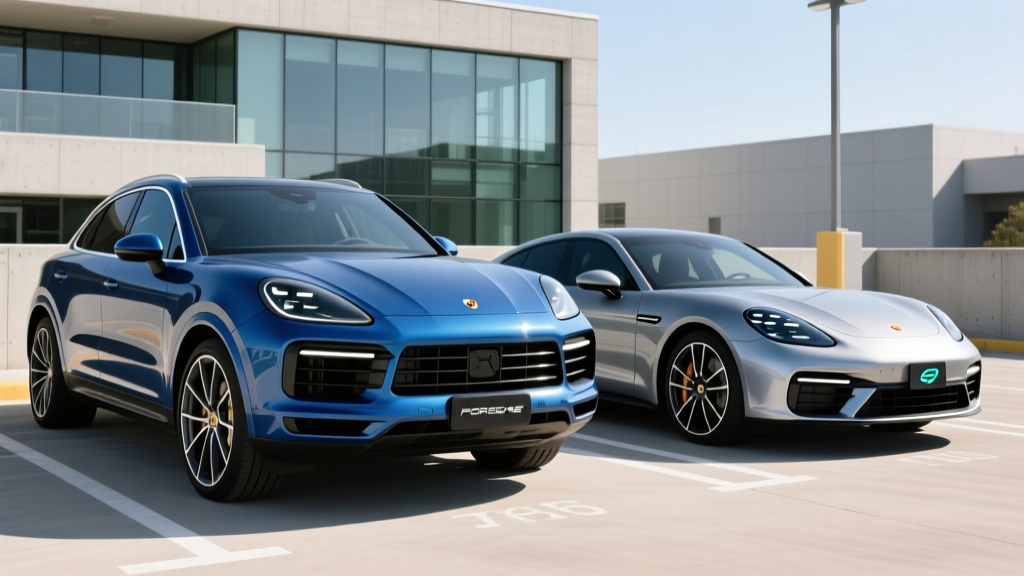
Porsche's electrification strategy leans heavily on plug-in hybrid technology, and for 2026 the lineup centers on two flagship E-Hybrid models: the Cayenne SUV and the Panamera sedan. Both use Porsche's latest PHEV architecture with substantially larger batteries than their predecessors, delivering meaningful electric-only range before the gasoline engine engages. If you're researching a hybrid Porsche, these are the two models that matter—and understanding their powertrains, real-world efficiency, and ownership economics is essential before signing a six-figure check.
This guide breaks down every critical spec, from battery capacity and electric range to charging logistics and federal tax credit eligibility under current IRS §30D rules.
HEV vs PHEV: What Porsche Actually Offers in 2026
First, a crucial distinction. Porsche does not sell a conventional hybrid (HEV) in the US market for 2026. Every electrified Porsche is a plug-in hybrid (PHEV), meaning it has a larger battery you can charge from an external power source and a meaningful electric-only driving range.
| Feature | Conventional Hybrid (HEV) | Plug-In Hybrid (PHEV) — Porsche E-Hybrid |
|---|---|---|
| External Charging | No — charges via regenerative braking and engine | Yes — plug into Level 1 or Level 2 charger |
| Electric-Only Range | 0–2 miles at low speed | 25–35+ miles (Porsche E-Hybrids) |
| Battery Size | 1–2 kWh | 17.9–25.9 kWh usable (2026 Porsche PHEVs) |
| Federal Tax Credit | Not eligible | Potentially eligible under §30D (up to $7,500) |
| Best For | Drivers who can't charge at home | Drivers with home/work charging who want EV daily + gas for road trips |
If you don't have access to a plug, a Porsche E-Hybrid still functions as a very efficient hybrid once the battery depletes—but you'll miss the core value proposition of the larger battery and electric-only commuting.
2026 Porsche Cayenne E-Hybrid: Full Specs
The Cayenne E-Hybrid received a major powertrain update for the current generation, pairing a revised 3.0-liter turbocharged V6 with a more powerful electric motor integrated into the 8-speed Tiptronic transmission. The result is a luxury SUV that can commute on electricity alone and still deliver Porsche performance when you need it.
| Specification | 2026 Cayenne E-Hybrid | 2026 Cayenne S E-Hybrid |
|---|---|---|
| Powertrain | 3.0L Turbo V6 + Electric Motor | 3.0L Turbo V6 + Electric Motor (higher output) |
| Combined Horsepower | 463 hp | 512 hp |
| Combined Torque | 479 lb-ft | 553 lb-ft |
| 0–60 mph | 4.6 seconds | 4.2 seconds |
| Battery (usable) | ~20.8 kWh (NMC) | ~20.8 kWh (NMC) |
| EPA Electric-Only Range | ~32 miles | ~30 miles |
| Total Combined Range | ~440 miles | ~420 miles |
| EPA MPG (gas, battery depleted) | 21 city / 24 hwy / 22 combined | 20 city / 23 hwy / 21 combined |
| MPGe (electric + gas) | 54 MPGe | 51 MPGe |
| AC Charging (Level 2) | 11 kW onboard charger | 11 kW onboard charger |
| DC Fast Charging | Not available | Not available |
| Level 2 Charge Time (0–100%) | ~2.5 hours | ~2.5 hours |
| Base MSRP | $96,950 | $108,550 |
2026 Porsche Panamera E-Hybrid: Full Specs
The Panamera E-Hybrid sedan targets a different buyer: someone who prioritizes driving dynamics and executive comfort over SUV practicality. The latest Panamera E-Hybrid uses a 2.9-liter twin-turbo V6 paired with an electric motor, while the Turbo S E-Hybrid steps up to a 4.0-liter twin-turbo V8 for supercar-rivaling output.
| Specification | 2026 Panamera E-Hybrid | 2026 Panamera Turbo S E-Hybrid |
|---|---|---|
| Powertrain | 2.9L Twin-Turbo V6 + Electric Motor | 4.0L Twin-Turbo V8 + Electric Motor |
| Combined Horsepower | 502 hp | 761 hp |
| Combined Torque | 553 lb-ft | 737 lb-ft |
| 0–60 mph | 4.1 seconds | 2.7 seconds |
| Battery (usable) | ~21.8 kWh (NMC) | ~21.8 kWh (NMC) |
| EPA Electric-Only Range | ~35 miles | ~30 miles |
| Total Combined Range | ~460 miles | ~390 miles |
| EPA MPG (gas, battery depleted) | 23 city / 27 hwy / 25 combined | 17 city / 22 hwy / 19 combined |
| MPGe (electric + gas) | 58 MPGe | 44 MPGe |
| AC Charging (Level 2) | 11 kW onboard charger | 11 kW onboard charger |
| DC Fast Charging | Not available | Not available |
| Level 2 Charge Time (0–100%) | ~2.25 hours | ~2.25 hours |
| Base MSRP | $107,200 | $195,900 |
The Panamera E-Hybrid achieves better electric-only range and fuel economy than the Cayenne thanks to its lower weight, more aerodynamic profile, and slightly larger usable battery. For daily commutes under 35 miles, owners who charge nightly will rarely visit a gas station.
Charging a Porsche E-Hybrid: What You Need at Home
Neither the Cayenne E-Hybrid nor the Panamera E-Hybrid supports DC fast charging. This is a deliberate engineering choice: Porsche prioritized packaging and weight over fast-charge capability, reasoning that PHEV batteries are small enough to refill quickly on AC power.
| Charging Level | Power | Time (0–100%) | Practical Use |
|---|---|---|---|
| Level 1 (120V household outlet) | ~1.4 kW | ~15–17 hours | Overnight top-up only; too slow for daily full recharge |
| Level 2 (240V, dedicated charger) | Up to 11 kW | ~2–2.5 hours | Ideal home solution; full recharge while you work or sleep |
| DC Fast Charging | N/A | N/A | Not supported on 2026 Porsche E-Hybrids |
Home charging setup: A Level 2 home charger (such as a ChargePoint Home Flex or Porsche's own Mobile Charger Connect) on a 48-amp circuit will fully replenish either E-Hybrid in roughly 2 to 2.5 hours. Installation typically costs $800–$2,000 depending on your electrical panel capacity and the distance from panel to charger location. A licensed electrician should verify your panel has sufficient headroom—most 200-amp residential panels can accommodate a Level 2 charger without upgrade.
Because the battery is relatively small (~21 kWh usable), you don't need DC fast charging for practical daily use. Plug in when you get home, and the car is fully charged well before morning.
Federal Tax Credit Eligibility for Porsche E-Hybrids
Under the current IRS §30D rules, plug-in hybrids with sufficient battery capacity can qualify for up to $7,500 in federal tax credits—but eligibility is far from automatic, especially for a premium vehicle like a Porsche. Here's what applies:
- MSRP Cap: SUVs (Cayenne) must have an MSRP at or below $80,000. Sedans (Panamera) must be at or below $55,000. Both Porsche E-Hybrids exceed these caps at their base MSRPs, making them ineligible for the new-vehicle §30D credit as currently structured.
- Battery Capacity: Both models exceed the minimum 7 kWh battery requirement. ✓
- Income Limits: Modified adjusted gross income must not exceed $150,000 (single), $225,000 (head of household), or $300,000 (joint filers).
- Critical Minerals & Battery Sourcing: The vehicle must meet escalating sourcing thresholds for critical minerals and battery component manufacturing. Porsche's supply chain compliance varies by model year—check the IRS's official eligible vehicle list at fueleconomy.gov.
- Point-of-Sale Transfer: If eligible, the credit can be transferred to the dealer at purchase for an immediate price reduction.
Reliability, Battery Warranty, and Replacement Costs
Porsche backs the E-Hybrid battery pack and hybrid-specific components with an 8-year / 100,000-mile warranty (whichever comes first), which aligns with the federal mandate for emissions-related components on PHEVs. This warranty covers battery capacity falling below approximately 70% of original capacity, as well as defects in the electric motor, power electronics, and charging system.
Porsche's NMC (nickel manganese cobalt) battery chemistry offers high energy density but requires careful thermal management. The E-Hybrids use active liquid cooling to keep battery temperatures within an optimal range, which helps minimize degradation over time.
Real-world degradation data: Based on owner reports and fleet data from earlier-generation Porsche PHEVs (2019–2023 Cayenne and Panamera E-Hybrids), typical battery degradation after 5 years and 60,000 miles is in the range of 8–12%. This means a Cayenne E-Hybrid that originally delivered 32 electric miles might deliver 28–29 miles after five years of normal use—a modest reduction.
Battery replacement cost: If the high-voltage battery requires replacement outside of warranty, expect a cost between $12,000 and $18,000 including parts and labor at a Porsche dealership. This is less catastrophic than some full-EV battery replacements because the PHEV battery is significantly smaller, but it's still a meaningful expense to budget for if you plan to own the vehicle well beyond the warranty period.
Real-World MPG: What Owners Actually See
Porsche E-Hybrids behave differently from conventional hybrids when it comes to real-world fuel economy. The MPG you achieve depends almost entirely on your charging habits:
| Driving Scenario | Cayenne E-Hybrid Real-World | Panamera E-Hybrid Real-World |
|---|---|---|
| Daily commute under 30 mi, nightly charging | 80–120 MPGe (mostly electric) | 90–130 MPGe (mostly electric) |
| Mixed driving, charging 3–4x per week | 35–50 MPGe | 40–55 MPGe |
| Road trips / highway, battery depleted | 20–22 MPG (gas only) | 23–26 MPG (gas only) |
| Never charging (running as a conventional hybrid) | 19–21 MPG | 22–24 MPG |
The critical insight: if you charge nightly and your daily driving stays within the electric-only range, you'll burn very little gasoline during the week. The gasoline engine is there for road trips, cold-weather days when the battery range shrinks, and spontaneous long drives. But if you never plug in, you're carrying around 400+ pounds of battery and electric motor for no benefit—and fuel economy will be worse than a comparable non-hybrid Cayenne or Panamera.
In cold weather (below 30°F), expect electric-only range to drop 20–30% due to battery chemistry limitations and cabin heating demands. The gasoline engine will engage more frequently to provide heat and maintain performance.
Who Should Buy a Hybrid Porsche vs. a Full EV or Gas Car
Choose a Porsche E-Hybrid if:
- You have reliable home or workplace Level 2 charging
- Your daily commute is under 35 miles round-trip
- You want electric commuting but also take regular road trips where charging infrastructure is uncertain
- You value the Cayenne's cargo space or Panamera's driving dynamics and don't want range anxiety on long drives
- You live in a region with extreme cold that significantly impacts full-EV range
Choose a full EV (like the Porsche Taycan) if:
- You want zero tailpipe emissions and lower maintenance costs (no oil changes, no gasoline engine upkeep)
- You have home charging and your longest regular trips fall within DC fast-charging corridors
- You want access to DC fast charging (the Taycan supports up to 320 kW on 800V architecture)
Choose a conventional gas Porsche if:
- You cannot install a home charger and have no workplace charging access
- You want the lowest purchase price (non-hybrid Cayenne starts ~$15,000 less)
- You drive primarily long highway routes where the PHEV's weight and complexity offer no efficiency advantage
Porsche E-Hybrid Pros
- 30–35 miles of electric-only range covers most commutes
- Combined output exceeds 460 hp (Cayenne) or 500 hp (Panamera)
- No range anxiety — gas engine provides 400+ total miles
- Level 2 home charging fully replenishes in ~2.5 hours
- Quieter, smoother daily driving in E-Power (electric) mode
- Porsche build quality and driving dynamics
Porsche E-Hybrid Cons
- Base MSRPs exceed federal tax credit caps ($80K SUV / $55K sedan)
- No DC fast charging capability
- Higher purchase price vs. non-hybrid equivalents
- Battery replacement cost ($12K–$18K) after warranty
- Electric range drops significantly in cold weather
- Added weight from hybrid system reduces handling agility vs. gas-only models
Frequently Asked Questions
How many MPG does the hybrid Porsche Cayenne get?
The EPA rates the 2026 Cayenne E-Hybrid at 21 city / 24 highway / 22 combined MPG when running on gasoline after the battery is depleted. In combined MPGe (accounting for electric-only driving), the rating is 54 MPGe. Real-world results vary dramatically based on how often you charge—owners who plug in nightly and commute short distances may use almost no gasoline during the work week.
How far can the Porsche Panamera E-Hybrid go on electric only?
The EPA rates the 2026 Panamera E-Hybrid at approximately 35 miles of electric-only range. In real-world conditions, expect 28–33 miles in moderate temperatures, dropping to 22–26 miles in cold weather or at sustained highway speeds above 70 mph.
Does the Porsche Cayenne E-Hybrid qualify for the $7,500 federal tax credit?
No. Under current IRS §30D rules, SUVs must have an MSRP at or below $80,000 to qualify. The 2026 Cayenne E-Hybrid starts at $96,950, well above the cap. The Panamera E-Hybrid (starting at $107,200) also exceeds the $55,000 sedan cap. Neither model qualifies for the federal new-vehicle EV/PHEV credit. Check IRS.gov for the most current rules, as legislation may change.
Is the Porsche E-Hybrid battery reliable, and what does replacement cost?
Porsche's E-Hybrid batteries have demonstrated moderate degradation (8–12% over 5 years/60,000 miles) based on owner fleet data. The battery is covered by an 8-year/100,000-mile warranty against capacity loss below ~70%. Out-of-warranty replacement costs range from $12,000 to $18,000 including parts and labor at a Porsche dealer.
Can I charge a Porsche E-Hybrid at a Tesla Supercharger?
No. Porsche E-Hybrids use a standard J1772 connector for Level 2 AC charging. They do not support DC fast charging at all, so Supercharger compatibility (which is DC) is irrelevant. You can charge at any public Level 2 station (ChargePoint, EVgo, Electrify America Level 2 locations) using the standard J1772 plug. At home, any Level 2 charger with a J1772 connector will work.
Hybrid vs PHEV vs EV — which Porsche is right for me?
If you can charge at home and your daily driving is under 35 miles, the E-Hybrid gives you the best of both worlds: electric commuting with gasoline backup for road trips. If you want a fully electric Porsche, the Taycan offers up to 318 miles of EPA range and 320 kW DC fast charging. If you have no charging access at all, a conventional gas Cayenne or Panamera avoids the PHEV price premium and complexity you'd never benefit from.