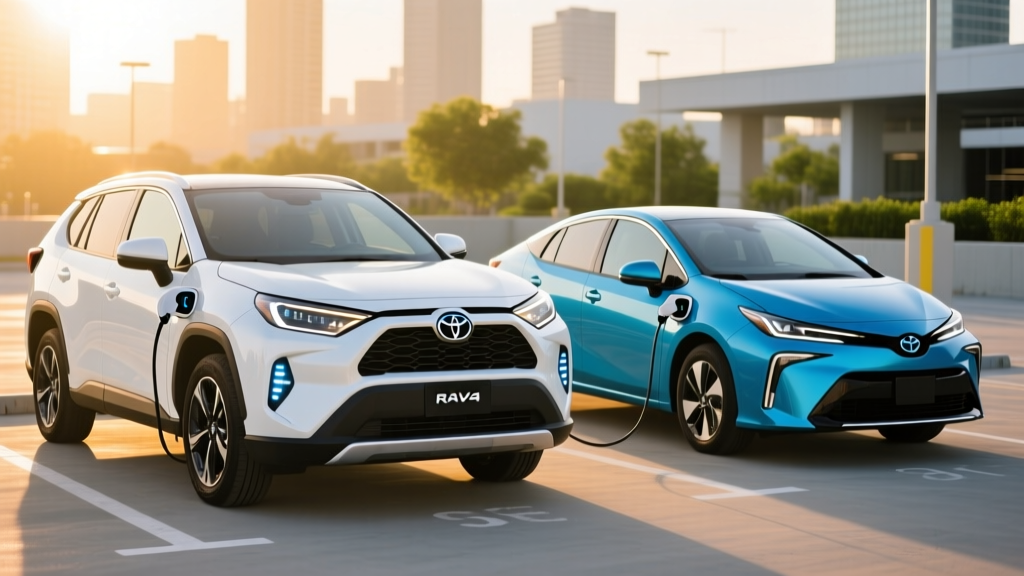
If you want electric commuting without range anxiety, Toyota's plug-in hybrid (PHEV) lineup offers a compelling middle ground. For 2026, Toyota sells two plug in Toyota hybrids: the RAV4 Prime SUV and the Prius Prime liftback. Both pair a gasoline engine with a larger battery and electric motor than their conventional hybrid siblings, delivering 40+ miles of electric-only driving before seamlessly switching to hybrid mode.
This guide breaks down exact EPA figures, real-world efficiency, pricing, federal tax credit eligibility under current IRS §30D rules, and which Toyota PHEV fits your driving pattern — or whether a full BEV or conventional HEV makes more sense.
HEV vs PHEV: What Toyota Actually Sells
Toyota's hybrid lineup can confuse first-time buyers. Here's the critical distinction:
| Feature | Conventional Hybrid (HEV) | Plug-In Hybrid (PHEV) |
|---|---|---|
| Battery size | ~1.0–1.6 kWh | 13.6–18.1 kWh |
| Electric-only range | 0–1 mi at low speed | 42–44 mi (EPA) |
| Plug in to charge? | No — self-charging via regen & engine | Yes — Level 1 or Level 2 |
| DC fast charging? | N/A | No (Level 2 max) |
| Federal tax credit | Not eligible | Potentially up to $7,500 (§30D) |
| Example models | RAV4 Hybrid, Prius, Camry Hybrid | RAV4 Prime, Prius Prime |
Conventional hybrids like the RAV4 Hybrid or standard Prius never need plugging in — they recover energy through regenerative braking and the gasoline engine. PHEVs have a much larger battery that you should plug in to unlock their electric-only range, but they still drive as a regular hybrid if you forget to charge.
2026 Prius Prime: Specs, Range, and Efficiency
The redesigned Prius Prime pairs a 2.0-liter four-cylinder engine with dual electric motors for a combined 220 horsepower. It uses a 13.6 kWh lithium-ion battery pack (usable capacity approximately 10.9 kWh).
| Specification | 2026 Toyota Prius Prime |
|---|---|
| Powertrain | 2.0L I4 + 2 electric motors (220 hp combined) |
| Battery | 13.6 kWh lithium-ion |
| EPA electric-only range | 44 miles (SE trim); 40 mi (XSE) |
| EPA MPGe (electric + gas) | 127 MPGe (SE) |
| EPA MPG (hybrid mode, combined) | 52 MPG (SE); 48 MPG (XSE) |
| MPG breakdown (SE hybrid mode) | City 53 / Hwy 51 / Combined 52 |
| Total combined range | ~440+ miles (EV + gas tank) |
| Level 1 charging (120V) | ~11 hours (0–100%) |
| Level 2 charging (240V, 3.3 kW) | ~4 hours (0–100%) |
| DC fast charging | Not supported |
| 0–60 mph | 6.6 seconds |
| Base MSRP (SE) | $33,445 |
| Top trim MSRP (XSE Premium) | $39,990 |
The SE trim delivers the highest efficiency at 127 MPGe and 44 miles of electric range thanks to lighter weight and lower-resistance tires. The XSE trims sacrifice 4 miles of EV range for larger wheels, a panoramic roof, and additional features.
2026 RAV4 Prime: Specs, Range, and Efficiency
The RAV4 Prime is Toyota's most powerful RAV4 variant, producing 302 combined horsepower from its 2.5-liter four-cylinder engine and front/rear electric motors (enabling electronic all-wheel drive). Its 18.1 kWh battery is the largest in Toyota's PHEV lineup.
| Specification | 2026 Toyota RAV4 Prime |
|---|---|
| Powertrain | 2.5L I4 + dual electric motors, eAWD (302 hp combined) |
| Battery | 18.1 kWh lithium-ion |
| EPA electric-only range | 42 miles |
| EPA MPGe (electric + gas) | 94 MPGe |
| EPA MPG (hybrid mode, combined) | 38 MPG |
| MPG breakdown (hybrid mode) | City 40 / Hwy 36 / Combined 38 |
| Total combined range | ~470+ miles (EV + 14.5-gal tank) |
| Level 1 charging (120V) | ~12 hours (0–100%) |
| Level 2 charging (240V, 6.6 kW) | ~2.5 hours (0–100%) |
| DC fast charging | Not supported |
| 0–60 mph | 5.7 seconds |
| Base MSRP (SE) | $43,865 |
| Top trim MSRP (XSE Premium) | $49,690 |
A key advantage of the RAV4 Prime over the Prius Prime: it supports 6.6 kW Level 2 charging, cutting charge time to roughly 2.5 hours versus the Prius Prime's 4 hours at 3.3 kW. Neither vehicle supports DC fast charging — a common limitation of PHEVs due to smaller battery packs.
Real-World MPG and Electric Range vs EPA Stickers
What to expect in the real world:
- Prius Prime EV range: EPA rates it at 44 mi (SE). Expect 38–42 mi in mixed driving, dropping to 32–36 mi in sustained cold weather (below 35°F) or at highway speeds above 70 mph.
- RAV4 Prime EV range: EPA rates it at 42 mi. Expect 36–40 mi in mixed driving, and 30–34 mi in cold weather or loaded highway driving.
- Hybrid-mode MPG: Toyota hybrids frequently exceed EPA city estimates in stop-and-go traffic where regenerative braking shines. The Prius Prime's 53 city MPG is routinely matched or beaten in urban driving. Highway MPG tends to fall 2–4 MPG below the EPA sticker at speeds above 75 mph.
The electric-only range figures assume moderate temperatures (65–75°F), speeds under 65 mph, and minimal HVAC load. Running the cabin heater in winter can reduce EV range by 20–30% because PHEVs use electric resistance heating or a heat pump (the Prius Prime uses a heat pump on higher trims) rather than engine waste heat when in EV mode.
Once the battery depletes, both vehicles operate as conventional hybrids. The Prius Prime returns an impressive 52 MPG combined — better than many non-plug-in hybrids. The RAV4 Prime's 38 MPG combined is strong for a 302-hp AWD SUV.
Federal Tax Credits and Pricing for Toyota PHEVs
Under the current IRS §30D rules, plug in Toyota hybrids may qualify for the federal clean vehicle credit — but eligibility depends on several requirements that change frequently. Here's the framework:
- MSRP cap: SUVs (RAV4 Prime) must have an MSRP at or below $80,000; sedans/liftbacks (Prius Prime) must be at or below $55,000. All current trims qualify.
- Buyer income cap: Modified adjusted gross income cannot exceed $300,000 (joint), $225,000 (head of household), or $150,000 (single).
- Battery sourcing requirements: The credit is split into two halves — $3,750 for critical minerals and $3,750 for battery component sourcing. Toyota's supply chain has been adjusting, but as of the current tax year, the Prius Prime and RAV4 Prime typically qualify for a partial credit of $3,750, not the full $7,500. Verify current eligibility at fueleconomy.gov.
- Point-of-sale transfer: You can transfer the credit to the dealer at purchase to reduce your out-of-pocket cost immediately, rather than waiting to claim it on your tax return.
- No used-PHEV credit overlap: The §25E used vehicle credit (up to $4,000) applies only to used EVs/PHEVs purchased separately.
Always confirm current-year eligibility with your tax professional and the IRS clean vehicle credits page, as battery sourcing rules tighten annually.
Battery Warranty, Reliability, and Replacement Costs
Toyota PHEV battery warranty: Toyota covers the hybrid battery pack for 10 years or 150,000 miles (whichever comes first) across all 50 states. This applies to both the Prius Prime and RAV4 Prime.
Capacity retention guarantee: Toyota warrants that the battery will retain sufficient capacity to function as a PHEV. If degradation causes the battery to fall below approximately 60% of original capacity within the warranty period, Toyota will repair or replace it.
Toyota's hybrid systems have an exceptional reliability track record. The Prius platform has been in production since 1997, and real-world data shows Toyota hybrid batteries commonly lasting 150,000–200,000+ miles before significant degradation. PHEV batteries are larger and experience shallower charge/discharge cycles than full EVs, which generally extends their usable life.
Out-of-warranty replacement cost: If the hybrid battery does need replacement after 10 years/150,000 miles, expect to pay approximately $3,500–$5,500 for a Prius Prime battery and $5,000–$7,500 for a RAV4 Prime battery (parts and labor). Refurbished batteries are often available for 30–40% less.
Toyota's broader powertrain warranty covers 5 years/60,000 miles, and the vehicle limited warranty covers 3 years/36,000 miles. Safety equipment under Toyota Safety Sense 3.0 is included on all trims.
Side-by-Side: Prius Prime vs RAV4 Prime
| Attribute | 2026 Prius Prime SE | 2026 RAV4 Prime SE |
|---|---|---|
| Body style | 5-door liftback | 5-door compact SUV |
| Combined HP | 220 hp | 302 hp |
| Drivetrain | FWD | eAWD (electronic all-wheel drive) |
| Battery (kWh) | 13.6 kWh | 18.1 kWh |
| EPA EV range | 44 mi | 42 mi |
| EPA MPGe | 127 MPGe | 94 MPGe |
| EPA MPG (hybrid mode) | 52 combined | 38 combined |
| 0–60 mph | 6.6 sec | 5.7 sec |
| Level 2 charge rate | 3.3 kW (~4 hrs) | 6.6 kW (~2.5 hrs) |
| Cargo volume | 20.3 cu ft (rear seats up) | 33.5 cu ft (rear seats up) |
| Towing capacity | Not rated for towing | 2,500 lbs |
| Base MSRP | $33,445 | $43,865 |
| Est. price after $3,750 credit | ~$29,695 | ~$40,115 |
Who Should Buy a Toyota PHEV vs a Full EV or Gas Car?
Choose a Toyota PHEV if:
- Your daily commute is under 40 miles round-trip and you can charge at home (Level 1 overnight is sufficient for the Prius Prime)
- You regularly take road trips of 200+ miles and don't want to plan around DC fast chargers
- You live in an apartment or area with limited public charging infrastructure
- You want to reduce fuel consumption by 60–80% on daily driving without fully committing to a BEV
Choose a full BEV (like a Tesla Model Y or Hyundai Ioniq 5) if:
- You have reliable home Level 2 charging and your daily driving rarely exceeds 250 miles
- You want zero tailpipe emissions and minimal maintenance (no oil changes, no engine)
- You want access to DC fast charging at 150–350 kW for road trips
- You qualify for the full $7,500 federal credit on eligible BEVs
Choose a conventional Toyota HEV (like the RAV4 Hybrid or standard Prius) if:
- You cannot charge at home at all (no garage, no outdoor outlet access)
- Your budget is tighter — HEVs cost $5,000–$10,000 less than their PHEV counterparts
- Your daily mileage is high but mostly highway, where PHEV EV-range advantage diminishes
Toyota PHEV Advantages
- 40+ miles of electric commuting = near-zero gas use on short trips
- No range anxiety — gas engine covers any distance
- Excellent reliability and 10-year/150,000-mi battery warranty
- Strong resale value (RAV4 Prime has historically commanded premiums)
- Works with standard 120V outlet — no mandatory electrical upgrade
Toyota PHEV Limitations
- No DC fast charging — long road trips rely entirely on gas
- Prius Prime's 3.3 kW Level 2 rate is slow compared to competitors
- Premium pricing vs conventional HEV versions ($7,000–$10,000 more)
- Federal tax credit may be partial ($3,750) depending on sourcing rules
- EV range drops significantly in cold weather and at highway speeds
Frequently Asked Questions
How many MPG do Toyota plug-in hybrids get?
Once the battery is depleted, the 2026 Prius Prime returns an EPA-rated 52 MPG combined (53 city / 51 highway) in hybrid mode. The RAV4 Prime returns 38 MPG combined (40 city / 36 highway). During electric-only driving, efficiency is measured in MPGe: 127 MPGe for the Prius Prime and 94 MPGe for the RAV4 Prime. In real-world city driving, both models frequently meet or exceed their EPA city estimates thanks to aggressive regenerative braking.
How far can the Prius Prime and RAV4 Prime go on electric only?
The EPA rates the Prius Prime SE at 44 miles of electric-only range and the RAV4 Prime at 42 miles. In real-world conditions, expect 36–42 miles depending on speed, temperature, and terrain. Cold weather (below 35°F) can reduce EV range by 20–30%. Once the battery is depleted, the gasoline engine takes over seamlessly — you never need to stop or change driving behavior.
Do Toyota plug-in hybrids qualify for a federal tax credit?
Both the Prius Prime and RAV4 Prime are eligible under IRS §30D, but the actual credit amount depends on battery sourcing requirements, your income, and the vehicle's MSRP. As of the current tax year, most Toyota PHEVs qualify for a partial credit of approximately $3,750 (one of the two $3,750 halves). The credit can be transferred to the dealer at the point of sale to reduce your purchase price immediately. Always verify current eligibility at fueleconomy.gov and consult a tax professional.
Are Toyota PHEV batteries reliable, and what does replacement cost?
Toyota's hybrid batteries carry a 10-year/150,000-mile warranty across all states. Real-world data from two decades of Prius production shows these batteries commonly lasting 150,000–200,000+ miles. Out-of-warranty replacement costs approximately $3,500–$5,500 for the Prius Prime and $5,000–$7,500 for the RAV4 Prime, with refurbished options available at a discount. The PHEV battery is larger than a conventional hybrid's but undergoes shallower cycles, which supports longevity.
Can I charge a Toyota PHEV on a regular household outlet?
Yes. Both the Prius Prime and RAV4 Prime come with a Level 1 charging cord that plugs into a standard 120V household outlet. The Prius Prime fully charges in about 11 hours on Level 1 — practical for overnight charging if your daily EV-range use is under 40 miles. The RAV4 Prime takes about 12 hours on Level 1. For faster charging, a 240V Level 2 home charger reduces times to ~4 hours (Prius Prime at 3.3 kW) or ~2.5 hours (RAV4 Prime at 6.6 kW). Level 2 installation typically costs $500–$2,000 depending on your electrical panel's capacity and distance from the charger location.
Hybrid vs PHEV vs EV — which Toyota is right for me?
If you can charge at home and commute under 40 miles daily but take regular road trips, a Toyota PHEV gives you the best of both worlds: electric daily driving with gas-powered freedom. If you have no charging access, a conventional Toyota HEV (RAV4 Hybrid, standard Prius) delivers 40–57 MPG without ever plugging in. If you have reliable home charging, rarely drive more than 250 miles in a day, and want zero tailpipe emissions, a full BEV offers lower running costs and less maintenance — though you'll need to plan road-trip charging stops.