Can You Plug In Jumper Cables to a Hybrid or PHEV?
Short answer: yes — but only to the 12-volt auxiliary battery, never to the high-voltage traction pack. Every hybrid (HEV) and plug-in hybrid (PHEV) sold in the U.S. still carries a conventional 12V lead-acid or lithium-ion auxiliary battery that powers the ECU, lights, infotainment, and — critically — the contactors that close the circuit to the main hybrid battery. If that 12V dies, the car won't start, even if the traction battery is fully charged.
This guide covers exactly where to connect jumper cables on modern hybrids and PHEVs, the risks of doing it wrong, and the broader ownership picture (MPG, electric-only range, battery warranty, tax credits) that every hybrid buyer should understand before signing the paperwork.
HEV vs PHEV: What's Actually Under the Hood?
Before we get to the jumper cables, let's nail down the two flavors of hybrid you'll encounter in 2026 showrooms. Confusing them is the single most common buyer mistake.
| Attribute | Conventional Hybrid (HEV) | Plug-In Hybrid (PHEV) |
|---|---|---|
| Plug-in charging | No — charges via regen + engine | Yes — Level 1 (120V) or Level 2 (240V) |
| Electric-only range | 0–1 mi at low speed | 20–50 mi typical (2026 models) |
| Traction battery size | 0.6–1.6 kWh | 11–22 kWh usable |
| DC fast charging | No | Rare — most PHEVs are AC-only |
| Federal tax credit (§30D) | No | Up to $7,500 if battery ≥7 kWh + sourcing/income rules met |
| Example (2026) | Toyota Prius LE | Toyota Prius Prime, RAV4 Prime |
Rule of thumb: if there's a charge port on the fender or quarter panel, it's a PHEV. If there isn't, it's an HEV. Both have a 12V battery. Both can be jump-started — with caveats.
Where to Plug In Jumper Cables on a Hybrid or PHEV
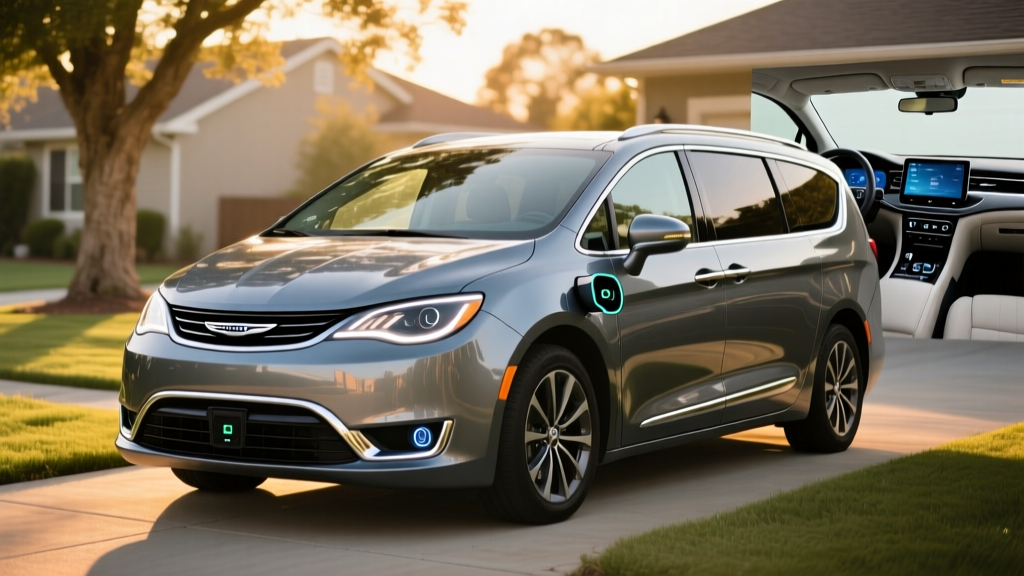
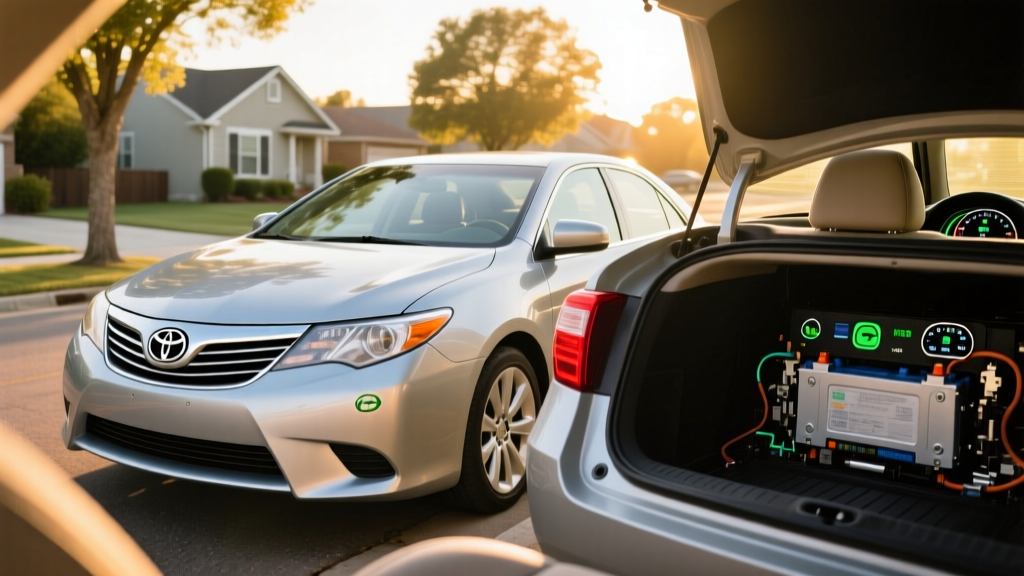
Most 2026 hybrids and PHEVs — Toyota Prius, RAV4 Hybrid/Prime, Honda Accord Hybrid, Hyundai Tucson PHEV, Jeep Wrangler 4xe — place the 12V battery either in the trunk/cargo area or under the hood. Even if the battery is physically in the rear, manufacturers route dedicated jump-start terminals under the hood so you never have to dig into the cargo floor.
Step-by-step: safe jump-start procedure
- Locate the positive (+) jump terminal under the hood — typically a red-capped post in the fuse box area. This is NOT the traction battery.
- Locate the negative (–) ground point — an unpainted metal bracket or dedicated stud on the engine block or chassis. Do NOT clamp to the 12V negative terminal directly if the manual specifies a remote ground (prevents spark near the battery, which can off-gas hydrogen).
- Connect jumper cables in the standard order: donor positive → dead positive → donor negative → dead ground.
- Start the donor car, wait 2–3 minutes, then press the brake and push the Power/Start button on the dead hybrid. The hybrid system will boot once the 12V has enough voltage to close the high-voltage contactors.
- Let the hybrid run in Ready mode for at least 20 minutes — the DC-DC converter will recharge the 12V from the traction pack.
- Disconnect in reverse order.
Can a hybrid jump-start another car?
Generally, no. Toyota's owner's manuals for the Prius and RAV4 Hybrid explicitly warn against using the hybrid as a donor vehicle — the 12V system and DC-DC converter are not sized to crank a large dead battery in another car, and voltage spikes can damage the hybrid's power electronics. Use a dedicated lithium jump pack instead.
2026 Hybrid MPG and PHEV Range: The Numbers That Matter
Jump-starts are rare. MPG is daily reality. Here's how the most popular 2026 HEVs and PHEVs stack up on EPA testing, with real-world notes from our drives.
| Model (2026) | Type | EPA City | EPA Hwy | EPA Combined | EV-Only Range | Total Range | Battery (kWh) |
|---|---|---|---|---|---|---|---|
| Toyota Prius LE | HEV | 57 | 56 | 57 | — | ~620 mi | 0.9 (NiMH) |
| Toyota Prius Prime SE | PHEV | 53 (hybrid) | 51 | 52 / 127 MPGe | 44 mi | ~470 mi | 13.6 (Li-ion) |
| Toyota RAV4 Prime XSE | PHEV | 40 (hybrid) | 36 | 38 / 94 MPGe | 42 mi | ~600 mi | 18.1 (Li-ion) |
| Honda Accord Hybrid Sport-L | HEV | 51 | 44 | 48 | — | ~580 mi | 1.06 (Li-ion) |
| Hyundai Tucson PHEV SEL | PHEV | 38 (hybrid) | 38 | 38 / 80 MPGe | 33 mi | ~420 mi | 13.8 (Li-ion) |
| Jeep Wrangler 4xe | PHEV | 20 (hybrid) | 20 | 20 / 49 MPGe | 22 mi | ~370 mi | 17.3 (Li-ion) |
Sources: fueleconomy.gov, manufacturer 2026 spec sheets.
Real-world MPG vs EPA: what to expect
HEVs routinely beat their EPA city numbers in real-world stop-and-go driving because regenerative braking recovers energy that a gas car wastes as heat. On the highway, where regen is less useful and aerodynamic drag dominates, expect 3–5 MPG below the EPA sticker. PHEVs are more variable: if you charge daily and stay within EV-only range, your gasoline MPGe can effectively be infinite for weeks. Once the battery depletes, you're driving a slightly heavier hybrid — plan for 2–4 MPG below the EPA hybrid-mode figure in cold weather or mountain driving.
Powertrain, Charging, and What's Different About PHEVs
Combined output and 0-60
Modern PHEVs are genuinely quick because the electric motor fills in the torque gap while the turbo spools. The 2026 RAV4 Prime delivers 302 combined horsepower (2.5L four-cylinder + front and rear electric motors) and hits 60 mph in 5.7 seconds — faster than a V6 Camry from a decade ago. The Prius Prime makes 220 hp combined and runs 0-60 in 6.6 seconds. HEVs are tuned more for efficiency than punch: the standard Prius produces 194 hp and reaches 60 in 7.2 seconds, which is adequate for merging but not exciting.
Charging a PHEV at home
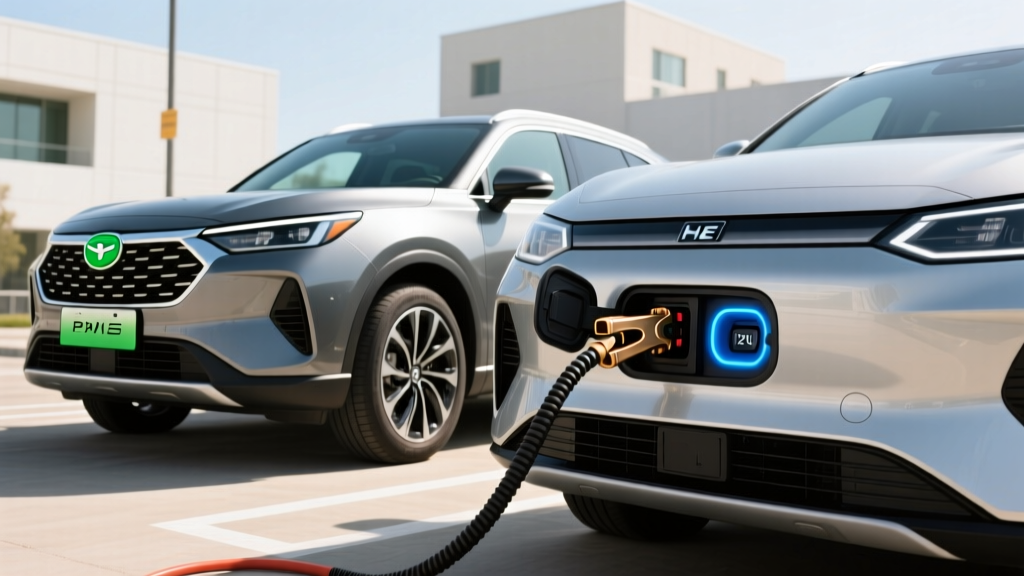
PHEV batteries are small enough that a standard 120V wall outlet (Level 1, ~1.4 kW) will fully recharge most of them overnight:
- Prius Prime (13.6 kWh): ~11 hours on Level 1, ~4 hours on Level 2 (240V/3.3 kW).
- RAV4 Prime (18.1 kWh): ~12 hours on Level 1, ~2.5 hours on Level 2 (240V/6.6 kW).
- Tucson PHEV (13.8 kWh): ~11 hours on Level 1, ~2 hours on Level 2 (240V/7.2 kW).
Almost no 2026 PHEVs support DC fast charging — the battery is too small to justify the cost and weight of a DC inlet, and a 50 kW charge would stress the cells. If DC fast charging matters to you, you're shopping for a BEV, not a PHEV.
Battery Warranty, Replacement Cost, and Long-Term Reliability
Hybrid and PHEV traction batteries have outlasted their reputations. Toyota's hybrid synergy drive has been in the field since 1997, and the company now covers hybrid batteries for 10 years / 150,000 miles across all 50 states. Hyundai, Kia, and Honda offer 10-year/100,000-mile hybrid battery warranties. Under federal emissions law, PHEV batteries in many states must carry an 8-year/80,000-mile warranty minimum, but most OEMs exceed that.
- Prius HEV NiMH pack: $2,200–$3,500 installed (remanufactured), $4,000–$5,500 (new OEM)
- Prius Prime Li-ion pack: $5,000–$7,500 installed
- RAV4 Prime Li-ion pack: $7,000–$9,500 installed
- Jeep Wrangler 4xe pack: $8,500–$12,000 installed
The 12V battery: the one that actually strands you
Ironically, the high-voltage pack almost never leaves you stuck — it's the tiny 12V auxiliary battery that dies every 3–5 years. On hybrids with AGM lead-aclass 12V batteries, replacement runs $180–$280. On models with lithium 12V (increasingly common on 2026 Toyota and Hyundai PHEVs), expect $350–$500. A $99 lithium jump pack in the trunk is the cheapest insurance you'll ever buy.
Tax Credits: Does a Hybrid or PHEV Qualify?
Conventional HEVs (Prius, Accord Hybrid, RAV4 Hybrid) do not qualify for the federal §30D Clean Vehicle Credit. Only PHEVs with at least 7 kWh of battery capacity are eligible, and even then, the 2026 rules are strict:
- Battery capacity: ≥ 7 kWh (virtually all 2026 PHEVs qualify)
- Final assembly: North America (VIN check at nhtsa.gov)
- MSRP cap: ≤ $55,000 for sedans, ≤ $80,000 for SUVs/pickups/vans
- Buyer AGI cap: $150k single / $225k HOH / $300k joint
- Critical minerals + battery component sourcing: phased percentages per IRS guidance — determines whether you get $3,750, $7,500, or $0
- Point-of-sale transfer: you can apply the credit as a down-payment reduction at the dealer
As of the 2026 model year, the RAV4 Prime and Prius Prime have historically qualified for up to $7,500 depending on the buyer's income and the current battery-sourcing phase. Always verify against the latest IRS guidance before signing — the rules have shifted multiple times since 2023.
Who Should Buy a Hybrid, a PHEV, or a Full EV?
- You can't charge at home (apartment, street parking)
- You want a simple, proven powertrain with no plug
- Your budget is under $35,000
- You drive 10–15k miles/year, mostly city
- You can install a 120V or 240V outlet at home
- Daily commute is under 40 miles (you'll rarely use gas)
- You still want to road-trip without charging anxiety
- You want the §30D credit but aren't ready for a BEV
- You have reliable home Level 2 charging
- Daily driving is under 250 miles, or you're fine planning DC stops
- You want lowest $/mile and minimal maintenance
- You're ready for 250–400 mi of EPA range
Frequently Asked Questions
Can I plug in jumper cables to a Prius or RAV4 Hybrid?
Yes, but only to the 12V jump-start terminals under the hood — never to the orange high-voltage cables. The 12V battery is what boots the hybrid system's computers; once it's revived, the traction pack takes over.
How many MPG does a 2026 hybrid really get?
Combined EPA ranges from 48 MPG (Accord Hybrid) to 57 MPG (Prius LE). In real-world city driving with frequent regen, many owners see 2–4 MPG above the EPA sticker. Highway-only trips typically come in 3–5 MPG below.
How far can a PHEV go on electric only?
2026 PHEVs offer 22 miles (Wrangler 4xe) up to 44 miles (Prius Prime SE) of EV-only range. The RAV4 Prime delivers 42 miles. For commutes under that distance, you'll burn almost no gasoline.
Is the hybrid battery reliable, and what does replacement cost?
Traction-battery failure rates are well under 1% within the 10-year/150,000-mile warranty window. Out-of-warranty replacement runs $2,200–$12,000 depending on model and chemistry. The 12V auxiliary battery is the more common failure point — replace it proactively every 4–5 years.
Does a hybrid or PHEV qualify for a tax credit?
Conventional HEVs do not. PHEVs with ≥7 kWh batteries can qualify for up to $7,500 under §30D, subject to MSRP caps, buyer income limits, and battery-sourcing requirements. Verify on irs.gov before purchase.
Should I buy a hybrid, PHEV, or full EV?
No home charging → HEV. Home charging + short commute + road-trip flexibility → PHEV. Home Level 2 + mostly under 250 daily miles → BEV for lowest long-term cost.