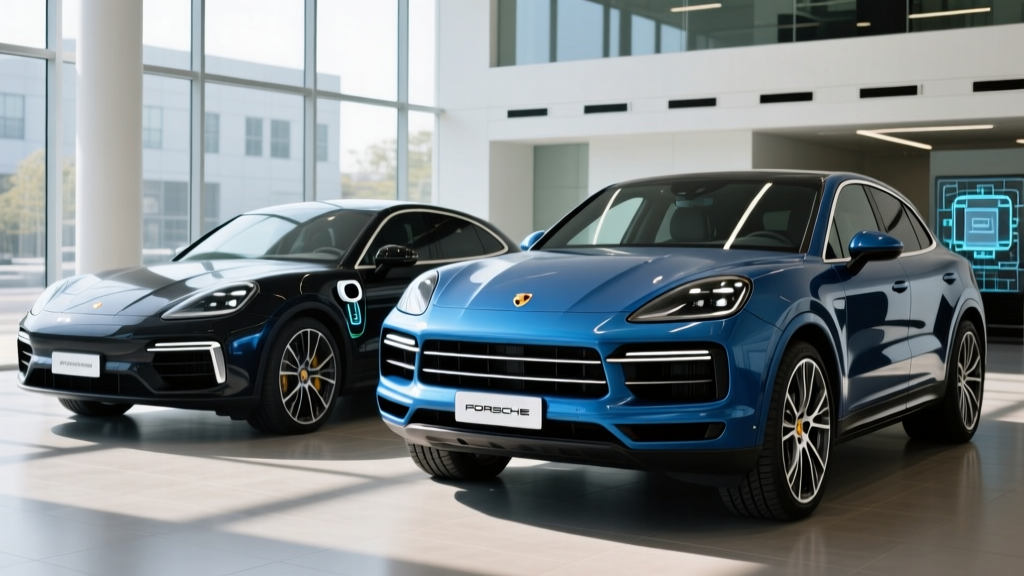
Porsche has gone all-in on plug-in hybrids as a bridge between its combustion heritage and an electric future. For 2026, the Porsche E-Hybrid lineup spans four model families — the Cayenne SUV, Panamera sedan, Macan compact SUV (newly redesigned), and the 911 (now available as the T-Hybrid). But the phrase plug in hybrid Porsche doesn't mean one thing. These powertrains vary wildly in electric-only range, battery size, charging capability, and performance intent.
This guide breaks down exactly what Porsche's 2026 PHEV lineup delivers in real numbers: EPA electric range, combined MPG, battery kWh, charge times, horsepower, and pricing — plus the tax-credit realities most luxury PHEV buyers overlook.
HEV vs PHEV: What Porsche Actually Offers in 2026
Before diving into specs, the distinction matters because Porsche now sells both types simultaneously:
Conventional Hybrid (HEV)
- Example: 2026 Porsche 911 Carrera GTS T-Hybrid
- No plug: Charges via regenerative braking and engine
- Battery: ~1.9 kWh (small, performance-oriented)
- Electric-only range: Minimal — designed for torque fill, not EV driving
- Goal: Performance boost and slight efficiency gain
Plug-In Hybrid (PHEV)
- Examples: Cayenne E-Hybrid, Panamera E-Hybrid, Macan E-Hybrid
- Plugs in: Charges from a wall outlet or Level 2 station
- Battery: 17.9–25.9 kWh usable (substantial)
- Electric-only range: 25–54 miles EPA
- Goal: Daily EV commuting with gas-engine flexibility
If you're searching for a plug in hybrid Porsche you can actually charge and drive on electricity alone, you want the E-Hybrid models. The 911 T-Hybrid is brilliant engineering but is not a PHEV — it has no plug and no meaningful EV range.
2026 Porsche E-Hybrid Lineup: Spec Comparison Table
| Spec | Cayenne E-Hybrid | Cayenne S E-Hybrid | Panamera 4 E-Hybrid | Panamera Turbo S E-Hybrid | Macan E-Hybrid |
|---|---|---|---|---|---|
| Combined HP | 394 hp | 512 hp | 463 hp | 717 hp | ~340 hp (est.) |
| Engine | 3.0L V6 + e-motor | 3.0L V6 + e-motor | 2.9L V6 + e-motor | 4.0L V8 + e-motor | 2.0L I4 + e-motor |
| Battery (usable) | 20.6 kWh | 20.6 kWh | 21.8 kWh | 21.8 kWh | ~17.9 kWh |
| EPA Electric Range | ~32 mi | ~30 mi | ~34 mi | ~29 mi | ~25 mi (est.) |
| Total Combined Range | ~440 mi | ~420 mi | ~430 mi | ~380 mi | ~390 mi (est.) |
| MPG Combined (hybrid mode) | ~21 MPG | ~20 MPG | ~22 MPG | ~18 MPG | ~25 MPG (est.) |
| MPGe (electric mode) | ~46 MPGe | ~44 MPGe | ~50 MPGe | ~42 MPGe | ~48 MPGe (est.) |
| 0-60 mph | 5.2 sec | 4.5 sec | 4.1 sec | 2.9 sec | ~5.5 sec (est.) |
| Max AC Charge Rate | 7.2 kW | 7.2 kW | 7.2 kW | 7.2 kW | 7.2 kW |
| DC Fast Charging | No | No | No | No | No |
| Level 2 Charge Time (0-100%) | ~2 hr 45 min | ~2 hr 45 min | ~3 hr | ~3 hr | ~2 hr 30 min |
| Base MSRP | $95,700 | $108,300 | $113,500 | $205,000 | $72,500 (est.) |
Sources: EPA fueleconomy.gov, Porsche USA specifications. Estimates noted for Macan E-Hybrid reflect pre-final-EPA-certification figures for the 2026 model year.
Electric-Only Range: How Far Can a Plug In Hybrid Porsche Go on Electricity?
EPA Electric Range: 25–34 miles depending on model.
Real-World Expectation: 20–28 miles in mixed driving. Highway speeds above 70 mph will reduce electric range by 15–25%. Cold weather (below 40°F) can cut electric range by 20–30% due to cabin heating demands and reduced battery efficiency.
Porsche's E-Hybrid lineup prioritizes usable daily range over maximum numbers. The Panamera 4 E-Hybrid leads at roughly 34 miles EPA, which covers most commutes. The Cayenne E-Hybrid delivers around 32 miles — enough for school runs, grocery trips, and typical suburban commutes without the engine engaging.
One critical detail: Porsche E-Hybrids default to E-Power (electric-only) mode on startup, and the system is smart about preserving charge. The "E-Hold" mode lets you save battery for later — useful if you're driving on the highway and want electric-only operation once you hit city streets. The "E-Charge" mode uses the engine to recharge the battery while driving, though this sacrifices fuel economy.
Top electric speed is 84 mph in E-Power mode for most models, meaning you can handle full highway speeds without the gas engine kicking in — provided you don't floor it.
Fuel Economy: Real-World MPG vs EPA Stickers
| Model | City MPG | Highway MPG | Combined MPG | Real-World Combined |
|---|---|---|---|---|
| Cayenne E-Hybrid | ~20 | ~22 | ~21 | 19–23 MPG* |
| Cayenne S E-Hybrid | ~19 | ~21 | ~20 | 18–22 MPG* |
| Panamera 4 E-Hybrid | ~22 | ~24 | ~22 | 21–25 MPG* |
| Panamera Turbo S E-Hybrid | ~17 | ~20 | ~18 | 16–19 MPG* |
| Macan E-Hybrid | ~26 | ~28 | ~25 | 24–28 MPG* |
*Real-world range depends heavily on charging habits. Drivers who plug in nightly and commute within electric range will use minimal gasoline. Once the battery depletes, these are the hybrid-mode MPG figures.
The MPG numbers for Porsche E-Hybrids require context. These are hybrid-mode figures — what you get after the battery is depleted. If you charge daily and drive within your electric range, your actual fuel consumption may be near zero for weeks at a time. Porsche owners who plug in regularly report using gas only on road trips.
On the highway with a depleted battery, expect the Cayenne E-Hybrid to return roughly 20–22 MPG and the Panamera around 22–24 MPG. The Turbo S E-Hybrid's V8 drops that to 17–19 MPG — performance has a cost. These figures are competitive with non-hybrid luxury peers but not class-leading among PHEVs. The BMW X5 xDrive50e, for comparison, returns ~22 MPG combined in hybrid mode with 38 miles of electric range.
Charging: Level 2 Only, No DC Fast Charging
Every 2026 Porsche E-Hybrid charges at a maximum of 7.2 kW on Level 2 AC. None of them support DC fast charging. This is a deliberate engineering choice — Porsche prioritizes weight savings and packaging over fast-charge capability in its PHEVs.
Here's what charging looks like in practice:
| Charging Level | Power | Miles of EV Range per Hour | Full Charge Time (Cayenne) |
|---|---|---|---|
| Level 1 (120V household) | ~1.4 kW | ~3–4 mi/hr | ~14–16 hours |
| Level 2 (240V, 32A) | 7.2 kW | ~12–14 mi/hr | ~2 hr 45 min |
| DC Fast Charge | Not supported | N/A | N/A |
For PHEV ownership, Level 2 charging is the standard. A 240V home charger (like a Porsche Mobile Charger Connect or a third-party unit such as a ChargePoint Home Flex) will replenish any E-Hybrid battery in under three hours. Since you're only refilling 18–22 kWh, even overnight Level 1 charging is viable for most commutes — though a Level 2 installation is strongly recommended for convenience.
Home Level 2 installation typically costs $800–$2,000 including a quality charger and electrician labor, assuming your electrical panel has capacity. A panel upgrade adds $1,500–$3,500. (Consult a licensed electrician for your specific requirements.)
Performance: Where Porsche PHEVs Separate from the Pack
Porsche doesn't do PHEVs solely for efficiency — the E-Hybrid badge also means serious performance. The e-motor fills torque gaps before the turbo spools, delivering instant thrust that pure combustion engines can't match.
The Panamera Turbo S E-Hybrid is the headline act: 717 combined horsepower, a 4.0L twin-turbo V8 paired with a 140 kW (188 hp) electric motor, and a 2.9-second 0-60 time. That puts it in supercar territory in a four-door luxury sedan. The e-motor's instant torque is especially noticeable in Sport and Sport Plus modes, where the system combines engine and electric output for maximum acceleration.
The Cayenne S E-Hybrid at 512 hp and 4.5 seconds to 60 mph is the sweet spot for SUV buyers — fast enough to thrill, with enough electric range for daily practicality. The base Cayenne E-Hybrid at 394 hp still outperforms most gas-only luxury SUVs in its price class.
All Porsche E-Hybrids use an 8-speed PDK dual-clutch transmission with the electric motor integrated between the engine and gearbox. This is not a CVT or a power-split device like Toyota's hybrid system — it feels like a proper sports car transmission with electric assist.
Pricing, Tax Credits, and Total Cost
Porsche E-Hybrids carry a premium over their gas-only counterparts, but the calculus changes when you factor in fuel savings and potential incentives.
§30D Federal Tax Credit Eligibility (2026 Rules)
- MSRP cap for SUVs (Cayenne, Macan): $80,000 — the Cayenne E-Hybrid at $95,700 does NOT qualify. The Macan E-Hybrid at ~$72,500 may qualify if below the cap after options.
- MSRP cap for sedans (Panamera): $55,000 — no Panamera E-Hybrid qualifies.
- Buyer income cap: $300,000 joint / $150,000 individual AGI
- Battery sourcing requirements: Critical minerals and battery components must meet escalating domestic-content thresholds under the Inflation Reduction Act
- Point-of-sale transfer: Eligible credits can be transferred to the dealer at purchase for an immediate price reduction
Source: IRS §30D Clean Vehicle Credits. Consult a tax professional for your specific eligibility. Rules subject to change.
The hard truth: most Porsche E-Hybrids exceed the MSRP caps for the federal §30D tax credit. The Cayenne's $80,000 SUV cap is the closest to reachable, and the Macan E-Hybrid (estimated ~$72,500 base) is the most likely candidate — though adding options can push it over. The Panamera, starting at $113,500 for the 4 E-Hybrid, is far above the $55,000 sedan cap.
Some states offer additional incentives for PHEVs that aren't subject to federal MSRP caps. Check your state's energy or environmental agency for current programs. California's Clean Vehicle Rebate Project (CVRP), for example, has historically included PHEVs with income-based eligibility.
| Cost Factor | Cayenne E-Hybrid (Est.) | Cayenne Gas (V6, Est.) |
|---|---|---|
| Base MSRP | $95,700 | $84,700 |
| Fuel/Energy (5 yr, 15k mi/yr) | $6,500–$9,000 | $12,000–$14,500 |
| Insurance (5 yr avg) | $14,000–$18,000 | $12,000–$16,000 |
| Maintenance (5 yr) | $4,500–$6,000 | $5,000–$7,000 |
| Fed. Tax Credit | $0 (exceeds MSRP cap) | $0 |
| Estimated 5-Year Total | $120,700–$128,700 | $113,700–$122,200 |
The E-Hybrid's fuel savings partially offset its higher purchase price, but the gap narrows further when you factor in the lack of a federal tax credit. The E-Hybrid makes financial sense primarily for buyers who value the driving refinement, instant torque, and reduced emissions — not purely as a cost-saving measure.
Battery Warranty, Reliability, and Replacement Cost
Porsche PHEV Battery Warranty
Hybrid battery: 8 years / 100,000 miles (whichever comes first), with a capacity retention threshold of 70%.
Hybrid components: 8 years / 100,000 miles covering the e-motor, power electronics, and onboard charger.
Standard vehicle warranty: 4 years / 50,000 miles bumper-to-bumper.
Porsche's hybrid battery warranty aligns with the industry standard for luxury PHEVs. The 70% capacity retention threshold means Porsche will repair or replace the battery if it degrades below 70% of original capacity within the warranty period. In practice, Porsche's lithium-ion PHEV batteries have shown strong longevity — early-generation Panamera E-Hybrid owners (2018–2020) report minimal degradation at 60,000–80,000 miles.
Battery replacement cost: If out of warranty, a Porsche E-Hybrid battery replacement typically ranges from $12,000 to $18,000 including parts and labor at a Porsche dealer. This is significant but comparable to BMW and Mercedes PHEV battery costs. Individual module replacement (rather than the full pack) may be possible for localized cell failures, reducing cost.
Reliability data from owner surveys and J.D. Power vehicle dependability studies place Porsche in the mid-to-upper tier for luxury brands. The PHEV powertrain adds complexity (two power sources, high-voltage systems, cooling circuits), but Porsche's engineering has proven robust. The primary maintenance difference vs. a gas Cayenne is the additional cooling system for the battery and the onboard charger — both covered under the hybrid warranty.
Plug In Hybrid Porsche vs Full EV vs Gas: Which Fits You?
Choose a Porsche E-Hybrid (PHEV) if:
- You can charge at home (garage or driveway with 240V access)
- Your daily commute is under 30 miles and you want EV-only operation most days
- You take road trips where charging infrastructure is sparse or unreliable
- You want Porsche performance with the torque-fill benefit of electric assist
- You're not ready to commit to a full EV but want to reduce fuel consumption
Choose a Full EV (Taycan, Macan EV) if:
- You have reliable home charging and access to DC fast chargers for road trips
- You want the lowest operating cost per mile and minimal maintenance
- You drive less than 250 miles between charging opportunities
- You want the quietest, smoothest powertrain experience
Choose a Gas-Only Porsche if:
- You cannot charge at home (apartment, street parking only)
- You prioritize lower upfront purchase price over operating cost
- You want the simplest powertrain with the widest service network
- Your annual mileage is low enough that fuel savings don't justify a PHEV premium
Porsche E-Hybrid Pros
- 30+ miles of EV range covers most daily commutes
- Instant electric torque enhances Porsche's signature performance
- No range anxiety — gas engine for long trips
- Refined, quiet operation in E-Power mode
- Strong battery warranty (8 yr / 100k mi)
- E-Hold and E-Charge modes give driver control over battery use
Porsche E-Hybrid Cons
- No DC fast charging — road trip recharging is slow
- Most models exceed federal tax credit MSRP caps
- $10,000–$15,000 premium over gas-only equivalents
- Battery replacement cost ($12k–$18k) if out of warranty
- Heavy — the Cayenne E-Hybrid weighs ~5,300 lbs, impacting tire wear and handling vs. gas models
- MPG in hybrid mode is modest, not Prius-like
Frequently Asked Questions
How many MPG does a plug in hybrid Porsche get?
In hybrid mode (battery depleted), the Cayenne E-Hybrid returns approximately 21 MPG combined, the Panamera 4 E-Hybrid about 22 MPG combined, and the Macan E-Hybrid roughly 25 MPG combined. These are EPA-estimated figures; real-world results vary with driving style and conditions. If you charge daily and stay within electric range, your gasoline consumption could be near zero for daily driving.
How far can a Porsche E-Hybrid go on electric only?
EPA electric-only range spans 25 to 34 miles depending on the model. The Panamera 4 E-Hybrid leads at roughly 34 miles. Real-world range is typically 20–28 miles, with highway driving and cold weather reducing that figure. This covers most daily commutes and errands without the gasoline engine engaging.
Does a plug in hybrid Porsche qualify for a federal tax credit?
Most do not. The §30D federal tax credit has MSRP caps of $80,000 for SUVs and $55,000 for sedans. The Cayenne E-Hybrid starts at $95,700 and the Panamera E-Hybrid at $113,500 — both above their respective caps. The Macan E-Hybrid, estimated at ~$72,500, is the most likely candidate if it stays under $80,000 after options. Check IRS §30D guidelines and consult a tax professional for your eligibility.
Is the Porsche E-Hybrid battery reliable and what does replacement cost?
Porsche covers the hybrid battery for 8 years or 100,000 miles with a 70% capacity retention guarantee. Real-world degradation has been minimal based on owner reports from earlier generations. Out-of-warranty replacement costs $12,000–$18,000 at a Porsche dealer. Individual module repair may be possible for partial failures.
Can I DC fast charge a Porsche E-Hybrid?
No. All 2026 Porsche E-Hybrid models support AC charging only, at a maximum rate of 7.2 kW on Level 2. A full charge takes approximately 2.5–3 hours. DC fast charging is not available on any Porsche PHEV — only the fully electric Taycan and Macan Electric support DC fast charging.
What's the difference between the 911 T-Hybrid and the E-Hybrid models?
The 911 Carrera GTS T-Hybrid is a conventional hybrid (HEV) — it has no plug, a small ~1.9 kWh battery, and no meaningful electric-only range. It uses electrification for performance enhancement (torque fill, turbo spool assist), not for EV driving. The Cayenne, Panamera, and Macan E-Hybrids are true plug-in hybrids with 25–34 miles of electric range and a charging port.
Is a Porsche E-Hybrid worth it over a full EV like the Taycan?
It depends on your charging access and driving patterns. If you have home charging and rarely exceed 250 miles between stops, the Taycan offers lower operating costs, better performance per dollar, and DC fast charging. If you regularly drive long distances in areas with sparse charging infrastructure, or you want one vehicle for both electric commuting and cross-country road trips, the E-Hybrid's dual powertrain provides flexibility the Taycan can't match.