Quick Verdict: Is the Plug-In Hybrid Highlander Worth It?
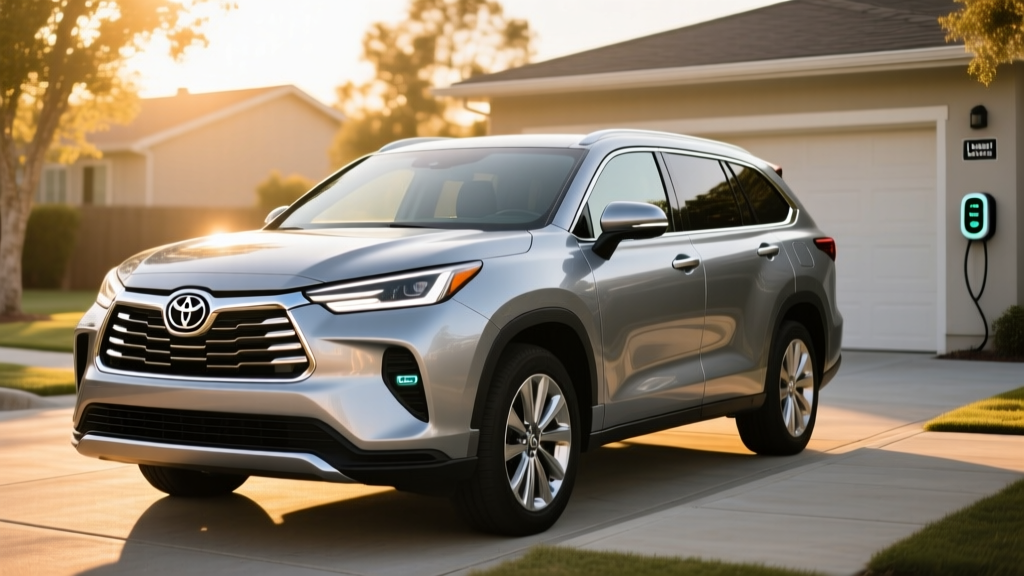
The Toyota Highlander has long been the default three-row family hauler, and for 2026, Toyota continues to offer it in two electrified flavors: a conventional hybrid (HEV) and a plug-in hybrid (PHEV), the latter badged as the Highlander Hybrid Prime in some markets but sold in the U.S. simply as the Highlander PHEV variant. If you've been searching for a plug in hybrid Highlander, you're looking at a vehicle that bridges the gap between Toyota's proven hybrid synergy drive and full battery-electric territory — giving you roughly 30 miles of electric-only commuting before the 2.5-liter four-cylinder kicks in.
This guide covers everything a buyer needs: real-world MPG, electric-only range, charging logistics, powertrain specs, pricing, and whether the federal tax credit applies. We'll also compare it head-to-head with the conventional Highlander Hybrid so you can pick the right powertrain for your household.
HEV vs PHEV: Which Highlander Powertrain Do You Actually Need?
Before we get into the numbers, it's critical to understand the difference between the two electrified Highlander variants Toyota sells. They are not interchangeable.
| Feature | Highlander Hybrid (HEV) | Highlander Plug-In Hybrid (PHEV) |
|---|---|---|
| Plug-in charging required? | No — charges via regenerative braking and engine | Yes — plug in to access electric-only range |
| Battery size (usable) | ~1.6 kWh (NiMH/Li-ion) | ~18.1 kWh (Lithium-ion) |
| Electric-only range | Less than 1 mile at low speeds | EPA-est. ~30 miles |
| EPA combined MPG (hybrid mode) | 35 MPG combined | 35 MPG combined (after battery depleted) |
| DC fast charging | No | No — AC charging only |
| Home charging time (Level 2, 240V) | N/A | ~4.5 hours (0-100%) |
| Federal tax credit (§30D) | Not eligible | May qualify — see eligibility section below |
| Starting MSRP (2026) | ~$42,320 | ~$49,870 |
The bottom line: If you can charge at home and your daily round-trip commute is under 30 miles, the PHEV lets you drive on electricity most weekdays while keeping the gas engine for road trips. If you can't charge at home — or you drive 60+ miles daily — the conventional HEV is the simpler, more cost-effective choice.
Electric-Only Range and Total Driving Range
The 2026 Highlander PHEV carries an 18.1 kWh lithium-ion battery pack (usable capacity approximately 14.5 kWh, with the remainder held as a buffer to protect long-term battery health). On a full charge, the EPA estimates 30 miles of electric-only driving in EV mode.
EPA Electric-Only Range: 30 miles
Real-World Expectation: 24–28 miles in mixed driving; expect 18–22 miles in cold weather (below 32°F) or sustained highway speeds above 65 mph. Electric motors are less efficient at highway velocities, and cold temperatures reduce lithium-ion discharge capacity.
Once the battery is depleted, the Highlander PHEV seamlessly transitions to hybrid mode, operating identically to the conventional HEV. Total combined range (electric + gasoline) exceeds 550 miles, thanks to the 17.1-gallon fuel tank and 35 MPG hybrid-mode efficiency. You'll never be stranded waiting for a charger — this is the PHEV's core advantage over a full BEV for one-car households.
Fuel Economy: EPA MPG and Real-World Numbers
| Driving Mode | City | Highway | Combined |
|---|---|---|---|
| Hybrid mode (battery depleted) | 35 MPG | 35 MPG | 35 MPG |
| Electric mode (MPGe equivalent) | 86 MPGe combined (EPA-est.) | ||
| Conventional Highlander HEV | 36 MPG | 35 MPG | 35 MPG |
Toyota's hybrid system excels in stop-and-go city traffic, where regenerative braking recaptures energy and the electric motor handles low-speed propulsion. According to fueleconomy.gov, the Highlander Hybrid posts nearly identical city and highway numbers — a hallmark of Toyota's power-split hybrid architecture.
Real-world MPG reality check: Many Highlander Hybrid owners report exceeding the EPA city estimate by 1–3 MPG in suburban driving with moderate regenerative braking. However, sustained highway driving at 75+ mph, heavy cargo loads, or towing (rated at 3,500 lbs for the PHEV, 5,000 lbs for the HEV) will push real-world economy down to 28–31 MPG. Cold-weather operation also reduces efficiency by roughly 10–15% due to cabin heating demands and reduced battery performance.
Powertrain and Performance Specs
| Specification | Highlander PHEV (2026) |
|---|---|
| Engine | 2.5L inline-4 Atkinson-cycle |
| Engine output | 184 hp / 175 lb-ft torque |
| Front electric motor | 134 hp / 199 lb-ft |
| Rear electric motor (AWD) | 54 hp / 89 lb-ft |
| Combined net horsepower | 308 hp |
| Transmission | eCVT (electronically controlled) |
| Drivetrain | AWD-i (electronic on-demand AWD) |
| 0–60 mph | ~6.6 seconds |
| Towing capacity | 3,500 lbs (PHEV) / 5,000 lbs (HEV) |
| Battery chemistry | Lithium-ion (NMC) |
| Battery capacity (gross / usable) | 18.1 kWh / ~14.5 kWh |
| Max AC charge rate | 3.3 kW (Level 2, 240V) |
| DC fast charge capable? | No |
| Charge time (Level 2, 0–100%) | ~4.5 hours |
| Charge time (Level 1, 120V, 0–100%) | ~12 hours |
The 308 combined horsepower figure makes the PHEV variant the most powerful Highlander in the lineup. The instant torque from the front electric motor delivers strong off-the-line acceleration that the conventional HEV can't match. The AWD-i system uses the rear motor to provide all-wheel traction without a mechanical driveshaft — it engages on demand during acceleration, slippery conditions, or when the system detects front-wheel slip.
Charging reality: The 3.3 kW onboard charger is the PHEV's most notable limitation. Unlike competitors such as the Chrysler Pacifica PHEV (which offers 6.6 kW), the Highlander PHEV charges at a relatively slow rate. A dedicated Level 2 home charger (240V) will fully replenish the battery in about 4.5 hours — fine for overnight charging, but it means you can't "top up" quickly during a midday stop. There is no DC fast charging, which is typical for PHEVs in this class. The smaller battery simply doesn't warrant the added cost and weight of DC fast-charge hardware.
Pricing, Trims, and Federal Tax Credit Eligibility
The 2026 Highlander PHEV starts at approximately $49,870 (including destination charge) for the XLE PHEV trim. Higher trims push the price well past $55,000:
| Trim | MSRP (est.) |
|---|---|
| XLE PHEV | $49,870 |
| Limited PHEV | $53,920 |
| $56,470 |
By comparison, the conventional Highlander Hybrid XLE starts at roughly $42,320 — a $7,550 gap that you'll need to justify through fuel savings and any applicable incentives.
Federal §30D Tax Credit: Does the Highlander PHEV Qualify?
Under current IRS rules for the new clean vehicle credit (§30D), plug-in hybrids may qualify for up to $7,500, but eligibility depends on several factors that change frequently:
- MSRP cap: SUVs must have an MSRP at or below $80,000 — all Highlander PHEV trims clear this threshold.
- Buyer income cap: Modified adjusted gross income must not exceed $300,000 (joint), $225,000 (head of household), or $150,000 (individual).
- Battery sourcing requirements: A percentage of critical minerals and battery components must be sourced from the U.S. or free-trade-agreement countries. These thresholds tighten annually. As of 2026, the critical-minerals requirement stands at 80% and battery components at 100% — making many Toyota PHEVs ineligible for the full credit due to Japanese and Chinese supply-chain dependencies.
- Point-of-sale transfer: If eligible, you can transfer the credit to the dealer at purchase for an immediate price reduction rather than waiting to claim it on your tax return.
- FEOC restriction: Vehicles with battery components from a "foreign entity of concern" (primarily Chinese suppliers) are disqualified entirely.
Bottom line: Check the official fueleconomy.gov tax credit lookup for the specific 2026 Highlander PHEV VIN eligibility before purchasing. Do not assume the full $7,500 applies — partial credits of $3,750 are common for Toyota PHEVs, and some model years have qualified for $0 due to sourcing rules. Consult a tax professional for your personal situation.
Reliability, Battery Warranty, and Replacement Costs
Hybrid/PHEV Battery Warranty: Toyota covers the high-voltage hybrid battery for 10 years or 150,000 miles (whichever comes first) in all 50 states, effective for model year 2020 and later. Prior to 2020, the warranty was 8 years / 100,000 miles in most states and 10 years / 150,000 miles in CARB states.
Powertrain warranty: 5 years / 60,000 miles.
Hybrid system components warranty: 8 years / 100,000 miles (covers inverter, motor, control module).
Toyota's hybrid reliability record is arguably the strongest in the industry. The Highlander Hybrid has been in continuous production since 2006, and the powertrain architecture in the current generation is a refined evolution of the same planetary-gear eCVT system found in millions of Prius, Camry, and RAV4 Hybrid vehicles on the road.
Battery replacement cost: If the high-voltage battery fails outside of warranty, a replacement typically costs between $3,000 and $5,000 (parts and labor) at a Toyota dealer. Independent hybrid specialists can sometimes perform the replacement for $2,000–$3,500 using refurbished or new cells. Given the 10-year/150,000-mile warranty and Toyota's track record of hybrid batteries lasting 200,000+ miles with minimal degradation, this is a low-probability expense for most owners.
The PHEV's larger lithium-ion battery may see slightly faster capacity loss over time compared to the HEV's smaller NiMH pack, simply because it undergoes deeper charge/discharge cycles. However, Toyota's battery management system maintains a generous buffer (roughly 3.5 kWh of the 18.1 kWh gross is reserved), which significantly extends cycle life. Owners who regularly charge to 100% and deplete to near-zero should expect 5–8% capacity loss over 100,000 miles — meaning the 30-mile EV range might shrink to 27–28 miles over a decade.
Who Should Buy the Plug-In Hybrid Highlander?
Choose the Highlander PHEV if:
- You can install a Level 2 charger at home (garage or driveway with 240V access)
- Your daily round-trip commute is under 30 miles
- You want electric commuting Monday–Friday but need gas-engine range for weekend road trips
- You want the most powerful Highlander variant (308 hp)
- You live in a state with PHEV-specific incentives (e.g., California, Colorado, New York) that stack on top of federal credits
Choose the conventional Highlander HEV if:
- You don't have reliable home charging access (apartment, street parking)
- Your daily driving exceeds 40–50 miles
- You want a lower purchase price ($7,500+ savings)
- You need maximum towing capacity (5,000 lbs vs. 3,500 lbs)
- You want the simplest possible ownership experience with no charging logistics
Consider a full EV (e.g., Kia EV9, Tesla Model X) if:
- You have home charging and drive under 250 miles daily
- You want zero tailpipe emissions and minimal maintenance (no oil changes, no engine)
- You're eligible for the full $7,500 federal credit on a qualifying BEV
- You're comfortable with public DC fast charging for road trips
Real-World Ownership Costs: PHEV vs HEV vs Gas
Let's run a quick five-year cost comparison assuming 15,000 miles/year, $3.50/gallon regular unleaded, and $0.14/kWh home electricity:
| Cost Factor (5 yr / 75k mi) | Highlander PHEV | Highlander HEV | Gas-only Highlander (26 MPG) |
|---|---|---|---|
| Fuel / electricity cost | ~$5,800 | ~$7,500 | ~$10,100 |
| Maintenance (oil, filters, brakes) | ~$2,800 | ~$3,200 | ~$3,800 |
| Purchase price premium (vs HEV) | +$7,550 | Baseline | -$3,000 (cheapest) |
| Estimated tax credit | $0–$3,750 | $0 | $0 |
The PHEV's fuel savings over the HEV are modest — roughly $1,700 over five years — because most of the savings come from those 30 miles of daily electric driving. If you can't charge daily, the PHEV operates as a slightly heavier HEV and the fuel-cost advantage shrinks to nearly zero. The math only works if you plug in consistently.
Pros and Cons
Pros
- 30 miles of electric-only range covers most daily commutes
- 308 combined hp — most powerful Highlander available
- 550+ total range eliminates range anxiety on road trips
- Proven Toyota hybrid reliability with 10yr/150k battery warranty
- Three-row seating for seven passengers
- No DC fast-charging dependency — Level 2 overnight is sufficient
Cons
- 3.3 kW onboard charger is slow for a PHEV in 2026
- ~$7,550 price premium over the conventional HEV variant
- Federal tax credit eligibility uncertain due to battery sourcing rules
- Towing drops to 3,500 lbs (from 5,000 lbs on the HEV)
- EV range drops significantly in cold weather and at highway speeds
- No DC fast charging limits midday electric top-ups
Frequently Asked Questions
How many MPG does the plug-in hybrid Highlander get?
The 2026 Highlander PHEV achieves an EPA-estimated 35 MPG combined (35 city / 35 highway) when operating in hybrid mode after the battery is depleted. In electric mode, it earns 86 MPGe. Real-world highway driving at 75+ mph typically yields 29–32 MPG, while city driving with regenerative braking can push above 37 MPG.
How far can the Highlander PHEV go on electric only?
The EPA rates the Highlander PHEV at 30 miles of electric-only range. In real-world conditions, expect 24–28 miles in moderate temperatures and mixed driving, and as low as 18–22 miles in sub-freezing weather or sustained highway speeds. The vehicle seamlessly switches to hybrid mode once the battery is depleted.
Does the Highlander plug-in hybrid qualify for a federal tax credit?
It may qualify for a partial credit under IRS §30D, but eligibility depends on battery component and critical-mineral sourcing requirements that tighten each year. Many Toyota PHEVs have qualified for $3,750 rather than the full $7,500, and some configurations may not qualify at all. Always verify the specific VIN on fueleconomy.gov before purchasing, and consult a tax professional.
Is the Highlander hybrid battery reliable and expensive to replace?
Toyota's hybrid battery reliability is industry-leading, with many units lasting 200,000+ miles. The high-voltage battery is warrantied for 10 years / 150,000 miles. Out-of-warranty replacement costs $3,000–$5,000 at a dealer, or $2,000–$3,500 at an independent hybrid specialist. For most owners, battery replacement is a non-issue within the vehicle's typical ownership period.
Should I get the Highlander PHEV or a full electric SUV?
If you regularly drive more than 250 miles in a day, take frequent road trips to areas with sparse charging infrastructure, or can't install a home charger, the Highlander PHEV is the safer choice. If your daily driving stays under 250 miles, you have reliable home charging, and you want the lowest operating costs and zero tailpipe emissions, a full EV like the Kia EV9 or Tesla Model X may be a better long-term fit. The PHEV is a bridge solution — excellent for households not yet ready to commit fully to electric.
Can I charge the Highlander PHEV on a regular 120V outlet?
Yes, but slowly. On a standard 120V household outlet (Level 1), a full charge takes approximately 12 hours. For practical daily use, a Level 2 (240V) home charger is strongly recommended, cutting charge time to about 4.5 hours. Level 2 installation typically costs $500–$2,000 depending on your electrical panel's capacity and the distance from the panel to the charging location.
What's the difference between the Highlander Hybrid and the Highlander PHEV?
The conventional Highlander Hybrid (HEV) never plugs in — it charges its small battery through regenerative braking and the gas engine, achieving 35 MPG combined at a lower purchase price. The plug-in hybrid (PHEV) adds a much larger 18.1 kWh battery that you charge by plugging in, enabling 30 miles of electric-only driving before the gas engine takes over. The PHEV is more powerful (308 hp vs. 243 hp) but costs roughly $7,550 more and has a lower towing capacity.