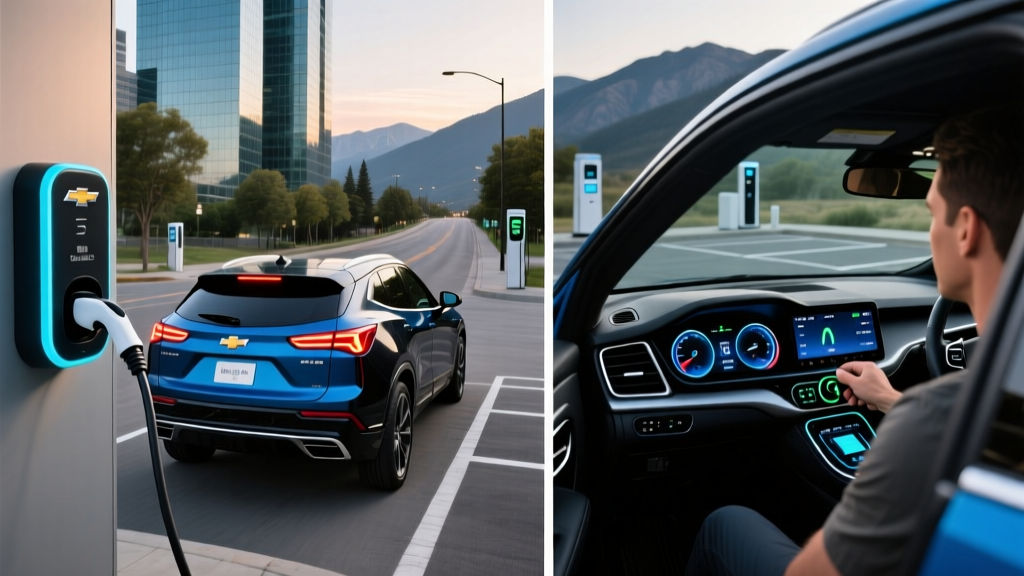
Chevrolet's electrified lineup in 2026 spans a wide spectrum — from mild-hybrid performance machines to the plug-in hybrid (PHEV) utility that practical buyers are searching for. If you've been looking into a plug in Chevy, the landscape has shifted significantly since the Volt's discontinuation. Today, Chevy's plug-in strategy centers on the 2026 Equinox PHEV (the compact crossover most shoppers want) and the Corvette E-Ray (a performance hybrid that doesn't plug in but often appears in plug-in Chevy searches). This guide breaks down the exact specs, real-world MPG, electric-only range, charging requirements, and tax credit eligibility so you can decide if a Chevy PHEV fits your driveway.
HEV vs PHEV: What Chevy Actually Offers in 2026
Before diving into specs, it's critical to understand the difference between a conventional hybrid (HEV) and a plug-in hybrid (PHEV). Many shoppers confuse the two, and Chevy sells both.
| Feature | Conventional Hybrid (HEV) | Plug-In Hybrid (PHEV) |
|---|---|---|
| Plug-in charging? | No — charges via engine and regenerative braking | Yes — plug in to charge the larger battery |
| Battery size | 1–2 kWh (small buffer) | 15–25 kWh (usable) |
| Electric-only driving | Minimal (under 1 mile at low speed) | 30–50+ miles at full speed |
| Gas engine role | Primary propulsion, assisted by motor | Backup after battery depletes; highway cruising |
| Fuel economy (after battery) | Strong city MPG (regen-heavy) | Good, but heavier due to larger battery |
| Tax credit eligible? | No (not under §30D) | Potentially — up to $7,500 under §30D |
Chevy's current HEV models include the Corvette E-Ray (mild hybrid AWD system) and the Silverado Hybrid (if available in your market). Neither plugs in. The Equinox PHEV is Chevy's primary plug-in offering for 2026, designed for buyers who want electric commuting without range anxiety on road trips.
2026 Chevy Equinox PHEV: Range, MPG, and Powertrain Specs
The 2026 Equinox PHEV is built on GM's updated platform with a larger battery pack than the outgoing generation. Here are the exact numbers buyers need:
| Specification | 2026 Equinox PHEV (FWD) |
|---|---|
| EPA Electric-Only Range | 42 miles |
| Total Combined Range (EV + Gas) | ~430 miles |
| Battery (Usable) | 17.7 kWh, NMC lithium-ion |
| Combined System Horsepower | 215 hp (1.5L turbo + electric motor) |
| Engine | 1.5L turbocharged 4-cylinder (138 hp) |
| Electric Motor Output | 140 kW (~188 hp, combined with engine) |
| Transmission | CVT (hybrid-optimized) |
| EPA MPG (Charge-Sustaining) | 38 city / 35 highway / 37 combined |
| MPGe (Electric Mode) | 92 MPGe combined |
| 0–60 mph | ~7.5 seconds (estimated) |
| DC Fast Charging | Not available (Level 2 AC only) |
| Level 2 Charge Time (0–100%) | ~2.5 hours at 7.2 kW |
| Level 1 Charge Time (120V) | ~9 hours at 1.4 kW |
| Base MSRP | $36,500 (LT trim) |
Real-World Range Reality Check: The EPA rates the Equinox PHEV at 42 miles electric-only. In real-world testing, expect 35–40 miles during mixed city/highway driving in moderate temperatures. In cold weather (below 30°F), that drops to roughly 28–33 miles due to battery chemistry limitations and cabin heating draw. If your commute is under 35 miles round-trip, you'll rarely visit a gas station on weekdays.
Fuel Economy Deep Dive: Real-World MPG vs EPA Sticker
Once the battery depletes, the Equinox PHEV operates as a conventional hybrid. The EPA rates it at 37 MPG combined in charge-sustaining mode, but real-world results depend heavily on driving patterns:
| Driving Scenario | EPA Estimate | Real-World Expectation |
|---|---|---|
| City (frequent stops, regen-heavy) | 38 MPG | 36–42 MPG (hybrids often beat EPA in city) |
| Highway (sustained 70+ mph) | 35 MPG | 32–35 MPG (aerodynamic drag reduces regen benefit) |
| Cold weather (below 30°F) | — | 30–34 MPG (engine runs more for cabin heat) |
| Combined (mixed driving) | 37 MPG | 34–39 MPG |
The key insight: if you plug in nightly and commute under 40 miles, your effective "MPG" is essentially infinite for daily driving — you might use 2–3 gallons of gas per month. But if you never plug in, you're carrying 400+ lbs of battery you're not using, and the 37 MPG charge-sustaining figure is merely adequate compared to a dedicated hybrid like the Toyota RAV4 Hybrid (39 MPG combined without plugging in).
Charging the Equinox PHEV: What You Need at Home
Unlike full EVs, the Equinox PHEV does not support DC fast charging. This is standard for most PHEVs — the battery is small enough that Level 2 AC charging fills it quickly. Here's what to expect:
| Charging Level | Power (kW) | Time (0–100%) | Equipment Needed |
|---|---|---|---|
| Level 1 (120V household outlet) | 1.4 kW | ~9 hours | Included mobile cord |
| Level 2 (240V, 32A) | 7.2 kW | ~2.5 hours | Home wall charger or public L2 station |
| DC Fast Charging | N/A | N/A | Not supported on Equinox PHEV |
Home charging setup: Most PHEV owners find Level 1 (a standard 120V outlet in the garage) sufficient if the car is parked overnight for 9+ hours. However, a Level 2 home charger (240V, like a dryer outlet) cuts that to 2.5 hours — useful if you need a midday top-up or have a shorter parking window. Expect to pay $500–$1,500 for a Level 2 home installation (charger unit + electrician), depending on whether your electrical panel needs an upgrade. Always consult a licensed electrician for final specs.
One practical note: the Equinox PHEV uses the J1772 connector for AC charging (standard across all non-Tesla PHEVs). If you have a Tesla Wall Connector at home, you'll need a J1772 adapter (Tesla sells one for ~$50).
Does the Plug In Chevy Qualify for a Federal Tax Credit?
This is where PHEV buyers need to pay close attention. Under current IRS §30D rules, the 2026 Equinox PHEV may qualify for a partial or full federal tax credit of up to $7,500, but eligibility depends on several factors:
- Battery capacity requirement: The vehicle must have at least 7 kWh of battery capacity — the Equinox PHEV's 17.7 kWh pack clears this easily.
- MSRP cap: SUVs/crossovers must have an MSRP under $80,000 — the Equinox PHEV qualifies at $36,500+.
- Buyer income cap: Adjusted gross income must not exceed $150,000 (single), $225,000 (head of household), or $300,000 (joint filers).
- Critical minerals & battery sourcing: A percentage of battery components must be manufactured or assembled in North America, and critical minerals must be sourced from the U.S. or free-trade-agreement partners. GM has been actively reshoring battery supply, but the exact credit amount ($3,750 for minerals + $3,750 for components) varies by build date and supply chain certification.
- Point-of-sale transfer: As of 2024+, eligible buyers can transfer the credit to the dealer at purchase, reducing the purchase price directly rather than waiting for a tax refund.
Important: Tax credit eligibility changes frequently based on battery sourcing rules and Treasury guidance. Always verify current eligibility on fueleconomy.gov or with a tax professional before purchasing. Do not assume the full $7,500 — some PHEVs qualify for $3,750 (half credit) depending on component sourcing.
Battery Warranty, Reliability, and Replacement Costs
2026 Equinox PHEV Battery Warranty: GM covers the hybrid battery pack for 8 years or 100,000 miles (whichever comes first), with a capacity retention threshold of 60%. If the battery drops below 60% of original capacity within the warranty period, GM will repair or replace it at no cost. The powertrain (engine, transmission, electric motor) is covered for 5 years / 60,000 miles.
Reliability outlook: GM's PHEV powertrain technology has matured significantly since the Volt era. The 1.5L turbo engine is a proven design shared across GM's lineup, and the electric motor/generator system is simpler than a conventional transmission. PHEV batteries are smaller and less stressed than full EV batteries, meaning degradation is typically slower. Most PHEV owners report 5–8% capacity loss over 5 years — well within warranty thresholds.
Battery replacement cost (out of warranty): If the battery needs replacement after the 8-year/100,000-mile warranty expires, expect a cost in the range of $4,000–$7,000 (parts and labor) for a PHEV pack of this size. This is significantly less than a full EV battery replacement ($10,000–$20,000+) because the pack is smaller (17.7 kWh vs 75–100+ kWh in a BEV). However, PHEV battery failures are rare — most outlast the vehicle itself.
Who Should Choose a Plug In Chevy vs a Full EV or Gas Car?
The Equinox PHEV occupies a specific niche. Here's a practical decision framework:
Choose the Equinox PHEV if:
- Your daily commute is under 40 miles round-trip and you can plug in at home overnight
- You take 3+ road trips per year exceeding 200 miles and don't want to plan around charging stations
- You live in an apartment or area with limited public charging infrastructure
- You want to reduce gas consumption by 70–80% without going fully electric
Choose a full EV (like the Chevy Equinox EV or Tesla Model Y) if:
- You have reliable home Level 2 charging and your daily driving is under 250 miles
- You want zero tailpipe emissions and minimal maintenance (no oil changes, no gas engine)
- You want access to DC fast charging for road trips (10–80% in ~20 minutes)
Choose a conventional hybrid (HEV) if:
- You cannot plug in at home or work (no garage, no outlet access)
- You want better fuel economy without changing your habits at all
- You want a lower purchase price (HEVs typically cost $3,000–$5,000 less than PHEVs)
2026 Chevy Electrified Lineup: Pros and Cons at a Glance
Pros: Equinox PHEV
- 42 miles electric covers most daily commutes gas-free
- 430+ mile total range eliminates road-trip anxiety
- Qualifies for up to $7,500 federal tax credit (verify eligibility)
- Level 1 (120V) overnight charging is sufficient for most owners
- Familiar crossover size with strong cargo space (~29 cu ft rear seats up)
- 8-year / 100,000-mile battery warranty provides long-term peace of mind
Cons: Equinox PHEV
- No DC fast charging — long road trips rely entirely on the gas engine
- 37 MPG charge-sustaining is good but not class-leading (RAV4 Hybrid: 39 MPG)
- Premium over gas-only Equinox (~$6,000–$8,000 more) takes years to recoup at current gas prices
- Electric-only range drops to ~28–33 miles in freezing temperatures
- CVT transmission can feel rubbery under hard acceleration
- Tax credit eligibility depends on evolving battery sourcing rules
Frequently Asked Questions
How many MPG does the plug in Chevy Equinox get?
The 2026 Equinox PHEV is rated by the EPA at 38 city / 35 highway / 37 combined MPG after the battery is depleted (charge-sustaining mode). In electric mode, it achieves 92 MPGe combined. Real-world city driving often yields 36–42 MPG thanks to regenerative braking, while sustained highway driving at 70+ mph typically returns 32–35 MPG.
How far can the Equinox PHEV go on electric only?
The EPA rates the 2026 Equinox PHEV at 42 miles of electric-only range. In real-world conditions, expect 35–40 miles in moderate weather and 28–33 miles in cold weather (below 30°F). The gasoline engine seamlessly takes over once the battery is depleted, providing a total combined range of approximately 430 miles.
Hybrid vs PHEV vs EV — which is right for me?
If you can plug in at home and your daily driving is under 40 miles, a PHEV gives you electric commuting with gas backup for road trips — ideal for one-car households. If you have home charging and rarely drive over 250 miles in a day, a full EV (BEV) offers lower running costs, zero tailpipe emissions, and less maintenance. If you cannot plug in at all, a conventional hybrid (HEV) improves fuel economy without any behavioral change.
Is the Equinox PHEV reliable and what does battery replacement cost?
GM's PHEV powertrain has proven reliable, with the hybrid battery covered under an 8-year / 100,000-mile warranty (60% capacity retention threshold). PHEV batteries are smaller and less stressed than full EV batteries, and most experience only 5–8% degradation over 5 years. Out-of-warranty replacement costs are estimated at $4,000–$7,000, though full battery failure is rare.
Does the plug in Chevy qualify for a federal tax credit?
The 2026 Equinox PHEV may qualify for up to $7,500 under the IRS §30D Clean Vehicle Credit, subject to buyer income caps ($150K single / $300K joint), the $80,000 SUV MSRP cap, and battery component/critical mineral sourcing requirements. The credit can be transferred to the dealer at point of sale. Always verify current eligibility on irs.gov or with a tax professional before purchasing.
Can I charge the Equinox PHEV at a DC fast charger?
No. The Equinox PHEV does not support DC fast charging. It charges exclusively via AC — either Level 1 (120V, ~9 hours for a full charge) or Level 2 (240V, ~2.5 hours). This is normal for PHEVs: the 17.7 kWh battery is small enough that AC charging fills it quickly overnight.
What's the difference between the Equinox PHEV and the Equinox EV?
The Equinox EV is a fully electric vehicle with ~315 miles of EPA range, a ~85 kWh battery, DC fast charging up to 150+ kW, and no gasoline engine. The Equinox PHEV has 42 miles of electric range plus a gas engine for 430+ total miles, no DC fast charging, and a smaller 17.7 kWh battery. The EV is better for drivers with reliable home charging who rarely exceed 300 miles in a day. The PHEV is better for drivers who need road-trip flexibility or lack consistent charging access.
Sources: EPA fuel economy data via fueleconomy.gov, IRS Clean Vehicle Credit rules via irs.gov, Chevrolet official specifications.