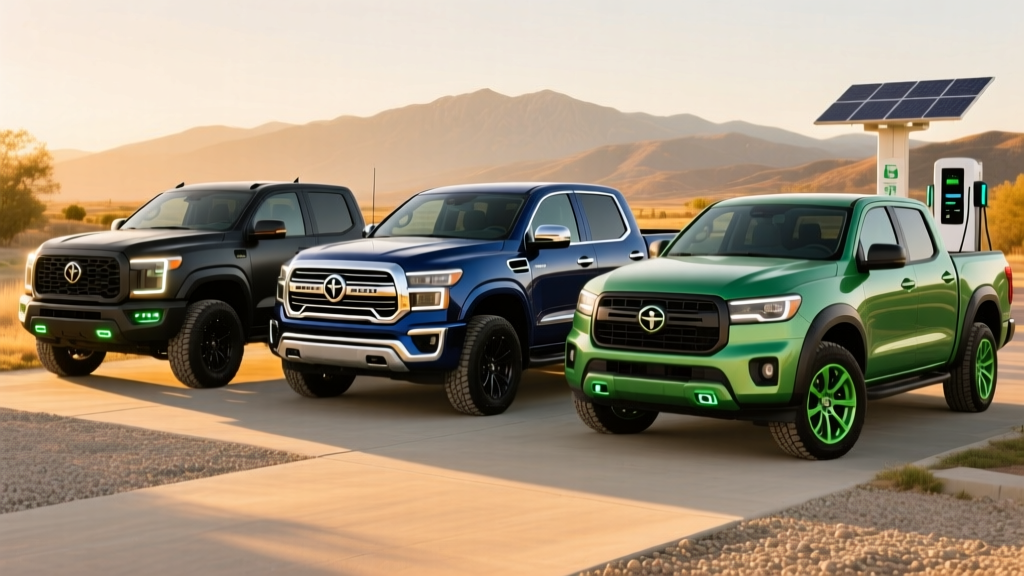
If you need a truck that can tow on the weekend, commute during the week, and skip the pain of $4-per-gallon fuel without plugging in or worrying about range, a pickup hybrid truck is the most practical bridge between old-school gas power and a fully electric future. As of the 2026 model year, the market has matured: Ford offers both a conventional hybrid (HEV) and a plug-in hybrid (PHEV) F-150, Toyota's Tundra i-FORCE MAX uses a hybrid powertrain tuned for torque, and newcomers like the Ram 1500 Ramcharger extend range with a series-hybrid setup. This guide breaks down the real numbers — EPA MPG, electric-only range, battery warranties, towing capacity, and tax-credit eligibility — so you can choose the right electrified truck for how you actually drive.
HEV vs PHEV Pickup Trucks: What's the Difference?
Before comparing models, it's critical to understand the two flavors of hybridization available in today's pickup trucks. A conventional hybrid (HEV) uses a small battery recharged by regenerative braking and the gas engine — you never plug it in. A plug-in hybrid (PHEV) carries a larger battery you charge from a wall outlet or public charger, giving you a meaningful electric-only driving range before the gas engine kicks in.
HEV vs PHEV at a Glance
| Feature | Conventional Hybrid (HEV) | Plug-In Hybrid (PHEV) |
|---|---|---|
| Plug in to charge? | No — self-charging via regen & engine | Yes — for electric-only range |
| Battery size | 1–2 kWh (small buffer) | 12–20+ kWh usable |
| Electric-only range | ~1 mile or less (low-speed assist) | 20–50+ miles (EPA rated) |
| Federal tax credit | Generally not eligible | Up to $7,500 if §30D requirements met |
| Best for | Drivers without home charging access | Drivers who can charge at home & commute short distances |
2026 Hybrid & PHEV Pickup Trucks: Side-by-Side Specs
Here are the key specifications for every major electrified pickup available for the 2026 model year. All figures reflect EPA-published data and manufacturer specs at the time of writing.
| Spec | Ford F-150 PowerBoost (HEV) | Ford F-150 PHEV | Toyota Tundra i-FORCE MAX (HEV) | Ram 1500 Ramcharger (EREV) |
|---|---|---|---|---|
| Powertrain type | HEV | PHEV | HEV | Series EREV |
| Engine + Motor | 3.5L V6 + 35 kW electric | 2.5L I4 + electric motor | 3.4L twin-turbo V6 + electric | Dual electric motors + 3.6L V6 generator |
| Combined HP | 430 hp | ~380 hp (est.) | 437 hp | 663 hp |
| Combined torque | 570 lb-ft | ~470 lb-ft (est.) | 583 lb-ft | 615 lb-ft |
| Battery (usable) | 1.5 kWh (NiMH/Li-ion buffer) | ~18 kWh (Li-ion) | 1.87 kWh (NiMH) | 92 kWh (NMC) |
| EPA electric-only range | N/A (self-charging) | ~35 mi (announced) | N/A (self-charging) | ~145 mi |
| EPA MPG (combined) | 25 MPG | ~28 MPG (charge-sustaining) | 20–22 MPG | ~30 MPG (charge-sustaining) |
| Total combined range | ~700 mi | ~550 mi | ~550 mi | ~690 mi |
| Max towing | 11,200 lbs | ~8,000 lbs (est.) | 11,175 lbs | 11,500 lbs |
| DC fast charge | No | No (Level 2 only) | No | Yes, ~150 kW peak |
| Level 2 charge time | N/A | ~2.5 hrs (240V/32A) | N/A | ~7 hrs (Level 2) |
| Starting MSRP | $62,050 | $65,000 (est.) | $59,895 | $72,095 |
| Federal tax credit (§30D) | Not eligible | Up to $7,500 (if sourcing met) | Not eligible | Up to $7,500 (if sourcing met) |
Note: Ford F-150 PHEV specs are preliminary based on manufacturer announcements; finalized EPA figures expected mid-2026. Ramcharger is classified as an extended-range EV (EREV), which operates as a series hybrid — the gas engine never drives the wheels directly.
Fuel Economy Breakdown: EPA MPG vs Real-World
Hybrid trucks don't deliver the dramatic efficiency gains of a compact hybrid sedan. Weight and aerodynamics work against them. Still, the gains over a conventional V8 are meaningful — especially in stop-and-go driving where regenerative braking recovers energy that would otherwise be lost.
| Model | EPA City | EPA Highway | EPA Combined | Real-World Expectation |
|---|---|---|---|---|
| F-150 PowerBoost HEV | 25 MPG | 24 MPG | 25 MPG | 23–26 MPG (city-biased driving can exceed EPA) |
| Tundra i-FORCE MAX HEV | 20–22 MPG | 19–22 MPG | 20–22 MPG | 18–21 MPG (heavy towing drops to 12–14) |
| Ram 1500 Ramcharger EREV | ~30 MPG* | ~28 MPG* | ~30 MPG* | Depends heavily on daily charge habits |
*Ramcharger figures preliminary. When battery is depleted, the 3.6L V6 generator sustains charge; expect lower MPG on long highway trips without charging. Source: fueleconomy.gov
Electric-Only Range: How Far Can PHEV Trucks Go Without Gas?
For plug-in hybrid and EREV pickups, electric-only range is the headline feature. If your daily commute falls within that range and you charge at home, you could go weeks without visiting a gas station — while still having a full gas tank for towing or road trips.
- Ford F-150 PHEV: Approximately 35 miles of electric-only range (preliminary). Sufficient for most suburban commutes. Level 2 charging on a 240V/32A circuit takes roughly 2.5 hours — practical for overnight top-ups.
- Ram 1500 Ramcharger: A class-leading ~145 miles on its 92 kWh battery before the onboard V6 generator activates. This is possible because the Ramcharger is an EREV — the wheels are always driven by electric motors, and the gas engine serves purely as a generator. It also supports DC fast charging at up to 150 kW, adding roughly 50 miles of range in 10 minutes.
Conventional hybrids (F-150 PowerBoost, Tundra i-FORCE MAX) offer no meaningful electric-only range. Their small batteries provide brief low-speed electric assist, but the engine is always the primary power source.
Tax Credit Eligibility for Hybrid and PHEV Trucks
Under current IRS §30D Clean Vehicle Credit rules, only plug-in hybrids and EREVs with sufficient battery capacity can qualify — and even then, eligibility is far from guaranteed. Conventional HEVs like the F-150 PowerBoost and Tundra i-FORCE MAX do not qualify.
§30D Tax Credit Checklist for PHEV/EREV Trucks
- Battery capacity: Must be at least 7 kWh — both the F-150 PHEV and Ramcharger exceed this.
- MSRP cap: Vans, SUVs, and pickup trucks must have an MSRP at or below $80,000. Higher-trim Ramcharger models may exceed this cap.
- Buyer income limits (2026): Modified AGI must not exceed $300,000 (joint), $225,000 (head of household), or $150,000 (single).
- Battery sourcing & critical minerals: The credit is split into two halves ($3,750 each) based on battery component manufacturing and critical mineral sourcing requirements. These rules tighten annually — verify current-year compliance on the IRS website or with a tax professional.
- Point-of-sale transfer: Eligible buyers can transfer the credit to the dealer at purchase, reducing the purchase price directly rather than waiting for a tax refund.
Credit eligibility depends on the specific VIN and build date. Always confirm using the IRS Clean Vehicle Credit tool before purchasing.
Battery Warranty, Reliability & Replacement Costs
Hybrid battery longevity is the number-one concern among truck buyers considering electrification. The good news: hybrid batteries are engineered for the life of the vehicle, and federal law mandates minimum warranty coverage.
Hybrid Battery Warranty Comparison
| Model | Battery Warranty | Capacity Retention Threshold |
|---|---|---|
| Ford F-150 PowerBoost / PHEV | 8 years / 100,000 miles | Below 70% capacity |
| Toyota Tundra i-FORCE MAX | 10 years / 150,000 miles | Below 70% capacity |
| Ram 1500 Ramcharger | 8 years / 100,000 miles | Below 70% capacity |
Replacement costs if out of warranty: Conventional hybrid batteries (F-150 PowerBoost, Tundra) are relatively small — replacement typically runs $3,000–$5,000 including labor. The Ramcharger's 92 kWh pack is a different story: out-of-warranty replacement could exceed $15,000–$20,000, similar to a full BEV battery swap. However, with proper thermal management and typical degradation rates of 1–2% per year, most owners will never face this cost within the warranty period.
Toyota's hybrid systems carry an especially strong reliability reputation — the i-FORCE MAX powertrain shares architecture with the proven hybrid systems in the Sequoia and Land Cruiser. Ford's PowerBoost has been in the F-150 since 2021 and has accumulated significant real-world mileage data with few widespread battery failure reports.
Who Should Buy a Hybrid Truck vs a Full EV or Gas Truck?
Decision Framework: Which Powertrain Fits Your Truck Use?
Choose a conventional hybrid (HEV) truck if:
- You don't have access to home or workplace charging
- You tow frequently and want maximum towing capacity without range compromise
- You want better fuel economy with zero behavior change — just fill up with gas
- You prefer proven, simpler ownership (no charging infrastructure needed)
Choose a PHEV or EREV truck if:
- You have Level 2 charging at home and a commute within electric-only range
- You want to drive on electricity most weekdays but need gas flexibility for weekend towing or road trips
- You want to potentially qualify for the §30D federal tax credit
- You want to reduce fuel costs significantly without full BEV range anxiety
Choose a full BEV truck (F-150 Lightning, Silverado EV, Rivian R1T) if:
- You have reliable home charging and your daily driving is under 250 miles
- You rarely tow heavy loads over long distances (towing cuts BEV range by 40–50%)
- You want the lowest per-mile fuel cost and minimal maintenance
- You're comfortable planning DC fast-charging stops on road trips
Pros and Cons: Hybrid Pickup Trucks at a Glance
✓ Pros
- 15–30% better fuel economy than equivalent gas-only trucks
- No range anxiety — gas engine provides 500+ mile total range
- Strong low-end torque from electric motor assist (ideal for towing)
- HEVs require zero charging infrastructure
- PHEVs/EREVs can eliminate daily gas use for short commutes
- ProV2L/V2H capability on some models (power tools, campsite, home backup)
- Hybrid battery warranties cover 8–10 years
✗ Cons
- Higher MSRP than gas-only equivalents ($5,000–$15,000 premium)
- HEVs do not qualify for the §30D federal tax credit
- Highway MPG gains are modest — aerodynamics limit hybrid advantage at speed
- PHEV/EREV battery replacement costs are significant out of warranty
- Added weight from hybrid system can slightly reduce payload capacity
- Towing with a depleted PHEV battery drops MPG substantially
- Fewer hybrid truck options compared to gas — limited trim/bed configurations
Frequently Asked Questions
How many MPG does a hybrid pickup truck get?
It depends on the model. The Ford F-150 PowerBoost HEV achieves an EPA-rated 25 MPG combined (25 city / 24 highway). The Toyota Tundra i-FORCE MAX delivers 20–22 MPG combined depending on trim and drivetrain. The Ram 1500 Ramcharger EREV targets approximately 30 MPG combined in charge-sustaining mode (after the battery is depleted). In real-world city driving, hybrids often exceed their EPA city rating thanks to regenerative braking — but highway-heavy driving at 75+ MPH erodes the advantage.
How far can a PHEV truck go on electric only?
The Ford F-150 PHEV is expected to deliver approximately 35 miles of electric-only range — enough for most suburban commutes. The Ram 1500 Ramcharger, with its 92 kWh battery, achieves a class-leading ~145 miles of electric-only range before its onboard V6 generator activates. Conventional HEV trucks (F-150 PowerBoost, Tundra i-FORCE MAX) have no meaningful electric-only range.
Do hybrid trucks qualify for a tax credit?
Only plug-in hybrids and EREVs with at least 7 kWh of battery capacity are potentially eligible for the federal §30D Clean Vehicle Credit of up to $7,500. Conventional hybrids (HEVs) do not qualify. Even for PHEVs and EREVs, eligibility depends on MSRP caps ($80,000 for trucks), buyer income limits, and battery sourcing requirements that tighten each year. Check the IRS Clean Vehicle Credit page for current-year rules.
Are hybrid truck batteries reliable, and what does replacement cost?
Hybrid batteries are designed to last the life of the vehicle. Federal law requires a minimum 8-year/100,000-mile warranty on hybrid battery systems; Toyota extends this to 10 years/150,000 miles. Real-world data from millions of Toyota and Ford hybrids shows that catastrophic battery failure within the warranty period is rare. If replacement is needed out of warranty, conventional hybrid batteries cost $3,000–$5,000. The Ramcharger's large 92 kWh pack would cost significantly more — estimated at $15,000–$20,000 — though degradation rates of 1–2% per year mean most owners won't need replacement during typical ownership.
Can I tow with a hybrid truck without losing all my fuel economy?
You can tow — hybrid trucks are rated for 8,000–11,500 lbs depending on the model. However, towing dramatically reduces fuel economy for every powertrain. Expect a hybrid truck's MPG to drop to 12–16 MPG when towing near max capacity. The hybrid advantage is most pronounced in unloaded or lightly loaded daily driving. For PHEVs and EREVs, towing will also deplete the battery faster, reducing or eliminating electric-only range on that trip.
Hybrid vs PHEV vs full EV truck — which should I choose?
If you lack home charging and tow frequently, a conventional HEV (F-150 PowerBoost or Tundra i-FORCE MAX) is the lowest-risk choice. If you have home charging and a short commute but need gas flexibility for road trips, a PHEV or EREV (F-150 PHEV or Ramcharger) gives you electric daily driving with gas-engine backup. If you rarely tow long distances and have reliable charging access, a full BEV like the F-150 Lightning or Rivian R1T offers the lowest operating cost and zero tailpipe emissions.