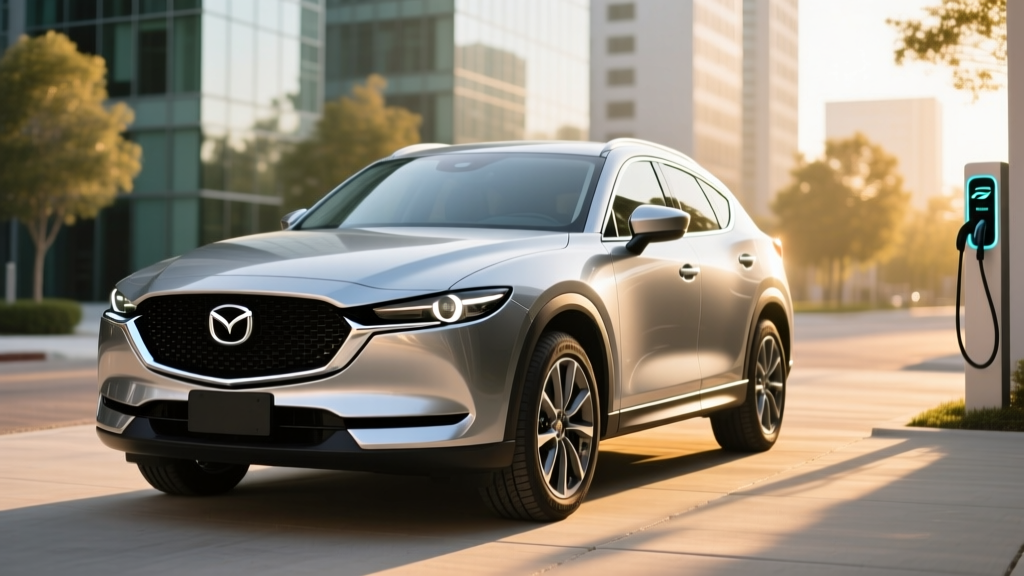
The 2026 Mazda CX-50 Hybrid Premium occupies a specific niche: it's a conventional hybrid (HEV) that pairs Toyota's proven hybrid synergy drive system with Mazda's rugged styling and upscale interior. Unlike a plug-in hybrid (PHEV) or a full battery-electric vehicle (BEV), the CX-50 Hybrid never needs to be plugged in. You fuel it like any other gasoline car, and the hybrid system handles the rest — regenerating energy under braking and assisting the gas engine for better efficiency.
For buyers cross-shopping the Mazda CX-50 Hybrid Premium against the Toyota RAV4 Hybrid (its mechanical cousin), the Honda CR-V Hybrid, and the Ford Escape Hybrid, this guide breaks down exactly what you get: real-world MPG expectations, powertrain specs, ownership costs, and whether the Premium trim's feature set justifies its MSRP.
Hybrid (HEV) vs. Plug-In Hybrid (PHEV) — Which Is the CX-50?
The Mazda CX-50 Hybrid is a conventional hybrid (HEV). It has no plug, no electric-only driving range to speak of, and no kWh battery you can charge from the grid. The small traction battery (approximately 1.6 kWh, nickel-metal hydride) is charged exclusively through regenerative braking and the gasoline engine.
| Feature | CX-50 Hybrid (HEV) | Typical PHEV (e.g., RAV4 Prime) |
|---|---|---|
| Plug-in charging | No — gas only | Yes — Level 1 or Level 2 |
| Electric-only range | ~1 mile at low speed | 35–42 miles EPA |
| Battery size | ~1.6 kWh (NiMH) | 18.1 kWh (Li-ion) |
| Federal tax credit (§30D) | Not eligible | Up to $7,500 (if eligible) |
| Best for | No home charging access | Home chargers with short commutes |
If you were hoping the CX-50 Hybrid could do school runs and grocery trips on electricity alone, you need a PHEV or a BEV. The CX-50 Hybrid's advantage is simplicity: zero behavior change from your current gas car, with meaningfully better fuel economy.
Fuel Economy: EPA MPG and Real-World Expectations
The 2026 Mazda CX-50 Hybrid Premium carries an EPA-estimated 38 MPG combined, with a breakdown of 39 MPG city and 37 MPG highway, according to fueleconomy.gov. These figures apply to the all-wheel-drive (AWD) configuration, which is standard on every CX-50 Hybrid trim.
| Driving Cycle | EPA Estimate | Real-World Expectation |
|---|---|---|
| City | 39 MPG | 38–42 MPG (hybrids excel here) |
| Highway (70+ mph) | 37 MPG | 33–36 MPG (aero drag, less regen benefit) |
| Combined | 38 MPG | 35–39 MPG depending on mix |
| Cold weather (below 32°F) | — | 30–34 MPG (engine runs more for heat) |
Why real-world often beats EPA in the city: Conventional hybrids recapture kinetic energy during stop-and-go driving, letting the electric motor handle low-speed acceleration while the gas engine shuts off at stops. On the highway, the gas engine does most of the work and aerodynamic drag dominates, which is why highway MPG dips slightly below the city figure — the opposite of a conventional gas car.
With a 15.9-gallon fuel tank, expect a real-world driving range of roughly 540–590 miles per fill-up under mixed conditions.
Powertrain: Toyota Hybrid Hardware in a Mazda Shell
The CX-50 Hybrid uses a powertrain sourced from Toyota — specifically the 2.5-liter four-cylinder Dynamic Force engine paired with two electric motor-generators and an electronically controlled continuously variable transmission (eCVT). This is the same architecture found in the Toyota RAV4 Hybrid and Highlander Hybrid, which is a strong reliability signal.
| Specification | 2026 Mazda CX-50 Hybrid Premium |
|---|---|
| Engine | 2.5L inline-4 Atkinson-cycle |
| Combined system output | 219 hp |
| Transmission | eCVT (planetary gearset, not a belt CVT) |
| Drivetrain | AWD standard (electronic rear motor) |
| 0–60 mph | ~7.8 seconds (est.) |
| Towing capacity | 3,500 lbs |
| Battery type | NiMH, ~1.6 kWh |
| EPA combined MPG | 38 MPG |
| Fuel tank | 15.9 gallons |
The eCVT here is Toyota's planetary gearset design — not the rubber-belt CVTs that give the technology a bad reputation. It's gear-driven, exceptionally durable, and has been refined over 25+ years of Prius production. The AWD system uses a dedicated rear electric motor rather than a mechanical driveshaft, which reduces parasitic loss and enables torque vectoring.
Pricing: 2026 CX-50 Hybrid Premium MSRP and Tax Credit Eligibility
The 2026 Mazda CX-50 Hybrid Premium starts at approximately $40,050 MSRP (including destination). This positions it between the base CX-50 Hybrid Select (~$35,350) and the top-tier Premium Plus (~$43,250).
Federal tax credit: The CX-50 Hybrid does not qualify for the IRS §30D Clean Vehicle Credit. That credit applies exclusively to plug-in electric vehicles (BEVs and PHEVs) with sufficient battery capacity and domestic battery-sourcing compliance. Conventional hybrids have not qualified for the federal purchase credit since the original Hybrid Tax Credit expired for most manufacturers in the late 2000s. Check IRS.gov §30D guidelines for the latest rules.
State incentives: A handful of states offer modest rebates or HOV-lane access for hybrids, but these vary widely and change frequently. Check your state's energy office or DMV for current programs.
Battery Warranty, Reliability, and Replacement Cost
Hybrid battery warranty: Mazda covers the CX-50 Hybrid's traction battery for 8 years / 100,000 miles (10 years / 150,000 miles in California and states adopting CARB emissions standards). This is the industry-standard hybrid battery warranty.
Reliability outlook: Because the CX-50 Hybrid's powertrain is Toyota's fourth-generation hybrid system, it inherits one of the most proven drivetrains in automotive history. Toyota's hybrid synergy drive has accumulated billions of real-world miles across the Prius, Camry Hybrid, RAV4 Hybrid, and Highlander Hybrid lineups. The NiMH battery chemistry is less energy-dense than lithium-ion but is extremely tolerant of the shallow charge-discharge cycles that hybrids use — meaning degradation is minimal over the vehicle's life.
Battery replacement cost: If the hybrid battery fails outside warranty, expect to pay between $2,500 and $4,500 for a replacement, depending on whether you use a new OEM unit, a refurbished module, or an independent hybrid specialist. In practice, Toyota-sourced hybrid batteries routinely last 150,000–200,000+ miles before capacity loss becomes noticeable, and even then the vehicle remains drivable with reduced electric assist.
The eCVT transmission carries the same powertrain warranty (5 years / 60,000 miles for the general powertrain, 8 years / 100,000 miles for hybrid-specific components). Because it has no belts, clutches, or friction bands to wear, eCVT failure is exceedingly rare.
Premium Trim: What You Get for the Money
The Premium trim sits in the upper-middle of the CX-50 Hybrid lineup. Key equipment includes:
- 10.25-inch infotainment display with wireless Apple CarPlay and Android Auto
- Bose 12-speaker premium audio system
- Leather-trimmed seats with heated front seats and heated steering wheel
- Power liftgate
- Head-up display (HUD)
- 360-degree surround-view monitor
- Wireless phone charging pad
- Mazda's i-Activsense safety suite: adaptive cruise control, lane-keeping assist, blind-spot monitoring, rear cross-traffic alert
Compared to the RAV4 Hybrid XLE Premium (its closest mechanical equivalent), the CX-50 Hybrid Premium trades slightly less rear-seat headroom and cargo volume for a more upscale cabin, standard AWD, and a more engaging driving character. The trade-off is roughly $1,500–$2,500 more at equivalent trim levels.
Who Should Choose the CX-50 Hybrid vs. a PHEV or Full EV?
Pros
- No plug-in required — zero behavior change from a gas car
- Toyota-sourced hybrid powertrain with exceptional reliability track record
- 38 MPG combined saves ~$600–$900/year in fuel vs. the turbo gas CX-50
- 3,500-lb towing capacity (above class average for hybrids)
- Premium interior materials and quiet cabin
Cons
- No federal tax credit eligibility
- No electric-only driving mode for zero-emission commutes
- Cargo space slightly less than RAV4 Hybrid (31.4 cu ft vs. 37.6 cu ft behind rear seats)
- Infotainment uses a rotary dial, not touchscreen (polarizing)
- Highway MPG drops noticeably above 75 mph
Choose the CX-50 Hybrid Premium if: You don't have reliable access to home or workplace charging, you want a proven hybrid with strong reliability, and you value Mazda's interior quality over maximum cargo space.
Consider a PHEV (like the RAV4 Prime or CX-50 PHEV, if Mazda offers one) if: You can install a Level 2 charger at home and your daily commute is under 40 miles — you'd drive mostly on electricity and only use gas for longer trips.
Consider a full BEV (like the Tesla Model Y or Hyundai Ioniq 5) if: You have home charging, your daily driving is under 250 miles, and you want to eliminate gasoline entirely while accessing the up-to-$7,500 federal tax credit.
Frequently Asked Questions
How many MPG does the Mazda CX-50 Hybrid Premium get?
The EPA rates it at 39 MPG city, 37 MPG highway, and 38 MPG combined. In real-world mixed driving, expect 35–39 MPG. City driving often exceeds the EPA estimate thanks to regenerative braking; sustained highway driving above 70 mph typically returns 33–36 MPG.
Does the CX-50 Hybrid need to be plugged in?
No. The CX-50 Hybrid is a conventional hybrid (HEV), not a plug-in hybrid (PHEV). It charges its own small battery through regenerative braking and the gas engine. You only ever put gasoline in it.
Is the Mazda CX-50 Hybrid reliable?
The powertrain is Toyota's proven hybrid system, which has decades of reliability data behind it. The NiMH battery is rated for 8 years/100,000 miles under warranty and routinely lasts 150,000–200,000+ miles. The eCVT transmission has no wear-prone friction components. Overall, this is one of the most reliable powertrains available in a new vehicle.
What does it cost to replace the CX-50 Hybrid battery?
Out-of-warranty hybrid battery replacement runs approximately $2,500–$4,500 depending on the source (OEM new, refurbished, or independent specialist). However, Toyota-sourced NiMH hybrid batteries rarely need replacement before 150,000+ miles.
Does the CX-50 Hybrid qualify for any tax credit?
It does not qualify for the federal §30D Clean Vehicle Credit, which is reserved for plug-in vehicles (BEVs and PHEVs). Some states may offer small hybrid incentives — check your state's energy office. The IRS Clean Vehicle Credit page has the full eligibility details for plug-in vehicles if you're considering switching.
How does the CX-50 Hybrid compare to the RAV4 Hybrid?
Both share the same 219-hp Toyota hybrid powertrain and similar EPA MPG (RAV4 Hybrid is rated at 39/35/37 city/highway/combined for AWD). The CX-50 Hybrid Premium offers a more upscale interior, standard Bose audio, and a slightly sportier drive. The RAV4 Hybrid wins on cargo space (37.6 vs. 31.4 cu ft) and offers the plug-in RAV4 Prime variant with 42 miles of electric-only range.
Can the CX-50 Hybrid tow?
Yes — it's rated for 3,500 lbs of towing capacity, which covers a small utility trailer, a pair of jet skis, or a lightweight camping trailer. This matches the gas-only turbo CX-50 and exceeds many competing hybrid SUVs.
Sources: EPA fuel economy data from fueleconomy.gov; federal tax credit rules from IRS.gov §30D; vehicle specifications from Mazda USA.