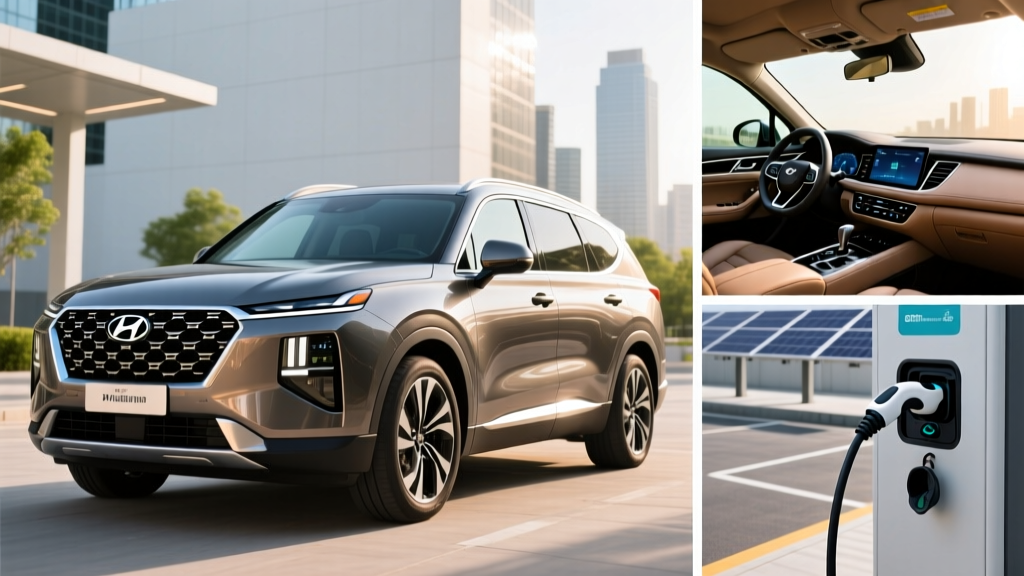
The three-row SUV segment has been slow to embrace electrification, but the 2026 Hyundai Palisade Hybrid changes that equation — especially in the range-topping Calligraphy trim. With a turbocharged hybrid powertrain, premium interior appointments, and a starting MSRP around $58,500, the Palisade Hybrid Calligraphy targets families who want three-row space, upscale comfort, and meaningfully better fuel economy without committing to a plug-in or full battery-electric vehicle.
This guide breaks down every number that matters: EPA fuel economy, real-world MPG expectations, powertrain output, battery warranty coverage, pricing, and whether any federal or state incentives apply. We also clarify exactly what kind of hybrid this is — and who should consider it versus a PHEV or full EV alternative.
HEV vs PHEV: What Kind of Hybrid Is the Palisade?
Before diving into specs, it's critical to understand what the Palisade Hybrid is not: it is not a plug-in hybrid (PHEV). The Palisade Hybrid is a conventional hybrid electric vehicle (HEV). That distinction carries real ownership implications.
HEV vs PHEV at a Glance
| Feature | Palisade Hybrid (HEV) | Typical PHEV SUV |
|---|---|---|
| Plug-in charging required? | No — self-charging via engine + regen | Yes — plug in for electric-only range |
| Electric-only driving range | Not applicable (electric assist only) | 25–45 miles typical |
| Battery size | ~1.5–2.0 kWh (small, high-discharge) | 15–30 kWh |
| DC fast charging | No | Varies (some yes, some no) |
| Federal tax credit (§30D) | Not eligible | Up to $7,500 if requirements met |
| Home charging install needed? | No | Recommended (Level 2) |
The Palisade Hybrid's small battery pack charges itself through regenerative braking and the gasoline engine. You never plug it in. You simply refuel at any gas station and drive. The hybrid system's job is to optimize fuel efficiency — shutting off the engine at stops, providing electric torque assist during acceleration, and recapturing energy during braking — not to enable electric-only commutes.
Fuel Economy: EPA Ratings and Real-World MPG
For a three-row SUV weighing over 4,500 pounds, the Palisade Hybrid's fuel economy represents a substantial improvement over its gasoline-only sibling. Here are the EPA-estimated figures for the 2026 Palisade Hybrid with all-wheel drive (the Calligraphy trim comes exclusively with AWD):
| Driving Cycle | EPA Estimate | Real-World Expectation |
|---|---|---|
| City | 27 MPG | 28–31 MPG (hybrids excel in stop-and-go) |
| Highway | 28 MPG | 25–27 MPG (aerodynamic drag hurts at 70+ mph) |
| Combined | 27 MPG | 26–29 MPG depending on driving mix |
Real-world note: Conventional hybrids like the Palisade often exceed their EPA city rating in real-world stop-and-go driving because regenerative braking recaptures energy that a gas-only vehicle wastes as heat. Conversely, sustained highway driving at higher speeds reduces the hybrid system's advantage. On a 300-mile highway road trip at 75 mph with A/C running, expect closer to 25–26 MPG. In suburban and city mixed driving, 29–31 MPG is achievable.
Compared to the gas-only Palisade AWD (rated at 19 city / 25 highway / 21 combined per fueleconomy.gov), the hybrid delivers roughly a 28% improvement in combined fuel economy. Over 15,000 miles annually at $3.50/gallon, that translates to approximately $550–$650 in annual fuel savings.
Powertrain and Performance Specs
The 2026 Palisade Hybrid pairs a turbocharged 2.5-liter four-cylinder engine with an electric motor integrated into the transmission housing. The combined system output is substantially more than the gas-only model, delivering confident acceleration for a vehicle of this size.
| Specification | Palisade Hybrid Calligraphy |
|---|---|
| Engine | 2.5L turbocharged 4-cylinder + electric motor |
| Combined system horsepower | 329 HP |
| Combined system torque | 383 lb-ft |
| Transmission | 6-speed automatic (hybrid-optimized) |
| Drivetrain | AWD (standard on Calligraphy) |
| 0–60 mph (est.) | ~6.8 seconds |
| Towing capacity | 5,000 lbs (when properly equipped) |
| Battery type | Lithium-ion polymer (~1.5 kWh) |
| Seating capacity | 7 passengers (2nd-row captain's chairs on Calligraphy) |
| Cargo volume (behind 3rd row) | ~20.4 cu ft |
| Cargo volume (max, all rows folded) | ~86.4 cu ft |
The 329 HP combined output is a significant upgrade over the gas-only Palisade's 291 HP V6, and the electric motor's instant torque delivery makes the hybrid feel noticeably more responsive from a stop. Highway merging and passing maneuvers benefit from the combined torque curve — there's less of the downshift hesitation you get from a conventional V6 under load.
Calligraphy Trim: What You Get for the Money
The Calligraphy sits at the top of the Palisade Hybrid lineup, and for 2026 it carries an MSRP of approximately $58,500 (including destination). That positions it against luxury-badged three-row SUVs at a fraction of their price. Key Calligraphy-specific features include:
- Nappa leather seating surfaces with quilted door panel inserts
- Head-up display (HUD) with hybrid-specific energy flow readout
- Dual 12.3-inch panoramic displays (instrument cluster + infotainment)
- Hyundai Digital Key 2 (phone-as-key via NFC/UWB)
- Highway Driving Assist 2 (HDA2) — SAE Level 2 driver assistance with lane-change assist
- Remote Smart Parking Assist (RSPA)
- Premium 12-speaker Bose audio system
- Heated/ventilated front and second-row seats
- Acoustic laminated glass (front and rear doors)
- 20-inch alloy wheels with all-season tires
Hyundai's HDA2 system is an SAE Level 2 driver-assistance suite. It handles adaptive cruise control and lane centering on divided highways, and can even assist with lane changes when the driver signals. However, it requires continuous driver attention — hands on or near the wheel and eyes on the road at all times. It is not autonomous driving.
Battery Warranty, Lifespan, and Replacement Cost
Hybrid battery longevity remains a top concern for buyers transitioning from conventional vehicles. Hyundai addresses this with one of the strongest warranty packages in the segment.
Palisade Hybrid Battery & Powertrain Warranty
| Coverage | Duration / Mileage |
|---|---|
| Hybrid battery pack | 10 years / 100,000 miles (original owner) |
| Hybrid system components (motor, inverter, controller) | 10 years / 100,000 miles |
| Powertrain (engine, transmission) | 10 years / 100,000 miles |
| New vehicle limited warranty | 5 years / 60,000 miles |
| Hybrid battery (subsequent owners, where applicable by state) | Varies — often 8 years / 80,000 miles under CARB states |
The Palisade Hybrid's battery pack is small (~1.5 kWh) compared to a PHEV or full EV, which works in its favor for longevity. Smaller packs experience shallower charge/discharge cycles, reducing degradation stress. Based on data from Hyundai's earlier hybrid models (Ioniq, Sonata Hybrid), these packs routinely exceed 150,000 miles without meaningful capacity loss.
Replacement cost: If the hybrid battery does require replacement outside of warranty, expect a cost in the range of $2,500–$4,000 including labor for the battery module. This is substantially less than a full EV battery replacement ($8,000–$20,000+) because you're replacing a small pack, not a 75+ kWh traction battery. Individual module replacement (rather than the full pack) may reduce costs further depending on the failure mode.
Tax Credits and Incentives
Here is where the Palisade Hybrid's conventional HEV status matters financially:
- Federal §30D Clean Vehicle Credit: The Palisade Hybrid does not qualify for the federal EV tax credit. Per IRS guidelines, the §30D credit applies only to plug-in electric vehicles (BEVs and PHEVs) that meet battery capacity, critical mineral sourcing, MSRP cap, and buyer income requirements. Conventional hybrids are excluded.
- Federal §25D or energy credits: Not applicable — these cover home energy equipment, not vehicles.
- State incentives: A small number of states offer modest rebates or HOV-lane access for conventional hybrids, but most state incentive programs have shifted exclusively to plug-in vehicles. Check your state's energy or DMV website for current programs.
- Dealer/manufacturer incentives: Hyundai periodically offers cash-back or low-APR financing on the Palisade lineup. These vary by region and month — check HyundaiUSA.com or your local dealer for current offers.
The absence of federal tax incentives means the Palisade Hybrid Calligraphy's value proposition rests entirely on its fuel savings, premium feature content, and warranty coverage rather than government subsidies.
Who Should Choose the Palisade Hybrid Calligraphy?
Choose the Palisade Hybrid Calligraphy If:
- You need three rows of seating and premium comfort but don't want to pay luxury-brand pricing
- You want better fuel economy without changing your refueling habits (no plugs, no apps, no charging networks)
- Your driving is a mix of city and highway, and you value the hybrid's city MPG advantage
- You plan to keep the vehicle 8–10+ years (the warranty coverage rewards long-term ownership)
- You tow occasionally (5,000-lb capacity is competitive for the class)
Consider a PHEV or Full EV Instead If:
- You have a short commute (under 30 miles) and home charging access — a PHEV could eliminate most gasoline use
- You want to qualify for the $7,500 federal tax credit (requires a qualifying BEV or PHEV)
- You want zero tailpipe emissions during daily driving
- You already own a home Level 2 charger and want to maximize electric-only miles
The Palisade Hybrid Calligraphy occupies a specific niche: it's the choice for buyers who want electrification's efficiency benefits without any of its infrastructure demands. There's no charging cable to manage, no range to monitor, no public charging network to rely on. You drive it exactly like a conventional SUV — it just visits the gas station less often.
Palisade Hybrid vs. Alternatives: Quick Comparison
| Vehicle | Type | Combined MPG / MPGe | 3-Row? | Starting MSRP (approx.) | Federal Credit? |
|---|---|---|---|---|---|
| Hyundai Palisade Hybrid Calligraphy | HEV | 27 MPG | Yes | $58,500 | No |
| Toyota Grand Highlander Hybrid | HEV | 35 MPG | Yes | $53,000 | No |
| Mazda CX-90 PHEV Premium Plus | PHEV | 25 MPG / 56 MPGe | Yes | $61,500 | Up to $7,500* |
| Kia EV9 GT-Line AWD | BEV | 88 MPGe (270 mi range) | Yes | $65,500 | Up to $7,500* |
* Federal credit eligibility depends on MSRP caps, buyer income, battery sourcing, and current IRS rules. Verify at irs.gov before purchasing.
The Grand Highlander Hybrid delivers superior fuel economy but lacks the Palisade's premium Calligraphy interior. The CX-90 PHEV offers electric-only commuting but requires plug-in access and a smaller third row. The EV9 eliminates gasoline entirely but demands charging infrastructure and accepts range trade-offs on long road trips. The Palisade Hybrid's advantage is simplicity — premium three-row SUV ownership with no behavioral changes required.
Frequently Asked Questions
How many MPG does the 2026 Palisade Hybrid get?
The EPA rates the Palisade Hybrid AWD at 27 city / 28 highway / 27 combined MPG. In real-world driving, city-heavy commutes can yield 29–31 MPG thanks to regenerative braking, while sustained highway driving at 75+ mph may drop to 25–26 MPG.
Does the Palisade Hybrid need to be plugged in?
No. The Palisade Hybrid is a conventional HEV. Its small battery charges through the gasoline engine and regenerative braking. You never plug it in — you refuel at any gas station as usual.
Is there an electric-only driving range?
No. Unlike a PHEV, the Palisade Hybrid cannot drive on electric power alone for any meaningful distance. The electric motor assists the engine and can propel the vehicle at very low speeds briefly (parking lots, traffic creep), but the engine remains the primary propulsion source.
Is the Palisade Hybrid reliable? What about battery replacement cost?
Hyundai's hybrid systems have proven durable in earlier models (Sonata Hybrid, Ioniq), with battery packs commonly lasting well beyond 100,000 miles. The hybrid battery carries a 10-year / 100,000-mile warranty. Out-of-warranty replacement is estimated at $2,500–$4,000 — far less than a full EV battery.
Does the Palisade Hybrid qualify for the $7,500 federal tax credit?
No. The federal §30D Clean Vehicle Credit applies only to qualifying plug-in electric vehicles (BEVs and PHEVs). Conventional hybrids like the Palisade Hybrid are not eligible. Check IRS.gov for current credit rules and qualifying vehicles.
How does the Palisade Hybrid Calligraphy compare to the gas-only Palisade?
The hybrid delivers approximately 28% better combined fuel economy (27 vs. 21 MPG combined), more horsepower (329 vs. 291 HP), and more torque. The trade-off is a higher starting price — the Calligraphy Hybrid commands roughly a $4,000–$5,000 premium over the equivalent gas-only Calligraphy, with fuel savings recovering that premium in approximately 6–8 years at 15,000 miles/year.
What is the Palisade Hybrid's towing capacity?
The Palisade Hybrid is rated to tow up to 5,000 pounds when properly equipped with the factory tow package. Note that towing significantly reduces fuel economy — expect 18–20 MPG while towing a loaded trailer.
The 2026 Palisade Hybrid Calligraphy isn't trying to be a revolution. It's a pragmatic, premium three-row SUV that happens to sip fuel more efficiently than its gas-only peers — without asking anything different of its owner. For families who want the comfort and technology of a top-trim SUV with a meaningful MPG upgrade and zero plug-in complexity, it makes a compelling case.