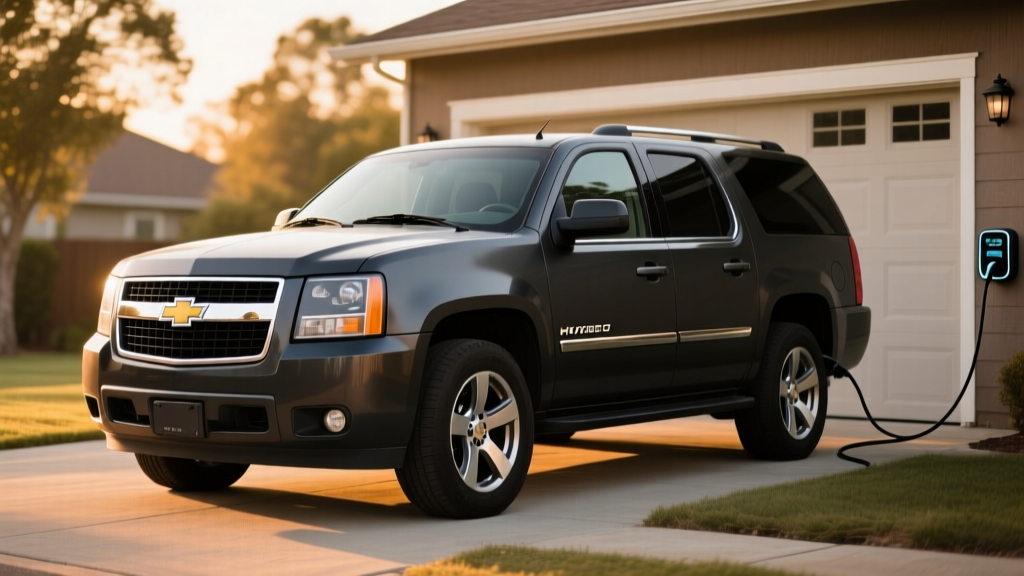
The 2008 Chevrolet Tahoe Hybrid was an anomaly when it launched: a body-on-frame, three-row SUV that could match a midsize sedan at the pump. As GM's first full-size two-mode hybrid, it paired a 6.0-liter V8 with a dual-motor electric system to deliver an EPA-rated 21 MPG combined — a figure that seemed almost impossible for a 5,800-pound vehicle. Nearly two decades later, the Tahoe Hybrid remains a curiosity on the used market, and buyers considering one need a clear-eyed look at what this vehicle actually delivers, what it costs to maintain, and how its aging hybrid system holds up.
This is a conventional hybrid (HEV), not a plug-in hybrid (PHEV). You never plug it in. The nickel-metal hydride (NiMH) battery charges exclusively through regenerative braking and the gasoline engine. If you're shopping for a Tahoe Hybrid today, you're buying a used vehicle — production ended after the 2013 model year — so understanding real-world efficiency, battery replacement costs, and ownership economics is essential before signing any paperwork.
2008 Chevy Tahoe Hybrid: MPG and Fuel Economy Breakdown
The EPA rated the 2008 Tahoe Hybrid at 21 MPG city / 22 MPG highway / 21 MPG combined for the two-wheel-drive model. The four-wheel-drive variant drops slightly to 20 MPG city / 22 MPG highway / 21 MPG combined. For context, the conventional 2008 Tahoe with the 5.3L V8 was rated at 14 city / 20 highway / 16 combined — meaning the hybrid delivered roughly a 31% improvement in combined fuel economy.
| Configuration | City MPG | Highway MPG | Combined MPG |
|---|---|---|---|
| 2WD Hybrid (6.0L V8 + 2-mode) | 21 | 22 | 21 |
| 4WD Hybrid (6.0L V8 + 2-mode) | 20 | 22 | 21 |
| 2WD Gas (5.3L V8) | 14 | 20 | 16 |
| 4WD Gas (5.3L V8) | 14 | 19 | 16 |
Source: fueleconomy.gov
Real-World MPG vs. EPA Estimates
Hybrid systems tend to outperform their EPA city ratings in stop-and-go driving, and the Tahoe Hybrid is no exception. Owner reports on fuel-tracking platforms consistently show real-world combined figures between 19 and 23 MPG, with city-heavy commuters occasionally touching 24 MPG in warm weather. Highway cruising at 75+ MPH tends to drop efficiency to 18–19 MPG, where the electric motors contribute less and aerodynamic drag dominates.
Cold weather reduces fuel economy by roughly 8–12%, primarily because the engine runs longer to heat the cabin and the battery operates less efficiently at low temperatures. Expect 17–19 MPG combined in freezing conditions with short trips.
Understanding the Two-Mode Hybrid Powertrain
The 2008 Tahoe Hybrid uses GM's Two-Mode Hybrid System, co-developed with BMW and Chrysler (then DaimlerChrysler). This is fundamentally different from the simpler hybrid systems found in a Toyota Prius or even the Toyota Highlander Hybrid of the same era.
| Specification | Detail |
|---|---|
| Engine | 6.0L V8 (Vortec), Active Fuel Management (cylinder deactivation) |
| Engine Horsepower | 332 HP @ 5,100 RPM |
| Electric Motors | Two 60 kW (80 HP each) AC synchronous motors |
| Combined System Output | 379 HP |
| Transmission | Electrically Variable Transmission (EVT) — 2-mode |
| Hybrid Battery | NiMH (nickel-metal hydride), ~1.8 kWh gross capacity |
| Battery Location | Under second-row seat |
| Towing Capacity | 6,200 lbs (2WD) / 6,000 lbs (4WD) |
| 0–60 MPH | ~8.2 seconds |
| Curb Weight | ~5,840 lbs |
The "two-mode" designation refers to how the system manages power delivery. In Mode 1 (low speed, city driving), the Tahoe can operate on electric power alone at speeds up to about 25 MPH, with the V8 shutting down entirely via cylinder deactivation and auto stop/start. In Mode 2 (highway and load-carrying), the system blends engine and motor power for sustained performance, including towing. This is why the Tahoe Hybrid could maintain its towing rating while still improving fuel economy — a feat that simpler single-mode hybrids struggled with in heavy vehicles.
HEV vs. PHEV: Why the Tahoe Hybrid Is a Conventional Hybrid Only
It's critical for used-car shoppers to understand what they're buying. The 2008 Tahoe Hybrid is a conventional hybrid (HEV). It has no plug, no electric-only range to speak of (the EV mode operates only at very low speeds for brief distances), and no ability to charge from an external power source.
| Feature | HEV (Tahoe Hybrid) | PHEV (e.g., 2026 RAV4 Prime) | BEV (e.g., 2026 Tesla Model X) |
|---|---|---|---|
| Plug-in Charging | No | Yes | Yes |
| Electric-Only Range | ~0 miles (low-speed EV creep only) | 35–42 miles | 300–350+ miles |
| Battery Size | ~1.8 kWh (NiMH) | ~18.1 kWh (Li-ion) | ~100 kWh (Li-ion) |
| DC Fast Charging | No | Rarely (most are Level 2 only) | Yes (150–250 kW typical) |
| Gasoline Engine | Yes (primary power + regen) | Yes (backup + highway) | No |
| Federal Tax Credit (§30D) | Not eligible (new or used) | Up to $7,500 if eligible | Up to $7,500 if eligible |
| Fuel Cost per Mile | ~$0.15–$0.18 (gas only) | ~$0.05 (electric) / $0.15 (gas) | ~$0.04–$0.06 (electric) |
Plug-in hybrids (PHEVs) didn't really exist in the full-size SUV segment in 2008. Today's PHEV SUVs like the Toyota Grand Highlander Hybrid Max or the Jeep Wrangler 4xe offer 25–42 miles of electric-only driving before the gas engine engages. If your daily commute is under 35 miles and you can charge at home, a modern PHEV delivers dramatically lower operating costs than the Tahoe Hybrid ever could.
Hybrid Battery Lifespan, Warranty, and Replacement Cost
This is the single biggest concern for anyone buying a used hybrid, and it should be. The 2008 Tahoe Hybrid's NiMH battery pack was covered by GM's original hybrid battery warranty: 8 years / 100,000 miles (10 years / 150,000 miles in California and states that adopted CARB emissions standards).
Original Battery Warranty: 8 years / 100,000 miles (federal) — 10 years / 150,000 miles (CARB states including CA, NY, MA, NJ, CT, RI, VT, ME, OR, WA)
Status in 2026: All 2008 Tahoe Hybrids are well past the 8-year federal warranty window. Any battery failure is an out-of-pocket expense unless an extended warranty was purchased and is still active.
How Long Does the NiMH Battery Last?
NiMH batteries in GM's two-mode system have proven more durable than early critics predicted. Based on owner forums and hybrid specialist shop data, most Tahoe Hybrid battery packs reach 140,000–180,000 miles before showing significant capacity loss (below 60% of original). Some have exceeded 200,000 miles with gradual degradation rather than sudden failure.
NiMH chemistry degrades more gracefully than early lithium-ion packs — you'll typically notice a slow decline in fuel economy and reduced EV-mode engagement rather than a complete battery death. However, once the pack fails to hold sufficient charge, the vehicle will throw a "Check Hybrid System" code and default to engine-only operation with reduced efficiency.
Battery Replacement Cost
As of 2026, replacement options for the Tahoe Hybrid NiMH battery include:
- New OEM battery (GM/ACDelco): $3,000–$3,800 for the battery pack alone; $4,200–$5,500 installed at a dealer
- Remanufactured battery: $1,800–$2,500 installed at a hybrid specialist shop
- Used/salvage yard battery: $600–$1,200 plus installation — risky given the age of available units
Given that a clean 2008 Tahoe Hybrid sells for $5,500–$9,000 in 2026 depending on mileage and condition, a $4,000+ OEM battery replacement represents a significant percentage of the vehicle's value. This is the core economic calculus every used hybrid buyer must face.
Reliability, Common Issues, and Maintenance Realities
The two-mode hybrid system itself is robust, but the 2008 Tahoe platform carries some well-documented issues that apply to both hybrid and gas models. The hybrid-specific components add a layer of complexity that independent mechanics may not be equipped to handle.
Known Issues Specific to the Tahoe Hybrid
- Hybrid battery cooling fan: The battery pack has its own cooling system. Fan failures can lead to overheating and accelerated battery degradation. Replacement: $400–$700.
- Inverter/coolant pump: The hybrid system's inverter has a dedicated coolant loop. Pump failures are uncommon but expensive — $1,200–$2,000 to repair.
- Electric motor bearing wear: High-mileage examples (160,000+ miles) may develop whining noises from the EVT unit. Rebuilding or replacing the EVT: $3,500–$6,000.
- Active Fuel Management (AFM) lifter failure: The 6.0L V8's cylinder-deactivation system is known for lifter failures that can destroy camshafts. This affects all GM trucks of this era, not just the hybrid. Repair: $2,500–$4,500.
General Tahoe Platform Issues
The 2007–2014 GMT900 Tahoe platform is generally stout mechanically, but expect typical wear items at this age: worn suspension components (control arm bushings, struts), power steering pump leaks, and aging interior materials. The hybrid's additional weight (~300 lbs over gas models) puts slightly more stress on brakes and suspension.
Parts availability remains reasonable for the gas-model components, but hybrid-specific parts (inverter, EVT, hybrid battery modules) are increasingly sourced from specialty suppliers or salvage operations rather than dealer shelves.
Does the 2008 Tahoe Hybrid Qualify for Any Tax Credits?
No. The 2008 Chevy Tahoe Hybrid does not qualify for any federal tax credit — not when it was new, and not today.
When new (2008): The Tahoe Hybrid qualified for a modest IRS hybrid tax credit of approximately $2,200 under the pre-2009 Energy Policy Act hybrid credit system (not the current §30D plug-in credit). This credit phased out after GM reached its manufacturer cap.
Today (2026): The current IRS §30D Clean Vehicle Credit applies only to new plug-in electric vehicles (PHEVs and BEVs) meeting battery sourcing, MSRP, and buyer income requirements. Conventional hybrids like the Tahoe Hybrid have never been eligible under §30D.
Used EV credit (§25E): The used clean vehicle credit (up to $4,000) also requires a plug-in vehicle. The Tahoe Hybrid does not qualify.
If tax incentives are a priority in your SUV purchase, you'll need to look at plug-in vehicles. A used PHEV like the 2019–2022 Toyota RAV4 Prime or a used BEV may qualify for the §25E used-vehicle credit (up to $4,000 or 30% of sale price, whichever is lower) if the sale price is under $25,000 and buyer income falls within limits.
Pricing, Value, and Total Cost of Ownership
Original MSRP for the 2008 Tahoe Hybrid was $50,480 (2WD) and $53,275 (4WD) — a significant premium over the gas-only Tahoe LT, which started around $37,000. That premium has long since evaporated in the used market.
| Metric | Tahoe Hybrid (Used) | Tahoe Gas (Used, Same Year) | 2026 Toyota Grand Highlander Hybrid (New) |
|---|---|---|---|
| Purchase Price | $5,500–$9,000 | $5,000–$8,500 | $46,000–$55,000 |
| Combined MPG | 21 EPA (19–23 real-world) | 16 EPA (14–18 real-world) | 36 EPA (34–38 real-world) |
| Annual Fuel Cost (15k mi) | ~$2,500 (at $3.50/gal) | ~$3,280 | ~$1,460 |
| Annual Insurance (est.) | $1,100–$1,500 | $1,100–$1,500 | $1,600–$2,100 |
| Battery Replacement Risk | $2,000–$5,500 (if needed) | N/A | Under warranty (10yr/150k mi) |
The fuel savings over a gas-only Tahoe of the same year are real but modest: roughly $700–$900 per year at 15,000 miles driven and $3.50/gallon fuel. Over five years, that's $3,500–$4,500 in savings — potentially wiped out by a single hybrid battery replacement.
Pros
- 31% better fuel economy than gas Tahoe (same year)
- Full towing capacity retained (6,200 lbs 2WD)
- Smooth, quiet low-speed electric operation
- Three-row seating for up to 8 passengers
- Proven, durable GMT900 platform
- NiMH battery degrades gracefully (not sudden failure)
Cons
- All vehicles are 17+ years old — general maintenance costs rising
- Hybrid battery replacement cost can exceed vehicle value
- No federal or state tax credits available
- Hybrid-specific parts becoming harder to source
- Fuel economy still far below modern hybrids (36+ MPG)
- Heavy vehicle — higher tire and brake wear costs
Who Should Buy the 2008 Tahoe Hybrid — and Who Shouldn't
The 2008 Tahoe Hybrid occupies a narrow niche in 2026. It makes sense for a specific buyer profile and is a poor choice for everyone else.
Choose the 2008 Tahoe Hybrid If:
- You need a cheap, large SUV with three rows and real towing capability
- You can inspect the hybrid battery state of health (SoH) before purchase using a scan tool
- You drive mostly city/suburban routes where the hybrid system delivers its best MPG gains
- You have access to a hybrid-competent mechanic or are willing to learn basic hybrid diagnostics
- Your budget is under $10,000 and you need maximum passenger/cargo space
Look Elsewhere If:
- You want modern fuel economy (35+ MPG) — consider a used Toyota Highlander Hybrid or a new Grand Highlander Hybrid
- You want electric-only driving — look at PHEVs like the RAV4 Prime or Chrysler Pacifica Hybrid
- You're risk-averse about expensive out-of-warranty repairs
- You want the latest safety tech (the 2008 Tahoe predates automatic emergency braking, lane-keeping, and modern crash structures)
- You want any form of tax credit or incentive
Frequently Asked Questions
How many MPG does the 2008 Chevy Tahoe Hybrid actually get?
The EPA rates it at 21 MPG combined (21 city / 22 highway for 2WD). Real-world owners report 19–23 MPG combined depending on driving mix. City-heavy driving can push it toward 24 MPG in warm weather; sustained highway driving at 75+ MPH drops it to 18–19 MPG.
Can I plug in the 2008 Tahoe Hybrid to charge it?
No. This is a conventional hybrid (HEV), not a plug-in hybrid (PHEV). The battery charges only through regenerative braking and the gasoline engine. There is no charging port and no electric-only driving range beyond very low-speed creep (under 25 MPH for short distances).
How much does it cost to replace the hybrid battery?
A new OEM NiMH battery pack costs $3,000–$3,800 for the part, or $4,200–$5,500 installed at a dealership. Remanufactured batteries from hybrid specialists run $1,800–$2,500 installed. Given that the vehicle itself is worth $5,500–$9,000, this is a major financial consideration.
Is the 2008 Tahoe Hybrid reliable?
The GMT900 platform and 6.0L V8 are mechanically durable, and the two-mode hybrid system has proven more robust than early skeptics predicted. The main risk is the aging NiMH battery and hybrid-specific components (inverter, EVT) that are expensive to repair and increasingly difficult to source. Budget $1,500–$3,000 annually for maintenance on any 17-year-old vehicle of this size.
Does the 2008 Tahoe Hybrid qualify for any tax credit?
No. It qualified for a ~$2,200 federal hybrid credit when new in 2008 (under a different, now-expired program), but it does not qualify for the current IRS §30D Clean Vehicle Credit or the §25E used-vehicle credit. Those credits require plug-in capability (PHEV or BEV).
Hybrid vs. PHEV vs. EV — which is right for me?
If you want maximum simplicity with no plug and no range anxiety, a conventional hybrid (HEV) like this Tahoe works but delivers modest efficiency gains. If you can charge at home and your commute is under 35 miles, a PHEV gives you electric-only daily driving with a gas engine for road trips. If you want the lowest per-mile cost and have reliable charging access, a full EV (BEV) eliminates gasoline entirely but requires a higher upfront investment and charging infrastructure.
What should I check before buying a used 2008 Tahoe Hybrid?
Have a hybrid-qualified technician scan the battery state of health (SoH) and check for stored hybrid system codes. Inspect the battery cooling fan and ducts for blockages. Check for Active Fuel Management (AFM) lifter noise on cold start. Verify that regenerative braking engages smoothly. And as with any used vehicle, get a pre-purchase inspection covering frame rust, suspension, and transmission operation.