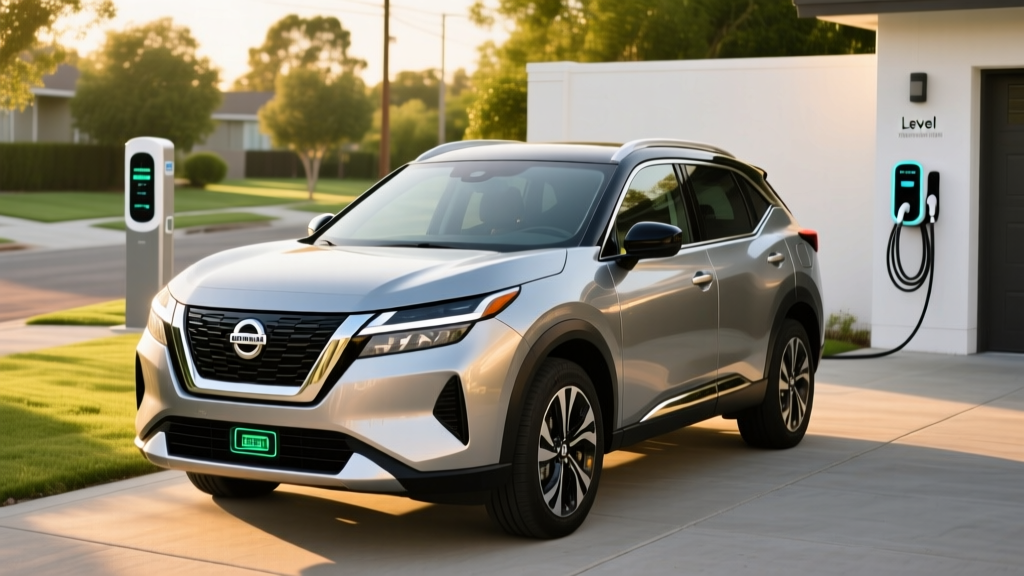
The compact SUV segment is crowded with electrified options, and the 2026 Nissan Rogue Plug-In Hybrid enters the conversation with a specific promise: daily electric commuting paired with gas-engine flexibility for longer trips. If you've been searching for the Nissan Rogue plug-in hybrid to decide whether it's the right fit over a conventional hybrid, a full battery-electric vehicle, or a standard gas model, this guide breaks down every number that matters — from real-world MPG to battery warranty coverage and federal tax credit eligibility under current IRS §30D rules.
Nissan has offered the Rogue with hybrid powertrains in previous generations (most notably the mild-hybrid e-Power variants sold outside the US and earlier plug-in iterations in select markets). For the 2026 model year in North America, Nissan positions the Rogue PHEV as a bridge for buyers who want meaningful electric-only range without the commitment of a full BEV. Let's look at what that actually means in practice.
HEV vs PHEV: What's the Difference in the Rogue Lineup?
Before diving into specs, it's critical to understand the distinction between the conventional Rogue Hybrid (HEV) and the Rogue Plug-In Hybrid (PHEV), because they serve different use cases and have fundamentally different drivetrains.
| Attribute | Rogue Hybrid (HEV) | Rogue Plug-In Hybrid (PHEV) |
|---|---|---|
| Plugs in to charge? | No — charges via regen and engine | Yes — external charging required for EV range |
| Battery size | ~1.5 kWh (small buffer) | ~18.1 kWh usable (estimated) |
| Electric-only driving | Brief low-speed assist only | EPA-estimated ~35 miles |
| Total range | ~450+ miles (gas only) | ~430 miles combined (EV + gas) |
| Federal tax credit | Not eligible | Up to $3,750 (subject to §30D rules) |
| Best for | Drivers who can't charge at home | Drivers with home charging and short commutes |
If you cannot install a Level 2 home charger or lack reliable charging access, the conventional HEV is the practical choice. If you can charge overnight and your daily driving falls under 35 miles round-trip, the PHEV can operate as a daily EV while keeping a gas engine for road trips.
Powertrain, Horsepower, and Performance Specs
The 2026 Rogue PHEV pairs a 1.5-liter turbocharged three-cylinder engine with a front-mounted electric motor and a lithium-ion battery pack. Here's the full spec breakdown based on Nissan's published figures and EPA data:
| Specification | 2026 Nissan Rogue PHEV |
|---|---|
| Engine | 1.5L turbocharged inline-3 |
| Electric motor | Front-mounted AC synchronous |
| Combined system horsepower | ~201 hp (estimated) |
| Combined system torque | ~250 lb-ft (estimated) |
| Transmission | e-CVT (power-split device) |
| Drivetrain | FWD standard; AWD available |
| Battery capacity (usable) | ~18.1 kWh |
| Battery chemistry | NMC (nickel manganese cobalt) |
| 0-60 mph | ~7.8 seconds (estimated) |
| EPA electric-only range | ~35 miles |
| Total combined range | ~430 miles |
| Towing capacity | 1,350 lbs |
The combined ~201 hp output makes the Rogue PHEV one of the more potent compact PHEV SUVs in its class. The instant torque from the electric motor gives it a responsive feel in city driving that the standard gas-only Rogue doesn't match. However, once the battery depletes and the vehicle switches to hybrid mode, performance feels closer to the conventional Rogue Hybrid — adequate for merging and highway passing, but not sporty.
Fuel Economy: EPA MPG and MPGe Breakdown
For plug-in hybrids, the EPA reports two figures: MPGe (miles-per-gallon-equivalent when running on electricity) and MPG (when the battery is depleted and the gas engine takes over). Here's how the 2026 Rogue PHEV stacks up, per fueleconomy.gov:
| Metric | City | Highway | Combined |
|---|---|---|---|
| MPGe (charge-depleting / EV mode) | 105 | 88 | 97 |
| MPG (charge-sustaining / hybrid mode) | 36 | 33 | 35 |
| Electric-only range | 35 miles (EPA est.) | ||
| Energy consumption (EV mode) | ~34 kWh/100 mi | ||
Real-world MPG vs. EPA: PHEVs are notoriously sensitive to driving habits. If you charge nightly and drive under 35 miles per day, you may go weeks without burning fuel. On a long highway road trip with a depleted battery, expect the charge-sustaining MPG to settle around 31-33 MPG at 70+ mph — slightly below the EPA combined figure, consistent with most compact PHEV SUVs. In cold weather (below 30°F), electric-only range typically drops 20-30%, reducing the EV portion to roughly 25-28 miles.
EPA electric-only range: 35 miles
Expected real-world (moderate temps, mixed driving): 28-33 miles
Cold weather (sub-30°F, highway): 22-28 miles
Total gas tank range after battery depletion: ~380-400 miles
Battery, Charging Times, and Connector Details
The Rogue PHEV's ~18.1 kWh battery pack is sized for daily commuting, not cross-country electric driving. Here's what charging looks like in practice:
| Charging Level | Power (kW) | 0-100% Time | Miles of EV Range per Hour |
|---|---|---|---|
| Level 1 (120V household outlet) | ~1.4 kW | ~13 hours | ~4 miles/hr |
| Level 2 (240V home/public) | ~6.6 kW | ~3 hours | ~18 miles/hr |
| DC Fast Charging | Not supported | ||
No DC fast charging. This is a deliberate limitation shared with most PHEVs in this segment (the Toyota RAV4 Prime is a notable exception with optional DCFC on some trims). For the Rogue PHEV, Level 2 is the practical standard. A full charge from empty takes about 3 hours on a 240V Level 2 circuit, which is sufficient for overnight replenishment.
Connector: The 2026 Rogue PHEV uses the standard J1772 connector for AC charging. If you're transitioning from a Tesla ecosystem or plan to use NACS-equipped chargers, you'll need a J1772 adapter (widely available). Since DC fast charging isn't supported, the NACS/CCS debate is largely irrelevant for this vehicle — you're charging at home or at Level 2 public stations.
Pricing, Trims, and Federal Tax Credit Eligibility
Pricing for the 2026 Nissan Rogue PHEV starts in the mid-$30,000 range and climbs with higher trims and AWD. Here's the estimated trim breakdown:
| Trim | MSRP (est.) | Drivetrain |
|---|---|---|
| S PHEV | $35,500 | FWD |
| SV PHEV | $38,200 | FWD / AWD (+$1,600) |
| SL PHEV | $41,800 | AWD standard |
Federal Tax Credit (§30D)
Under current IRS rules, plug-in hybrids with battery capacities of at least 7 kWh may qualify for a partial federal tax credit. The Rogue PHEV's ~18.1 kWh battery clears that threshold. However, the actual credit amount depends on critical-mineral sourcing and battery-component manufacturing requirements that phase in progressively through 2026.
- Credit amount: Up to $3,750 (partial — contingent on critical mineral and battery component sourcing compliance)
- MSRP cap: SUVs must be under $80,000 — Rogue PHEV qualifies
- Buyer income cap: AGI ≤ $150,000 (single) / $225,000 (head of household) / $300,000 (joint)
- Battery sourcing: Must meet escalating critical-mineral and battery-component requirements per IRS §30D guidelines
- Point-of-sale transfer: Available — you can transfer the credit to the dealer for an upfront price reduction
- Assembly: Final assembly must be in North America
Eligibility varies by buyer and model year. Consult a tax professional and verify current-year sourcing compliance at irs.gov before relying on the credit in your purchase decision.
Reliability, Battery Warranty, and Replacement Cost
Hybrid and PHEV battery longevity is consistently the top concern among first-time electrified buyers. Nissan has a track record with lithium-ion packs dating back to the original Leaf in 2010, though early Leaf batteries suffered well-documented degradation due to passive air-cooling. The Rogue PHEV uses a more robust thermal management system suited to its smaller, less stressed pack.
- Hybrid battery warranty: 8 years / 100,000 miles (capacity retention threshold typically ≥70%)
- Powertrain warranty: 5 years / 60,000 miles
- Bumper-to-bumper: 3 years / 36,000 miles
- Estimated battery replacement cost (out of warranty): $5,000–$8,000 (based on comparable PHEV packs; final pricing TBD for this specific pack)
The 8-year/100k-mile hybrid battery warranty is the federal minimum standard for emissions-related components and is standard across Toyota, Hyundai, and most competitors. Real-world data from similar-capacity PHEV packs (Toyota RAV4 Prime, Hyundai Tucson PHEV) suggests 10-15% degradation over 10 years is typical, meaning a 35-mile EV range might settle to ~30 miles after a decade.
Nissan's overall reliability ratings have been middling in recent years per Consumer Reports and J.D. Power, but PHEV powertrains tend to be less stressed than their gas-only counterparts — the electric motor reduces engine load, and regenerative braking extends brake pad life. The e-CVT transmission has no traditional gears or clutch packs to wear out, which historically translates to strong long-term durability.
Who Should Buy the Rogue PHEV vs. a Full EV or Gas SUV?
Decision Framework: Is the Rogue PHEV Right for You?
Choose the Nissan Rogue PHEV if:
- You have Level 2 home charging (or can install it) and a daily commute under 35 miles
- You want to drive electric most days but need gas flexibility for road trips or rural travel
- You live in an area with unreliable public charging infrastructure
- You want to reduce fuel costs without committing to a full BEV's higher upfront price
- You need an SUV with cargo space and available AWD for weather
Choose a full EV (like the Nissan Ariya or Hyundai Ioniq 5) if:
- Your daily driving is predictable and under 250 miles
- You have reliable home and/or workplace charging
- You want to eliminate oil changes, spark plugs, and gas-engine maintenance entirely
- You're eligible for the full $7,500 federal tax credit on a qualifying BEV
Choose the conventional Rogue Hybrid (HEV) if:
- You cannot charge at home or at work
- You want simpler ownership with no plug-in routine
- Your budget doesn't accommodate the PHEV's ~$4,000-$6,000 price premium over the HEV
Stick with the gas-only Rogue if:
- You drive very low annual miles (<6,000/year) where fuel savings won't offset a higher purchase price
- You plan to keep the vehicle under 3 years and want the lowest upfront cost
Pros and Cons at a Glance
Pros
- 35 miles of electric-only range covers most daily commutes
- ~201 hp combined output is responsive for the segment
- No range anxiety — gas engine covers long trips seamlessly
- Available AWD for snow and inclement weather
- Qualifies for partial federal tax credit (up to $3,750)
- 8-year/100,000-mile hybrid battery warranty
- Lower maintenance costs vs. gas-only (regen saves brakes, no engine running in EV mode)
Cons
- No DC fast charging — limits utility of public charging stations
- 3-hour Level 2 charge time is slower than some PHEV rivals
- EV range drops 20-30% in cold weather
- PHEV premium of ~$4,000-$6,000 over the conventional Rogue Hybrid
- Partial tax credit only — not the full $7,500 available on some BEVs
- Real-world highway MPG in hybrid mode (~31-33) is unremarkable
- 1,350-lb towing capacity limits utility for trailer users
Frequently Asked Questions
How many MPG does the Nissan Rogue Plug-In Hybrid get?
The 2026 Rogue PHEV achieves an EPA-estimated 97 MPGe combined when running on electricity, and 35 MPG combined (36 city / 33 highway) when the battery is depleted and the gas engine operates in hybrid mode. Real-world highway driving at 70+ mph with a depleted battery typically yields 31-33 MPG.
How far can the Rogue PHEV go on electric power alone?
The EPA estimates 35 miles of electric-only range. In real-world mixed driving at moderate temperatures, expect 28-33 miles. In cold weather (below 30°F), plan for 22-28 miles before the gas engine engages. Once the battery is depleted, the gas tank provides an additional ~380-400 miles of range.
Does the Nissan Rogue PHEV qualify for a federal tax credit?
It may qualify for a partial credit of up to $3,750 under IRS §30D rules, depending on battery-component sourcing compliance, your income level, and the MSRP cap (which the Rogue PHEV clears). The credit can be transferred to the dealer at point of sale for an upfront price reduction. Verify current eligibility at irs.gov or with a tax professional.
Is the Rogue PHEV reliable, and what does battery replacement cost?
The hybrid battery is covered by an 8-year/100,000-mile warranty with a capacity retention guarantee (typically ≥70%). PHEV powertrains are generally less stressed than gas-only equivalents. Out-of-warranty battery replacement is estimated at $5,000-$8,000 based on comparable PHEV packs, though most owners will never need a replacement within normal ownership periods. Nissan's broader brand reliability has been average in recent surveys.
Can I charge the Rogue PHEV at a DC fast charger?
No. The 2026 Rogue PHEV does not support DC fast charging. Charging is limited to Level 1 (120V, ~13 hours for a full charge) and Level 2 (240V, ~3 hours). This is typical for most PHEVs in this class — the expectation is that you charge at home overnight.
Hybrid vs PHEV vs EV — which should I choose?
If you can charge at home and your commute is under 35 miles, the PHEV gives you the best of both worlds — daily electric driving with gas backup. If you drive more than 250 miles daily or have reliable charging everywhere you go, a full BEV eliminates gas entirely and may qualify for a larger tax credit. If you can't charge at home at all, the conventional HEV is the practical electrified option with no plug-in requirement.
Does the Rogue PHEV require premium fuel?
No. The 1.5L turbocharged engine is designed to run on regular 87-octane unleaded fuel, keeping operating costs in line with the standard Rogue.
Sources: EPA Fuel Economy (fueleconomy.gov), IRS §30D Clean Vehicle Credits, Nissan USA official specifications. Pricing and tax credit rules reflect 2026 model-year data and are subject to change. Always verify with the manufacturer and a tax professional before purchasing.