Why Nissan Hybrids Deserve a Second Look in 2026
When most shoppers think of hybrid SUVs, Toyota and Honda dominate the conversation. But Nissan has quietly expanded its electrified lineup, and for 2026, the brand offers a mix of conventional hybrids (HEVs) and its unique e-POWER series-hybrid system that behaves more like an EV than a traditional gas-electric. If you're researching Nissan hybrids, this guide breaks down every current model, real-world MPG expectations, battery longevity, tax credit eligibility, and whether a Nissan hybrid fits your driving life better than a full EV or a conventional gas car.
Nissan's hybrid strategy differs from competitors in one important way: the e-POWER powertrain. Unlike Toyota's parallel hybrid system where both the engine and motor drive the wheels, Nissan's e-POWER uses the gasoline engine exclusively as a generator. The wheels are driven only by the electric motor at all times. This creates an EV-like driving feel — instant torque, one-pedal regenerative braking — without ever needing to plug in.
HEV vs PHEV vs e-POWER: Understanding Nissan's Hybrid Lineup
How Nissan's Hybrid Systems Compare
| Feature | Conventional Hybrid (HEV) | e-POWER (Series Hybrid) | Plug-in Hybrid (PHEV) |
|---|---|---|---|
| Wheels driven by | Engine + Motor (parallel) | Motor only (engine = generator) | Engine + Motor |
| Plug in to charge? | No | No | Yes |
| Electric-only range | ~1 mi at low speed | N/A (always electric drive) | 25–45 mi typical |
| Battery size | 1.0–1.5 kWh | 1.5–2.1 kWh | 13–18 kWh |
| Driving feel | Blended engine/motor | EV-like (instant torque) | EV-like in electric mode |
| Example | Nissan Rogue Hybrid (e-POWER) | Nissan X-Trail e-POWER | Not currently offered in US |
As of the 2026 model year, Nissan does not sell a plug-in hybrid (PHEV) in the United States. The brand's US hybrid lineup centers on the e-POWER series-hybrid system, available in the Rogue and select other models. This is an important distinction: you cannot plug in any current US-market Nissan hybrid. The battery charges through regenerative braking and the onboard gasoline generator.
If you need plug-in electric range — say, for a 30-mile round-trip commute on battery alone — you'll need to look at competitors like the Toyota RAV4 Prime or Hyundai Tucson PHEV. But if you want EV-like smoothness without charging infrastructure concerns, Nissan's e-POWER is a compelling middle ground.
2026 Nissan Rogue e-POWER: Specs, MPG, and Real-World Efficiency
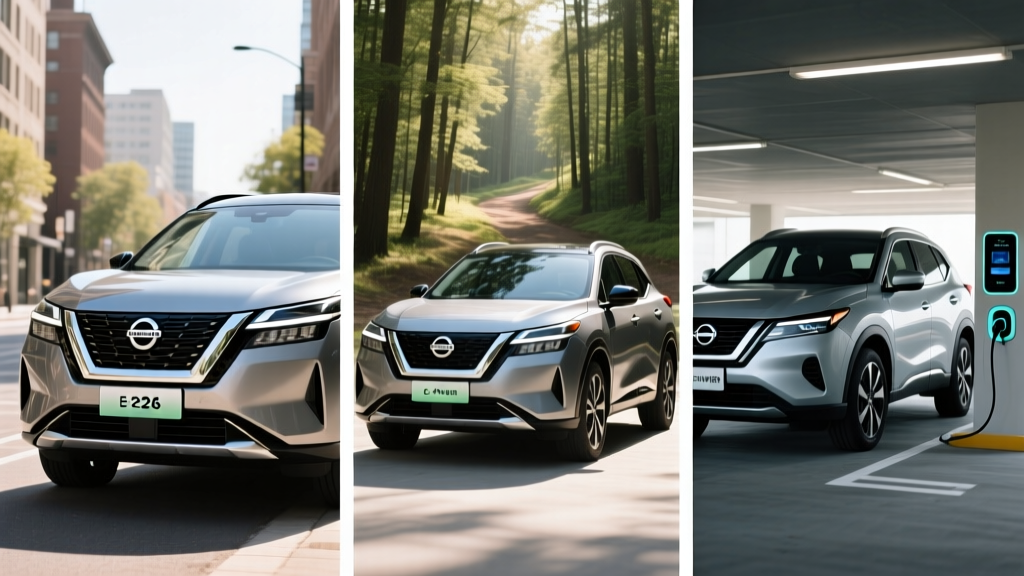
The Rogue e-POWER is Nissan's volume hybrid in the US market. It pairs a 1.5-liter VC-Turbo three-cylinder engine (acting solely as a generator) with a front-mounted electric motor producing the equivalent of approximately 201 horsepower. The system drives the front wheels only; all-wheel drive is not available on e-POWER trims.
2026 Nissan Rogue e-POWER Key Specifications
| Specification | Value |
|---|---|
| Powertrain Type | Series Hybrid (e-POWER) |
| Engine | 1.5L VC-Turbo 3-cylinder (generator only) |
| Electric Motor Output | ~201 hp combined |
| Battery Capacity | ~1.8 kWh (lithium-ion) |
| EPA MPG (City / Hwy / Combined) | 38 / 35 / 37 MPG (estimated) |
| Drivetrain | FWD |
| 0-60 mph | ~7.5 seconds (estimated) |
| Cargo Volume | ~31.6 cu ft (rear seats up) |
| Base MSRP | ~$33,500 (estimated, SV e-POWER trim) |
| Battery Warranty | 8 years / 100,000 miles |
Real-World MPG: What to Actually Expect
Series hybrids like the e-POWER system tend to perform closer to their EPA city rating in stop-and-go traffic, where regenerative braking is maximized and the generator runs at optimal RPM. On the highway, efficiency drops somewhat because the engine must run more continuously to sustain higher speeds — there's no engine-direct-drive mode like a Toyota parallel hybrid offers.
Based on comparable e-POWER models and fueleconomy.gov data for similar compact hybrid SUVs, expect:
- City driving: 37–40 MPG (e-POWER excels here; regen recaptures energy at every stop)
- Highway driving (70+ mph): 32–35 MPG (generator runs more often; less regen benefit)
- Cold weather (below 35°F): Expect a 5–10% MPG reduction as the engine runs more frequently for cabin heat and battery thermal management
This is honest territory: the Rogue e-POWER's highway MPG trails some parallel-hybrid competitors like the Toyota RAV4 Hybrid (39 MPG combined) and Honda CR-V Hybrid (37 MPG combined). Its advantage is driving feel — the electric-motor-only drivetrain delivers linear, quiet acceleration that feels more refined than the engine-motor handoff in parallel systems.
2026 Nissan Altima: Is There a Hybrid Option?
Nissan discontinued the Altima Hybrid after the 2011 model year. As of 2026, the Altima is sold exclusively with a 2.5-liter four-cylinder gasoline engine rated at approximately 32 MPG combined (28 city / 39 highway per EPA estimates). There is no hybrid or e-POWER variant of the US-market Altima.
If you specifically want a Nissan sedan with hybrid efficiency, your options are currently limited. The global-market Nissan Note and Kicks e-POWER exist overseas but are not sold in the US. For a hybrid sedan, you'll need to look at the Toyota Camry Hybrid (up to 52 MPG combined), Honda Accord Hybrid (48 MPG combined), or Hyundai Sonata Hybrid (52 MPG combined).
Battery Longevity, Warranty, and Replacement Costs
Nissan e-POWER Battery Warranty
Nissan covers the e-POWER hybrid battery with an 8-year / 100,000-mile warranty (whichever comes first), consistent with industry standards for hybrid battery packs. In California and states adopting CARB emissions standards, the hybrid battery warranty extends to 10 years / 150,000 miles.
The warranty covers defects and capacity loss below a specified threshold (typically 60–70% of original capacity, though exact terms vary by model year — confirm with your dealer's warranty booklet).
How Long Do Nissan Hybrid Batteries Last?
The e-POWER system uses a relatively small lithium-ion battery (~1.8 kWh) that undergoes shallow charge-discharge cycles rather than deep cycling. The system's software maintains the battery in a narrow state-of-charge window (roughly 40–80%), which significantly reduces degradation stress.
Based on long-term data from Nissan's global e-POWER fleet (over 1 million units sold worldwide since 2016) and general lithium-ion hybrid battery longevity research:
- Expected lifespan: 12–15 years or 150,000–200,000+ miles under normal use
- Failure rate: Hybrid battery failures within the warranty period remain low (estimated <3% based on industry-wide hybrid data)
- Replacement cost (out of warranty): $2,000–$4,000 for the e-POWER battery pack, depending on labor rates and whether you choose a new OEM pack or a refurbished unit
This is notably cheaper than full EV battery replacement ($7,000–$20,000+) because the e-POWER pack is small. It's also cheaper than some competitor hybrid batteries due to its modest capacity.
Maintenance Advantages
One underappreciated benefit of the e-POWER system: because the gasoline engine never directly drives the wheels, there is no traditional transmission (no CVT belt wear, no gear-set stress). The engine operates at relatively constant, optimal RPM when generating electricity, which reduces mechanical wear compared to a conventional engine that constantly varies its speed.
Regenerative braking also reduces brake pad wear — many e-POWER owners report original brake pads lasting 80,000+ miles.
Federal Tax Credits and Incentives for Nissan Hybrids
Here's the straightforward truth that surprises many buyers: conventional hybrids and series hybrids like Nissan's e-POWER do not qualify for the federal §30D Clean Vehicle tax credit. Under current IRS rules, the §30D credit (up to $7,500) applies only to plug-in electric vehicles — battery electric vehicles (BEVs) and plug-in hybrids (PHEVs) with battery capacities of at least 7 kWh.
Since the e-POWER battery is approximately 1.8 kWh and the vehicle cannot be plugged in, it does not meet the threshold. The same applies to all conventional HEVs from Toyota, Honda, Hyundai, and others.
§30D Tax Credit: Why Nissan Hybrids Don't Qualify
- ✗ Vehicle must be a BEV or PHEV (plug-in capable)
- ✗ Battery must be ≥7 kWh (e-POWER is ~1.8 kWh)
- ✗ MSRP must be under $55,000 (sedans) or $80,000 (SUVs/trucks) — N/A for non-plug-in
- ✗ Buyer income must be under $150K single / $300K joint — N/A for non-plug-in
Bottom line: No plug = no federal tax credit. If the credit is a dealbreaker, consider Nissan's BEV options (Ariya, Leaf) or a competitor PHEV.
Some states and local utilities offer smaller rebates for hybrid vehicles (typically $500–$1,500), but these vary widely by jurisdiction. Check your state energy office and local utility for current programs — never assume eligibility without verifying with official sources.
Nissan Hybrid vs. Competitors: How Does It Stack Up?
To put the Nissan Rogue e-POWER in context, here's how it compares to the segment's benchmark hybrid SUVs:
| Model (2026) | Type | EPA Combined MPG | AWD Available | Base MSRP (est.) | Hybrid Battery Warranty |
|---|---|---|---|---|---|
| Nissan Rogue e-POWER | Series HEV | ~37 MPG | No (FWD only) | ~$33,500 | 8 yr / 100K mi |
| Toyota RAV4 Hybrid | Parallel HEV | 39 MPG | Yes (standard) | ~$33,000 | 10 yr / 150K mi |
| Honda CR-V Hybrid | Parallel HEV | 37 MPG | Yes (available) | ~$35,000 | 8 yr / 100K mi |
| Hyundai Tucson Hybrid | Parallel HEV | 38 MPG | Yes (standard) | ~$34,500 | 10 yr / 100K mi |
Key takeaway: the Rogue e-POWER's combined MPG is competitive but not class-leading. Its primary differentiator is driving refinement — the electric-only drivetrain eliminates the engine-rpm surging that some drivers find intrusive in parallel hybrids under hard acceleration. If you prioritize smooth, EV-like driving feel and mostly drive in city and suburban conditions, the e-POWER system has a genuine comfort advantage.
If you need all-wheel drive (essential for snow-belt buyers), the Rogue e-POWER's FWD-only layout is a significant limitation. Toyota, Honda, and Hyundai all offer AWD hybrid SUVs in this segment.
Nissan Rogue e-POWER Pros
- EV-like driving feel with no plug-in required
- Strong city MPG from regenerative braking
- Refined, quiet acceleration (no engine-motor handoff)
- Reduced brake and transmission wear
- Small battery = lower eventual replacement cost
Nissan Rogue e-POWER Cons
- FWD only — no AWD option
- Highway MPG trails parallel-hybrid rivals
- No federal tax credit eligibility
- Smaller cargo area than some competitors
- Limited hybrid trim availability in some regions
Who Should Buy a Nissan Hybrid — And Who Shouldn't?
Choose the Nissan Rogue e-POWER If:
- You want EV-like driving smoothness but can't charge at home (apartment, street parking, no garage outlet)
- Your driving is mostly city and suburban (where series hybrids excel)
- You live in a mild climate where FWD is sufficient year-round
- You value reduced long-term maintenance (fewer brake jobs, no transmission service)
Choose a Competitor Hybrid If:
- You need AWD for snow or rough roads (RAV4 Hybrid, CR-V Hybrid)
- You do mostly highway driving and want maximum MPG (RAV4 Hybrid at 39 combined)
- You want a longer factory hybrid battery warranty (Toyota: 10 yr / 150K mi)
Choose a Full EV If:
- You have reliable home Level 2 charging
- You want the $7,500 federal tax credit (if income and MSRP qualify)
- Your daily driving is under 250 miles round-trip
- You want zero tailpipe emissions and minimal powertrain maintenance
Choose a PHEV If:
- You want 25–45 miles of electric-only commuting plus gas-engine range for road trips
- You can charge at home overnight but want flexibility for longer drives
- You want partial federal tax credit eligibility (PHEVs with ≥7 kWh batteries may qualify)
Frequently Asked Questions About Nissan Hybrids
How many MPG does the Nissan Rogue e-POWER get?
The 2026 Nissan Rogue e-POWER is estimated at approximately 37 MPG combined (38 city / 35 highway per EPA testing methodology). Real-world city driving often yields 37–40 MPG thanks to strong regenerative braking, while sustained highway driving at 70+ mph may return 32–35 MPG. Cold weather reduces efficiency by roughly 5–10%.
Does any Nissan hybrid need to be plugged in?
No. All current US-market Nissan hybrids use the e-POWER series-hybrid system, which charges its battery through regenerative braking and the onboard gasoline generator. There is no plug, no charging cable, and no electric-only driving range. You fuel it like a conventional car and never interact with a charger.
Does Nissan offer a plug-in hybrid (PHEV) in the US?
As of the 2026 model year, Nissan does not sell a plug-in hybrid in the United States. The brand previously offered no PHEV in its US lineup. If plug-in capability is essential to you, consider the Toyota RAV4 Prime (42 miles electric-only), Hyundai Tucson PHEV (33 miles), or Ford Escape PHEV (37 miles).
Is the Nissan e-POWER system reliable?
Nissan's e-POWER system has been in global production since 2016, with over 1 million units sold (primarily in Japan and Europe). The series-hybrid architecture is mechanically simpler than parallel hybrids — no transmission, no engine-to-wheel drivetrain — which reduces failure points. The hybrid battery is warrantied for 8 years / 100,000 miles (10 years / 150,000 miles in CARB states). Independent reliability data from NHTSA and consumer surveys suggest e-POWER reliability is on par with established hybrid systems.
What does it cost to replace a Nissan e-POWER hybrid battery?
Out-of-warranty replacement for the e-POWER lithium-ion battery pack is estimated at $2,000–$4,000 including labor. This is significantly less than full EV battery replacement due to the small (~1.8 kWh) pack size. Most hybrid batteries last 12–15 years or 150,000+ miles under normal conditions, so many original owners will never face this cost.
Does the Nissan Rogue Hybrid qualify for any tax credit?
No. The federal §30D Clean Vehicle Credit applies only to plug-in vehicles (BEVs and PHEVs) with batteries of at least 7 kWh. The Rogue e-POWER's ~1.8 kWh battery and lack of plug-in capability make it ineligible. Some state or utility programs may offer small hybrid rebates — check your local jurisdiction for details.
How does the e-POWER system differ from Toyota's hybrid system?
Toyota uses a parallel hybrid system (Hybrid Synergy Drive) where both the gasoline engine and electric motor can directly drive the wheels through a planetary gearset. Nissan's e-POWER is a series hybrid: the engine only generates electricity, and only the electric motor drives the wheels. The result is smoother, more EV-like acceleration in the Nissan, but slightly lower highway efficiency compared to Toyota's system, which can use the engine directly at highway speeds for better efficiency.
Can I get AWD on a Nissan hybrid?
No. The 2026 Nissan Rogue e-POWER is front-wheel drive only. If all-wheel drive is a priority in a hybrid SUV, the Toyota RAV4 Hybrid (AWD standard on all trims) and Hyundai Tucson Hybrid (AWD standard) are stronger options.
Sources: EPA fuel economy data via fueleconomy.gov; IRS §30D credit rules via irs.gov; Nissan USA specifications via Nissan's official press site. All MPG, pricing, and specification figures are estimates based on available 2026 model-year data and may vary by trim and market. Confirm final figures with your local Nissan dealer.