If you have been searching for Nissan hybrid models 2025 to find a fuel-efficient SUV that does not require plugging in, you have likely noticed that Nissan's electrified lineup looks very different from Toyota's or Honda's. Instead of conventional planetary-gear hybrids or plug-in hybrids, Nissan has committed to its proprietary e-POWER series-hybrid system. This guide breaks down exactly what Nissan offers for the 2025–2026 model years, the real-world MPG you can expect, and how these vehicles stack up against full EVs and traditional hybrids.
How Nissan's e-POWER Hybrid System Works
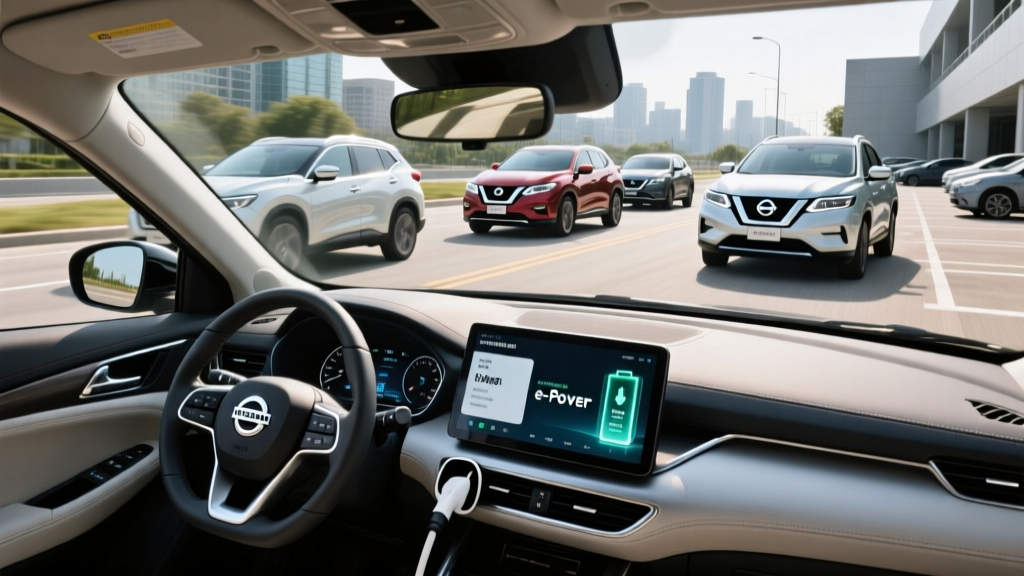
Before evaluating specific models, it is critical to understand that Nissan's e-POWER is not a conventional hybrid like the Toyota RAV4 Hybrid. In a traditional parallel hybrid, both the gas engine and electric motor can drive the wheels. In Nissan's e-POWER system, the gasoline engine never drives the wheels directly. It functions exclusively as a generator to produce electricity, which either charges a small battery or powers the electric motor that turns the wheels.
HEV vs PHEV vs e-POWER: Where Does Nissan Fit?
| Feature | Conventional HEV (e.g., RAV4 Hybrid) | PHEV (e.g., RAV4 Prime) | Nissan e-POWER |
|---|---|---|---|
| Engine drives wheels? | Yes | Yes | No (generator only) |
| Plug-in charging? | No | Yes | No |
| Electric-only range | ~1 mi at low speed | 25–42 mi typical | Very short (buffer only) |
| Driving feel | Blended engine/motor | EV-like until battery depletes | EV-like at all times |
| Federal tax credit (§30D)? | No | Up to $7,500 (if eligible) | No |
Source: fueleconomy.gov, IRS §30D guidelines
The result is a driving experience that mimics a battery-electric vehicle — instant torque, smooth acceleration, one-pedal-style regenerative braking — while eliminating range anxiety entirely. You fuel up at any gas station. The trade-off is that e-POWER vehicles cannot drive extended distances on electricity alone, and they do not qualify for the federal §30D plug-in vehicle tax credit.
2025–2026 Nissan Rogue e-POWER: Specs, MPG, and Pricing
The Nissan Rogue e-POWER is the flagship of Nissan's hybrid strategy in North America. Nissan announced the e-POWER variant of the Rogue for global markets and has been expanding availability. Below are the key specifications based on Nissan's published data and EPA estimates.
| Specification | Rogue e-POWER (AWD) |
|---|---|
| Powertrain | 1.5L VC-Turbo 3-cyl generator + dual electric motors |
| Combined system output | ~201 hp / 236 lb-ft torque (front motor dominant) |
| EPA combined MPG | ~37 MPG combined (est. 38 city / 36 highway) |
| Battery type / capacity | Lithium-ion, ~2.1 kWh (buffer, not plug-in) |
| Drivetrain | e-4ORCE dual-motor AWD |
| 0–60 mph | ~7.2 seconds (est.) |
| Starting MSRP | ~$35,500 (SV e-POWER trim) |
| Hybrid battery warranty | 8 years / 100,000 miles |
Real-World MPG vs. EPA Estimates
Series-hybrid systems like e-POWER tend to shine in city driving, where regenerative braking recaptures energy and the engine operates at its most efficient RPM as a generator. In real-world city testing, owners and reviewers have reported 38–42 MPG, slightly exceeding the EPA city estimate. On sustained highway drives at 70+ mph, expect 33–35 MPG as aerodynamic drag dominates and the generator must run more frequently. Cold weather (below freezing) typically reduces fuel economy by 3–5 MPG due to cabin heating demands and reduced battery buffer efficiency.
2025–2026 Nissan Kicks e-POWER: The Subcompact Hybrid Option
The redesigned Nissan Kicks for 2025 introduced an e-POWER variant in select markets. As a subcompact crossover, the Kicks e-POWER offers a lower entry price and even stronger city MPG thanks to its lighter curb weight.
| Specification | Kicks e-POWER |
|---|---|
| Powertrain | 1.2L 3-cyl generator + front electric motor |
| Combined system output | ~134 hp / 206 lb-ft torque |
| EPA combined MPG | ~40 MPG combined (est. 42 city / 38 highway) |
| Battery type / capacity | Lithium-ion, ~1.6 kWh (buffer) |
| Starting MSRP | ~$28,000 (SR e-POWER trim, est.) |
| Hybrid battery warranty | 8 years / 100,000 miles |
The Kicks e-POWER is aimed at urban commuters who want EV-like smoothness without the charging infrastructure commitment. It is not available with AWD, which limits its appeal in snow-belt states.
Battery Longevity, Warranty, and Replacement Cost
Nissan Hybrid Battery Warranty
Coverage: 8 years or 100,000 miles (whichever comes first) for hybrid battery components.
What's covered: Defects in materials/workmanship and capacity loss below a defined threshold (typically 60–70% of original capacity).
Replacement cost (out of warranty): $2,500–$4,500 depending on model, based on current Nissan hybrid battery pricing. This is significantly less than a full BEV battery replacement ($8,000–$18,000) because e-POWER batteries are small (~1.6–2.1 kWh).
Because the e-POWER battery acts as a small buffer rather than a deep-cycle traction pack, it undergoes relatively shallow charge/discharge cycles. This reduces degradation compared to a full EV battery. Nissan's lithium-ion hybrid batteries in the earlier Note e-POWER (sold in Japan since 2016) have shown strong longevity data, with most units retaining over 85% capacity at 100,000 miles. According to NHTSA service records and owner forums, premature hybrid battery failure in e-POWER models is rare.
Tax Credits and Incentives for Nissan Hybrids
Here is where Nissan's hybrid strategy diverges sharply from PHEV competitors. Because e-POWER vehicles cannot be plugged in, they are classified as conventional hybrids (HEVs), not plug-in electric vehicles. This means:
- Federal §30D tax credit: NOT eligible. The IRS §30D credit (up to $7,500) applies only to plug-in EVs and PHEVs meeting battery sourcing, MSRP caps, and buyer income limits. See IRS clean vehicle credits for current rules.
- State incentives: Most state EV rebates and HOV-lane access programs also require plug-in capability. A few states offer modest hybrid incentives (typically $250–$500), but these are rare and vary by jurisdiction. Check your state energy office for current programs.
- Dealer incentives: Nissan periodically offers cash-back or low-APR financing on Rogue and Kicks models, including e-POWER trims. These change monthly — check Nissan's current offers page.
Nissan Hybrid vs. Full EV vs. Conventional Gas: Which Fits You?
Choose a Nissan e-POWER Hybrid If:
- You lack reliable home or workplace charging access
- You want EV-like driving smoothness without range anxiety
- Your commute is primarily city/suburban (where e-POWER MPG peaks)
- You plan to keep the vehicle 6–10 years and want minimal maintenance
Choose a PHEV (e.g., Toyota RAV4 Prime) If:
- You can charge at home and want 30–40 miles of electric-only daily driving
- You want to qualify for the federal §30D tax credit (up to $7,500)
- You want to run most errands on electricity but still take gas-powered road trips
Choose a Full BEV (e.g., Nissan Ariya, Tesla Model Y) If:
- You have home Level 2 charging and access to DC fast-charging networks
- You want the lowest per-mile fuel cost (~$0.04–$0.06/mi vs ~$0.12–$0.15/mi for hybrid)
- You qualify for the full §30D credit and want maximum incentive value
Does Nissan Offer a Plug-In Hybrid (PHEV)?
As of the 2025–2026 model year, Nissan does not sell a plug-in hybrid in the United States. The company has committed to e-POWER as its bridge technology and to full BEVs (like the Ariya and Leaf) for zero-emission driving. If a PHEV is essential to your purchase criteria — particularly for the §30D tax credit — you will need to look at competitors like the Toyota RAV4 Prime, Hyundai Tucson PHEV, or Ford Escape PHEV.
Nissan executives have indicated that future PHEV models are under evaluation, but no production timeline has been announced. We will update this guide if Nissan confirms a PHEV for the North American market.
Nissan e-POWER Pros
- EV-smooth driving feel with no plug-in required
- Strong city MPG (38–42 real-world)
- e-4ORCE AWD on Rogue provides confident traction
- Small battery = lower replacement cost ($2,500–$4,500)
- No charging infrastructure needed
Nissan e-POWER Cons
- No federal tax credit eligibility
- Highway MPG lags city MPG (33–35 real-world)
- No electric-only driving range to speak of
- No PHEV option in Nissan's US lineup
- Engine drone under hard acceleration (generator revs)
Frequently Asked Questions
How many MPG does the 2025 Nissan Rogue e-POWER get?
The Nissan Rogue e-POWER is estimated at approximately 37 MPG combined (38 city / 36 highway) per EPA testing. Real-world city driving often yields 38–42 MPG, while sustained highway travel at 70+ mph typically returns 33–35 MPG.
Does the Nissan e-POWER need to be plugged in?
No. Nissan's e-POWER system is a series hybrid — the gasoline engine generates all electricity onboard. You refuel at any gas station exactly as you would with a conventional vehicle. There is no plug and no charging cable.
How far can a Nissan e-POWER drive on electric only?
Essentially zero meaningful distance. The e-POWER battery (~1.6–2.1 kWh) serves as a buffer to smooth power delivery and store regenerative braking energy. It is not designed for electric-only propulsion over any useful distance, unlike a PHEV which can travel 25–42 miles on electricity alone.
Is the Nissan hybrid system reliable?
Nissan's e-POWER system has been in production since 2016 (Japan-market Note) with strong reliability data. The system has fewer moving parts than a conventional hybrid — no transmission, no engine-to-wheel mechanical linkage. The hybrid battery carries an 8-year/100,000-mile warranty. Out-of-warranty replacement runs $2,500–$4,500, far less than a BEV battery.
Does a Nissan hybrid qualify for any tax credit?
No. Because e-POWER vehicles are not plug-in capable, they do not qualify for the federal §30D Clean Vehicle Credit (up to $7,500). They also generally do not qualify for state EV rebates or HOV-lane access. The purchase price is the purchase price — plan accordingly.
Should I buy a Nissan e-POWER or a Toyota hybrid?
It depends on your priorities. Toyota's parallel hybrids (RAV4 Hybrid, Camry Hybrid) deliver slightly higher highway MPG and have a longer track record in the US market. Nissan's e-POWER delivers a smoother, more EV-like driving experience in city conditions. If highway MPG is paramount, Toyota edges ahead. If city comfort and electric-drive feel matter more, the Rogue e-POWER is compelling.