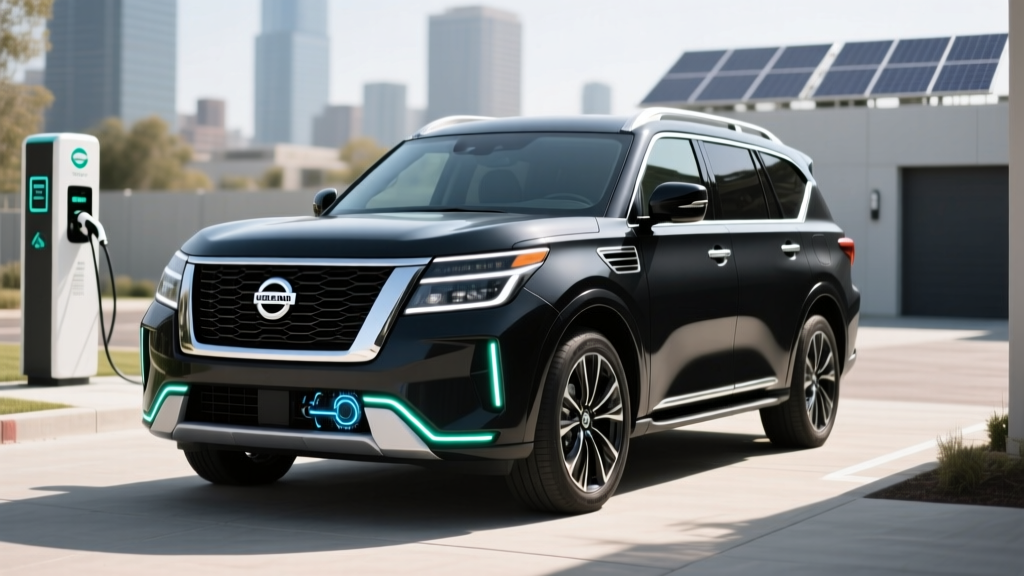
The full-size SUV segment has been slow to adopt electrification, but the 2026 Nissan Armada brings a hybrid-assisted powertrain to Nissan's flagship three-row hauler. Unlike a Toyota Grand Highlander Hybrid or a plug-in rival, the Armada uses a mild-hybrid system paired with its twin-turbocharged 3.5-liter V6. This guide breaks down exactly what that means for your fuel bill, whether it qualifies for any federal tax credits, and how it stacks up against full hybrids and EVs in the large-SUV space.
What Kind of Hybrid Is the Nissan Armada?
Before we get into the numbers, it's critical to understand what type of hybrid system the Armada uses — because not all hybrids are created equal.
HEV vs. PHEV vs. Mild Hybrid: Where the Armada Fits
| Type | Plug In? | Electric-Only Driving? | Battery Size | Tax Credit? |
|---|---|---|---|---|
| Mild Hybrid (MHEV) — Armada | No | No — assists gas engine only | ~0.5–1.5 kWh | No |
| Full Hybrid (HEV) — e.g., Grand Highlander Hybrid | No | Limited, low-speed only | ~1.5–2.5 kWh | No |
| Plug-in Hybrid (PHEV) — e.g., RAV4 Prime | Yes | Yes, 20–45 mi range | 15–25 kWh | Potentially (IRS §30D) |
| Battery Electric (BEV) — e.g., Rivian R1S | Yes (only) | 100% electric | 90–150 kWh | Potentially (IRS §30D) |
The 2026 Armada is a mild hybrid (MHEV). Its small electric motor-generator is integrated between the engine and the 9-speed automatic transmission. It cannot propel the vehicle on electric power alone. Instead, it smooths stop-start transitions, provides brief torque fill during acceleration, and enables minor regenerative braking. You never plug it in — it charges itself through braking and engine operation.
This is fundamentally different from a full hybrid like the Toyota Grand Highlander Hybrid, which can drive short distances on electric power and delivers significantly higher MPG gains, or a PHEV, which offers a meaningful electric-only range when plugged in.
Powertrain Specs: Twin-Turbo V6 Meets Electric Assist
| Specification | 2026 Nissan Armada |
|---|---|
| Engine | 3.5L twin-turbocharged V6 (VR35DDTT) |
| Hybrid System | Mild-hybrid (MHEV) with integrated motor-generator |
| Combined Horsepower | 425 hp |
| Combined Torque | 516 lb-ft |
| Transmission | 9-speed automatic |
| Drivetrain | RWD standard; 4WD available |
| Towing Capacity | Up to 8,500 lbs (properly equipped) |
| 0–60 mph (est.) | ~5.9 seconds |
The VR35DDTT replaced the legendary 5.6-liter V8 (VK56VD) from the previous-generation Armada. On its own, the twin-turbo six produces substantial power, and the mild-hybrid system adds electric torque fill at low RPMs — the exact scenario where turbo lag is most noticeable. The result is strong, linear acceleration from a stop and confident highway merging, even with a full load of passengers and cargo.
However, mild-hybrid assist does not dramatically alter fuel consumption. Expect roughly a 1–3 MPG improvement over what the same powertrain would achieve without hybrid assist — primarily from smoother stop-start operation and minor regenerative gains during deceleration.
Fuel Economy: EPA MPG and Real-World Expectations
This is where mild-hybrid buyers need realistic expectations. The Armada is a 5,500+ pound body-on-frame SUV, and physics is not on its side.
| Drivetrain | City MPG | Highway MPG | Combined MPG |
|---|---|---|---|
| RWD (EPA est.) | 17 | 23 | 19 |
| 4WD (EPA est.) | 16 | 22 | 18 |
Source: fueleconomy.gov — verify exact figures for your trim and model year.
Real-World MPG: What to Actually Expect
In mixed real-world driving, owners of similarly equipped large turbocharged SUVs typically report:
- City driving: 15–18 MPG (stop-and-go traffic can push it to the low end; mild-hybrid stop-start helps here)
- Highway cruising (65–70 mph): 21–23 MPG on flat terrain
- Towing: 10–13 MPG depending on trailer weight and terrain
- Cold weather (below 32°F): Expect a 1–2 MPG drop due to denser air, winter fuel blends, and increased idle time for cabin heat
For context, the Toyota Grand Highlander Hybrid achieves an EPA-estimated 35–36 MPG combined — nearly double the Armada's figure. The tradeoff is that the Grand Highlander uses a unibody platform with lower towing capacity (5,000 lbs) and less off-road capability. If you need body-on-frame toughness and 8,500-lb towing, the Armada's MPG is competitive with rivals like the Chevrolet Tahoe (non-hybrid, ~17 combined) and the Ford Expedition (~18–19 combined).
How Does the Armada Hybrid Compare to Rivals?
| Vehicle | Hybrid Type | Combined MPG | Max Towing | Starting MSRP |
|---|---|---|---|---|
| 2026 Nissan Armada | Mild Hybrid (MHEV) | 18–19 | 8,500 lbs | ~$56,000 |
| Toyota Grand Highlander Hybrid | Full Hybrid (HEV) | 35–36 | 5,000 lbs | ~$47,000 |
| Toyota Sequoia | Full Hybrid (i-Force Max) | 20–22 | 9,520 lbs | ~$62,000 |
| Ford Expedition | None (gas) | 18–19 | 9,300 lbs | ~$55,000 |
| Chevrolet Tahoe | None (gas, V8/Duramax diesel avail.) | 16–24 (varies) | 8,400 lbs | ~$57,000 |
The Toyota Sequoia is the closest true rival — it also uses a body-on-frame platform with a full hybrid (not mild) powertrain and delivers 2–4 MPG more while matching the Armada on towing. The Sequoia commands a price premium, however, and has faced long dealer markups.
Pricing, Trims, and Tax Credit Eligibility
The 2026 Armada is offered across multiple trims, with pricing that reflects its position as Nissan's flagship SUV.
| Trim | Est. MSRP (RWD) | Est. MSRP (4WD) |
|---|---|---|
| SV (base) | ~$56,000 | ~$59,000 |
| SL | ~$62,000 | ~$65,000 |
| Platinum | ~$69,000 | ~$72,000 |
| PRO-4X | — | ~$70,000 |
| NISMO | ~$72,000 | ~$75,000 |
Does the Nissan Armada Hybrid Qualify for a Federal Tax Credit?
No. Under current IRS §30D Clean Vehicle Credit rules, only plug-in electric vehicles (PHEVs and BEVs) with sufficient battery capacity qualify for the federal tax credit of up to $7,500. The Armada's mild-hybrid system does not meet the minimum battery capacity threshold (at least 7 kWh for PHEVs), and it has no plug-in capability.
Some states may offer minor incentives for hybrid vehicles, but these are rare and vary by jurisdiction. Check your state's energy or environmental agency website for current programs. There is no federal incentive for conventional or mild-hybrid vehicles as of 2026.
Battery Warranty, Reliability, and Replacement Cost
Hybrid Battery Warranty
Nissan covers the Armada's hybrid system components — including the motor-generator and associated battery — under its hybrid/electric component warranty:
- Hybrid system warranty: 8 years / 100,000 miles (whichever comes first)
- Powertrain warranty: 5 years / 60,000 miles
- Bumper-to-bumper: 3 years / 36,000 miles
Verify exact coverage with your dealer, as warranty terms can vary by model year.
Reliability Outlook
The VR35DDTT twin-turbo V6 is a newer engine for the Armada (introduced with the 2025 redesign), so long-term reliability data is still accumulating. Nissan's twin-turbo V6 has been used in the Infiniti QX60 and the new Nissan Pathfinder with generally positive early results. The mild-hybrid motor-generator adds minimal complexity compared to a full hybrid system — there's no high-voltage traction battery, no electric-only drivetrain, and no plug-in hardware to fail.
The mild-hybrid battery pack is small (~0.5–1.5 kWh) and operates under much less stress than a PHEV or BEV battery. These units typically last the lifetime of the vehicle. If replacement is ever needed, costs are far lower than a full hybrid or EV battery:
- Mild-hybrid battery replacement (est.): $500–$1,500
- Motor-generator unit replacement (est.): $1,500–$3,000
Compare this to a full hybrid battery replacement ($3,000–$6,000) or a BEV battery replacement ($10,000–$25,000+), and the mild-hybrid's simplicity becomes a clear ownership-cost advantage.
Who Should Buy the Armada Hybrid — And Who Shouldn't?
Choose the Armada Hybrid If:
- You need body-on-frame capability and 8,500-lb towing
- You want a premium three-row SUV with Nissan's latest tech and safety features
- You prefer a turbocharged V6 over a traditional V8 and want marginally better fuel economy
- You don't have reliable access to home or workplace charging (no plug needed)
- You regularly drive in remote or rural areas where charging infrastructure is sparse
Look Elsewhere If:
- Fuel economy is your top priority — consider the Grand Highlander Hybrid (35+ MPG) or Sequoia (20+ MPG)
- You want electric-only commuting — look at a PHEV or BEV
- You want to qualify for the $7,500 federal tax credit — you need a PHEV or BEV
- You rarely tow or go off-road — a unibody hybrid SUV will save you thousands in fuel
Armada vs. Full EV: The Large SUV Question
Fully electric large SUVs like the Rivian R1S (EPA range up to ~410 miles with the Max Pack) offer instant torque, zero tailpipe emissions, and dramatically lower per-mile fuel costs. However, they start above $75,000, may not match the Armada's towing capacity (R1S: 7,700 lbs), and require reliable charging access for road trips. For families who tow boats or campers regularly and drive in areas with limited DC fast-charging infrastructure, the Armada's mild-hybrid powertrain removes range and charging anxiety entirely.
Frequently Asked Questions
How many MPG does the Nissan Armada hybrid get?
The 2026 Nissan Armada with RWD is EPA-estimated at 17 city / 23 highway / 19 combined MPG. With 4WD, figures drop to 16/22/18. Real-world results vary: expect 15–18 MPG in city driving, 21–23 on the highway, and 10–13 when towing.
Can the Nissan Armada drive on electric power alone?
No. The Armada uses a mild-hybrid (MHEV) system, which cannot propel the vehicle without the gasoline engine. The electric motor-generator only assists the engine during acceleration and smooths stop-start operation. For electric-only driving, you'd need a PHEV or BEV.
Do I need to plug in the Nissan Armada hybrid?
No. The Armada is not a plug-in hybrid. Its small hybrid battery charges through regenerative braking and the gasoline engine. There is no charging port.
Does the Nissan Armada hybrid qualify for any tax credit?
No. Under current IRS §30D rules, only plug-in hybrids (PHEVs) and battery-electric vehicles (BEVs) with sufficient battery capacity qualify for the federal Clean Vehicle Credit. The Armada's mild-hybrid system does not qualify. Check your state for any local hybrid incentives.
Is the Nissan Armada hybrid reliable?
The mild-hybrid system adds minimal complexity — there's no high-voltage traction battery or electric drivetrain to maintain. The twin-turbo V6 is newer to the Armada (2025+), so long-term data is limited, but early results from Nissan/Infiniti applications are encouraging. The hybrid components are covered by an 8-year/100,000-mile warranty.
How much does it cost to replace the Armada hybrid battery?
The mild-hybrid battery is small and low-stress, typically lasting the vehicle's lifetime. If replacement is needed, expect $500–$1,500 — far less than a full hybrid or EV battery replacement.
What's the difference between the Armada hybrid and the Toyota Sequoia hybrid?
The Sequoia uses a full hybrid system (Toyota's i-Force Max) that delivers 20–22 MPG combined vs. the Armada's 18–19. The Sequoia also tows slightly more (9,520 lbs vs. 8,500). However, the Sequoia typically costs more and has faced significant dealer markups. The Armada may offer better value at the dealership level.
Is a mild hybrid worth it on a large SUV?
The fuel-economy gains are modest (1–3 MPG), but the mild-hybrid system also improves drivability — smoother stop-start, better low-RPM torque response, and reduced turbo lag. On a $60,000+ SUV, the refinement improvement may matter more than the MPG gain.
The Bottom Line
The 2026 Nissan Armada's mild-hybrid system is best understood as a refinement upgrade, not a fuel-economy revolution. If you're shopping for a body-on-frame, three-row SUV with serious towing capability and don't have access to plug-in charging, the Armada delivers strong performance, a premium interior, and marginally better efficiency than a conventional gas-only rival. But if maximum fuel savings or electric-only commuting is your goal, a full hybrid like the Sequoia or Grand Highlander Hybrid — or a PHEV/BEV if you can charge at home — will serve you better. Know what you need from a large SUV, and the right choice becomes clear.