The Mitsubishi Hybrid Lineup: One PHEV, Big Utility
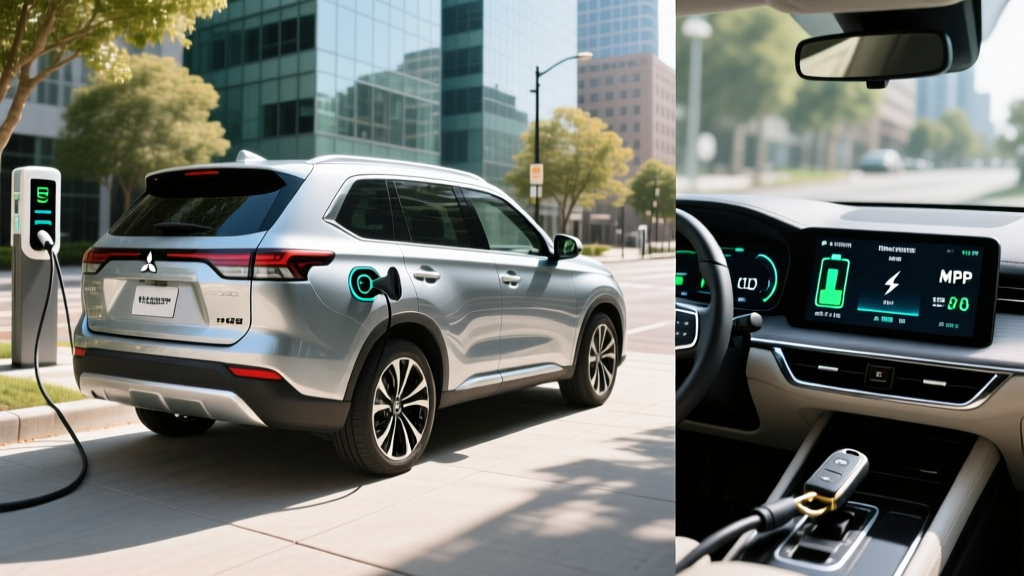
If you're researching Mitsubishi hybrids in 2026, the conversation starts and ends with a single model: the Mitsubishi Outlander PHEV. Unlike Toyota or Hyundai, Mitsubishi does not currently sell a conventional hybrid (HEV) in the U.S. market. The Outlander plug-in hybrid is the brand's sole electrified offering — a compact crossover that pairs a 2.4-liter gasoline engine with dual electric motors and a 20.5 kWh battery pack.
That singular focus actually works in Mitsubishi's favor. Rather than spreading engineering resources across a broad lineup, the company has iterated on one plug-in hybrid platform for over a decade. The current-generation Outlander PHEV (introduced for 2023, refreshed for 2025) represents the most refined version yet, with improved electric-only range, more horsepower, and updated interior technology.
Here's what you need to know before visiting a dealer.
HEV vs. PHEV: What Mitsubishi Actually Sells
| Feature | Conventional Hybrid (HEV) | Plug-In Hybrid (PHEV) |
|---|---|---|
| Plug-in charging | No — charges via regenerative braking and engine | Yes — plug in to access electric-only range |
| Electric-only driving | Minimal (low-speed, short bursts) | Full electric mode for 20-40+ miles typically |
| Battery size | 1–2 kWh | 10–25 kWh typical |
| Federal tax credit | No | Potentially, under §30D (varies by sourcing/income) |
| Mitsubishi offering | None in U.S. | Outlander PHEV |
This distinction matters because many shoppers searching for "Mitsubishi hybrids" may expect a Prius-style conventional hybrid that never needs plugging in. Mitsubishi doesn't make one. If you want a no-plug HEV, you'll need to look at competitors like the Toyota RAV4 Hybrid or Honda CR-V Hybrid. But if you have access to home or workplace charging and want electric-only commuting with a gas backup, the Outlander PHEV fits a specific and practical use case.
EPA Fuel Economy and Electric-Only Range
| Metric | 2026 Outlander PHEV (EPA) |
|---|---|
| Electric-only range | 38 miles |
| Combined MPGe (electric + gas) | 64 MPGe |
| Gas-only combined MPG | 26 MPG |
| Gas-only city MPG | 25 MPG |
| Gas-only highway MPG | 27 MPG |
| Total combined range (electric + gas) | ~420 miles |
| Fuel tank capacity | 14.8 gallons |
The 38-mile EPA electric-only range is the headline figure. For context, the EPA's fueleconomy.gov listing confirms this rating, which places the Outlander PHEV among the longer-range PHEVs in its class — ahead of the Toyota RAV4 Prime's 42-mile rating only slightly behind, and well ahead of most non-Prime PHEV competitors.
Real-world range reality: Expect 30–35 miles of electric-only driving in mixed conditions, and as low as 22–26 miles in freezing weather with cabin heat running. Highway driving at 70+ mph also reduces electric range significantly. The 38-mile EPA figure assumes moderate temperatures, mixed city/suburban driving, and no aggressive acceleration.
Once the battery depletes, the Outlander PHEV operates as a conventional hybrid, returning 26 MPG combined. This is respectable for a 4,600-pound AWD crossover, though it trails the Toyota RAV4 Hybrid's 39 MPG combined. In real-world city driving, PHEVs often exceed their EPA gas-only MPG because regenerative braking recaptures energy — expect 27–29 MPG in stop-and-go traffic.
Battery, Charging, and Powertrain Specs
| Specification | 2026 Outlander PHEV |
|---|---|
| Battery capacity (total / usable) | 20.5 kWh / ~17.5 kWh usable |
| Battery chemistry | Lithium-ion (NMC) |
| Level 1 charging (120V, 1.4 kW) | ~14 hours (0–100%) |
| Level 2 charging (240V, 3.3 kW onboard) | ~6.5 hours (0–100%) |
| DC fast charging (CHAdeMO) | Yes — up to 22 kW, 0–80% in ~38 min |
| Engine | 2.4L 4-cylinder Atkinson-cycle, 126 hp |
| Front electric motor | 114 hp / 188 lb-ft |
| Rear electric motor | 134 hp / 144 lb-ft |
| Combined system output | 248 hp |
| Drivetrain | Standard AWD (S-AWC) |
| 0–60 mph | ~6.8 seconds |
| Towing capacity | 1,500 lbs |
The Outlander PHEV's 3.3 kW onboard charger is its most significant charging limitation. While competitors like the RAV4 Prime offer 6.6 kW Level 2 charging (halving charge time), the Outlander needs a full night on a Level 2 home charger to replenish its 20.5 kWh pack. For daily commuters who plug in overnight, this is rarely an issue — you're only replacing the 17–18 kWh you actually used, which takes about 5–6 hours.
The CHAdeMO DC fast-charging port is a Mitsubishi hallmark. While the broader industry has largely standardized on CCS1 and NACS connectors, Mitsubishi continues with CHAdeMO. This means you can DC fast-charge at Electrify America and some other networks, but CHAdeMO stations are becoming less common as CCS and NACS dominate. The 22 kW peak DC rate is modest — this is not a vehicle designed for rapid road-trip recharging.
Pricing, Trims, and Federal Tax Credit Eligibility
The 2026 Outlander PHEV starts at $40,445 (including destination) for the ES trim and climbs to approximately $50,000 for a fully loaded SEL Platinum Edition. Here's the trim breakdown:
- ES: $40,445 — cloth seats, 8-inch display, basic driver assists
- SE: $43,845 — synthetic leather, power liftgate, 9-inch display, heated front seats
- SEL: $46,645 — genuine leather, panoramic sunroof, premium audio
- SEL Platinum Edition: ~$49,995 — two-tone paint, quilted leather, additional tech
Federal §30D Tax Credit — Key Requirements (2026):
- Maximum credit: Up to $7,500 if all requirements met ($3,750 for critical minerals + $3,750 for battery components)
- MSRP cap: SUVs/vans must be under $80,000 — Outlander PHEV qualifies
- Buyer income cap: AGI must not exceed $150,000 (single) / $300,000 (joint) / $225,000 (head of household)
- Battery sourcing: Critical minerals and battery components must meet phased-in domestic/FHA-partner sourcing thresholds — check IRS.gov current guidance for the Outlander PHEV's specific eligibility
- Point-of-sale transfer: Eligible buyers can transfer the credit to the dealer for an upfront price reduction
Critical caveat: The Outlander PHEV's battery is manufactured in Japan, and its critical-mineral sourcing chain may not fully satisfy 2026 thresholds. This could reduce the credit to $3,750 or eliminate it entirely depending on the specific model year and production batch. Always verify current eligibility on the IRS Clean Vehicle credit page or with your tax professional before counting on the full $7,500.
Battery Warranty, Reliability, and Replacement Costs
Mitsubishi PHEV Battery Warranty:
- Coverage: 10 years / 100,000 miles (whichever comes first)
- What's covered: Battery capacity loss below a defined threshold (typically 70% state of health), defects, and failures
- Powertrain warranty: 10 years / 100,000 miles (engine, motors, transmission)
- Bumper-to-bumper: 5 years / 60,000 miles
Mitsubishi's 10-year powertrain and battery warranty is among the best in the industry, matching Hyundai/Kia and exceeding Toyota's 8-year/100,000-mile hybrid battery coverage. This matters for PHEV buyers concerned about long-term battery health.
Regarding reliability: Mitsubishi's PHEV system has been in production since 2012 (the original Outlander PHEV launched in Japan that year). Over a decade of real-world data shows the dual-motor, series-parallel hybrid architecture to be robust. Common issues reported by owners tend to involve infotainment software and minor electrical gremlins rather than powertrain or battery failures.
If the battery does need replacement out of warranty, expect a cost in the $8,000–$12,000 range for the pack itself, plus $1,500–$2,500 in labor. However, PHEV batteries experience less degradation than full EV batteries because the system maintains a larger buffer — the Outlander PHEV uses roughly 17.5 kWh of its 20.5 kWh total capacity, leaving a ~3 kWh buffer that protects cell longevity. Most owners report minimal range loss even after 80,000–100,000 miles.
Outlander PHEV vs. Full EV vs. Gas: Who Should Choose What?
Choose the Outlander PHEV if:
- Your daily commute is under 35 miles round-trip and you can charge at home
- You take regular road trips where charging infrastructure is sparse
- You want AWD and three-row seating (the Outlander offers a small third row) without full-EV pricing
- You're not ready to commit to a battery-electric vehicle but want meaningful fuel savings
Choose a full EV (like the Hyundai Ioniq 5 or Tesla Model Y) if:
- You have reliable home Level 2 charging and your daily driving is under 250 miles
- You want to eliminate gasoline entirely and minimize maintenance (no oil changes, no engine)
- You qualify for the full $7,500 federal credit on an eligible EV
- You prioritize lower per-mile energy costs (~$0.04–0.06/mile on home electricity vs. ~$0.12–0.15/mile on gas)
Choose a conventional hybrid (like the Toyota RAV4 Hybrid) if:
- You cannot charge at home or at work — no garage, no outlet access
- You want the simplest possible ownership experience with no plug-in routine
- You prioritize maximum MPG (RAV4 Hybrid: 39 combined) over electric-only driving
- You want a lower starting price (RAV4 Hybrid starts around $33,000)
Pros and Cons at a Glance
Pros
- 38-mile EPA electric range covers most daily commutes gas-free
- Standard AWD (S-AWC) with 248 combined hp — confident in snow and rain
- 10-year/100,000-mile battery and powertrain warranty
- Three-row seating (rare in the PHEV compact crossover segment)
- DC fast charging capability (CHAdeMO), uncommon among PHEVs
- Competitive pricing relative to RAV4 Prime and Sportage PHEV
Cons
- 3.3 kW onboard charger is slow for Level 2 — takes 6.5 hours for full charge
- CHAdeMO connector is losing ground to CCS/NACS at public stations
- 26 MPG gas-only is below the RAV4 Hybrid's 39 MPG combined
- Third row is cramped — best for small children only
- Full federal tax credit eligibility is uncertain due to battery sourcing
- No conventional hybrid (HEV) option if you can't plug in
Frequently Asked Questions
How many MPG does the Mitsubishi Outlander PHEV get?
The 2026 Outlander PHEV achieves 64 MPGe when operating in combined electric-and-gas mode, and 26 MPG combined (25 city / 27 highway) once the battery is depleted and it runs on gasoline alone. In real-world city driving with frequent regenerative braking, owners report 27–29 MPG on gas. Over a typical commute where you charge nightly and drive under 38 miles, you may use very little gasoline at all.
How far can the Outlander PHEV go on electric only?
The EPA rates the Outlander PHEV at 38 miles of electric-only range. In real-world conditions, expect 30–35 miles in moderate weather and 22–26 miles in freezing temperatures with cabin heat active. Highway driving above 65 mph also reduces electric range due to increased aerodynamic drag. Total combined range (electric + full gas tank) is approximately 420 miles.
Does the Mitsubishi Outlander PHEV qualify for a federal tax credit?
Potentially, but it depends. Under the IRS §30D Clean Vehicle Credit, the Outlander PHEV may qualify for up to $7,500 if battery sourcing and critical-mineral requirements are met. However, Mitsubishi's Japan-sourced battery may not satisfy all 2026 thresholds, which could reduce or eliminate the credit. Buyer income caps ($150K single / $300K joint) and the $80,000 SUV MSRP cap also apply. Always verify on IRS.gov before purchasing.
Is the Mitsubishi PHEV system reliable, and what does battery replacement cost?
Mitsubishi's PHEV drivetrain has been in production since 2012 and has proven reliable, with few reported battery failures. The battery is covered by a 10-year / 100,000-mile warranty. Out-of-warranty battery replacement costs approximately $8,000–$12,000 for the pack plus $1,500–$2,500 in labor. However, the large buffer (~3 kWh) between total and usable capacity helps preserve long-term battery health, and most owners experience minimal range degradation over 100,000+ miles.
Can I charge the Outlander PHEV at a Tesla Supercharger?
Not directly. The Outlander PHEV uses a J1772 connector for Level 1/Level 2 AC charging and a CHAdeMO connector for DC fast charging. Tesla's North American Charging Standard (NACS) is a different physical connector. Adapters exist for J1772-to-NACS AC charging, but CHAdeMO-to-NACS DC adapters are not widely available or reliable. You can charge at Electrify America, EVgo, and other non-Tesla networks that support CHAdeMO.
Does Mitsubishi make any non-plug-in hybrids?
Not in the United States as of 2026. Mitsubishi's global lineup includes mild-hybrid systems in some markets, but the only electrified model sold in the U.S. is the Outlander PHEV. If you need a conventional hybrid that never requires plugging in, consider the Toyota RAV4 Hybrid, Honda CR-V Hybrid, or Hyundai Tucson Hybrid instead.