Quick Verdict: A Practical Bridge to Electrification
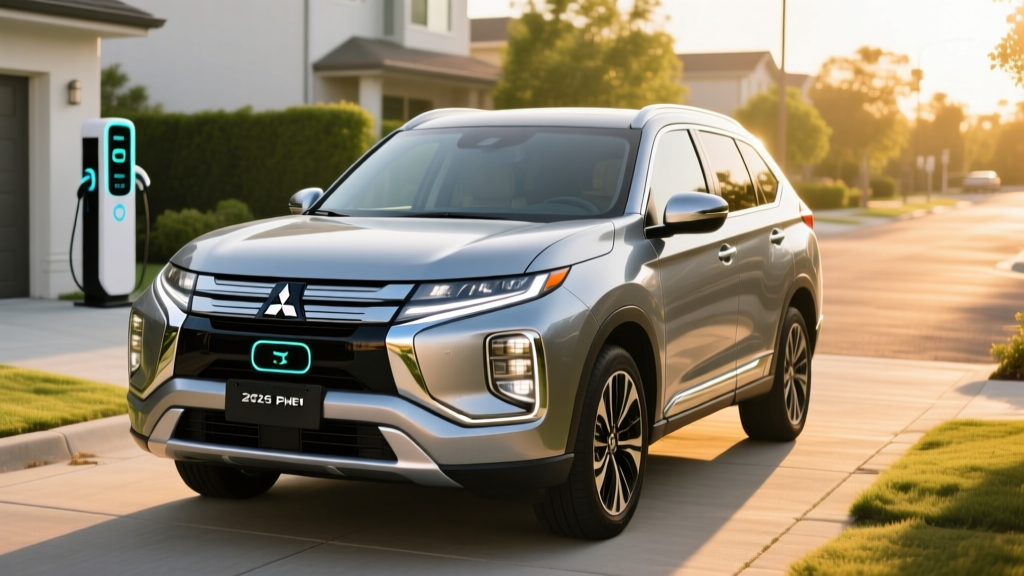
The 2026 Mitsubishi Outlander PHEV occupies a specific and increasingly crowded niche: a three-row plug-in hybrid SUV that lets most commuters drive on electricity alone during the week while preserving gas-engine flexibility for weekend road trips. With an EPA-rated 38 miles of electric-only range, a combined 248 horsepower from its twin-motor all-wheel-drive system, and a starting MSRP around $41,440, it undercuts rivals like the Toyota RAV4 Prime and Hyundai Tucson PHEV on price while offering something neither can — a usable third row.
But the Outlander PHEV isn't without compromises. Its charge-curve taper above 80% state of charge stretches Level 2 top-ups, and highway fuel economy once the battery depletes falls short of some competitors. Here's everything you need to know before signing the paperwork.
HEV vs PHEV: What's the Difference?
Before examining specs, it's worth clarifying the distinction between a conventional hybrid (HEV) and a plug-in hybrid (PHEV), because Mitsubishi sells only the plug-in version of the Outlander in the U.S.
Conventional Hybrid (HEV)
- Small battery (~1-2 kWh), charged only by regenerative braking and the engine
- No plug — never needs external charging
- Electric motor assists the gas engine; limited or no pure-electric driving
- Example: Toyota Highlander Hybrid (36 MPG combined)
Plug-In Hybrid (PHEV)
- Larger battery (~20 kWh), charged via plug (Level 1 or Level 2)
- Significant electric-only range before the gas engine engages
- Can operate as a full EV for daily commuting, then switch to hybrid mode
- Example: 2026 Mitsubishi Outlander PHEV (38 mi electric, then hybrid)
The Outlander PHEV is strictly a plug-in hybrid. If you never plug it in, it still functions as a conventional hybrid — but you'll miss the entire point of the larger, more expensive battery pack.
Range, MPGe, and Fuel Economy
The 2026 Outlander PHEV carries a 20.0 kWh lithium-ion battery pack (approximately 17.5 kWh usable), which the EPA rates at 38 miles of electric-only range. That figure is based on combined city/highway driving; expect closer to 40-42 miles in stop-and-go city traffic where regenerative braking recaptures energy, and roughly 32-35 miles at sustained 70 mph highway speeds.
Real-World Range Expectations
| Condition | Electric-Only Range | Notes |
|---|---|---|
| EPA Combined | 38 miles | Official sticker rating |
| City / Stop-and-Go | 40-42 miles | Regen recaptures energy at low speeds |
| Highway (70 mph) | 32-35 miles | Aero drag and no regen benefit |
| Cold Weather (below 32°F) | 26-30 miles | Battery efficiency drops; cabin heat draws power |
Once the battery depletes, the 2.4-liter four-cylinder engine and twin electric motors operate as a series-parallel hybrid. Here's the EPA fuel economy breakdown:
| Metric | EPA Rating |
|---|---|
| Combined (Charge-Sustaining) | 26 MPG |
| City (Charge-Sustaining) | 25 MPG |
| Highway (Charge-Sustaining) | 27 MPG |
| Combined MPGe (Electric + Gas) | 64 MPGe |
| Electric Energy Consumption | 52 kWh/100 mi |
| Total Combined Range | ~420 miles |
Source: fueleconomy.gov
Real-World MPG vs EPA: What to Expect
Hybrid and PHEV fuel economy often exceeds EPA city estimates because regenerative braking recovers energy that conventional brakes waste as heat. In mixed suburban driving with frequent stops, owners regularly report 28-30 MPG in charge-sustaining mode. Highway-only driving, however, tends to match or slightly undershoot the EPA's 27 MPG figure, since aerodynamic drag dominates and regen opportunities are scarce.
The 64 MPGe combined rating is meaningful only if you regularly charge and drive within the 38-mile electric window. If your commute is 50 miles each way and you rarely plug in, you'll see closer to 26 MPG — making the Outlander PHEV's premium over a conventional hybrid harder to justify.
Powertrain: 248 HP Twin-Motor AWD
The 2026 Outlander PHEV pairs a 2.4-liter Atkinson-cycle four-cylinder engine (126 hp, 144 lb-ft) with two electric motors — one on each axle — for standard all-wheel drive. The front motor produces 114 hp and 188 lb-ft; the rear motor adds 134 hp and 144 lb-ft. Combined system output is 248 horsepower.
| Specification | 2026 Mitsubishi Outlander PHEV |
|---|---|
| Engine | 2.4L Atkinson-cycle I4 |
| Combined System Power | 248 hp |
| Front Motor | 114 hp / 188 lb-ft |
| Rear Motor | 134 hp / 144 lb-ft |
| Battery (Total / Usable) | 20.0 kWh / ~17.5 kWh |
| Battery Chemistry | NMC (Nickel Manganese Cobalt) |
| EPA Electric Range | 38 miles |
| EPA Combined MPGe | 64 MPGe |
| Charge-Sustaining MPG | 26 combined (25 city / 27 hwy) |
| Drivetrain | Twin-motor AWD (S-AWC) |
| 0-60 mph | ~7.2 seconds |
| Towing Capacity | 1,500 lbs |
| Seating | 3 rows / 7 passengers |
| Cargo (Behind 3rd Row) | 11.7 cu ft |
| Cargo (Behind 2nd Row) | 33.5 cu ft |
Mitsubishi's Super All-Wheel Control (S-AWC) system uses the twin motors to actively torque-vector between axles, providing confident traction in rain and light snow. The 0-60 mph time of roughly 7.2 seconds is adequate for merging and passing, though it trails the RAV4 Prime's 5.7-second sprint.
Charging: Level 1, Level 2, and the DC Fast-Charging Question
The Outlander PHEV charges through a J1772 inlet for AC charging. Here's what to expect at each level:
| Charging Level | Power | Time (0-100%) | Miles of Range Added per Hour |
|---|---|---|---|
| Level 1 (120V household) | ~1.4 kW | ~14-15 hours | ~3 miles |
| Level 2 (240V, 16A) | ~3.8 kW | ~5.5 hours | ~8 miles |
| Level 2 (240V, 32A) | ~7.7 kW | ~3.5 hours | ~12 miles |
| DC Fast Charge (CHAdeMO) | Up to 22 kW | ~38 min (10-80%) | N/A |
DC Fast Charging: Limited but Present
One area where the Outlander PHEV stands apart from most plug-in hybrids: it still offers DC fast-charging capability via a CHAdeMO connector. However, peak rate is limited to roughly 22 kW, meaning a 10-80% charge takes approximately 38 minutes. That's far slower than a dedicated BEV (which might peak at 150-250 kW), but it's useful for topping up during a road-trip rest stop.
Important caveat: CHAdeMO infrastructure is rapidly declining in the U.S. as networks standardize on NACS (Tesla) and CCS1. Many newer Electrify America and EVgo stations no longer include CHAdeMO connectors. Before relying on DC fast charging, verify connector availability on your regular routes using apps like PlugShare or A Better Routeplanner.
Home Charging: What You Need
Most Outlander PHEV owners will charge at home overnight on a standard 120V outlet (Level 1), which adds roughly 3 miles of range per hour — enough to replenish the 38-mile battery in about 13-15 hours. For faster replenishment, a 240V Level 2 home charger (like a ChargePoint Home Flex or Emporia Level 2) on a 32-amp circuit will fully recharge the pack in about 3.5 hours.
Level 2 installation typically costs $800-$2,000 including equipment and electrician labor, depending on panel proximity and local permit fees. No panel upgrade is usually needed for a PHEV's modest 7.7 kW draw, unlike higher-power BEVs that may require 200-amp service.
Pricing, Trims, and Tax Credit Eligibility
The 2026 Outlander PHEV is offered in four trims:
| Trim | MSRP | Key Features |
|---|---|---|
| ES | $41,440 | Base AWD, 18" wheels, 8" touchscreen, heated front seats |
| SE | $44,640 | Synth-leather, power liftgate, 9" display, wireless CarPlay |
| SEL | $48,140 | Leather, panoramic roof, head-up display, MI-PILOT Assist |
| GT-Premium | $51,840 | Nappa leather, premium audio, quilted seats, adaptive suspension |
All trims include Mitsubishi's S-AWC all-wheel drive and the 20 kWh battery pack as standard.
Federal Tax Credit: The §30D Reality Check
Under current IRS §30D Clean Vehicle Credit rules, the Outlander PHEV may qualify for a partial federal tax credit of up to $3,750, depending on battery critical-mineral and component sourcing requirements that shift annually. The full $7,500 credit requires meeting both the critical-minerals threshold ($3,750) and the battery-component sourcing threshold ($3,750).
§30D Eligibility Requirements (2026)
- Vehicle MSRP cap: SUVs/vans/pickups must be ≤ $80,000 (all Outlander PHEV trims qualify)
- Buyer income cap: Modified AGI ≤ $150,000 (single) / $300,000 (joint)
- Battery sourcing: Critical minerals and component percentages must meet annual thresholds (varies by model year)
- Assembly: Final assembly must occur in North America (the Outlander PHEV is assembled in Okazaki, Japan — this may disqualify it)
- Point-of-sale transfer: Eligible credits can be transferred to the dealer at purchase for an upfront price reduction
Critical issue: The Outlander PHEV is manufactured in Japan, which fails the North American final-assembly requirement under §30D. This likely makes it ineligible for the federal purchase credit. However, some buyers may qualify for a used-EV credit (§25E) of up to $4,000 when purchasing a qualifying pre-owned Outlander PHEV, or for state-level incentives (California's CVRP, Colorado's state credit, etc.). Always verify eligibility on the IRS website and consult a tax professional before relying on a credit.
Battery Warranty, Reliability, and Replacement Costs
Plug-in hybrid buyers consistently rank battery longevity as a top concern. Here's how Mitsubishi addresses it:
Outlander PHEV Warranty Coverage
| Coverage | Term |
|---|---|
| PHEV Battery (capacity retention) | 10 years / 100,000 miles |
| Powertrain (engine, motors, transmission) | 10 years / 100,000 miles |
| Bumper-to-Bumper | 5 years / 60,000 miles |
| Roadside Assistance | 5 years / unlimited miles |
The battery warranty guarantees the pack will retain at least 70% of its original capacity during the coverage period. If capacity drops below that threshold, Mitsubishi will repair or replace the pack at no cost.
Reliability Track Record
Mitsubishi's PHEV system has been in production since 2013 (first-generation Outlander PHEV), making it one of the longest-running plug-in hybrid platforms on the market. The current third-generation system benefits from over a decade of iteration. Common issues reported by owners are minor — primarily related to infotainment software rather than the powertrain itself.
Battery Replacement Cost
Out-of-warranty PHEV battery replacement for the Outlander typically ranges from $8,000 to $12,000 including parts and labor, based on dealer pricing for the 20 kWh pack. However, NMC battery degradation in PHEV applications tends to be gradual — most owners report 85-90% state of health after 5 years and 60,000 miles, well within the warranty threshold. The buffer between usable and total capacity (~2.5 kWh) also helps mask early degradation from the driver.
Who Should Choose the Outlander PHEV?
Decision Framework
Choose the Outlander PHEV if:
- Your daily commute is under 35 miles round-trip and you can charge at home
- You need three-row seating (kids, carpool, occasional passengers) but don't want a minivan
- You take 3+ road trips per year and aren't ready to plan around DC fast-charger availability
- You want standard AWD for snow/rain without a fuel-economy penalty
Choose a full BEV (like the Kia EV6 or Tesla Model Y) if:
- You have reliable home charging and your trips rarely exceed 250 miles
- You want to eliminate oil changes, spark plugs, and gas-engine maintenance entirely
- You prioritize the lowest per-mile fuel cost (electricity at $0.12/kWh ≈ $0.04/mile vs gas at $3.50/gal ≈ $0.13/mile)
Choose a conventional hybrid (like the Toyota Highlander Hybrid) if:
- You can't charge at home (apartment, no garage, street parking only)
- You want hybrid efficiency without the PHEV price premium (~$6,000-$8,000 more than the Outlander PHEV)
- You drive mostly highway miles where the electric range provides minimal benefit
Pros
- 38-mile electric range covers most daily commutes
- Standard AWD with torque vectoring (S-AWC)
- Three-row seating (rare in PHEV segment)
- DC fast charging (CHAdeMO) — uncommon for PHEVs
- 10-year/100,000-mile battery and powertrain warranty
- Competitive starting price for a PHEV SUV
Cons
- Assembled in Japan — likely ineligible for §30D federal credit
- Charge-sustaining MPG (26 combined) trails RAV4 Prime (38 MPG)
- Third row is tight — best for children only
- CHAdeMO connector is a declining standard
- Towing limited to 1,500 lbs
- Cargo space behind 3rd row is just 11.7 cu ft
Frequently Asked Questions
How many MPG does the 2026 Outlander PHEV get?
The EPA rates it at 64 MPGe combined when factoring in electric driving. Once the battery depletes, it achieves 26 MPG combined (25 city / 27 highway) in charge-sustaining hybrid mode. Real-world city driving often yields 28-30 MPG thanks to regenerative braking.
How far can it go on electric only?
The EPA rates the Outlander PHEV at 38 miles of electric-only range. In mild-weather city driving, expect 40-42 miles. On the highway or in cold weather, plan for 26-35 miles before the gas engine engages.
Does the Outlander PHEV qualify for the $7,500 federal tax credit?
Almost certainly not. The Outlander PHEV is assembled in Japan, which fails the North American final-assembly requirement under IRS §30D. Some buyers may qualify for state incentives or the used-EV credit (§25E) on pre-owned models. Always check current rules at fueleconomy.gov and consult a tax professional.
Is the Outlander PHEV reliable, and what does a battery replacement cost?
Mitsubishi's PHEV system has been in production since 2013 and is considered mature. The battery is warranted for 10 years / 100,000 miles at 70% minimum capacity retention. Out-of-warranty replacement runs $8,000-$12,000, though most packs retain 85-90% capacity after 5 years of normal use.
Can I charge the Outlander PHEV at a Tesla Supercharger?
Not directly. The Outlander PHEV uses a J1772 connector for AC charging and CHAdeMO for DC fast charging. Tesla Superchargers use the NACS connector. While Tesla's Magic Dock adapter enables some non-Tesla vehicles to charge at select Superchargers, it supports CCS1 — not CHAdeMO. You'll rely on Electrify America, ChargePoint, and EVgo networks for public charging.
How does it compare to the Toyota RAV4 Prime?
The RAV4 Prime offers more electric range (42 miles), better charge-sustaining fuel economy (38 MPG combined), faster acceleration (5.7 sec 0-60), and is assembled in North America (more likely to qualify for the federal credit). However, the RAV4 Prime has only two rows of seating, a higher starting price (~$44,000), and limited availability due to high demand. If you need a third row, the Outlander PHEV is one of the only options in the segment.