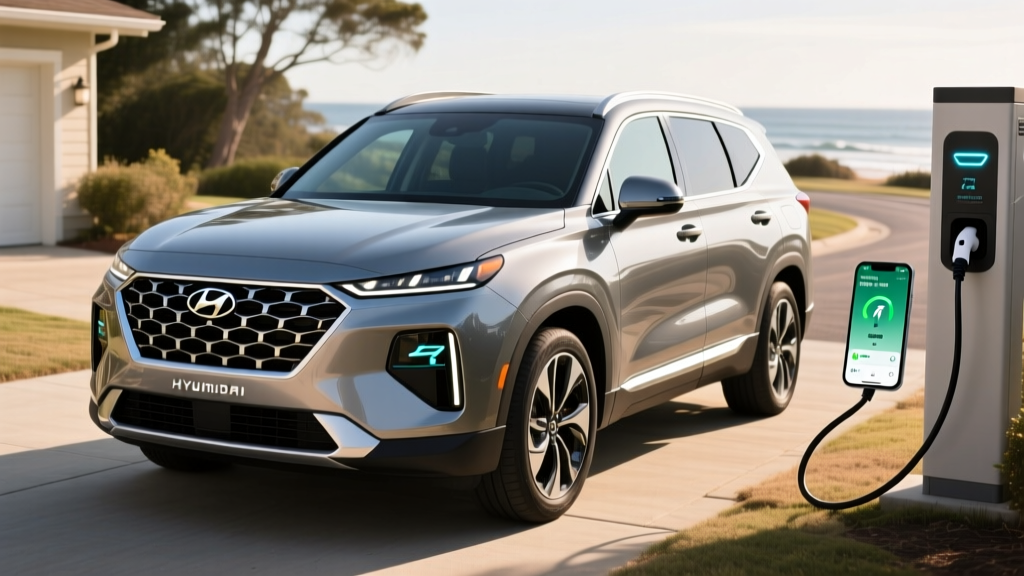
The Hyundai Santa Fe has long been a midsize SUV staple, but the current generation's boxy redesign and electrified powertrains have made the hybrid Santa Fe one of the most compelling three-row family haulers on the market. For 2026, Hyundai continues to offer the Santa Fe in two electrified flavors: a conventional hybrid (HEV) that never needs plugging in, and a plug-in hybrid (PHEV) that delivers meaningful electric-only driving for daily commutes. If you're cross-shopping the hybrid Santa Fe against the Toyota Highlander Hybrid, Kia Sorento Hybrid, or even a full battery-electric SUV, this guide breaks down every number that matters — EPA MPG, real-world efficiency, battery warranty, powertrain output, pricing, and tax credit eligibility.
HEV vs PHEV: Which Hybrid Santa Fe Is Right for You?
Before diving into specs, it's critical to understand the fundamental difference between the two electrified Santa Fe variants. This distinction determines how you fuel the vehicle, what you'll spend at the pump, and whether you qualify for federal incentives.
| Feature | Santa Fe Hybrid (HEV) | Santa Fe Plug-In Hybrid (PHEV) |
|---|---|---|
| Needs to be plugged in? | No — regenerative braking and engine charge the battery | Yes — plug in to access electric-only range |
| Electric-only driving | Very limited (low-speed creep only) | EPA-estimated ~30 miles on battery alone |
| Battery size | ~1.5 kWh (small, self-charging) | ~13.8 kWh usable (larger, plug-in capable) |
| Federal tax credit (§30D) | Not eligible | Up to $6,587 (varies by sourcing compliance) |
| Best for | Drivers who can't charge at home; apartment dwellers | Home chargers with short commutes wanting EV-like daily driving |
The conventional HEV is the simpler choice: you drive it exactly like a gas car, and the hybrid system handles the rest. The PHEV rewards owners who can install a Level 2 home charger with near-EV daily commuting and a gas engine for road trips.
Fuel Economy: EPA MPG and Real-World Numbers
Fuel economy is the primary reason most buyers search for a hybrid Santa Fe. Here's what the EPA rates each variant at, along with what you can realistically expect.
| Powertrain | City MPG | Highway MPG | Combined MPG | Real-World Expectation |
|---|---|---|---|---|
| Santa Fe Hybrid (HEV) FWD | 36 | 35 | 36 | 33–38 (city-biased driving favors hybrids) |
| Santa Fe Hybrid (HEV) AWD | 35 | 34 | 34 | 32–36 |
| Santa Fe PHEV (AWD, hybrid mode) | 33 | 30 | 32 | 30–34 (once battery is depleted) |
| Santa Fe PHEV (charge-depleting/EV mode) | 80 MPGe combined (est.) | ~30 mi electric, then 32 MPG gas | ||
Source: fueleconomy.gov
Real-world note: Hybrids excel in stop-and-go city driving where regenerative braking recovers energy that a gas car wastes as brake heat. Many Santa Fe Hybrid owners report exceeding the EPA city figure on urban commutes. Highway efficiency is less impressive because the electric motor provides less benefit at sustained speeds, and the boxy, three-row body creates more aerodynamic drag than sleeker crossovers. Expect a 10–15% fuel economy drop in sustained cold weather (below 30°F) due to increased engine operation for cabin heat and reduced battery efficiency.
Powertrain Specs: Horsepower, Engine, and Motors
| Specification | Santa Fe Hybrid (HEV) | Santa Fe Plug-In Hybrid (PHEV) |
|---|---|---|
| Engine | 1.6L turbocharged 4-cylinder | 1.6L turbocharged 4-cylinder |
| Electric motor output | 47.7 kW (~64 hp) | 66.9 kW (~90 hp) |
| Combined system horsepower | 230 hp | 258 hp |
| Combined torque | 271 lb-ft | 271 lb-ft |
| Transmission | 6-speed automatic | 6-speed automatic |
| Drivetrain | FWD or AWD | AWD (HTRAC standard) |
| 0–60 mph (est.) | ~7.6 sec | ~7.0 sec |
| Towing capacity | 2,000 lbs | 2,000 lbs |
The PHEV's larger motor and higher-output battery pack give it a meaningful 28-hp advantage over the HEV, which you'll notice during highway merging and passing. Both use Hyundai's proven turbo-hybrid architecture paired with a conventional 6-speed automatic rather than a CVT, which makes for more natural acceleration feel compared to the rubber-band effect of continuously variable transmissions found in the Toyota Highlander Hybrid.
PHEV Electric-Only Range and Charging Details
If you're considering the Santa Fe PHEV, the electric-only range and charging logistics are make-or-break factors.
- EPA-estimated electric-only range: ~30 miles
- Total combined range (EV + gas): ~440 miles
- Usable battery capacity: 13.8 kWh (lithium-ion polymer)
- Level 1 charging (120V household outlet): ~11 hours for a full charge
- Level 2 charging (240V, home or public): ~3.5 hours at 3.3 kW onboard charger
- DC fast charging: Not available — the Santa Fe PHEV does not support DC fast charging
The 30-mile EV range covers most daily commutes and school runs entirely on electricity. A typical owner who charges nightly and drives 25–30 miles per day may go weeks without the gasoline engine engaging for propulsion. However, the lack of DC fast charging means public fast-charger networks (Electrify America, EVgo, Tesla Superchargers) are irrelevant to PHEV owners. Your charging strategy is home Level 2 or overnight Level 1.
Install note: A dedicated 240V Level 2 home charger (like a ChargePoint Home Flex or Emporia Level 2) on a 240V/20A circuit will fully replenish the PHEV battery overnight. Expect $500–$1,200 for a quality Level 2 unit plus $500–$2,000 for electrician installation, depending on panel proximity and whether a panel upgrade is needed.
Pricing, Trims, and Federal Tax Credit Eligibility
| Trim | Powertrain | 2026 MSRP (est.) | Federal Tax Credit |
|---|---|---|---|
| SE | HEV | $39,000 | None |
| SEL Premium | HEV | $43,000 | None |
| Limited | HEV | $47,000 | None |
| SEL Premium | PHEV | $47,500 | Up to $6,587* |
| Limited | PHEV | $51,500 | Up to $6,587* |
*Federal tax credit amounts vary based on critical mineral and battery component sourcing requirements under IRS §30D. Credit is non-refundable and subject to buyer income caps ($150K single / $300K joint). The credit can be transferred to the dealer as a point-of-sale discount. Always verify current eligibility on irs.gov before purchasing.
The conventional hybrid Santa Fe does not qualify for the §30D federal tax credit — only plug-in hybrids and full battery-electric vehicles with sufficient battery capacity are eligible. However, some states offer additional rebates for hybrids; check your state energy office or AFDC state incentive database for local programs.
The PHEV's tax credit significantly narrows the price gap with the HEV. A PHEV SEL Premium at ~$47,500 minus a potential $6,587 credit lands near $40,900 — comparable to a mid-trim HEV with the added benefit of 30 miles of daily electric driving.
Battery Warranty, Reliability, and Replacement Cost
Santa Fe Hybrid Battery Warranty
- Hybrid/EV battery warranty: 10 years / 100,000 miles (original owner)
- Hybrid system components: 10 years / 100,000 miles
- Powertrain warranty: 10 years / 100,000 miles
- New vehicle warranty: 5 years / 60,000 miles
Hyundai's hybrid battery warranty is among the best in the industry, matching the coverage offered on its full EVs. The 10-year/100,000-mile battery warranty protects against capacity loss below a defined threshold (typically 70% state of health). In practice, Hyundai's lithium-ion polymer hybrid batteries have shown strong longevity — the brand's hybrid systems have been in production since the Sonata Hybrid in 2011, and widespread battery failure reports are rare.
Out-of-warranty replacement cost: If the hybrid battery does require replacement after the warranty expires, expect $2,000–$4,000 for the HEV pack (smaller capacity) and $5,000–$8,000 for the PHEV pack (larger capacity), including labor. Third-party refurbishers and aftermarket options are increasingly available at lower costs.
For reliability data, the Santa Fe has earned strong marks from IIHS with top safety ratings. Hyundai's hybrid powertrain components have proven robust in long-term ownership surveys, though the brand's infotainment software has drawn more complaints than its mechanical systems.
Hybrid vs PHEV vs Full EV: Which Fits Your Life?
Choose the Santa Fe Hybrid (HEV) if:
- You live in an apartment or lack access to home charging
- You want three-row SUV space without range anxiety on road trips
- You drive 30+ miles daily with mostly highway miles
- You want the lowest upfront cost and simplest ownership
- You don't want to think about charging — ever
Choose the Santa Fe PHEV if:
- You can install a Level 2 charger at home (garage or driveway)
- Your daily commute is under 30 miles round-trip
- You want EV-like daily driving with a gas safety net for road trips
- You qualify for the federal tax credit, narrowing the price gap
- You want lower fuel costs without committing to a full BEV
Choose a full EV (e.g., Hyundai Ioniq 5, Kia EV9) if:
- You can charge at home and have access to DC fast charging for road trips
- Your daily driving is under 250 miles
- You want zero tailpipe emissions and minimal maintenance (no oil changes, fewer moving parts)
- You qualify for the full $7,500 federal tax credit on a qualifying BEV
- You're willing to plan charging stops on longer trips
The hybrid Santa Fe occupies a pragmatic middle ground. It eliminates the charging infrastructure barrier that keeps many buyers from going electric while still delivering 30–40% better fuel economy than the gas-only Santa Fe (rated at 24 MPG combined). For families who need three rows, tow occasionally, and take cross-country road trips, the hybrid powertrain is arguably the most versatile option available in 2026.
Ownership Economics: 5-Year Cost Snapshot
| Cost Factor | Santa Fe HEV (AWD) | Santa Fe PHEV (AWD) | Santa Fe Gas (AWD, 2.5T) |
|---|---|---|---|
| MSRP (mid-trim) | $43,000 | $47,500 | $41,000 |
| Federal tax credit | $0 | –$6,587 (est.) | $0 |
| Effective purchase price | $43,000 | $40,913 | $41,000 |
| Annual fuel cost (15K mi/yr) | ~$1,520 | ~$900 (with home charging) | ~$2,280 |
| 5-year fuel cost | $7,600 | $4,500 | $11,400 |
| Maintenance (5-year est.) | $2,500 | $2,200 | $3,000 |
| 5-year total (purchase + fuel + maint.) | $53,100 | $47,613 | $55,400 |
Fuel costs based on $3.80/gallon gas and $0.14/kWh electricity (national averages). Actual costs vary by region and driving pattern. Source: EPA fuel economy data via fueleconomy.gov.
The PHEV emerges as the most cost-effective variant over five years when the federal tax credit applies and the owner charges at home regularly. Even without the credit, the HEV saves nearly $8,000 in fuel compared to the gas-only model over the same period.
Frequently Asked Questions
How many MPG does the hybrid Santa Fe get?
The 2026 Hyundai Santa Fe Hybrid (HEV) is EPA-rated at 36 city / 35 highway / 36 combined MPG in FWD form, and 35/34/34 with AWD. In real-world driving, city-heavy commuters often exceed the EPA city figure thanks to regenerative braking, while sustained highway driving at 75+ mph may yield 30–32 MPG.
How far can the Santa Fe PHEV go on electric only?
The Santa Fe Plug-In Hybrid delivers an EPA-estimated ~30 miles of electric-only range on a full charge. This covers most daily commutes and errands without using any gasoline. Once the battery is depleted, the PHEV operates as a conventional hybrid at approximately 32 MPG combined.
Does the hybrid Santa Fe qualify for a tax credit?
The conventional Santa Fe Hybrid (HEV) does not qualify for the federal §30D clean vehicle tax credit. The Santa Fe Plug-In Hybrid (PHEV) may qualify for up to $6,587, depending on battery component and critical mineral sourcing compliance, and subject to buyer income limits ($150,000 single / $300,000 joint). The credit can be applied as a point-of-sale discount at the dealer. Verify current eligibility at irs.gov before purchase.
Is the hybrid Santa Fe reliable, and what does a battery replacement cost?
Hyundai's hybrid powertrains have a strong reliability record, and the Santa Fe's hybrid battery is covered by a 10-year/100,000-mile warranty. Out-of-warranty replacement costs range from approximately $2,000–$4,000 for the HEV battery to $5,000–$8,000 for the PHEV battery. Widespread premature battery failures have not been a pattern with Hyundai's hybrid systems.
Does the Santa Fe Hybrid need to be plugged in?
No. The conventional Santa Fe Hybrid (HEV) charges its small battery entirely through regenerative braking and the gasoline engine. You never plug it in. Only the Santa Fe Plug-In Hybrid (PHEV) requires plugging in to access its 30-mile electric-only range — if you never plug in a PHEV, it simply operates as a heavier, slightly less efficient conventional hybrid.
Can I tow with the hybrid Santa Fe?
Yes, both the HEV and PHEV Santa Fe are rated for 2,000 pounds of towing capacity when properly equipped. This is sufficient for a small utility trailer, a pair of jet skis, or a light pop-up camper, but not for larger boat or travel trailer applications.