What Does "Mild Hybrid" (Significado) Actually Mean?
If you've searched mild hybrid significado, you're likely encountering the term on a new-car window sticker or spec sheet and wondering what separates it from a "regular" hybrid or a plug-in. The answer comes down to one number: 48 volts.
A mild hybrid electric vehicle (MHEV) pairs a conventional internal-combustion engine with a small 48-volt integrated starter-generator (ISG) and a compact lithium-ion battery pack — typically between 0.4 and 1.0 kWh. Unlike a full hybrid (HEV) or plug-in hybrid (PHEV), a mild hybrid cannot drive the wheels on electric power alone. Instead, the electric motor assists the engine during acceleration, smooths stop-start operation, and recovers energy during deceleration.
Think of it as an efficiency enhancement layered over a traditional gas powertrain — not a step toward electrified driving, but a meaningful reduction in fuel consumption and emissions for buyers who aren't ready to plug in.
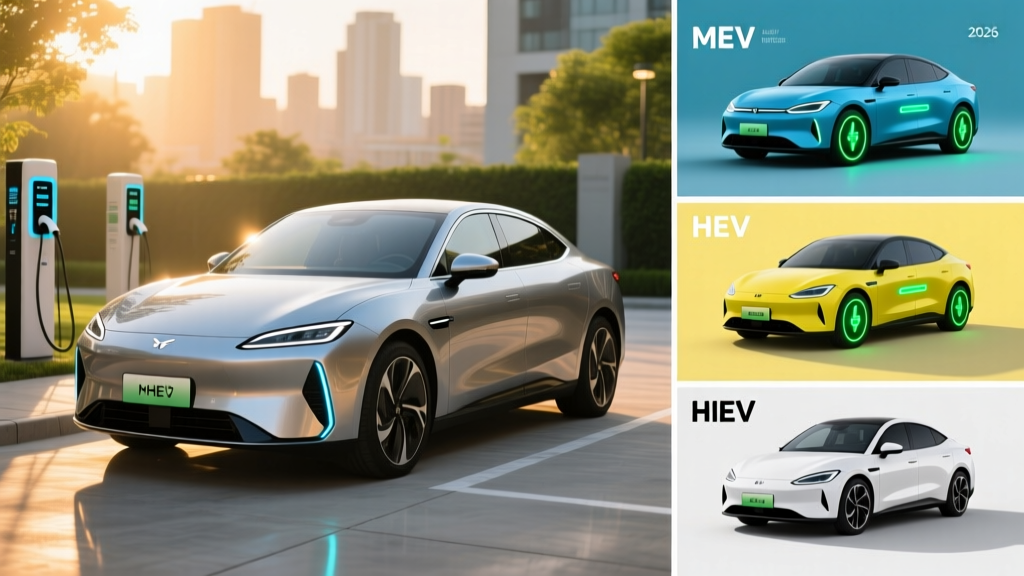
HEV vs PHEV vs MHEV vs BEV — The Quick Breakdown
| Feature | Mild Hybrid (MHEV) | Full Hybrid (HEV) | Plug-in Hybrid (PHEV) | Battery EV (BEV) |
|---|---|---|---|---|
| Electric-only driving | No | Yes (short bursts, low speed) | Yes (20–50 mi typical) | Yes (full range) |
| Battery size | 0.4–1.0 kWh | 1.0–2.0 kWh | 13–30 kWh | 50–120+ kWh |
| Plug-in charging | No | No | Yes (Level 1/2, some DC) | Yes (Level 1/2/DC) |
| Typical MPG gain vs gas | +2–5 MPG combined | +10–25 MPG combined | 45–100+ MPGe on electric | 100–140 MPGe |
| Federal tax credit (§30D) | No | No | Up to $7,500 (if eligible) | Up to $7,500 (if eligible) |
| Price premium over gas | $500–$1,500 | $1,500–$3,500 | $4,000–$8,000 | $5,000–$15,000 |
How a 48-Volt Mild Hybrid System Works
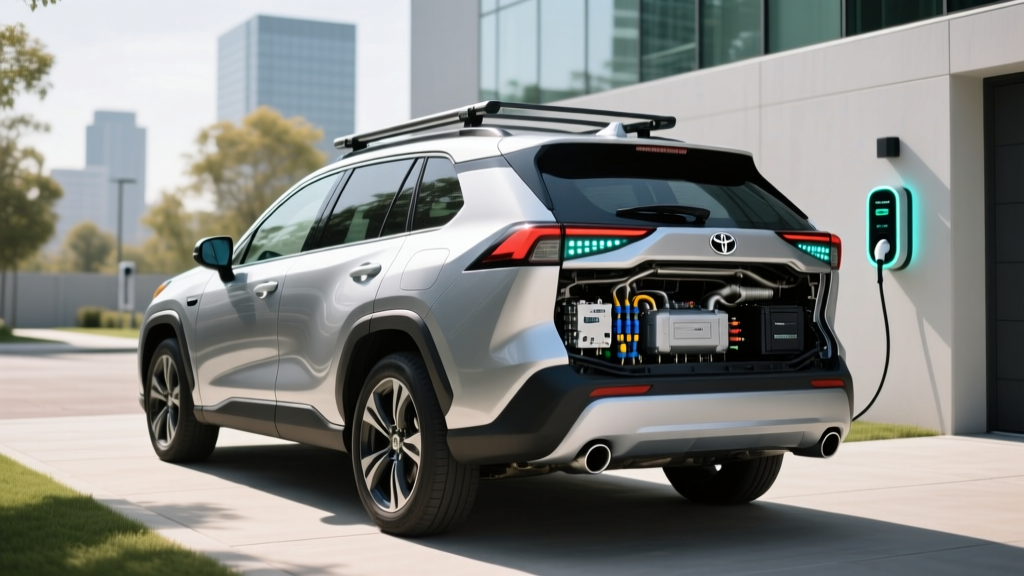
Under the hood, a mild hybrid replaces the traditional 12-volt alternator and starter motor with a belt-driven or crank-mounted integrated starter-generator (ISG). This unit connects to a 48-volt lithium-ion battery, usually mounted under the front passenger seat or in the cargo area.
The system performs four key functions:
- Engine assist under load: The ISG adds 10–20 horsepower of torque fill during hard acceleration, reducing the engine's fuel consumption during its least efficient operating mode.
- Extended engine-off coasting: At highway speeds, the system can shut off the engine entirely while the vehicle coasts, eliminating fuel burn during deceleration phases. Some systems allow "sailing" for up to 40 seconds.
- Smoother stop-start: The 48V ISG restarts the engine nearly instantly and vibration-free at traffic lights — a dramatic improvement over the clunky 12V stop-start systems of the 2010s.
- Regenerative braking: During deceleration, the ISG acts as a generator, converting kinetic energy back into electrical energy stored in the 48V battery.
The net result: a 5–15% improvement in combined fuel economy compared to the same vehicle without the MHEV system, depending on driving conditions. City driving sees the largest gains because of frequent stop-start events and low-speed assist opportunities.
Real-World MPG: Mild Hybrid vs Full Hybrid vs Gas
To make this concrete, let's compare three powertrain configurations available in popular 2026 model-year vehicles. All EPA figures sourced from fueleconomy.gov.
| Vehicle (2026) | Type | City MPG | Hwy MPG | Combined MPG | Real-World Note |
|---|---|---|---|---|---|
| Ram 1500 3.6L V6 | Gas | 20 | 25 | 22 | ~19–21 combined mixed driving |
| Ram 1500 3.6L V6 eTorque | MHEV | 20 | 25 | 22 | EPA identical; real-world +1–2 MPG city |
| Toyota RAV4 (gas) | Gas | 27 | 35 | 30 | ~28–30 combined |
| Toyota RAV4 Hybrid | HEV | 41 | 38 | 39 | Often exceeds EPA in city: 42–45 MPG |
| Hyundai Tucson Hybrid | HEV | 38 | 38 | 38 | ~36–40 combined |
| Mercedes-Benz C300 (2026) | MHEV | 25 | 35 | 29 | ~27–30 combined; coasting helps highway |
Key takeaway: Mild hybrids show their biggest advantage in stop-and-go city driving, where engine-off coasting and smooth restarts cut fuel consumption. On the highway, gains are smaller — typically 1–3 MPG — because the engine operates near its efficient steady-state anyway. A full hybrid like the RAV4 Hybrid delivers dramatically larger gains because its larger battery and more powerful motor can actually propel the vehicle at low speeds without the engine.
Which 2026 Vehicles Use Mild Hybrid Technology?
Mild hybrid adoption has grown significantly as automakers seek cost-effective ways to meet fleet fuel-economy standards. Here are notable 2026 MHEV models available in the US market:
- Mercedes-Benz C300 / E350: 2.0L turbo I4 + 48V ISG, producing 255 hp combined. EPA 25/35/29 MPG (C300). The ISG adds ~20 hp and enables engine-off coasting.
- Mercedes-Benz GLE 450: 3.0L turbo I6 + 48V ISG, 375 hp. EPA 21/27/23 MPG.
- Audi Q5 45 TFSI (2026): 2.0L turbo I4 + 12V mild-hybrid system (MHEV-lite), 261 hp. EPA 23/29/25 MPG.
- Volvo XC60 B5: 2.0L turbo I4 + 48V ISG, 247 hp. EPA 23/30/26 MPG.
- Land Rover Range Rover Sport P400: 3.0L turbo I6 + 48V MHEV, 395 hp. EPA 19/26/22 MPG.
- Jeep Wrangler 4xe (mild-hybrid assist): While the 4xe is a PHEV, the standard 3.6L V6 Wrangler with eTorque qualifies as an MHEV. EPA 20/24/22 MPG.
Pricing varies widely. In luxury brands, the 48V system is often standard across the lineup rather than an option, meaning the MHEV premium is baked into the MSRP. Expect to pay $44,000–$55,000 for a well-equipped Mercedes C300 or Volvo XC60 B5 with mild-hybrid tech.
Battery Warranty, Reliability, and Replacement Costs
One of the most common buyer concerns: what happens when the hybrid battery fails?
Mild Hybrid Battery Warranty — What to Expect
Most 48V mild-hybrid batteries carry an 8-year/100,000-mile warranty (or 10 years/150,000 miles in California Air Resources Board states). This is shorter than the 10-year/150,000-mile coverage typical of full hybrid (HEV) and PHEV traction batteries because the 48V pack is smaller, less stressed, and classified differently under emissions-component regulations.
Replacement cost for a 48V MHEV battery: $800–$2,500 depending on the vehicle — a fraction of the $3,000–$8,000+ cost for a full HEV or PHEV traction battery. The smaller capacity and lower voltage make MHEV battery replacement more akin to swapping a large 12V battery than a major powertrain service.
Real-world degradation data on 48V systems remains limited compared to the decades of Toyota HEV data, but early indications from Mercedes and Volvo show minimal capacity loss at 100,000+ miles because the battery cycles shallowly (typically between 40–80% state of charge) and never provides sustained high-current discharge.
Overall MHEV reliability is strong. The 48V system adds few mechanical components beyond the ISG (which replaces the alternator and starter anyway) and the small battery pack. There's no high-voltage inverter, no electric drive axle, and no complex power-split device. If anything, MHEVs are simpler to service than full hybrids because the 48V system operates at a voltage that doesn't require the same high-voltage safety protocols technicians need for HEV and PHEV traction systems.
Tax Credits: Does a Mild Hybrid Qualify?
This is where the mild hybrid's limitations become clear from a financial standpoint. Under current IRS §30D rules, the federal clean vehicle credit applies only to plug-in electric vehicles — battery electric vehicles (BEVs) and plug-in hybrids (PHEVs) with at least 7 kWh of battery capacity. Mild hybrids, with their sub-1 kWh 48V packs, do not qualify.
Full hybrids (HEVs) like the Toyota RAV4 Hybrid also do not qualify for the §30D credit because they cannot be plugged in.
Here's the eligibility landscape for 2026:
- Mild Hybrid (MHEV): No federal tax credit. No state EV rebates in most jurisdictions.
- Full Hybrid (HEV): No federal §30D credit. A few states offer small hybrid rebates (check your state energy office).
- Plug-in Hybrid (PHEV): Up to $7,500 federal credit if the vehicle meets MSRP caps ($55,000 sedans / $80,000 SUVs and trucks), buyer income limits ($150K single / $300K joint AGI), and battery critical-mineral and component sourcing requirements. Point-of-sale transfer available at participating dealers.
- Battery Electric (BEV): Same §30D rules as PHEV, with the same caps and sourcing requirements.
For buyers motivated by tax incentives, a PHEV like the Toyota RAV4 Prime (42 miles electric-only, EPA 38 MPG combined after battery depletion, ~$44,500 MSRP) or the Chrysler Pacifica Hybrid (32 miles electric-only, 30 MPG combined, ~$50,000 MSRP) delivers both fuel savings and potential credit eligibility — something no MHEV can match.
Mild Hybrid vs Full Hybrid vs PHEV vs EV: Which Powertrain Fits You?
Choose Your Powertrain
Choose a Mild Hybrid (MHEV) if: You want marginally better fuel economy without changing your driving habits, you buy luxury brands where MHEV is standard, you have no access to plug-in charging, and you don't need tax incentives to justify the purchase.
Choose a Full Hybrid (HEV) if: You want significant MPG gains (35–50 MPG combined) without ever plugging in, you do lots of city driving, and you want proven long-term reliability with minimal upfront cost premium.
Choose a Plug-in Hybrid (PHEV) if: You can charge at home (Level 1 or 2), your daily commute is under 40 miles, you want electric-only weekday driving plus gas-engine flexibility for road trips, and you want to potentially claim the $7,500 federal tax credit.
Choose a Battery EV (BEV) if: You have reliable home or workplace charging, you want the lowest per-mile fuel cost (~$0.04–$0.06/mile vs $0.12–$0.16/mile for gas), you want zero tailpipe emissions, and you're comfortable with 250–350+ miles of EPA range.
Pros and Cons of Mild Hybrid Technology
✓ Pros
- No behavior change required — no plugging in, no range planning
- Smoother stop-start than conventional 12V systems
- 5–15% fuel economy improvement for a small price premium
- Lower battery replacement cost ($800–$2,500) vs HEV/PHEV
- No high-voltage safety concerns for owners or first responders
- Often standard equipment on luxury models (no extra cost)
✗ Cons
- Cannot drive on electric power alone — zero EV miles
- No federal or state EV tax credits or rebates
- Fuel savings are modest: ~1–3 MPG highway, ~2–5 MPG city
- Still 100% dependent on gasoline
- Higher complexity than a pure gas car (additional battery, ISG)
- Full HEV delivers 2–5× the fuel savings for only $1,500–$3,000 more
Frequently Asked Questions
How many MPG does a mild hybrid get compared to a gas car?
A mild hybrid typically improves combined fuel economy by 2–5 MPG over the same vehicle without the MHEV system. In city driving with frequent stops, gains can reach 3–5 MPG thanks to engine-off coasting and regenerative braking. Highway gains are smaller, usually 1–3 MPG. For example, the 2026 Mercedes-Benz C300 with its 48V mild-hybrid system achieves an EPA-estimated 25 city / 35 highway / 29 combined MPG.
Can a mild hybrid run on electric power alone?
No. A mild hybrid's electric motor is too small (typically 10–20 hp) and its battery too small (0.4–1.0 kWh) to propel the vehicle independently. The system only assists the gasoline engine and enables features like engine-off coasting and smooth stop-start. If you want electric-only driving, you need at minimum a full hybrid (HEV) for short low-speed bursts, or a PHEV for 20–50 miles of EV range.
Do I need to plug in a mild hybrid?
No. Mild hybrids charge their 48V battery exclusively through regenerative braking and the integrated starter-generator. There is no charging port and no plug-in capability. This is a key distinction from PHEVs and BEVs.
Is a mild hybrid reliable and what does battery replacement cost?
Mild hybrid systems are generally reliable. The 48V battery is small, cycles shallowly, and operates at voltages that don't require the complex thermal management of larger HEV/PHEV packs. Most manufacturers warranty the 48V battery for 8 years/100,000 miles. Replacement costs range from $800 to $2,500 — significantly less than the $3,000–$8,000+ for a full hybrid traction battery. The ISG replaces the alternator and starter, so you're not adding many failure points.
Does a mild hybrid qualify for any tax credit?
No. The federal §30D clean vehicle credit requires a plug-in vehicle with at least 7 kWh of battery capacity. Mild hybrids have sub-1 kWh batteries and no plug-in capability, making them ineligible. Full hybrids (HEVs) are also ineligible. Only PHEVs and BEVs can qualify, subject to MSRP caps, income limits, and battery sourcing requirements per current IRS guidelines.
Is a mild hybrid worth it over a regular gas car?
It depends on the price premium. If the MHEV system is standard equipment (as on most Mercedes, Volvo, and Land Rover models), you're getting free efficiency and refinement improvements. If you're paying a $1,000–$1,500 option premium, the fuel savings alone likely won't pay back the cost within typical ownership periods — but the smoother stop-start and slight performance assist add daily-driving value. If you're choosing between a mild hybrid and a full hybrid, the full hybrid almost always delivers better long-term value through far greater fuel savings.
What's the difference between a 12V and 48V mild hybrid?
A 12V mild hybrid (found in some Audi and earlier-model vehicles) uses a smaller, less capable system that can assist the engine and smooth stop-start but has limited regenerative braking capacity and cannot enable engine-off coasting. A 48V system is more powerful, recovers more energy, enables extended engine-off sailing, and provides more noticeable torque fill. For 2026, most new MHEV designs use 48V architecture.
Sources: fueleconomy.gov (EPA estimates), IRS §30D Clean Vehicle Credits, manufacturer specifications. Real-world MPG figures reflect aggregated owner reports and independent testing; your results will vary based on driving style, climate, and route conditions. Tax credit eligibility depends on individual circumstances — consult a tax professional and verify current rules at irs.gov before purchasing.