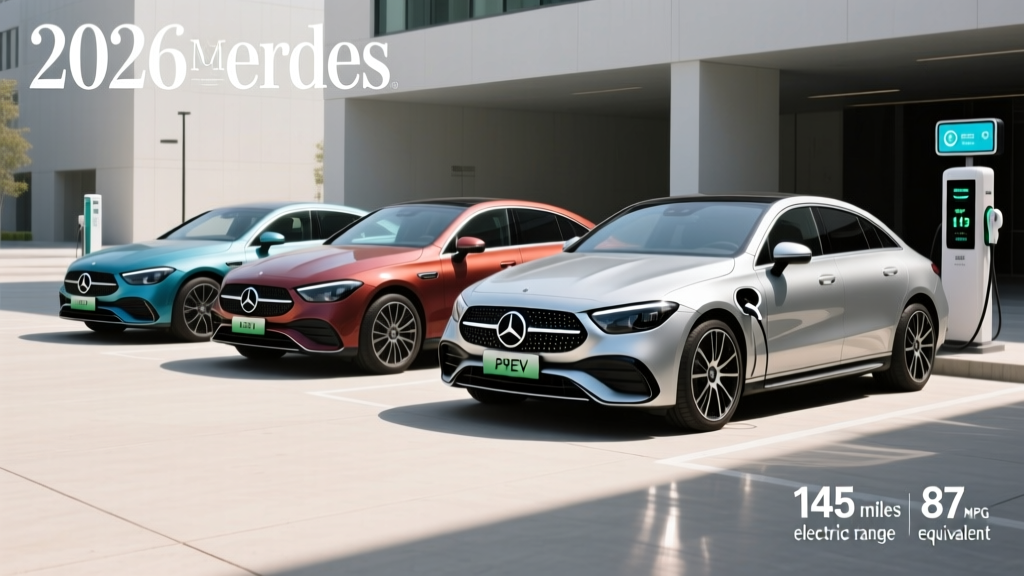
Mercedes-Benz has quietly built one of the most comprehensive plug-in hybrid lineups in the luxury segment. While competitors either pivoted fully to battery-electric vehicles or stuck with mild hybrids, Mercedes maintained a dual strategy: offering both BEVs and PHEVs across its core model lines. For buyers who want electric commuting without range anxiety on road trips, a Mercedes PHEV can be a compelling bridge — but the real-world efficiency, charging practicality, and tax-credit eligibility vary significantly across the lineup.
This guide breaks down the current Mercedes PHEV portfolio for 2026, covering the GLC 350e, S 580e, and other plug-in variants. We'll give you exact EPA figures, battery specs, charging times, and a clear framework for whether a PHEV, full EV, or conventional hybrid makes the most sense for your driving pattern.
HEV vs PHEV: What Mercedes Actually Offers
Before diving into specific models, it's critical to understand the distinction between hybrid types — because Mercedes sells both, and they serve different needs.
| Feature | Conventional Hybrid (HEV) | Plug-In Hybrid (PHEV) |
|---|---|---|
| Plugs in? | No — charges via regenerative braking and engine | Yes — has a larger battery you charge externally |
| Electric-only range | 0–2 miles at low speed | 30–50+ miles (EPA) |
| Battery size | ~1–2 kWh | ~20–30 kWh usable |
| Federal tax credit | Not eligible | Potentially up to $7,500 (§30D) |
| Best for | Drivers who can't plug in at home | Drivers with home/work charging who commute short distances |
Mercedes currently focuses its US PHEV offerings on the GLC 350e (compact luxury SUV) and S 580e (flagship sedan). The brand's mild-hybrid (MHEV) system — a 48-volt integrated starter-generator found on models like the E 350 and GLE 450 — is not a plug-in and provides no electric-only driving range. It simply smooths stop-start and provides brief torque assist. If you see "EQ Boost" or "mild hybrid" in Mercedes literature, that's MHEV, not PHEV.
2026 Mercedes PHEV Lineup: Spec Comparison
| Spec | GLC 350e 4MATIC | S 580e 4MATIC |
|---|---|---|
| Powertrain | 2.0L turbo I4 + electric motor | 3.0L turbo I6 + electric motor |
| Combined HP | 335 hp | 443 hp |
| Combined Torque | 406 lb-ft | 442 lb-ft |
| Battery (usable) | ~22.2 kWh (NMC) | ~22.7 kWh (NMC) |
| EPA Electric Range | ~39 miles | ~37 miles |
| EPA MPGe (EV mode) | ~76 MPGe | ~65 MPGe |
| EPA MPG (gas only) | ~28 city / 30 hwy / 29 combined | ~24 city / 29 hwy / 26 combined |
| Total Combined Range | ~420 miles | ~460 miles |
| 0–60 mph | ~6.5 sec | ~5.0 sec |
| AC Charging (Level 2) | 7.4 kW (0–100% ~3.5 hrs) | 7.4 kW (0–100% ~3.5 hrs) |
| DC Fast Charging | Available (60 kW max) | Not available |
| Drivetrain | AWD (4MATIC) | AWD (4MATIC) |
| Base MSRP | ~$60,000 | ~$120,000 |
Sources: fueleconomy.gov, Mercedes-Benz USA. Specs reflect 2025–2026 model year data; verify with your dealer for the exact build.
Electric-Only Range and Real-World Efficiency
The GLC 350e's EPA-rated 39 miles of electric range is the standout figure in the lineup. For the roughly 60% of American commuters whose one-way trip is under 20 miles, this means you could drive all week on electricity alone and only fire up the gas engine for longer weekend trips. The S 580e's 37-mile electric range is comparable, though its heavier curb weight and larger engine reduce MPGe.
In mixed suburban/highway driving at 65–70°F, expect roughly 33–37 miles from the GLC 350e before the engine kicks in — close to the EPA sticker. In cold weather (below 35°F), plan for 25–30 miles of electric range due to cabin heating draw and reduced battery efficiency. Highway driving at 75+ mph also reduces electric range by 15–20% due to aerodynamic drag. The S 580e, being heavier, tends to deliver 30–35 real-world electric miles.
Once the battery depletes, these PHEVs operate as conventional hybrids. Here, the GLC 350e's 29 MPG combined (gas-only mode) is respectable for a luxury compact SUV, though it doesn't dramatically outperform a non-hybrid GLC 300 (which achieves roughly 26 MPG combined). The PHEV's advantage is the electric commuting buffer, not highway fuel savings.
Real-World MPG: City vs. Highway
A key insight for PHEV owners: your actual fuel consumption depends almost entirely on how often you charge. If you plug in nightly and commute 25 miles each way, you might burn zero gas on weekdays. If you never plug in, you're carrying 500+ lbs of dead battery weight and getting MPG figures that are only marginally better than the gas-only equivalent.
| Scenario | GLC 350e Effective MPG | S 580e Effective MPG |
|---|---|---|
| Daily charge + 30-mi commute | 80+ MPGe (mostly electric) | 70+ MPGe (mostly electric) |
| Charge 3x/week + 30-mi commute | ~50 MPGe blended | ~45 MPGe blended |
| Never charge (gas-only mode) | ~29 MPG combined | ~26 MPG combined |
| Highway road trip (75 mph) | ~27 MPG | ~25 MPG |
Charging: What You Need to Know
Mercedes PHEV batteries are smaller than full EV batteries, so charging is faster — but the onboard charger hardware limits how quickly you can replenish.
| Charging Level | Power | GLC 350e Time (0–100%) | Miles of EV Range Added/Hour |
|---|---|---|---|
| Level 1 (120V household) | ~1.4 kW | ~15–16 hours | ~5 miles |
| Level 2 (240V home/public) | 7.4 kW | ~3.5 hours | ~22 miles |
| DC Fast Charge (GLC 350e only) | 60 kW max | ~30 min (10–80%) | ~70+ miles |
The GLC 350e's optional DC fast charging capability (60 kW via CCS connector) is a significant differentiator — it's one of the few PHEVs in its class that supports DCFC. This means on a road trip, you can add 20–25 miles of electric range during a 15-minute rest stop. The S 580e, unfortunately, is limited to Level 2 AC charging only, which is fine for overnight home charging but limits public-charging utility.
Home charging setup: A standard 240V Level 2 home charger (like a ChargePoint Home Flex or Emporia Vue) on a 40-amp circuit will fully recharge either PHEV overnight. Installation typically runs $500–$2,000 depending on your electrical panel's capacity and the run length from panel to garage. For most PHEV owners, a Level 2 home charger is the single best investment — it transforms the ownership experience from "occasionally plug in" to "wake up with a full battery every morning."
Tax Credit Eligibility: Does a Mercedes PHEV Qualify?
Federal tax credit eligibility for PHEVs is governed by IRS §30D, and the rules have tightened significantly since the Inflation Reduction Act. Here's what applies to Mercedes PHEVs in 2026:
- Battery capacity: Must be ≥7 kWh — both Mercedes PHEVs qualify (~22 kWh).
- MSRP cap: SUVs/vans/trucks capped at $80,000; sedans at $55,000. The GLC 350e (~$60,000 MSRP) clears the SUV cap. The S 580e (~$120,000) exceeds the sedan cap and does not qualify.
- Buyer income limits: AGI must not exceed $150,000 (single), $225,000 (head of household), or $300,000 (joint filing).
- Battery component sourcing: Increasing percentages of battery components and critical minerals must be sourced from the US or FTA partners. Mercedes' supply chain compliance varies by model year — verify current eligibility on fueleconomy.gov before purchasing.
- Point-of-sale transfer: As of 2024+, you can transfer the credit to the dealer at purchase for an immediate price reduction, rather than waiting to claim it on your tax return.
Battery Longevity, Warranty, and Replacement Cost
PHEV batteries are smaller than full EV batteries, but they cycle more frequently (daily charge-discharge), so warranty coverage matters. Mercedes provides the following hybrid battery warranty on its PHEV lineup:
| Coverage | Term |
|---|---|
| High-voltage battery warranty | 6 years / 62,000 miles (whichever comes first) |
| Capacity retention threshold | ~70% of original capacity |
| Powertrain warranty | 4 years / 50,000 miles |
| Basic vehicle warranty | 4 years / 50,000 miles |
The 6-year/62,000-mile high-voltage battery warranty is shorter than what Toyota and Hyundai offer on their hybrids (10 years/150,000 miles). This is a legitimate consideration for buyers planning long-term ownership. However, PHEV batteries in the 20–25 kWh range have demonstrated strong longevity in practice — the smaller capacity means less absolute degradation impact. A 15% capacity loss over 8 years still leaves you with ~33 miles of electric range from an original 39.
Replacement cost: If the high-voltage battery needs replacement out of warranty, expect $8,000–$14,000 depending on the model and labor. This is less than full EV battery replacements ($15,000–$25,000+) because the pack is smaller, but it's still a significant expense. Third-party hybrid battery refurbishment services are emerging but not yet widely available for Mercedes PHEVs.
Reliability Considerations
Mercedes PHEV powertrains add complexity: you have both an internal combustion engine and an electric motor with associated power electronics. Historically, Mercedes' MBUX infotainment and electrical systems have drawn more complaints than the hybrid powertrain itself. The 2.0L turbo I4 in the GLC 350e is a well-proven engine family. The I6 in the S 580e is newer but has shown no systemic issues in early model years. For reliability data, check NHTSA.gov for recalls and technical service bulletins specific to your model year.
Who Should Buy a Mercedes PHEV?
Pros
- 30–40 miles of electric commuting eliminates daily gas use
- No range anxiety — gas engine covers road trips seamlessly
- GLC 350e offers DC fast charging (rare for PHEVs)
- Luxury interior, MBUX tech, and Mercedes safety systems
- GLC 350e may qualify for federal tax credit (up to $7,500)
- AWD standard on all PHEV models
Cons
- Battery warranty shorter than Toyota/Hyundai (6 yr vs 10 yr)
- S 580e exceeds tax credit MSRP cap — no federal incentive
- Gas-only MPG is only marginally better than non-hybrid equivalents
- Premium fuel required on both models
- Higher curb weight affects handling dynamics
- S 580e lacks DC fast charging
Decision Framework: PHEV vs. Full EV vs. Gas
Choose a Mercedes PHEV if: You have home Level 2 charging, your daily commute is under 40 miles round-trip, you take road trips 4+ times per year, and you're not ready to commit to a full EV. The GLC 350e is the strongest value proposition in the lineup.
Choose a full EV (like the EQE or EQS SUV) if: You have reliable home charging, rarely drive more than 250 miles in a single day, want minimal maintenance costs, and want to maximize fuel savings. A full EV eliminates oil changes, spark plugs, and transmission fluid entirely.
Choose a conventional hybrid (HEV) if: You cannot charge at home or work. A Toyota RAV4 Hybrid or Honda CR-V Hybrid will deliver 38–40 MPG combined without ever plugging in — and costs significantly less upfront than a Mercedes PHEV.
Choose the gas-only equivalent if: Your annual mileage is low (under 8,000 miles), fuel costs are a minor budget item, and you want the lowest purchase price. The fuel savings of a PHEV take years to recoup at low mileage.
Frequently Asked Questions
How many MPG does the Mercedes GLC 350e get?
The EPA rates the GLC 350e at approximately 28 city / 30 highway / 29 combined MPG in gas-only hybrid mode, and 76 MPGe when operating on electricity. Real-world city driving with regular charging can push effective efficiency well above these figures, since most short trips use electric-only mode.
How far can the Mercedes PHEV go on electric only?
The GLC 350e achieves an EPA-rated 39 miles of electric-only range. The S 580e is rated at approximately 37 miles. Real-world range in moderate temperatures is typically 33–37 miles for the GLC and 30–35 miles for the S 580e, dropping 15–25% in cold weather.
Does the Mercedes PHEV qualify for a federal tax credit?
The GLC 350e may qualify for up to $7,500 under IRS §30D, depending on your income, the vehicle's MSRP (must be under $80,000 for SUVs), and current battery-sourcing compliance. The S 580e does not qualify because its MSRP exceeds the $55,000 sedan cap. Always verify current eligibility on fueleconomy.gov and consult a tax professional.
Is the Mercedes PHEV battery reliable and what does replacement cost?
Mercedes covers the high-voltage battery for 6 years/62,000 miles with a 70% capacity retention guarantee. Real-world degradation has been modest — expect 10–15% capacity loss over 8 years. Out-of-warranty replacement costs range from $8,000 to $14,000 depending on model and labor.
Can I charge the Mercedes PHEV at a public fast charger?
The GLC 350e supports DC fast charging at up to 60 kW via a CCS connector — a notable advantage for road trips. The S 580e is limited to Level 2 AC charging (7.4 kW) and cannot use DC fast chargers. Both models can charge at any public Level 2 station using a J1772 connector.
What's the difference between Mercedes mild hybrid and plug-in hybrid?
Mercedes mild hybrids (MHEV, labeled "EQ Boost") use a small 48-volt system that assists the engine during acceleration and enables smoother stop-start. They cannot drive on electricity alone and do not plug in. PHEVs have a much larger high-voltage battery (22+ kWh), a more powerful electric motor, 30+ miles of electric-only range, and must be plugged in to realize their efficiency benefits.
How long does it take to charge a Mercedes PHEV at home?
On a 240V Level 2 home charger at 7.4 kW, both the GLC 350e and S 580e charge from empty to full in approximately 3.5 hours. On a standard 120V household outlet (Level 1), expect 15–16 hours for a full charge — adequate for overnight replenishment if your daily electric use is under 30 miles.