Mercedes Hybrid Lineup at a Glance: HEV and PHEV Explained
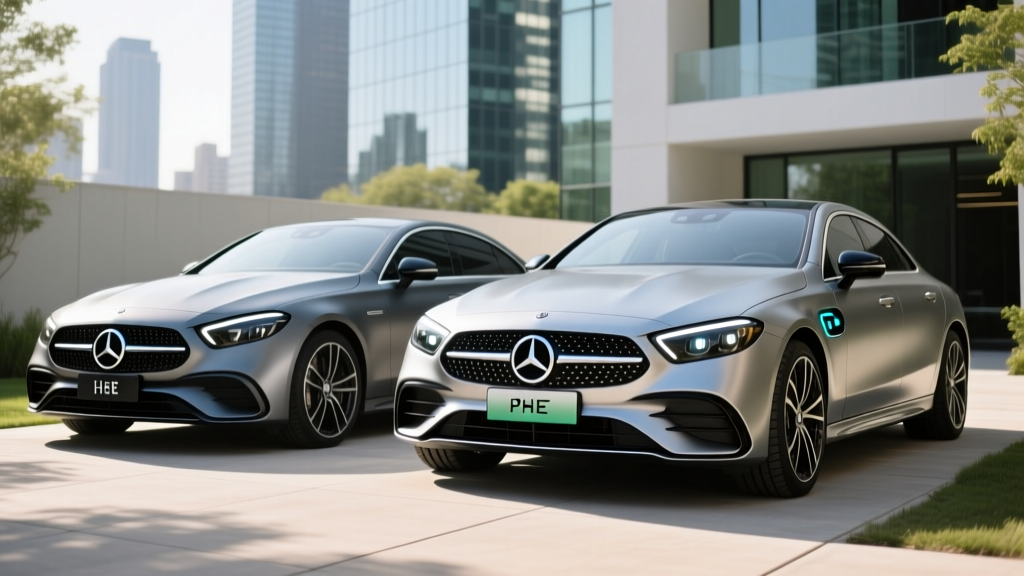
Mercedes-Benz sells two distinct types of electrified vehicles that don't require a full commitment to battery-electric driving: conventional hybrids (HEVs) and plug-in hybrids (PHEVs). The difference matters enormously for your fuel bill, your charging setup, and whether you qualify for federal tax incentives.
HEV vs PHEV — The Core Difference
Conventional Hybrid (HEV): A small battery (typically 1–2 kWh) recharges through regenerative braking and the gas engine. You never plug it in. The electric motor assists the engine during acceleration and enables brief electric-only driving at low speeds. Think of it as a more efficient gas car.
Plug-In Hybrid (PHEV): A much larger battery (18–31 kWh in the current Mercedes lineup) provides 30–50+ miles of electric-only range. You plug it in at home or at a public charger to refill the battery. Once the battery depletes, the gas engine takes over and it operates like a conventional hybrid. Think of it as an EV for daily commuting with a gas engine for road trips.
For the 2026 model year, Mercedes offers HEV technology primarily in the GLC and GLE lineups (mild-hybrid 48-volt systems with integrated starter-generators), while PHEV variants are available in the GLC, GLE, and S-Class. The C-Class PHEV, previously offered in some markets, has been streamlined in the U.S. lineup. Let's break down the key models with exact specs.
2026 Mercedes-Benz PHEV Models: Electric Range and MPG
Mercedes' plug-in hybrids use a turbocharged gasoline engine paired with a permanently excited synchronous electric motor and a lithium-ion battery pack mounted beneath the rear cargo area (which does reduce trunk space slightly). Here's how the current U.S.-available PHEV models stack up on paper and in practice.
| Model | Powertrain | Combined HP | Battery (kWh) | EV Range (mi) | Combined MPGe | Gas-Only MPG | Base MSRP |
|---|---|---|---|---|---|---|---|
| GLC 350e 4MATIC | 2.0L Turbo I4 + EV motor | 312 hp | 23.2 kWh (usable ~19.5) | EPA est. 39 mi | 81 MPGe | 28 combined | ~$60,550 |
| GLE 350de / 400e 4MATIC | 2.0L Turbo I4 + EV motor | 375 hp (400e) | 31.2 kWh (usable ~24.0) | EPA est. 45 mi | 56 MPGe | 23 combined | ~$72,200 |
| S 580e 4MATIC | 3.0L Turbo I6 + EV motor | 502 hp | 28.6 kWh (usable ~22.0) | EPA est. 42 mi | 54 MPGe | 22 combined | ~$121,350 |
Source: fueleconomy.gov and Mercedes-Benz USA. Specs reflect 2025–2026 model year data; confirm with your dealer as trim configurations can shift mid-year.
Real-World Electric Range vs. EPA Sticker
The EPA electric-range figures above assume moderate temperatures, mixed city/highway driving, and no heavy climate-control use. In practice:
- Summer, city driving: Expect to meet or slightly exceed EPA range. Regenerative braking recaptures energy in stop-and-go traffic, and the GLC 350e can return 42–44 real-world electric miles.
- Highway at 70+ mph: Electric range drops 15–25%. The GLE 400e may deliver only 34–38 electric miles on the interstate.
- Winter (below 35°F): Battery chemistry slows and cabin heating draws significant power. Expect a 25–40% reduction — the S 580e might deliver only 25–32 electric miles in cold conditions. Preconditioning the cabin while plugged in mitigates this substantially.
Mercedes Mild-Hybrid (HEV) Models: 48-Volt Efficiency
Not every Mercedes hybrid needs a plug. The brand's 48-volt mild-hybrid system, branded as EQ Boost on earlier models and now integrated as a standard feature on many powertrains, pairs an integrated starter-generator (ISG) with a small 48V lithium-ion battery. This system:
- Adds up to 15–20 hp of temporary electric assist during hard acceleration
- Enables seamless engine stop/start and brief coasting with the engine off
- Recaptures energy during braking to power vehicle electronics
- Does not provide meaningful electric-only driving range
| Model | Engine | HP | City MPG | Highway MPG | Combined MPG | Base MSRP |
|---|---|---|---|---|---|---|
| GLC 300 4MATIC | 2.0L Turbo I4 + 48V ISG | 258 hp | 24 | 32 | 27 | ~$49,150 |
| GLE 350 4MATIC | 2.0L Turbo I4 + 48V ISG | 258 hp | 20 | 27 | 23 | ~$62,750 |
| E 350 4MATIC | 2.0L Turbo I4 + 48V ISG | 258 hp | 25 | 33 | 28 | ~$60,350 |
Real-world MPG note: Mild hybrids often exceed their EPA city rating in stop-and-go traffic because the ISG recaptures braking energy and eliminates idle fuel burn. On the highway, the advantage narrows — expect EPA or slightly below at sustained 75+ mph speeds. In mixed suburban driving, owners commonly report 1–2 MPG above the combined EPA figure in the GLC 300.
PHEV Charging: How to Refill the Battery
A Mercedes PHEV's value proposition depends on how often you can drive on electricity alone. That means understanding the charging picture.
| Charging Level | Power (kW) | GLC 350e (0–100%) | GLE 400e (0–100%) | Connector |
|---|---|---|---|---|
| Level 1 (120V household) | ~1.4 kW | ~14 hours | ~17 hours | J1772 |
| Level 2 (240V home/public) | ~7.4 kW (onboard limit) | ~2.75 hours | ~3.25 hours | J1772 |
| DC Fast Charge | Up to 60 kW (GLE/S-Class) | Not available | ~30 min (10–80%) | CCS |
Key distinction: The GLC 350e does not support DC fast charging — it is limited to AC Level 2 at 7.4 kW. The GLE and S-Class PHEVs offer optional DC fast charging at up to 60 kW, which is modest compared to full EVs (150–350 kW) but sufficient for a quick top-up on a road trip. Always verify DC fast-charge capability on your specific trim, as it may be part of an option package.
kW vs kWh reminder: kW (kilowatts) is the rate of power flow — how fast you're charging. kWh (kilowatt-hours) is the battery's energy capacity — how much total energy it stores. A 23.2 kWh battery charging at 7.4 kW takes roughly 23.2 ÷ 7.4 = ~3.1 hours from empty, minus efficiency losses.
For daily use, a Level 2 home charger is the practical standard for any PHEV owner. Installing a 240V/32A circuit with a quality Level 2 unit (such as a ChargePoint Home Flex or Emporia Level 2) typically costs $500–$1,800 including equipment and electrician labor, depending on panel proximity and local permitting. A full 200-amp panel upgrade, if needed, adds $1,500–$3,000. Consult a licensed electrician for your specific installation.
Federal Tax Credits and Incentives for Mercedes Hybrids
Tax-credit eligibility is one of the sharpest dividing lines between HEVs and PHEVs — and it's where many buyers get confused.
IRS §30D Federal Tax Credit — 2026 Rules
- Conventional HEVs (GLC 300, GLE 350, E 350): Do not qualify for the §30D new clean vehicle credit. These vehicles lack sufficient battery capacity and plug-in capability.
- PHEVs: May qualify for up to $7,500, but eligibility depends on all of the following:
- Battery capacity ≥ 7 kWh (all current Mercedes PHEVs meet this)
- Vehicle MSRP ≤ $80,000 for SUVs (GLC 350e and GLE 400e qualify on price cap; S 580e exceeds the $55,000 sedan cap)
- Buyer modified adjusted gross income ≤ $150,000 (single) / $225,000 (head of household) / $300,000 (joint)
- Battery components and critical minerals must meet escalating domestic-sourcing thresholds — this is the rule that disqualifies many vehicles
- Point-of-sale transfer: As of 2024, the credit can be transferred to the dealer at purchase, reducing your out-of-pocket cost immediately rather than waiting for tax filing. The dealer must be IRS-registered.
Confirm current eligibility at IRS.gov §30D page and the DOE's fueleconomy.gov tax credit lookup. Sourcing rules tighten annually — a model that qualifies in January may not qualify in December.
Practical outcome: The GLC 350e (SUV, under $80K MSRP) has the strongest chance of qualifying for a partial or full credit, depending on battery-sourcing compliance for the specific build month. The S 580e exceeds the $55,000 sedan MSRP cap and does not qualify regardless of battery sourcing. Always verify with your dealer and a tax professional before counting on the credit in your purchase budget.
Battery Warranty, Reliability, and Replacement Costs
Hybrid battery longevity is consistently the top concern for buyers considering their first electrified vehicle. Here's what the data shows for Mercedes-Benz.
Mercedes-Benz Hybrid Battery Warranty
PHEV high-voltage battery: 6 years / 62,000 miles (whichever comes first) in the United States. This covers defects and capacity loss below a specified threshold (typically 70% of original capacity). Note that this is shorter than the 8-year/100,000-mile warranty offered by many competitors (Toyota, Hyundai, BMW).
48V mild-hybrid battery (HEV models): Covered under the standard new-vehicle warranty of 4 years / 50,000 miles. The 48V system is simpler and lower-voltage, and failure rates have been low in the field.
12V auxiliary battery: Covered under standard warranty; separate from the traction battery.
Replacement cost: If a PHEV high-voltage battery requires out-of-warranty replacement, expect $8,000–$15,000 depending on the model (GLC at the lower end, S-Class at the upper end) plus labor. The 48V ISG battery in mild hybrids is considerably less expensive — typically $1,500–$3,000 — because it's a smaller, lower-voltage unit.
Reliability track record: Mercedes PHEV powertrains in the current generation (2023+) are still relatively new, so long-term data is limited. The brand's 48V mild-hybrid system has been in widespread use since 2019 and has proven generally reliable, though early-model-year ISG units in some M264 engines drew technical service bulletins for software-related rough-start issues. These have largely been resolved through dealer updates. For the most current reliability data, consult owner forums and NHTSA recall/TSB records for your specific model year.
Mercedes Hybrid vs. Full EV vs. Gas: Which Should You Choose?
Decision Framework: Pick Your Powertrain
Choose a Mercedes HEV (GLC 300, GLE 350) if:
- You have no access to home or workplace charging
- You want a 2–4 MPG improvement over a non-hybrid equivalent without changing your driving habits
- You drive mostly highway miles where hybrid advantages are smallest
- Your budget is under $55,000 and you want luxury without PHEV complexity
Choose a Mercedes PHEV (GLC 350e, GLE 400e) if:
- You can install a Level 2 charger at home
- Your daily commute is under 40 miles round-trip (you'll rarely use gas on weekdays)
- You take regular road trips exceeding 200+ miles where EV charging infrastructure is sparse
- You want EV-like daily driving without range anxiety on longer trips
Choose a full EV (Mercedes EQE, EQS, or competitor) if:
- You have reliable home charging and your daily driving is under 250 miles
- You want to eliminate gasoline purchases entirely
- You want maximum federal tax credit eligibility (up to $7,500 with fewer MSRP restrictions on SUVs)
- You're willing to plan charging stops on road trips
The economics in practice: A GLC 350e owner who charges at home nightly and commutes 30 miles round-trip might use gasoline only on weekend trips — perhaps 5–8 fill-ups per year. At current electricity and gasoline prices, that owner could spend $600–$900/year on energy versus $2,200–$2,800/year in a GLC 300 mild hybrid driving 12,000 miles annually. The PHEV premium over the HEV (roughly $8,000–$11,000 at MSRP) pays back in 5–8 years on fuel savings alone, faster if you qualify for the tax credit.
Mercedes PHEV Pros
- 30–45 miles of silent, zero-tailpipe-emission daily driving
- No range anxiety — gas engine covers any distance
- Luxury interior and MBUX tech identical to gas variants
- Potential §30D tax credit on qualifying trims
- Strong combined horsepower (312–502 hp)
Mercedes PHEV Cons
- $8,000–$11,000 price premium over mild-hybrid equivalent
- Reduced cargo space due to battery placement
- Battery warranty (6 yr / 62K mi) shorter than competitors
- GLC 350e lacks DC fast charging
- Complex powertrain means more potential service points
Frequently Asked Questions
How many MPG does a Mercedes hybrid get?
The 2026 GLC 300 mild hybrid achieves an EPA-estimated 24 city / 32 highway / 27 combined MPG. The GLE 350 mild hybrid returns 20 city / 27 highway / 23 combined. For PHEVs, gas-only MPG (after battery depletion) is 28 combined for the GLC 350e and 23 combined for the GLE 400e. When factoring in electric driving, the GLC 350e achieves 81 MPGe combined.
How far can a Mercedes PHEV go on electric only?
EPA-estimated electric-only range is 39 miles for the GLC 350e, 45 miles for the GLE 400e, and 42 miles for the S 580e. In real-world conditions, expect to meet or exceed these figures in warm-weather city driving, but plan for a 25–40% reduction in cold weather (below 35°F) and a 15–25% reduction at sustained highway speeds above 70 mph.
Does a Mercedes hybrid qualify for a tax credit?
Conventional mild hybrids (GLC 300, GLE 350, E 350) do not qualify for the federal §30D tax credit. PHEVs may qualify for up to $7,500 if they meet MSRP caps ($80,000 for SUVs, $55,000 for sedans), buyer income limits, and battery-sourcing requirements. The GLC 350e is the strongest candidate; the S 580e exceeds the sedan MSRP cap. Verify eligibility at IRS.gov before purchase.
Is the Mercedes hybrid battery reliable and what does replacement cost?
Mercedes PHEV batteries carry a 6-year/62,000-mile warranty — shorter than the 8-year/100,000-mile coverage from Toyota and Hyundai. Out-of-warranty PHEV battery replacement runs $8,000–$15,000 depending on model. The 48V mild-hybrid battery is less expensive ($1,500–$3,000). Long-term reliability data on the current-generation PHEV powertrains (2023+) is still accumulating; the 48V system has been in use since 2019 with generally positive results.
Do I need to plug in a Mercedes hybrid?
Only if it's a PHEV (GLC 350e, GLE 400e, S 580e). Conventional mild hybrids (GLC 300, GLE 350, E 350) recharge their small 48V battery entirely through regenerative braking and the engine — they have no plug and no meaningful electric-only range. If you cannot charge at home or work, a mild hybrid is the appropriate choice.
Should I buy a Mercedes PHEV or a full EV?
If your daily commute is under 40 miles and you have home charging, a PHEV delivers EV-like daily driving with the freedom to take gas-powered road trips. If you drive under 250 miles daily, have reliable charging access, and want to eliminate gasoline entirely, a full EV (such as the Mercedes EQE SUV or a competitor like the BMW iX) offers lower running costs and a larger tax credit. The PHEV is the pragmatic bridge; the EV is the long-term destination.