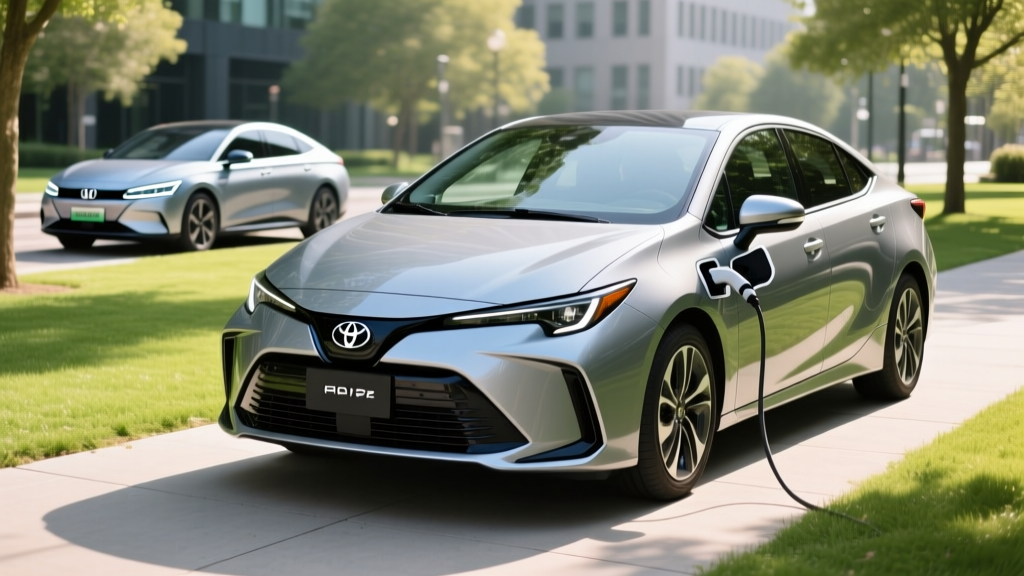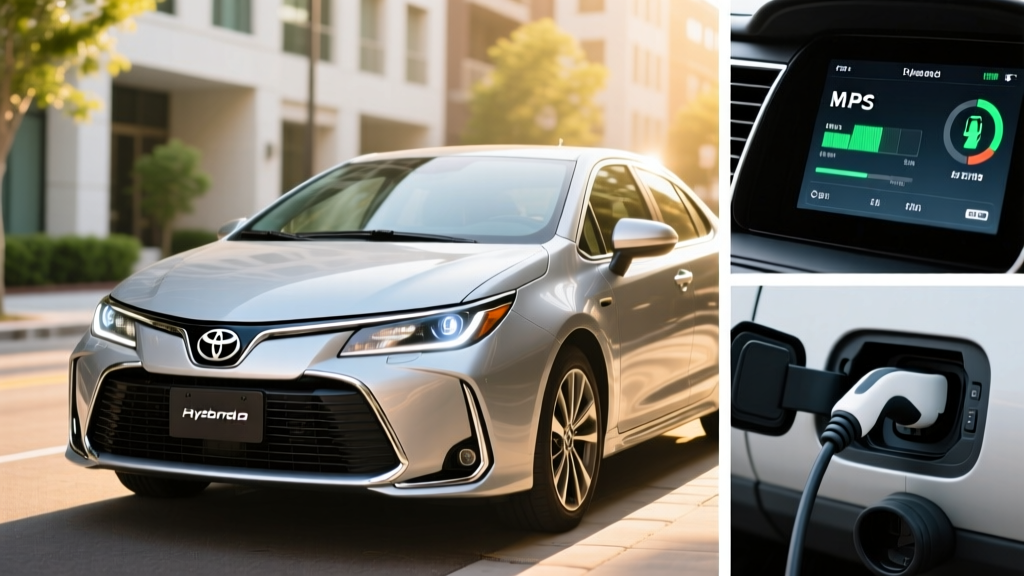
If you've searched for Toyota Corolla Hybrid mileage expecting modest gains over a gas car, the numbers will surprise you: the 2025/2026 Corolla Hybrid returns up to 50 MPG combined on the LE trim — matching the Prius of a generation ago in a conventional compact sedan body. No plug required, no range anxiety, and no premium fuel.
This guide breaks down every fuel-economy figure, compares the Corolla Hybrid (HEV) against plug-in hybrid and full EV alternatives, and addresses the reliability and battery-lifespan questions that dominate hybrid buyer research.
Toyota Corolla Hybrid MPG: EPA Ratings and Real-World Expectations
The Corolla Hybrid uses Toyota's fifth-generation hybrid system, pairing a 1.8-liter four-cylinder engine with dual motor-generators and a lithium-ion traction battery. Unlike plug-in hybrids, it charges its battery exclusively through regenerative braking and engine generation — you never plug it in.
| Trim | City MPG | Highway MPG | Combined MPG | Drivetrain |
|---|---|---|---|---|
| LE | 53 | 46 | 50 | FWD |
| LE AWD | 47 | 41 | 44 | AWD |
| SE | 50 | 43 | 47 | FWD |
| SE AWD | 47 | 41 | 44 | AWD |
| XLE | 50 | 43 | 47 | FWD |
Notice the city MPG exceeds highway — a hallmark of Toyota's hybrid synergy drive. At low speeds, the electric motor handles most propulsion while the engine stays off or runs at its most efficient RPM to generate electricity. Highway driving relies more on the gasoline engine directly, which is why the numbers flip compared to conventional cars.
Real-World MPG vs. EPA Sticker
Hybrids consistently overperform their EPA ratings in city driving. Owner-reported data on Fuelly and independent testing by outlets like Motor Trend show the Corolla Hybrid LE regularly achieving 52–56 MPG in stop-and-go urban commuting. Highway-only road trips at 75+ mph typically yield 40–43 MPG. Cold weather (below 35°F) reduces fuel economy by roughly 5–10% as the engine runs longer to warm the cabin and maintain battery temperature.
For mixed suburban driving — the most common ownership scenario — expect 48–52 MPG in temperate climates, closely matching or slightly exceeding the 50 MPG combined sticker.
Corolla Hybrid vs. Plug-In Hybrid vs. Full EV: Which Fits You?
A common point of confusion: Toyota does not offer a Corolla Plug-In Hybrid (PHEV) in the US market. The Corolla Hybrid is a conventional HEV only. If you want plug-in capability in the Toyota lineup, the closest comparison is the RAV4 Prime (SUV) or the Prius Prime (hatchback). Here's how these powertrain types differ:
| Attribute | Corolla Hybrid (HEV) | Prius Prime (PHEV) | Tesla Model 3 (BEV) |
|---|---|---|---|
| Plug-in Required? | No | Yes | Yes |
| Electric-Only Range | N/A | 44 miles | 341 miles (EPA) |
| Total Range | ~550 miles | ~440 miles | 341 miles |
| Combined Efficiency | 50 MPG | 52 MPG / 127 MPGe | 132 MPGe |
| Battery Capacity | ~0.9 kWh (Li-ion) | 13.6 kWh (Li-ion) | ~75 kWh (NMC/LFP) |
| DC Fast Charge? | No | No (Level 2 only) | Yes (250 kW peak) |
| Base MSRP | $23,500 | $33,445 | $38,990 |
Who Should Choose the Corolla Hybrid?
The Corolla Hybrid is ideal if you: drive a mix of city and highway miles, lack access to home or workplace charging (apartment dwellers, street parkers), want maximum fuel savings with zero behavioral change, and prefer the lowest purchase price among electrified options.
Consider a PHEV like the Prius Prime if your daily commute is under 45 miles and you have reliable Level 2 home charging — you'd drive on electricity most days while retaining a gas engine for road trips.
A full BEV makes sense if you have home charging, drive under 300 miles daily, and want to eliminate gasoline entirely. The total cost of ownership often favors EVs over 5+ years, but the upfront premium and charging logistics are real barriers.
Corolla Hybrid Powertrain and Battery Specifications
| Engine | 1.8L 4-cylinder Atkinson cycle |
| Combined Net Horsepower | 138 hp |
| Engine Output | 96 hp @ 5,200 rpm |
| Front Motor Output | 94 hp (70 kW) |
| Rear Motor (AWD only) | 40 hp (30 kW) |
| Transmission | Electronic CVT (eCVT) |
| Traction Battery | ~0.9 kWh lithium-ion (sealed Ni-MH on prior gens) |
| Fuel Tank Capacity | 11.4 gallons |
| 0–60 mph | ~9.1 seconds (estimated) |
| Curb Weight | ~3,050 lbs |
The eCVT is not a traditional belt-and-pulley CVT. Toyota uses a planetary gearset that seamlessly blends engine and motor power with no fixed gear ratios. The result is smooth, linear acceleration without the "rubber band" feel some associate with older CVTs. There are no conventional gear shifts, no clutch wear, and no transmission fluid changes on the standard maintenance schedule.
Pricing, Trims, and Tax Credit Eligibility
The 2025 Corolla Hybrid starts at $23,500 for the LE FWD trim, including destination charge. The AWD option adds $1,400. The sport-tuned SE trim starts at $26,500, and the XLE tops the range near $28,500.
Federal Tax Credit Status
The Corolla Hybrid does not qualify for the federal §30D Clean Vehicle Credit. Under current IRS rules, the credit applies only to plug-in electric vehicles (PHEVs and BEVs) with a minimum battery capacity of 7 kWh and external charging capability (IRS §30D guidelines). Conventional hybrids like the Corolla Hybrid, which charge their batteries solely through regenerative braking, are ineligible.
Some states offer rebates for conventional hybrids — check your state energy office or Alternative Fuels Data Center for local programs. These vary widely and change frequently.
Battery Warranty, Lifespan, and Replacement Cost
Battery longevity is the single most common concern among first-time hybrid buyers. Here's what Toyota's warranty and real-world data tell us:
Toyota Hybrid Battery Warranty
- Coverage: 10 years / 150,000 miles (whichever comes first) for model year 2020 and newer
- What's covered: Hybrid battery pack, hybrid control module, inverter with converter
- Capacity threshold: Toyota replaces or reconditions if the battery fails to function — no specific degradation percentage is published, as the small HEV buffer rarely shows measurable range loss
- Transferable: Yes, warranty transfers to subsequent owners automatically
Real-World Hybrid Battery Lifespan
Toyota's hybrid batteries are among the most durable in the industry. The Corolla Hybrid's ~0.9 kWh lithium-ion pack operates within a narrow state-of-charge window (roughly 40%–80% SoC), managed by the hybrid control system. This shallow cycling dramatically extends cell life compared to full EVs that routinely cycle between 10% and 90% SoC.
Based on data from Toyota Prius fleets (which use similar chemistry and management), hybrid battery packs routinely last 150,000–200,000+ miles before significant degradation. Many Prius taxis have exceeded 300,000 miles on the original battery pack. The Corolla Hybrid's smaller, less-stressed pack should match or exceed this track record.
Battery Replacement Cost
If a replacement is needed outside warranty coverage (rare but possible on high-mileage vehicles), a new Toyota Corolla Hybrid battery pack costs approximately $2,000–$3,500 including labor at a dealership. Independent hybrid specialists often offer reconditioned packs for $1,200–$2,000. Individual cell module replacement is also an option at $500–$1,000 if only a subset of cells has failed.
For context: a comparable gasoline car would spend $3,000–$5,000 on transmission replacements, timing belt services, and other major mechanical work over the same 150,000-mile lifespan — costs the Corolla Hybrid avoids.
Corolla Hybrid Pros and Cons
Pros
- 50 MPG combined — among the highest of any non-plug-in vehicle sold in the US
- No charging infrastructure needed — fill up at any gas station
- 10-year / 150,000-mile hybrid battery warranty
- Available AWD for snow-belt climates
- Low entry price ($23,500) undercuts most EVs and PHEVs by $10,000+
- Toyota Safety Sense 3.0 standard (pre-collision, lane departure, adaptive cruise, road sign assist)
- Proven Toyota reliability with widely available service network
Cons
- Modest 138 hp — not a performance vehicle; highway passing requires planning
- No federal tax credit eligibility
- Rear seat and cargo space tighter than Corolla gas model (battery packaging)
- No plug-in variant available — can't access HOV lane perks in many states
- Infotainment system functional but not class-leading in responsiveness
- AWD trims drop to 44 MPG combined
Corolla Hybrid Total Cost of Ownership: 5-Year Estimate
Let's compare the Corolla Hybrid LE (50 MPG, $23,500) against the gas-only Corolla LE (32 MPG combined, $22,050) and a typical compact EV over 5 years / 75,000 miles:
| Cost Category | Corolla Hybrid ($23,500) | Corolla Gas ($22,050) | Compact EV ($38,990) |
|---|---|---|---|
| Purchase Price | $23,500 | $22,050 | $38,990 |
| Federal Tax Credit | $0 | $0 | Up to $7,500* |
| Fuel/Energy (75k mi) | $4,500 | $7,030 | $2,250 |
| Maintenance (5 yr) | $1,800 | $2,400 | $1,200 |
| Insurance (5 yr) | $7,500 | $7,200 | $8,400 |
| Estimated Depreciation | $9,400 | $9,900 | $15,600 |
| Total 5-Year Cost | $37,300 | $38,680 | $35,340 |
*EV tax credit eligibility depends on MSRP caps, buyer income limits, and battery sourcing requirements under IRS §30D. Consult a tax professional. Fuel costs based on $3.50/gal gas and $0.15/kWh electricity. Your costs will vary.
The Corolla Hybrid saves roughly $1,400 over the gas Corolla across 5 years, primarily through fuel savings. Against a qualifying EV, the EV wins on operating costs but carries a higher upfront price and depreciation hit. The Corolla Hybrid's advantage is its low barrier to entry: no charging setup, no credit-eligibility hurdles, and strong resale value.
Frequently Asked Questions
How many MPG does the Toyota Corolla Hybrid get?
The 2025 Corolla Hybrid LE achieves 53 city / 46 highway / 50 combined MPG. AWD trims return 47 city / 41 highway / 44 combined. The SE and XLE FWD trims earn 50 city / 43 highway / 47 combined. In real-world city driving, owners commonly report 52–56 MPG thanks to the hybrid system's efficiency at low speeds.
Does the Corolla Hybrid need to be plugged in?
No. The Corolla Hybrid is a conventional hybrid (HEV), not a plug-in hybrid (PHEV). Its small lithium-ion battery charges through regenerative braking and the gasoline engine. You fuel it exactly like any other gas car — at a gas station, with regular 87-octane unleaded.
Is there a Corolla Plug-In Hybrid available?
Toyota does not sell a Corolla PHEV in the United States. If you want a Toyota plug-in hybrid, the Prius Prime (44 miles electric-only range, 52 MPG combined after battery depletion) is the closest alternative. The RAV4 Prime offers 42 miles of electric range in an SUV package.
Is the Toyota Corolla Hybrid reliable?
Toyota's hybrid system is one of the most proven powertrains in automotive history, with over 25 years of continuous refinement since the 1997 Prius. The Corolla Hybrid carries Toyota's 10-year/150,000-mile hybrid battery warranty and benefits from the eCVT's lack of traditional transmission wear components. Toyota consistently ranks at or near the top of J.D. Power and Consumer Reports reliability surveys.
What does it cost to replace the Corolla Hybrid battery?
Outside warranty, a new OEM hybrid battery pack costs $2,000–$3,500 installed at a dealership. Reconditioned packs run $1,200–$2,000. In practice, Toyota hybrid batteries regularly last 150,000–200,000+ miles, making out-of-warranty replacement uncommon during typical ownership.
Does the Corolla Hybrid qualify for any tax credit?
The Corolla Hybrid does not qualify for the federal §30D Clean Vehicle Credit, which is limited to plug-in vehicles (PHEVs and BEVs). Some states and utilities offer small rebates for conventional hybrids — check your state's energy office. The purchase price is low enough that most buyers don't need incentives to justify the fuel savings.
Corolla Hybrid vs. Prius: which gets better mileage?
The 2025 Prius LE achieves 57 MPG combined (57 city / 56 highway), edging out the Corolla Hybrid's 50 MPG. However, the Prius starts at approximately $28,350 — nearly $5,000 more than the Corolla Hybrid. If the lowest possible purchase price matters, the Corolla Hybrid delivers outstanding efficiency at a lower entry point. If maximum MPG is the priority, the Prius wins.
How does the Corolla Hybrid perform in cold weather?
Like all hybrids, the Corolla Hybrid sees a 5–10% fuel economy reduction in sustained cold weather (below 35°F) because the engine runs more frequently to provide cabin heat and maintain battery temperature. Expect 44–47 MPG combined in winter conditions versus 50 MPG in mild weather. This is still significantly better than a gas-only Corolla's winter fuel economy of roughly 28–30 MPG.