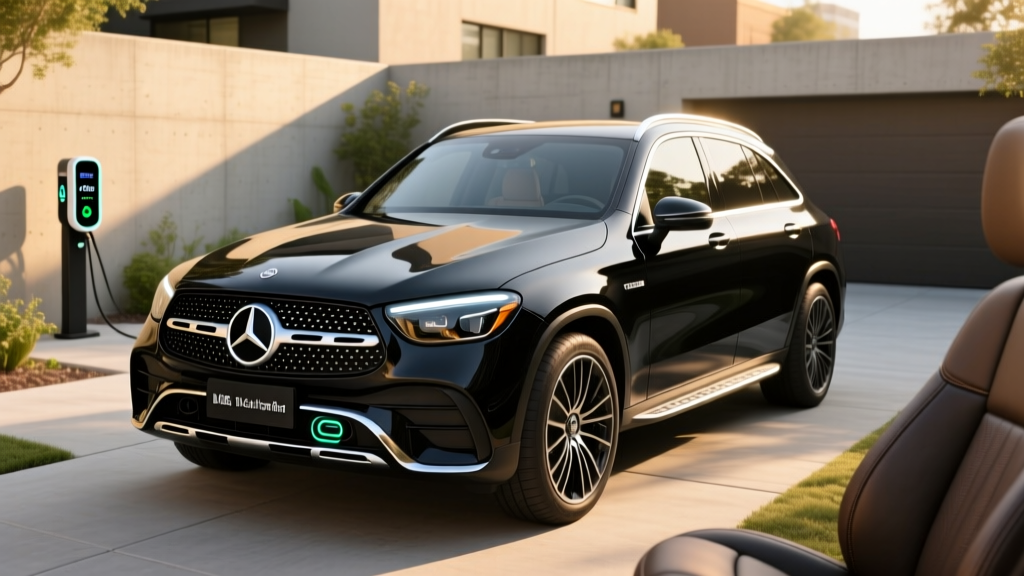
The Mercedes-Benz GLC 350e 4MATIC occupies a specific niche in the luxury compact SUV segment: it pairs a turbocharged four-cylinder with a substantial plug-in hybrid powertrain, offering genuine electric-only commuting capability while retaining the range and refueling convenience of a gas engine. For 2026, the GLC plug-in hybrid continues to target buyers who want to electrify their daily driving without committing to a battery-electric vehicle — and it does so with more electric range than most competitors in its class.
This guide breaks down the real-world numbers that matter: EPA electric range, combined MPGe and gas-only MPG, charging speed, powertrain output, pricing, federal tax credit eligibility, and long-term battery reliability. If you're weighing the GLC PHEV against a conventional hybrid, a full EV like the Tesla Model Y, or a gas-only luxury SUV, you'll find the data you need below.
2026 GLC 350e Powertrain and Performance Specs
| Specification | 2026 GLC 350e 4MATIC |
|---|---|
| Powertrain | 2.0L turbo I4 + electric motor (PHEV) |
| Combined System Output | 312 hp / 406 lb-ft torque |
| Gas Engine | 201 hp @ 5,800 rpm |
| Electric Motor | 134 hp (100 kW) |
| Transmission | 9-speed automatic (9G-TRONIC) |
| Drivetrain | 4MATIC all-wheel drive |
| 0-60 mph | 6.5 seconds |
| Battery Capacity | 31.2 kWh (total) / ~25.4 kWh usable |
| Battery Chemistry | NMC (nickel manganese cobalt) |
| EPA Electric-Only Range | 54 miles |
| EPA Combined MPGe (electric + gas) | 67 MPGe |
| EPA Gas-Only MPG (combined) | 28 MPG combined (25 city / 31 highway) |
| Total Combined Range | ~430 miles |
| Fuel Tank | 13.2 gallons |
| DC Fast Charging | Optional 60 kW DC (standard: AC only) |
| Level 2 AC Charging (max) | 11 kW onboard charger |
| Level 2 Charge Time (0-100%) | ~2 hours 45 minutes |
| Level 1 Charge Time (120V) | ~18-20 hours |
| Cargo Volume (behind rear seats) | 21.9 cu ft |
| Base MSRP | $60,250 (incl. destination) |
The 312 combined horsepower is notable for a compact luxury PHEV. The electric motor's 134 hp means the GLC 350e can accelerate briskly in electric-only mode — a common weakness in lesser PHEVs where the motor alone feels underpowered for highway merging. Mercedes' 9-speed automatic integrates the motor between the engine and transmission, enabling smooth transitions between electric and gas operation without the shudder some competitors exhibit.
Electric-Only Range and Charging: What You Can Actually Expect
Real-world expectation: 42-50 miles in mixed driving; 35-42 miles in cold weather (below 35°F) or sustained highway speeds above 70 mph. Cabin preconditioning while plugged in helps preserve range in winter.
The 54-mile EPA electric range is a genuine differentiator. Most luxury compact PHEVs — the BMW X3 xDrive30e, Audi Q5 TFSI e, Volvo XC60 Recharge — offer 25-38 miles of electric range. The GLC 350e's larger 31.2 kWh battery pack gives it a meaningful advantage for commuters with round trips under 50 miles, effectively making it an EV for daily use with a gas engine for weekend road trips.
Charging reality: The standard 11 kW onboard AC charger is excellent for home Level 2 use. On a 240V / 48-amp home charger, you'll go from empty to full in roughly 2 hours 45 minutes. That means an overnight charge is more than sufficient — even if you plug in at 11 PM, the car is topped off before you wake up.
The optional 60 kW DC fast-charging capability is worth considering if you lack home charging access or frequently take long trips. At 60 kW, you can add roughly 30 miles of electric range in about 20 minutes during a rest stop. However, this is a relatively modest DC rate compared to full EVs (which typically accept 150-250 kW), and the option adds cost. For most PHEV buyers who charge at home overnight, AC charging alone is perfectly adequate.
A critical note on kW vs. kWh: kW (kilowatts) measures the rate of energy flow — how fast the battery charges. kWh (kilowatt-hours) measures the total energy stored in the battery. The GLC's battery holds 31.2 kWh of energy and can accept charge at up to 11 kW on AC or 60 kW on DC.
HEV vs. PHEV vs. Full EV: Which Powertrain Fits You?
Before committing to the GLC plug-in hybrid, it's worth understanding how it compares to a conventional hybrid (HEV) and a full battery-electric vehicle (BEV). The GLC 350e is specifically a PHEV — it has a larger battery than a conventional hybrid and can be plugged in to charge, but it also carries a gas engine for extended range.
| Factor | Conventional Hybrid (HEV) | Plug-In Hybrid (PHEV) — GLC 350e | Full EV (BEV) |
|---|---|---|---|
| Plug in to charge? | No — charges via regenerative braking and engine | Yes — but can also run on gas only | Yes — required |
| Electric-only range | 0-2 miles (low-speed assist only) | ~54 miles (EPA) | 250-350+ miles typical |
| Gas engine? | Yes — primary power source | Yes — backup and highway driving | No |
| Home charging needed? | No | Strongly recommended (not required) | Essential |
| Federal tax credit | Not eligible | Eligible (up to $7,500 — see below) | Eligible (up to $7,500 — see below) |
| Best for | Drivers without home charging; minimal behavior change | Commuters who can charge at home; road-trip flexibility | Drivers with reliable home charging; lowest operating cost |
| Example (Mercedes) | N/A (no GLC HEV in US) | GLC 350e 4MATIC | None in GLC class; consider EQB |
- Your daily round-trip commute is under 50 miles and you can charge at home (Level 2)
- You take regular road trips exceeding 250 miles and want gas-engine flexibility
- You want a luxury compact SUV with meaningful electric driving without range anxiety
- You have reliable home Level 2 charging and rarely drive more than 250 miles in a day
- You want the lowest per-mile fuel cost and minimal maintenance
- You'd prefer a vehicle like the Tesla Model Y, BMW iX, or Mercedes EQB
- You cannot charge at home (apartment, street parking)
- You want better MPG than gas without any plug-in behavior change
Fuel Economy Breakdown: EPA vs. Real-World MPG
| Driving Mode | City | Highway | Combined |
|---|---|---|---|
| Electric + Gas (MPGe) | — | — | 67 MPGe |
| Gas Only (after battery depleted) | 25 MPG | 31 MPG | 28 MPG |
The 28 MPG combined gas-only figure is what you'll see once the battery is depleted — on long road trips, for instance. For a 4,700-pound luxury AWD SUV, that's respectable. The Lexus RX 350 (gas-only) achieves 25 MPG combined; the BMW X3 xDrive30i manages 26 MPG combined. The GLC 350e's gas-only efficiency is competitive with non-hybrid rivals.
Real-world MPG note: If you charge nightly and commute within the 54-mile electric range, your actual gasoline consumption could be near zero for months at a time. Many PHEV owners report using less than 10 gallons per month during commuting-heavy periods. However, if you never plug in, the GLC 350e functions as a slightly less efficient gas SUV due to the added weight of the battery pack — expect 25-27 MPG combined in that scenario, below the EPA's 28 MPG estimate, because the EPA test cycle includes some electric assist even in "gas-only" mode.
According to fueleconomy.gov, the GLC 350e's combined MPGe of 67 assumes you're regularly charging and utilizing the electric range. The more you charge, the closer your real-world "MPG" gets to infinity.
Pricing, Trims, and Federal Tax Credit Eligibility
The 2026 Mercedes-Benz GLC 350e 4MATIC starts at $60,250 including destination charge. A well-equipped example with the AMG Line package, premium driver-assistance systems, and the optional DC fast-charging capability can reach $72,000-$76,000.
Federal §30D Tax Credit: Does the GLC 350e Qualify?
- Vehicle MSRP cap: SUVs must be under $80,000 MSRP — the GLC 350e base qualifies; heavily optioned examples may exceed the cap
- Buyer income cap: Modified AGI must not exceed $150,000 (single), $225,000 (head of household), or $300,000 (joint filers)
- Battery sourcing: Critical minerals and battery components must meet phased-in domestic/free-trade-partner sourcing requirements — check the specific VIN on fueleconomy.gov before purchasing
- Point-of-sale transfer: Eligible buyers can transfer the credit to the dealer at purchase, reducing the purchase price directly rather than waiting for a tax refund
- Maximum credit: Up to $7,500, split between $3,750 for critical minerals and $3,750 for battery component sourcing
Important caveat: Battery sourcing requirements tighten annually under the Inflation Reduction Act. A vehicle that qualified for the full $7,500 in 2024 may qualify for $3,750 or nothing in 2026 depending on where its battery minerals and components originate. Always verify the specific VIN's eligibility on the official IRS clean vehicle credit page before finalizing a purchase. Consult a tax professional for your specific situation.
With the maximum $7,500 credit, the effective starting price drops to roughly $52,750 — competitive with a gas-only GLC 300 4MATIC ($49,050 MSRP) when you factor in fuel savings over time.
Battery Warranty, Reliability, and Replacement Costs
6 years / 62,000 miles (whichever comes first) for the high-voltage battery against capacity loss below 70% of original capacity.
Powertrain warranty: 4 years / 50,000 miles
Basic vehicle warranty: 4 years / 50,000 miles
Mercedes' 6-year/62,000-mile high-voltage battery warranty is shorter than the 8-year/100,000-mile minimum that many competitors offer (and that California Air Resources Board regulations mandate for PZEV vehicles sold in CARB states). This is a legitimate consideration for buyers planning long-term ownership.
Battery replacement cost: If the high-voltage battery requires replacement out of warranty, expect a cost in the range of $12,000-$16,000 for parts and labor at a Mercedes dealership. However, PHEV battery packs from Mercedes' current generation have shown low degradation rates in early data — the 31.2 kWh NMC pack is conservatively managed with a substantial buffer (roughly 5.8 kWh reserved at the top and bottom), which reduces stress on the cells and extends longevity.
Reliability context: The M254 2.0L turbocharged engine in the GLC 350e has been in production since the 2022 model year and has accumulated a solid reliability track record. The electric motor and power electronics add complexity compared to a gas-only GLC, but PHEV drivetrains from Mercedes have not shown systemic failure patterns. The main ownership risk is the out-of-warranty battery cost if you plan to keep the vehicle beyond 8 years.
For buyers in CARB-adopting states (California, New York, Massachusetts, and others), verify whether the extended 10-year/150,000-mile emissions-related hybrid component warranty applies to your specific vehicle, as this can provide additional coverage for the hybrid system.
Driving Experience and Technology
The GLC 350e's MBUX infotainment system (11.9-inch portrait touchscreen) includes dedicated PHEV displays showing energy flow, battery state of charge, and electric range remaining. The system's navigation integrates charging station locations and can precondition the battery for optimal charging efficiency when a charge point is set as the destination.
Mercedes' driver-assistance suite — branded as Driver Assistance Package — includes adaptive cruise control with stop-and-go, active lane-keeping, and route-based speed adaptation. This is an SAE Level 2 system, meaning the driver must remain attentive with hands on the wheel and eyes on the road at all times. It is not autonomous driving.
The regenerative braking system offers adjustable levels via steering-wheel paddles, from coasting (minimal regen) to strong one-pedal-style deceleration. However, unlike some EVs, the GLC 350e does not come to a complete stop via regen alone — you'll still use the brake pedal for final stopping.
Total Ownership Cost: PHEV vs. Gas vs. EV
| Cost Factor (5 years / 75,000 miles) | GLC 350e PHEV | GLC 300 (Gas) | Comparable EV (e.g., Model Y LR) |
|---|---|---|---|
| Purchase Price (MSRP) | $60,250 | $49,050 | $48,990 |
| Federal Tax Credit | -$3,750 to -$7,500 | $0 | -$3,750 to -$7,500 |
| Fuel/Energy Cost | ~$3,800 (mix of electricity + gas) | ~$9,400 (gas at $3.50/gal, 26 MPG avg) | ~$3,200 (electricity at $0.14/kWh) |
| Maintenance | ~$3,200 | ~$3,800 | ~$1,800 |
| Insurance (avg) | ~$10,500 | ~$9,200 | ~$11,000 |
| Estimated Depreciation | ~$22,000 | ~$18,000 | ~$20,000 |
| Approx. 5-Year Total | ~$62,000-$66,000 | ~$61,000 | ~$55,000-$59,000 |
The PHEV's total cost of ownership lands between the gas GLC and a full EV. The fuel savings are significant if you charge regularly — potentially cutting fuel costs by 60% compared to the gas-only GLC. However, the higher purchase price, slightly elevated insurance premiums, and steeper depreciation (common with PHEVs as the market shifts toward BEVs) partially offset those savings.
The economics improve substantially if you qualify for the full $7,500 tax credit and charge primarily at home using off-peak electricity rates.
Pros and Cons
- 54-mile EPA electric range — best in its luxury compact PHEV class
- 312 combined hp provides confident acceleration in both electric and hybrid modes
- 11 kW onboard AC charger fills the battery in under 3 hours at home
- Luxury interior quality, MBUX tech, and quiet electric-mode operation
- No range anxiety — gas engine covers long trips seamlessly
- Eligible for federal tax credit (up to $7,500, sourcing-dependent)
- Base price above $60,000; options push past the $80,000 MSRP credit cap
- Battery warranty (6 yr/62k mi) is shorter than many competitors' 8 yr/100k mi
- DC fast charging is optional, not standard — and limited to 60 kW
- Cargo space reduced vs. gas GLC (21.9 cu ft vs. 24.7 cu ft) due to battery placement
- Gas-only MPG (28 combined) is modest — no efficiency gain if you never plug in
- Out-of-warranty battery replacement cost ($12,000-$16,000) is a long-term risk
Frequently Asked Questions
How many MPG does the GLC plug-in hybrid get?
The 2026 GLC 350e is rated at 67 MPGe combined when using both electric and gas power. Once the battery is depleted, it achieves 28 MPG combined on gasoline alone (25 city / 31 highway). In practice, if you charge nightly and commute within the 54-mile electric range, your gasoline consumption can be near zero for daily driving.
How far can the GLC 350e go on electric only?
The EPA rates the GLC 350e at 54 miles of electric-only range. In real-world mixed driving, expect 42-50 miles; in cold weather or sustained highway driving, that may drop to 35-42 miles. This is sufficient for most daily commutes round-trip.
Hybrid vs PHEV vs EV — which fits me?
Choose the GLC 350e PHEV if you can charge at home and want electric commuting plus gas-engine road-trip range. Choose a full EV if you have reliable home charging and want the lowest operating cost with zero tailpipe emissions. Choose a conventional hybrid only if you cannot plug in at all. The GLC 350e is a PHEV, not a conventional hybrid — it benefits greatly from regular plug-in charging.
Is the GLC plug-in hybrid reliable and what does battery replacement cost?
The GLC 350e's powertrain has shown solid reliability since the current generation launched. The high-voltage battery is warranted for 6 years/62,000 miles (below 70% capacity triggers a claim). Out-of-warranty battery replacement is estimated at $12,000-$16,000. The conservative battery management system with a large buffer should limit long-term degradation.
Does the GLC 350e qualify for any tax credit?
The GLC 350e may qualify for the federal §30D clean vehicle credit of up to $7,500, subject to buyer income limits ($300,000 joint / $150,000 single), the $80,000 SUV MSRP cap, and battery critical-mineral/component sourcing requirements that tighten annually. The credit can be transferred to the dealer at point of sale. Always verify your specific VIN's eligibility on fueleconomy.gov and consult a tax professional before purchasing.
Can I charge the GLC 350e at home on a regular outlet?
Yes, via a standard 120V Level 1 outlet, but it will take 18-20 hours for a full charge — impractical for daily use. A 240V Level 2 home charger (recommended) fills the battery in about 2 hours 45 minutes. Budget $800-$2,000 for professional Level 2 charger installation depending on your electrical panel's capacity and the distance from panel to parking location.
Does the GLC 350e support DC fast charging?
DC fast charging is available as an option, not standard. When equipped, it accepts up to 60 kW on DC — adequate for adding ~30 miles of electric range during a 20-minute rest stop, but significantly slower than full EVs that charge at 150-250 kW. For most PHEV owners who charge at home, this option is unnecessary.
Sources: EPA Fuel Economy — Mercedes-Benz GLC 350e, IRS Clean Vehicle Credit Eligibility, Mercedes-Benz USA GLC Specifications