The 2006 Toyota Highlander Hybrid was one of the first midsize hybrid SUVs to reach the US market, pairing Toyota's Synergy Drive system with a 3.3-liter V6. For buyers researching the 2006 Toyota Highlander Hybrid gas mileage on the used market, understanding how its EPA ratings translate to real-world driving nearly two decades later is essential. This guide breaks down the original fuel economy figures, what you can actually expect today, hybrid battery health, and whether this pioneering HEV still holds up against modern hybrids, plug-in hybrids, and full EVs.
2006 Toyota Highlander Hybrid MPG: EPA Ratings vs. Real-World Numbers
When it launched, the 2006 Highlander Hybrid carried EPA ratings that impressed for a seven-passenger SUV. Toyota's hybrid system allowed the electric motor to handle low-speed driving while the V6 kicked in under heavier loads. Here are the official numbers as published by the EPA via fueleconomy.gov:
| Metric | Value |
|---|---|
| City MPG | 31 MPG |
| Highway MPG | 25 MPG |
| Combined MPG | 28 MPG |
| Fuel Tank Capacity | 17.2 gallons |
| Total Range (Combined) | ~482 miles |
Compared to the conventional gas-only 2006 Highlander V6 (rated at roughly 20 MPG combined), the hybrid variant delivered a meaningful 40% improvement in city efficiency — a gap that remains noticeable even by today's standards.
Hybrid Powertrain: How the 2006 Highlander Hybrid Works
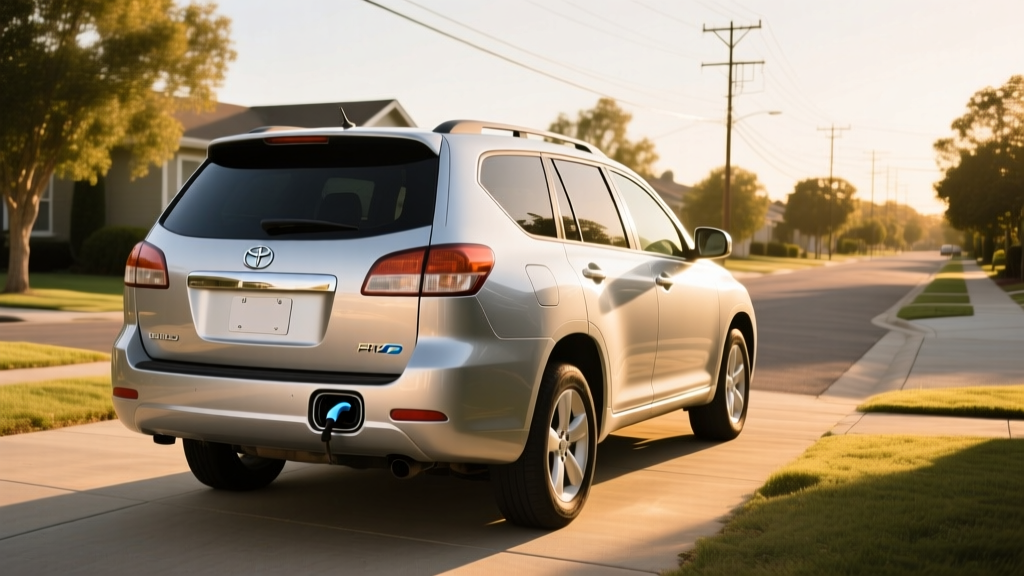
The 2006 Highlander Hybrid uses Toyota's first-generation Hybrid Synergy Drive adapted for a larger SUV platform. This is a conventional hybrid (HEV), meaning it does not plug in. The battery recharges through regenerative braking and the gasoline engine — you fuel it like any other car.
| Specification | Detail |
|---|---|
| Engine | 3.3L V6 (3MZ-FE) |
| Engine Horsepower | 215 hp @ 5,600 rpm |
| Electric Motor | Front-mounted, permanent magnet |
| Combined Net Horsepower | 270 hp |
| Transmission | eCVT (electronically controlled continuously variable) |
| Drivetrain | AWD (i-Force with rear electric motor) |
| Hybrid Battery | Nickel-Metal Hydride (NiMH), ~1.6 kWh (nominal) |
| 0–60 mph | ~7.8 seconds |
| Towing Capacity | 3,500 lbs |
The rear axle is driven by a separate electric motor, giving the Highlander Hybrid its AWD capability without a mechanical driveshaft — a clever packaging solution Toyota would refine for decades. Total system output of 270 hp gave it respectable acceleration for a family hauler of its era.
HEV vs. PHEV vs. EV: Understanding Your Electrified Options
If you're shopping for an electrified SUV today, it's critical to understand the distinctions between hybrid types. The 2006 Highlander Hybrid is an HEV — but the landscape has expanded considerably.
| Feature | HEV (e.g., 2006 Highlander Hybrid) | PHEV (e.g., 2026 RAV4 Prime) | BEV (e.g., 2026 Tesla Model Y) |
|---|---|---|---|
| Plugs In? | No | Yes | Yes |
| Electric-Only Range | ~1 mile at low speed | 30–45 miles | 250–350 miles |
| Battery Size | ~1.6 kWh (NiMH) | ~18 kWh (NMC) | 60–82 kWh (NMC/LFP) |
| Fuel Required? | Yes, always | Yes, for longer trips | No |
| Home Charging Needed? | No | Recommended (Level 2) | Essential (Level 2) |
| Federal Tax Credit | Not eligible (§30D expired for HEVs) | Up to $7,500 (if eligible) | Up to $7,500 (if eligible) |
| Best For | No home charging, simplicity | Short commutes + road trips | Home charging access, lowest running cost |
The 2006 Highlander Hybrid's advantage is simplicity: no plug, no charging infrastructure dependency, no range anxiety. Its trade-off is that it cannot drive meaningful distances on electricity alone and does not qualify for any current federal tax incentive.
Hybrid Battery Lifespan, Warranty, and Replacement Cost
For any used hybrid approaching or exceeding 200,000 miles, the traction battery is the single largest financial variable. The 2006 Highlander Hybrid uses a nickel-metal hydride (NiMH) battery pack — a chemistry known for durability but not immune to degradation.
How Long Do These Batteries Actually Last?
Based on owner reports and hybrid specialist data, the 2006 Highlander Hybrid's NiMH battery typically lasts between 150,000 and 220,000 miles before significant capacity loss triggers a check-engine light or noticeable MPG decline. Climate matters: batteries in hot southern states tend to degrade faster than those in moderate climates.
Battery Replacement Costs
- New OEM Toyota battery: $2,500–$3,500 (parts + dealer labor)
- Remanufactured battery: $1,500–$2,500 (popular options from Green Bean Battery, Dorman)
- Used/salvage battery: $500–$1,000 (risky — unknown SoH)
- Individual cell/module replacement: $300–$800 at a hybrid specialist shop (only viable if 1–2 modules have failed)
If you're evaluating a used 2006 Highlander Hybrid, ask for documentation of any battery replacement. A recently replaced remanufactured battery with a 1–3 year warranty can be a positive sign — it means the next owner may not face that expense for another decade.
Tax Credits and Incentives: What Applies Today?
The 2006 Toyota Highlander Hybrid does not qualify for the current federal §30D Clean Vehicle Credit. Under IRS rules, only new plug-in electric vehicles (BEVs and PHEVs) meeting battery sourcing, MSRP caps, and buyer income thresholds are eligible. Conventional hybrids (HEVs) that don't plug in have never qualified under §30D's current framework.
When the 2006 Highlander Hybrid was new, a different federal tax deduction (up to $2,200) was available under the Energy Policy Act of 2005, but that provision expired and was subject to Toyota's 60,000-unit cap, which was reached in 2007. No retroactive credits apply to used HEV purchases today.
Who Should Buy a 2006 Highlander Hybrid in 2026?
The 2006 Highlander Hybrid occupies a specific niche in today's used market. Here's a decision framework:
Choose the 2006 Highlander Hybrid if:
- You need a budget AWD family SUV under $6,000–$9,000
- You don't have access to home or workplace EV charging
- Your driving is primarily city/suburban where hybrid efficiency shines
- You value Toyota's long-term reliability reputation and parts availability
- You tow occasionally (3,500-lb capacity exceeds most modern compact crossovers)
Look at a newer PHEV or BEV instead if:
- You have Level 2 home charging and a short commute (PHEV covers daily driving on electricity)
- You want to qualify for federal or state tax credits
- You want modern safety tech (automatic emergency braking, lane-keeping assist — unavailable on the 2006 model)
- You plan to keep the vehicle 10+ years and want warranty coverage
Pros
- Strong city MPG for a 7-passenger SUV (28–31 real-world city)
- Proven Toyota hybrid reliability with abundant parts
- AWD via electric rear motor — no mechanical complexity
- 270 hp provides confident merging and passing
- No plug-in dependency — fuel and go
- Low used-market entry price ($5,000–$9,000)
Cons
- NiMH battery nearing or past end-of-life on most examples
- No modern ADAS features (no AEB, no lane assist)
- Highway MPG drops to 22–25 at sustained speeds
- Outdated infotainment (no Bluetooth audio, no backup camera on most trims)
- No federal tax credit eligibility
- Interior materials and ride refinement dated by 2026 standards
Real-World Ownership Costs: What to Budget
Buying a 20-year-old hybrid means planning for age-related maintenance alongside the hybrid-specific items. Here's a realistic annual budget for a 2006 Highlander Hybrid driven 12,000 miles per year at $3.50/gallon:
| Category | Annual Cost |
|---|---|
| Fuel (12,000 mi ÷ 26 real-world MPG × $3.50) | ~$1,615 |
| Insurance (varies by state/driver) | $800–$1,400 |
| Routine maintenance (oil, brakes, tires) | $600–$1,000 |
| Hybrid battery reserve (amortized) | $200–$400 |
| Total estimated annual cost | $3,215–$4,415 |
For comparison, a gas-only 2006 Highlander V6 at 20 MPG combined would cost roughly $2,100/year in fuel alone — about $485 more. The hybrid's fuel savings partially offset its potential battery replacement expense over a 3–5 year ownership window.
Frequently Asked Questions
How many MPG does the 2006 Toyota Highlander Hybrid get?
The EPA rates it at 31 city / 25 highway / 28 combined. Real-world results typically range from 24–32 MPG depending on driving mix, battery health, and climate. City-heavy driving favors the hybrid system; sustained highway driving at 75+ mph reduces efficiency.
Does the 2006 Highlander Hybrid plug in?
No. This is a conventional hybrid (HEV), not a plug-in hybrid (PHEV). The battery charges exclusively through regenerative braking and the gasoline engine. You never need to plug it in — just fill it with regular unleaded gasoline.
How much does it cost to replace the hybrid battery?
A remanufactured NiMH battery typically costs $1,500–$2,500 installed. A new OEM battery from Toyota runs $2,500–$3,500. Many hybrid specialist shops offer reconditioned packs with 1–3 year warranties. Individual module replacement is possible for $300–$800 if only a few cells have failed.
Is the 2006 Highlander Hybrid reliable?
The 3MZ-FE V6 engine and Toyota's eCVT transmission are among the most durable powertrains of that era, frequently reaching 250,000+ miles with basic maintenance. The primary reliability concern is the NiMH hybrid battery, which typically requires replacement between 150,000–220,000 miles. The NHTSA lists any open recalls — check the VIN before purchasing.
Does this hybrid qualify for any tax credit in 2026?
No. The federal §30D Clean Vehicle Credit only applies to plug-in vehicles (BEVs and PHEVs) meeting specific battery sourcing, MSRP, and income requirements. Conventional hybrids that don't plug in are not eligible. Some states offer minimal incentives for used hybrid purchases, but these vary widely — check with your state energy office.
How does it compare to a modern hybrid SUV?
A 2026 Toyota Highlander Hybrid achieves an EPA 36 MPG combined — about 29% better than the 2006 model — thanks to a more efficient 2.5L four-cylinder hybrid system, lighter construction, and improved aerodynamics. However, the 2026 model starts around $42,000 new versus $5,000–$9,000 for a used 2006 example. The cost-per-MPG-saved calculation strongly favors the used option for budget-conscious buyers.
Can I tow with the 2006 Highlander Hybrid?
Yes. The 2006 Highlander Hybrid is rated to tow up to 3,500 lbs when properly equipped — matching the conventional V6 Highlander. Towing will significantly reduce fuel economy (expect 16–20 MPG under load). Toyota does not recommend towing above this rating, and sustained mountain towing can stress the hybrid battery cooling system.
The 2006 Toyota Highlander Hybrid remains a pragmatic choice for buyers seeking an affordable, efficient AWD SUV without the complexity or infrastructure demands of plug-in electrification. Its gas mileage still holds up respectably, and Toyota's hybrid parts ecosystem makes ownership viable. Just budget for that battery — it's the difference between a smart bargain and an expensive lesson.