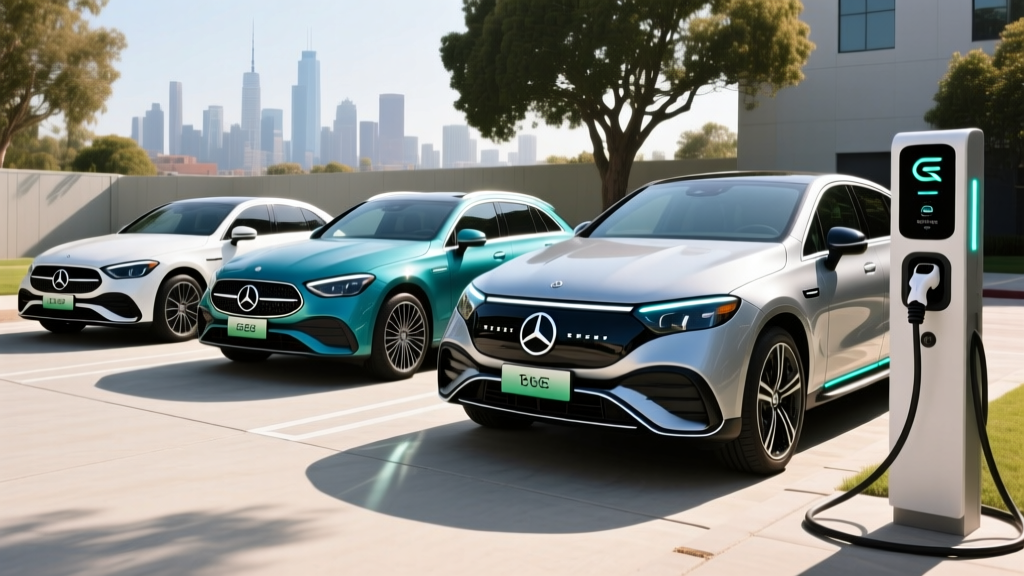
If you're shopping a Mercedes-Benz hybrid in 2026, you're actually choosing between two very different powertrain philosophies: a conventional hybrid (HEV) that never needs plugging in, or a plug-in hybrid (PHEV) that delivers meaningful electric-only range for daily commuting. Mercedes currently offers both across its core sedan and SUV lineup, and the right choice depends heavily on your commute distance, charging access, and budget.
This guide breaks down every current Mercedes-Benz hybrid and PHEV model with exact EPA figures, real-world expectations, battery specs, pricing, and federal tax credit eligibility — so you can decide whether an HEV, a PHEV, or a full BEV makes the most sense for your garage.
Mercedes-Benz HEV vs. PHEV: What's the Difference?
Before comparing models, it's critical to understand the two hybrid categories Mercedes sells. They serve different use cases entirely.
| Feature | HEV (Mild/Full Hybrid) | PHEV (Plug-In Hybrid) |
|---|---|---|
| Plugs in to charge? | No — charges via regenerative braking and engine | Yes — Level 1 or Level 2 AC charging |
| Electric-only driving | Very short distances at low speed, if at all | 40–48 miles EPA (2026 models) |
| Battery size | ~1–2 kWh | 25.4–31.2 kWh (usable ~21–25 kWh) |
| Ideal for | Drivers without home/workplace charging | Drivers with charging access and <50-mile commutes |
| Federal tax credit | Not eligible | May qualify (subject to §30D rules) |
Mercedes labels its conventional hybrids with an "h" suffix (e.g., S 580h) and its plug-in hybrids with an "e" suffix (e.g., S 580e). This naming convention applies across the lineup and is the quickest way to identify which powertrain you're looking at.
2026 Mercedes-Benz PHEV Lineup: Range, MPG, and Specs
The 2026 Mercedes-Benz PHEV lineup centers on the S-Class, GLC, and GLE families, each pairing a turbocharged gasoline engine with a rear-axle electric motor and a large lithium-ion battery. Here's how they stack up.
| Model | Powertrain | Combined HP | Battery (kWh usable) | EV Range (EPA) | Combined MPG / MPGe | 0–60 mph | Base MSRP |
|---|---|---|---|---|---|---|---|
| S 580e 4MATIC | 3.0L I6 turbo + e-motor | 502 hp | 25.4 kWh | 48 mi | 56 MPGe / 28 MPG | 5.0 sec | $119,350 |
| GLC 350e 4MATIC | 2.0L I4 turbo + e-motor | 313 hp | 23.3 kWh | 40 mi | 65 MPGe / 29 MPG | 6.2 sec | $59,900 |
| GLE 450e 4MATIC | 2.0L I4 turbo + e-motor | 375 hp | 23.3 kWh | 45 mi | 56 MPGe / 23 MPG | 5.8 sec | $72,850 |
Real-World Range and MPG Expectations
EPA figures are measured under controlled conditions. In real-world driving, expect the following adjustments:
- EV range in cold weather (below 40°F): Plan for 20–30% reduction. A 48-mile EPA rating may drop to 34–38 miles in winter.
- Highway-only driving: Electric-only range drops because higher speeds demand more energy. Expect ~80% of the EPA EV range on a sustained 70 mph cruise.
- Gas-engine MPG after battery depletion: Once the battery is depleted, these PHEVs operate as conventional hybrids. The GLC 350e, for instance, returns roughly 27–29 MPG combined on gas alone — slightly better than the EPA combined figure suggests because city driving benefits from regenerative braking.
Charging: What PHEV Buyers Need to Know
Mercedes-Benz PHEVs charge via AC only — none of the current models support DC fast charging. This is typical for PHEVs, whose smaller batteries don't justify the cost and weight of DC hardware.
| Charge Method | Power (kW) | Time (0–100%) | Miles of EV Range per Hour |
|---|---|---|---|
| Level 1 (120V household outlet) | ~1.4 kW | ~16–18 hours | ~3–4 mi/hr |
| Level 2 (240V, 32A) | 7.4 kW (onboard max) | ~3.5–4 hours | ~12–15 mi/hr |
For most PHEV owners, a Level 2 home charger is essential. A 240V/32A circuit replenishes the battery overnight and ensures you start every morning with a full charge. If you rely on a standard 120V outlet, you'll need to plug in for 16+ hours to fully charge — feasible only if the vehicle sits unused for long stretches.
kW vs. kWh reminder: kW (kilowatts) measures charging power — how fast energy flows. kWh (kilowatt-hours) measures battery capacity — how much energy is stored. The GLC 350e's 23.3 kWh battery charged at 7.4 kW takes roughly 3.1 hours (23.3 ÷ 7.4 = ~3.1 hours, plus charging losses).
Mercedes-Benz HEV: The S 580h
For buyers who want hybrid efficiency without any plug-in obligation, Mercedes offers the S 580h — a conventional hybrid variant of its flagship sedan.
| Model | City MPG | Highway MPG | Combined MPG | Combined HP | Base MSRP |
|---|---|---|---|---|---|
| S 580h (RWD) | 26 | 35 | 29 | 429 hp | $117,850 |
The S 580h pairs a 3.0L inline-six with a mild-hybrid EQ Boost system. It cannot drive on electric power alone for meaningful distances, but the electric assist smooths stop-start traffic and reduces fuel consumption by roughly 15–20% compared to the gas-only S 500.
Real-world note: Conventional hybrids like the S 580h often exceed their EPA city rating in stop-and-go traffic, where regenerative braking and electric assist work hardest. Owners report 30–32 MPG in urban driving. Highway MPG tends to track closer to the EPA sticker.
Federal Tax Credit and Incentives for Mercedes-Benz PHEVs
Under current IRS §30D rules, qualifying PHEVs may be eligible for a federal tax credit of up to $7,500 — but eligibility depends on multiple factors that change periodically.
- MSRP cap: SUVs (GLC 350e, GLE 450e) must have an MSRP ≤ $80,000; sedans (S 580e) must be ≤ $55,000. The S 580e exceeds this cap and does not qualify.
- Buyer income cap: Modified AGI must not exceed $150,000 (single), $225,000 (head of household), or $300,000 (joint filers).
- Battery sourcing: A percentage of critical minerals and battery components must be sourced from the US or free-trade-agreement countries. These thresholds increase annually.
- Point-of-sale transfer: Eligible buyers can transfer the credit to the dealer at purchase, reducing the purchase price directly rather than waiting for a tax refund.
As of 2026, the GLC 350e 4MATIC (MSRP $59,900) is the strongest candidate for at least partial credit, depending on the buyer's income and current sourcing compliance. The GLE 450e's base MSRP of $72,850 falls under the $80,000 SUV cap, but option packages can push it over. Always verify the final MSRP of your specific build against the IRS clean vehicle credit page before purchase.
The S 580e sedan exceeds the $55,000 sedan MSRP cap and does not qualify for the federal credit regardless of income.
Battery Warranty, Reliability, and Replacement Cost
Hybrid and PHEV battery longevity is the most common concern among buyers. Mercedes-Benz provides robust coverage:
Mercedes-Benz High-Voltage Battery Warranty: 6 years or 62,000 miles (whichever comes first) for capacity retention. If the battery degrades below 70% of original capacity within this period, Mercedes will repair or replace it. Some states with California Air Resources Board (CARB) emissions warranties extend this to 10 years/150,000 miles for PZEV-classified components.
Out-of-warranty replacement cost: Based on current parts pricing and labor, a Mercedes PHEV high-voltage battery replacement runs approximately $12,000–$18,000 depending on the model. This is a significant expense, though real-world degradation data from earlier-generation Mercedes PHEVs (2019–2023) shows most batteries retain 85–90% capacity after 100,000 miles under normal use.
Reliability context: Mercedes-Benz as a brand ranks mid-to-low in long-term reliability surveys from Consumer Reports and J.D. Power. However, the hybrid and PHEV powertrains themselves have proven durable — most reported issues involve infotainment, sensors, and air suspension rather than the hybrid system. The conventional hybrid S 580h, with its simpler mild-hybrid setup, carries fewer failure points than the more complex PHEV architecture.
Hybrid vs. PHEV vs. Full EV: Which Mercedes Is Right for You?
Choosing between a Mercedes-Benz HEV, PHEV, or full battery-electric vehicle (like the EQE or EQS) comes down to three variables: charging access, daily mileage, and willingness to manage two energy sources.
Choose a Mercedes HEV (S 580h) if:
- You have no access to home or workplace charging
- You want fuel savings with zero behavior change
- You drive long highway distances regularly
Choose a Mercedes PHEV (GLC 350e, GLE 450e, S 580e) if:
- You can install a Level 2 charger at home
- Your daily commute is under 45 miles round-trip
- You want electric commuting but gas flexibility for road trips
Choose a full Mercedes BEV (EQE, EQS, EQB) if:
- You have reliable home charging and access to DC fast charging
- You want to eliminate gasoline entirely
- You're eligible for the full $7,500 federal tax credit on a qualifying BEV
Pricing Breakdown: Total Cost of Ownership
Sticker price is only part of the equation. Here's a 5-year ownership comparison for the GLC 350e PHEV versus the gas-only GLC 300, assuming 12,000 miles/year and $3.50/gallon fuel.
| Cost Factor | GLC 350e 4MATIC (PHEV) | GLC 300 4MATIC (Gas) |
|---|---|---|
| Base MSRP | $59,900 | $48,250 |
| Est. federal tax credit | Up to $3,750 (partial)* | $0 |
| Fuel cost (5 years) | ~$3,200 (70% electric, 30% gas) | ~$8,400 |
| Home charging install | ~$1,200 (Level 2) | $0 |
| Maintenance (5 years) | ~$3,800 | ~$4,200 |
| 5-Year Net Cost | ~$64,850 | ~$60,850 |
*Credit amount depends on battery sourcing compliance and buyer income. Verify on fueleconomy.gov at time of purchase.
The PHEV's fuel savings of roughly $5,200 over five years nearly offset its $11,650 price premium. For buyers who can charge at home and drive mostly within EV range, the PHEV breaks even faster — and delivers a quieter, smoother daily commute.
Pros and Cons: Mercedes-Benz Hybrids and PHEVs
Pros
- 40–48 miles of real electric-only range (PHEVs) covers most commutes
- Premium interior, ride quality, and driver-assistance technology
- No range anxiety — gas engine provides unlimited range for road trips
- Strong combined horsepower with smooth e-motor torque fill
- GLC 350e may qualify for partial federal tax credit
Cons
- No DC fast charging on any PHEV — slow public charging
- High MSRP; S 580e exceeds sedan tax credit cap entirely
- Brand reliability ratings trail Toyota/Lexus hybrid benchmarks
- EV range drops significantly in cold weather (20–30%)
- Complex powertrain means higher long-term maintenance risk vs. simpler HEVs
Frequently Asked Questions
How many MPG does a Mercedes-Benz hybrid get?
The 2026 S 580h conventional hybrid achieves 26 city / 35 highway / 29 combined MPG. PHEV models like the GLC 350e return 29 MPG combined on gas alone after the battery is depleted, and up to 65 MPGe when factoring in electric-only driving. See fueleconomy.gov for official EPA data.
How far can a Mercedes-Benz PHEV go on electric only?
The S 580e offers the longest electric range at 48 miles EPA. The GLE 450e achieves 45 miles, and the GLC 350e manages 40 miles. In cold weather or at highway speeds, expect 20–30% less — roughly 30–38 miles in real-world winter commuting.
Does the Mercedes-Benz PHEV qualify for a federal tax credit?
It depends on the model and your income. The GLC 350e (MSRP $59,900, under the $80,000 SUV cap) is the strongest candidate, but the credit amount depends on battery mineral sourcing compliance, which changes annually. The S 580e sedan exceeds the $55,000 sedan MSRP cap and does not qualify. Always check the IRS §30D page for current rules.
Is a Mercedes-Benz hybrid reliable?
The hybrid powertrain components (e-motor, battery, power electronics) have proven durable, with most PHEV batteries retaining 85–90% capacity after 100,000 miles. However, Mercedes-Benz as a brand ranks below Toyota/Lexus in overall vehicle reliability. Most reported issues involve non-powertrain systems like infotainment and air suspension.
What does it cost to replace a Mercedes PHEV battery?
Out-of-warranty high-voltage battery replacement costs approximately $12,000–$18,000 depending on the model. The factory warranty covers 6 years/62,000 miles (or 10 years/150,000 miles in CARB states). Most owners will not need a replacement within the warranty period based on current degradation data.
Can I charge a Mercedes-Benz PHEV at a public DC fast charger?
No. Current Mercedes-Benz PHEVs support AC charging only (Level 1 at 120V or Level 2 at 240V). The onboard charger maxes out at 7.4 kW. For fast charging capability, you'd need to step up to a full BEV like the EQE or EQS.