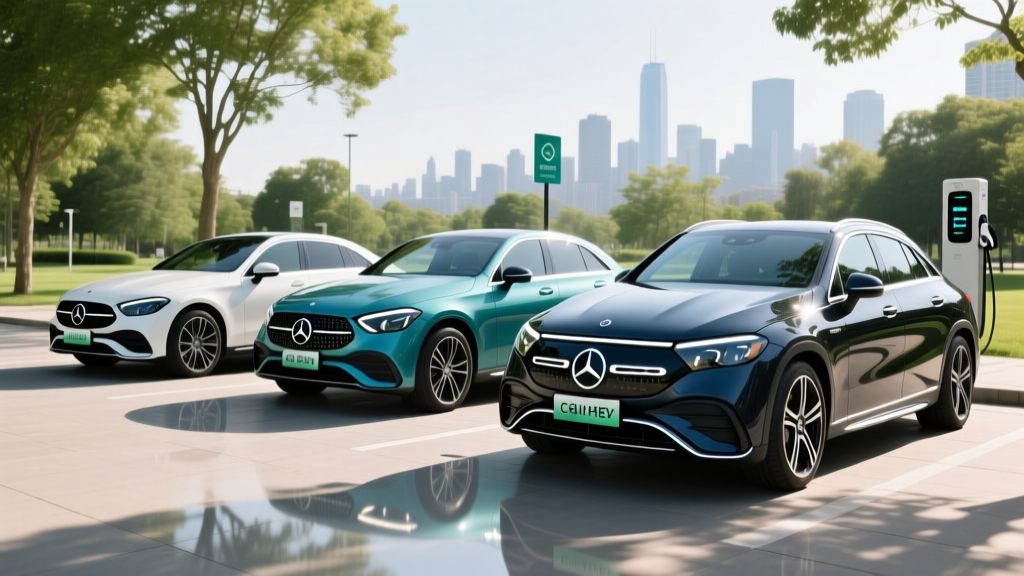
The 2026 Mercedes-Benz Hybrid Lineup at a Glance
Mercedes-Benz approaches electrification with a dual strategy: plug-in hybrid electric vehicles (PHEVs) that offer meaningful electric-only range for daily commuting, and conventional hybrids (HEVs) that boost fuel economy without ever needing a plug. For 2026, the brand's electrified portfolio spans from the compact CLA to the flagship S-Class, with PHEV variants of the GLC, GLE, and S-Class leading the charge.
Unlike some competitors still offering mild-hybrid systems with minimal electric assist, Mercedes has committed to substantial battery packs in its PHEVs — enabling 40-50+ miles of electric-only driving in several models. This makes them genuine alternatives to full EVs for drivers who can charge at home but still want gasoline flexibility for road trips.
Understanding the Difference: HEV vs PHEV
Conventional Hybrid (HEV): Charges its small battery through regenerative braking and the engine. No plug required. Typically delivers 30-40 MPG combined. Think Toyota Prius territory.
Plug-in Hybrid (PHEV): Features a larger battery you charge via plug (Level 1 or Level 2). Offers 30-50+ miles of electric-only range before the gas engine engages. Mercedes's 2026 PHEVs fall squarely here.
Mercedes-Benz PHEV Models: Electric Range and Efficiency
The 2026 Mercedes-Benz PHEV lineup centers on three core models, each pairing a turbocharged gasoline engine with a substantial electric motor and high-voltage battery. Here's how they stack up on paper and in practice.
| Model | Battery (kWh) | EV Range (EPA) | Combined HP | 0-60 mph | MSRP |
|---|---|---|---|---|---|
| GLC 350e 4MATIC | 31.2 kWh | 50 miles | 315 hp | 6.5 sec | $59,900 |
| GLE 350e 4MATIC | 31.2 kWh | 45 miles | 362 hp | 5.8 sec | $72,500 |
| S 580e 4MATIC | 28.6 kWh | 40 miles | 502 hp | 4.9 sec | $124,850 |
Real-world range reality: EPA estimates assume moderate temperatures and mixed driving. Expect 35-42 miles from the GLC 350e in cold weather (below 40°F) or at sustained highway speeds above 70 mph. The S 580e's heavier curb weight and larger tires typically yield 32-38 miles in real-world commuting.
Fuel Economy: What to Expect When the Battery Depletes
Once the electric range is exhausted, these PHEVs operate as conventional hybrids. This is where fuel economy matters for road trips or drivers who can't charge daily.
| Model | City MPG | Highway MPG | Combined MPG | MPGe (with charge) |
|---|---|---|---|---|
| GLC 350e 4MATIC | 27 | 29 | 28 | 65 MPGe |
| GLE 350e 4MATIC | 23 | 26 | 24 | 56 MPGe |
| S 580e 4MATIC | 22 | 28 | 25 | 58 MPGe |
Real-world MPG note: Unlike conventional hybrids that often exceed EPA city estimates through aggressive regenerative braking, PHEVs in charge-depleted mode typically match or fall slightly short of EPA figures — especially in heavy traffic where the engine cycles on/off frequently. The GLC 350e's 9-speed automatic and well-tuned regen system delivers within 1-2 MPG of its EPA rating in most conditions.
For comparison, the gas-only GLC 300 4MATIC achieves 25 MPG combined. The PHEV variant's 28 MPG represents a modest 12% improvement when running on gas alone — the real efficiency gains come from daily electric commuting.
Charging: Times, Connectors, and Infrastructure
Mercedes equips its 2026 PHEVs with a 31.2 kWh battery (28.6 kWh in the S-Class) and supports both Level 1 and Level 2 AC charging. Notably, the GLC and GLE PHEVs also offer optional DC fast charging — a rarity in the PHEV segment.
| Charging Level | Power (kW) | Time (0-100%) | Availability |
|---|---|---|---|
| Level 1 (120V) | 1.4 kW | ~22 hours | All models |
| Level 2 (240V) | 9.6 kW | ~3.5 hours | All models |
| DC Fast Charge | 60 kW | ~30 min (10-80%) | GLC/GLE optional |
Connector compatibility: All 2026 Mercedes PHEVs sold in North America use the J1772 connector for AC charging. Models equipped with DC fast charging use the CCS1 connector. Mercedes has announced a transition to the NACS (Tesla) connector for future EVs, but 2026 PHEVs retain CCS1/J1772.
Home charging reality: Most PHEV owners charge overnight on Level 2. A 240V/40A home charger (like a ChargePoint Home Flex or Tesla Wall Connector with J1772 adapter) replenishes the GLC 350e's battery in roughly 3.5 hours — easily covering a day's electric commuting by morning. Installation typically costs $800-$2,000 depending on electrical panel capacity and run length.
Powertrain Performance and Driving Dynamics
Mercedes pairs its PHEV systems with turbocharged engines and rear-biased all-wheel drive (4MATIC). The electric motor integrates directly into the transmission, delivering instant torque fill before the turbo spools.
GLC 350e 4MATIC
2.0L turbocharged I4 (208 hp) + electric motor (134 hp) = 315 combined hp, 406 lb-ft torque. The electric motor provides seamless low-end thrust, making the GLC feel quicker than its 6.5-second 0-60 time suggests in urban driving.
GLE 350e 4MATIC
2.0L turbocharged I4 (215 hp) + electric motor (134 hp) = 362 combined hp, 516 lb-ft torque. Despite its 5,500-lb curb weight, the GLE pulls confidently from stops and merges effortlessly.
S 580e 4MATIC
3.0L turbocharged I6 (362 hp) + electric motor (148 hp) = 502 combined hp, 516 lb-ft torque. The S-Class PHEV delivers flagship performance with near-silent electric cruising at low speeds.
Regen and one-pedal driving: Mercedes offers adjustable regenerative braking via steering-wheel paddles (D+, D, D-, D Auto). In D Auto mode, the car uses navigation and radar data to optimize regen — coasting when the road ahead is clear, braking when approaching slower traffic. It's not true one-pedal driving like a full EV, but it reduces brake wear significantly in stop-and-go traffic.
Pricing, Tax Credits, and Total Cost of Ownership
The 2026 Mercedes-Benz PHEVs command a premium over their gas-only siblings, but federal and state incentives can narrow the gap substantially.
| Model | Base MSRP | Federal Credit (est.) | Effective Price |
|---|---|---|---|
| GLC 350e 4MATIC | $59,900 | $3,750-$7,500 | $52,400-$56,150 |
| GLE 350e 4MATIC | $72,500 | $3,750-$7,500 | $65,000-$68,750 |
| S 580e 4MATIC | $124,850 | $0 (MSRP cap) | $124,850 |
Federal §30D Tax Credit Rules (2026)
- MSRP cap: SUVs (GLC, GLE) must be under $80,000; sedans (S-Class) under $55,000. The S 580e exceeds the cap and does not qualify.
- Income limits: $150,000 single / $300,000 joint filers (modified AGI)
- Battery sourcing: Varies by model year and critical mineral requirements — check IRS qualified vehicle list before purchase
- Credit amount: $3,750 (battery components only) or $7,500 (components + critical minerals)
- Point-of-sale transfer: Eligible buyers can apply the credit at purchase, reducing out-of-pocket cost immediately
5-year ownership cost: Assuming 15,000 miles/year, $3.50/gallon gas, and $0.14/kWh electricity, a GLC 350e driver who charges daily and drives 40 miles on electricity saves roughly $4,200 in fuel costs over 5 years compared to the gas-only GLC 300. Factor in the $3,750-$7,500 tax credit, and the PHEV breaks even or comes out ahead — while delivering superior performance and the option of electric commuting.
Battery Warranty, Reliability, and Replacement Costs
Mercedes-Benz PHEV Battery Warranty
Coverage: 6 years / 62,000 miles (whichever comes first)
Capacity threshold: Warranty applies if battery capacity drops below 70% of original
What's covered: Battery cell defects, management system failures, thermal management issues
How this compares: Most competitors (BMW, Volvo, Audi) offer 8 years / 100,000 miles on PHEV batteries. Mercedes's 6-year/62,000-mile warranty is below industry average — a notable weakness for buyers planning long-term ownership.
Real-world reliability: Mercedes's PHEV systems have proven robust in European markets where they've been sold since 2019. The 31.2 kWh battery uses NMC (nickel-manganese-cobalt) chemistry with active liquid cooling, which minimizes degradation. Expect 85-90% capacity retention after 5 years of daily cycling.
Replacement cost: Out-of-warranty PHEV battery replacement runs $12,000-$18,000 including labor. However, individual cell modules can sometimes be replaced for $3,000-$5,000 if only a portion of the pack has degraded.
Who Should Choose a Mercedes PHEV vs. Full EV or Gas?
Choose a Mercedes PHEV If:
- You can charge at home (Level 2) and your daily commute is under 45 miles
- You take frequent road trips (300+ miles) and want zero range anxiety
- You live in an area with limited public DC fast-charging infrastructure
- You want electric commuting without committing to a full EV
- You value the performance boost from electric torque fill
Consider a Full EV Instead If:
- You can charge at home and rarely drive more than 250 miles in a day
- You want minimal maintenance (no oil changes, fewer moving parts)
- You qualify for the full $7,500 federal EV tax credit
- You prioritize lowest cost-per-mile (electricity is 3-4x cheaper than gas)
- You want access to HOV lanes (varies by state; PHEVs often excluded)
Hybrid vs PHEV vs EV Decision Framework
Choose conventional hybrid (HEV) if: You cannot charge at home, drive 20,000+ miles/year, and want maximum MPG without behavioral change.
Choose PHEV if: You can charge at home, commute under 50 miles daily, but take 6+ road trips per year over 200 miles.
Choose full EV if: You can charge at home, rarely exceed 250 miles/day, and want lowest operating cost and maintenance.
Mercedes-Benz Hybrid Models FAQ
How many MPG does the Mercedes GLC 350e get?
The 2026 GLC 350e achieves 27 city / 29 highway / 28 combined MPG when operating as a hybrid (battery depleted). With a full charge, it delivers 65 MPGe over the first 50 miles. Real-world testing shows 26-29 MPG in mixed driving once the electric range is exhausted.
How far can the Mercedes GLE 350e go on electric only?
The EPA rates the GLE 350e at 45 miles of electric-only range. In real-world driving at highway speeds or in cold weather, expect 35-40 miles. For city commuting under 45 mph in moderate temperatures, you may achieve the full 45 miles or slightly more.
Does the Mercedes S 580e qualify for the federal tax credit?
No. The 2026 S 580e's $124,850 MSRP exceeds the §30D federal tax credit cap of $55,000 for sedans. Only the GLC 350e and GLE 350e (classified as SUVs with an $80,000 cap) are potentially eligible, subject to income limits and battery sourcing requirements.
Is the Mercedes PHEV battery reliable and what does replacement cost?
Mercedes's PHEV batteries have proven reliable in European markets since 2019, with typical degradation of 10-15% over 5 years. The 6-year/62,000-mile warranty is shorter than competitors' 8-year/100,000-mile coverage. Out-of-warranty replacement costs $12,000-$18,000, though partial repairs are sometimes possible for $3,000-$5,000.
Can I charge a Mercedes PHEV at a Tesla Supercharger?
Not directly. 2026 Mercedes PHEVs use J1772 (AC) and CCS1 (DC) connectors. Tesla Superchargers use the NACS connector. While Tesla has begun opening some Superchargers to non-Tesla EVs via Magic Dock adapters, PHEV compatibility varies by station. Use the PlugShare or ChargePoint apps to find compatible CCS1 stations.
How long does it take to charge the GLC 350e at home?
On a 240V Level 2 charger (9.6 kW), the GLC 350e's 31.2 kWh battery charges from 0-100% in approximately 3.5 hours. On a standard 120V outlet (Level 1, 1.4 kW), expect 22+ hours — impractical for daily use. Most owners install a Level 2 home charger for $800-$2,000.
Sources: EPA Fuel Economy, IRS §30D Tax Credit, Mercedes-Benz USA specifications