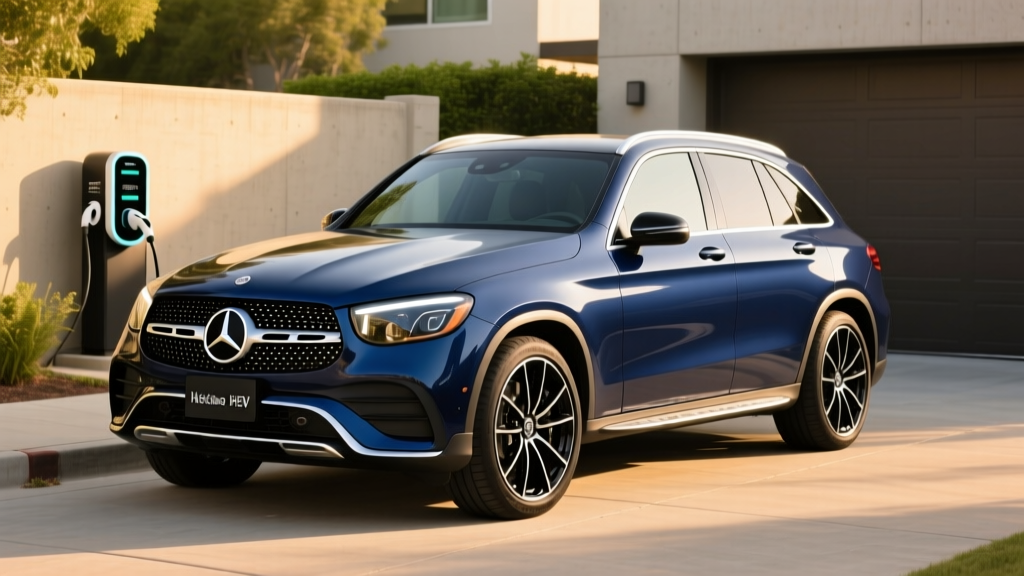
The Mercedes-Benz GLC has long been the brand's best-selling SUV in the United States, and for 2026, the plug-in hybrid variant — the GLC 350e 4MATIC — carries the torch for buyers who want electric commuting without the full commitment of a battery-electric vehicle. With a substantially larger battery than its predecessor and genuine DC fast-charging capability, the 2026 Mercedes-Benz hybrid GLC occupies a compelling middle ground between conventional luxury SUVs and full EVs like the EQE SUV.
This guide breaks down every spec that matters: real-world electric range, EPA fuel economy, charging times, powertrain output, battery longevity, pricing, and whether the federal tax credit applies. If you're cross-shopping the BMW X3 xDrive30e, Audi Q5 PHEV, or Volvo XC60 Recharge, you'll find the exact numbers you need here.
HEV vs PHEV: What the Mercedes-Benz Hybrid GLC Actually Is
Mercedes-Benz currently offers the GLC in the U.S. exclusively as a plug-in hybrid (PHEV) in the GLC 350e 4MATIC trim. There is no conventional hybrid (HEV) version of the current-generation GLC sold stateside — the mild-hybrid MHEV system found on the GLC 300 uses a 48-volt integrated starter-generator for minor efficiency assists, not a true self-charging hybrid drivetrain.
Quick Reference: HEV vs PHEV vs MHEV
| Type | Plugs In? | Electric-Only Range | Example |
|---|---|---|---|
| MHEV (Mild Hybrid) | No | None — assists engine only | GLC 300 (48V system) |
| HEV (Conventional Hybrid) | No | ~1 mile or less at low speed | Toyota RAV4 Hybrid |
| PHEV (Plug-In Hybrid) | Yes | 30–55+ miles typical | GLC 350e 4MATIC |
The distinction matters for your daily routine. A PHEV like the GLC 350e must be plugged in to realize its electric-range benefit. If you never charge it, you're simply driving a heavy luxury SUV with mediocre fuel economy. If you do charge it nightly at home, you may go weeks without visiting a gas station.
Powertrain and Performance Specs
The 2026 GLC 350e 4MATIC pairs a turbocharged 2.0-liter inline-four gasoline engine with a permanently excited synchronous electric motor integrated into the transmission housing. Combined system output reaches 312 horsepower and 406 lb-ft of torque, routed through a 9-speed automatic to all four wheels via 4MATIC all-wheel drive.
| Specification | 2026 GLC 350e 4MATIC |
|---|---|
| Engine | 2.0L turbocharged I4 |
| Electric Motor | 100 kW (134 HP) synchronous |
| Combined System Output | 312 HP / 406 lb-ft |
| Transmission | 9-speed automatic |
| Drivetrain | 4MATIC AWD |
| Battery (Gross / Usable) | 31.2 kWh / ~25.4 kWh |
| Battery Chemistry | NMC (nickel manganese cobalt) |
| 0–60 mph | 6.2 seconds |
| Top Speed (Electric Only) | 87 mph |
| Towing Capacity | 3,500 lbs (est.) |
The 100-kW electric motor is substantial for a PHEV. It can propel the GLC 350e to highway speeds on electricity alone, which is critical for drivers whose commutes include 65–70 mph freeway segments. Many competing PHEVs restrict electric-only operation to lower speeds; the GLC does not.
Electric-Only Range and EPA Fuel Economy
The EPA rates the 2026 GLC 350e at 54 miles of electric-only driving range. That figure places it near the top of the luxury compact PHEV segment — ahead of the BMW X3 xDrive30e (~35 miles) and comparable to the Volvo XC60 Recharge (~58 miles with extended-range battery).
Real-World Range vs. EPA Sticker
EPA Electric-Only Range: 54 miles
Expect in Real-World Driving: 40–48 miles in mixed city/highway use; 32–38 miles in sustained cold weather (below 35°F) or at sustained highway speeds above 70 mph with climate control running.
Total Combined Range (Electric + Gas): Approximately 420–440 miles with a full battery and full 16.4-gallon fuel tank.
Once the battery is depleted, the GLC 350e operates as a hybrid. Here's how the EPA rates its gasoline efficiency:
| Mode | City | Highway | Combined |
|---|---|---|---|
| Charge-Depleted (Hybrid Mode) | 25 MPG | 28 MPG | 26 MPG |
| Electric + Gas (Charge-Sustaining) | — | — | 56 MPGe |
Real-world MPG note: Like most PHEVs, the GLC 350e's fuel economy is highly dependent on charging habits. Drivers who charge daily and commute within the 54-mile electric envelope may use only 1–2 gallons of gasoline per week. Those who never charge will see closer to 23–25 MPG in mixed driving, as the vehicle carries the weight of a large battery without using its electric advantage. In city driving with regular charging, some owners report effective consumption well below the EPA combined figure because most miles are electric.
Charging: Level 1, Level 2, and DC Fast Charging
One of the GLC 350e's most significant upgrades over prior-generation Mercedes PHEVs is DC fast-charging capability — still relatively uncommon in the luxury PHEV segment. Here's the full charging picture:
| Charging Level | Power (kW) | Connector | 0–100% Time | Miles of Range per Hour |
|---|---|---|---|---|
| Level 1 (120V household) | ~1.4 kW | J1772 / NACS (with adapter) | ~18 hours | ~5 miles |
| Level 2 (240V home/public) | Up to 11 kW | J1772 / NACS (with adapter) | ~2.5 hours | ~22 miles |
| DC Fast Charge | Up to 60 kW | CCS / NACS (with adapter) | 10–80% in ~25 min | ~80 miles (equivalent) |
The 11 kW onboard AC charger is generous — many PHEVs cap at 3.6 or 7.2 kW, meaning overnight fills on Level 2 are fast and practical. The 60 kW DC fast-charging capability means you can meaningfully top up the battery during a shopping stop or lunch break on a road trip, recovering roughly 30+ miles of electric range in 15 minutes.
Connector note: For 2026, Mercedes-Benz has begun transitioning to the North American Charging Standard (NACS) port on new EVs. GLC 350e models may ship with either a CCS or NACS inlet depending on production date. Verify with your dealer and ensure you have the appropriate adapter for your home charger and preferred public networks. Tesla Supercharger access for non-Tesla vehicles continues to expand via adapter.
Pricing, Trims, and Tax Credit Eligibility
The 2026 Mercedes-Benz GLC 350e 4MATIC starts at approximately $59,900 (including destination). A well-equipped example with the AMG Line exterior, Premium Package, MBUX premium navigation, and driver-assistance features can reach $68,000–$72,000.
Federal Tax Credit (§30D) Eligibility
- Credit Amount: Up to $3,750 (partial credit — the GLC 350e battery sourcing may not meet the full $7,500 critical-mineral and battery-component thresholds under current IRS rules)
- MSRP Cap: SUVs must be at or below $80,000 — the GLC 350e qualifies
- Buyer Income Cap: Modified AGI ≤ $150,000 (single) / $300,000 (joint) — verify with a tax professional
- Point-of-Sale Transfer: Eligible buyers can apply the credit as an immediate discount at the dealership, reducing out-of-pocket cost
- Battery Sourcing: Critical mineral and battery component requirements under the Inflation Reduction Act tighten annually — check the latest IRS qualified vehicle list before purchasing
State incentives: Several states offer additional PHEV rebates. California's CVRP has been restructured, but states like Colorado, New York, and Massachusetts may offer $1,000–$4,000 in additional incentives depending on income and vehicle price. Check your state energy office for current programs.
Compared to the GLC 300 (starting ~$48,000), the PHEV commands roughly a $12,000 premium before incentives. The break-even calculation depends heavily on your electricity cost, gasoline cost, and daily mileage. At $3.50/gallon gas and $0.14/kWh electricity, a driver covering 30 miles daily on electricity saves approximately $1,200–$1,500 per year in fuel, reaching payback in roughly 6–8 years without tax credits, or 4–5 years with the $3,750 credit applied.
Battery Warranty, Reliability, and Replacement Cost
Mercedes-Benz provides a high-voltage battery warranty of 6 years or 62,000 miles (whichever comes first) for the GLC 350e, covering defects and capacity loss below a specified threshold (typically 70% of original capacity). This is slightly shorter than the 8-year/100,000-mile warranties offered by some competitors, though Mercedes has historically stood behind its hybrid systems in practice.
Battery Warranty Summary
High-Voltage Battery: 6 years / 62,000 miles (defect and capacity retention)
Powertrain Warranty: 4 years / 50,000 miles
Bumper-to-Bumper: 4 years / 50,000 miles
Estimated Replacement Cost: $8,000–$14,000 for the high-voltage battery pack if out of warranty (dealer-sourced; independent hybrid specialists may offer refurbished options for less)
On reliability, the GLC platform has been solid in its current generation. The PHEV powertrain adds complexity — an electric motor sandwiched between the engine and transmission, plus high-voltage cabling and thermal management — but Mercedes has been building PHEVs since the 2015 S 500e and the technology is mature. According to IIHS and NHTSA data, the GLC has performed well in crash testing, and the battery pack is housed in a reinforced underfloor structure.
The realistic risk of a full battery replacement within the first 10 years of ownership is low based on industry-wide NMC degradation data, which shows most modern PHEV batteries retaining 85–90% capacity after 100,000 miles when not routinely charged to 100% or deeply discharged. Setting the charge limit to 80–90% for daily use and avoiding prolonged storage at 0% or 100% SoC will extend battery life meaningfully.
Who Should Choose the GLC 350e PHEV vs. a Full EV or Gas SUV
The GLC 350e is not the right choice for everyone. Here's a decision framework to determine fit:
Choose the GLC 350e PHEV If:
- Your daily commute is under 50 miles round-trip and you can charge at home every night
- You take 3+ road trips per year exceeding 250 miles and don't want to plan around DC fast-charging infrastructure
- You want a luxury compact SUV with badge prestige and a premium interior but aren't ready for a full BEV
- You live in a region with extreme cold where EV range loss is a genuine concern
- You lack reliable access to public fast chargers for long trips
Choose a Full EV (EQE SUV, iX, etc.) If:
- You have home Level 2 charging and your daily driving rarely exceeds 200 miles
- You want zero tailpipe emissions and minimal maintenance (no oil changes, no gas engine upkeep)
- You want access to the full $7,500 federal tax credit (if eligible and vehicle qualifies)
Choose the Gas GLC 300 If:
- You cannot charge at home or at work
- Your annual mileage is low and fuel savings won't offset the PHEV price premium
- You prioritize lower upfront cost and simpler mechanical ownership
Pros
- 54-mile EPA electric range covers most daily commutes entirely on electricity
- 60 kW DC fast charging — rare for PHEVs — enables road-trip top-ups
- 312 HP combined delivers confident acceleration and highway passing power
- Genuine luxury interior with MBUX, excellent ride quality, and quiet cabin
- 420+ mile total range eliminates range anxiety on long trips
Cons
- $59,900 starting price is steep — ~$12K premium over gas GLC 300
- 6-year/62,000-mile battery warranty is shorter than some competitors
- Federal tax credit may only be $3,750 (partial) due to battery sourcing rules
- Cargo space reduced slightly vs. gas GLC due to battery placement (~2 oz less cargo volume behind rear seats)
- If you don't plug it in, fuel economy drops to an unremarkable 23–25 MPG
Frequently Asked Questions
How many MPG does the Mercedes-Benz hybrid GLC get?
The EPA rates the 2026 GLC 350e at 25 city / 28 highway / 26 combined MPG when operating in hybrid mode with a depleted battery. When factoring in electric driving, the combined rating is 56 MPGe. Real-world results vary dramatically based on charging habits — drivers who charge daily and stay within the electric range may use very little gasoline.
How far can the GLC 350e go on electric only?
The EPA rates it at 54 miles of electric-only range. In real-world mixed driving, expect 40–48 miles. In cold weather or sustained high-speed highway driving, that may drop to 32–38 miles. The electric motor can propel the vehicle up to 87 mph, so highway driving on electricity alone is fully supported.
Hybrid vs PHEV vs EV — which fits me?
If you can charge at home and commute under 50 miles daily but also take long road trips, the PHEV (GLC 350e) offers the best of both worlds. A conventional hybrid (HEV) requires no plug-in but offers no meaningful electric-only range. A full EV (like the Mercedes EQE SUV) eliminates gasoline entirely but requires reliable charging access and route planning for trips over 250 miles.
Is the GLC 350e reliable and what does battery replacement cost?
Mercedes-Benz PHEV technology is mature, and the current GLC platform has been well-received. The high-voltage battery is warrantied for 6 years/62,000 miles. Out-of-warranty replacement costs are estimated at $8,000–$14,000. Industry data suggests modern NMC PHEV batteries retain 85–90% capacity at 100,000 miles with reasonable charging habits, making a full replacement unlikely within the first decade.
Does the 2026 GLC 350e qualify for a federal tax credit?
It may qualify for a partial credit of up to $3,750 under IRS §30D rules, depending on battery component and critical mineral sourcing compliance, which tightens annually. The GLC 350e is under the $80,000 SUV MSRP cap. Buyer income limits apply ($150K single / $300K joint MAGI). The credit can be transferred at the point of sale as a purchase discount. Always verify current eligibility on the fueleconomy.gov vehicle listing and consult a tax professional before relying on credit assumptions.
Can I charge the GLC 350e at a Tesla Supercharger?
Depending on production date, 2026 GLC 350e models may come equipped with either a CCS or NACS charge port. If equipped with NACS, you can access Tesla Superchargers (where non-Tesla access is enabled) directly. If equipped with CCS, an approved NACS adapter is required. Confirm your vehicle's port type with your dealer before purchasing an adapter, and check Tesla's Supercharger map for non-Tesla availability in your area.
What happens if I never plug in the GLC 350e?
The vehicle will operate as a conventional hybrid once the battery is depleted, but it won't be an efficient one. Without electric-only miles, you'll see approximately 23–25 MPG combined — worse than a dedicated hybrid like the Toyota RAV4 Hybrid (39 MPG combined) and only marginally better than the gas-only GLC 300 (~26 MPG combined). You'll also be carrying roughly 500 lbs of unused battery weight. Plugging in is essential to realizing the PHEV's value proposition.
For the latest EPA ratings and official specifications, refer to fueleconomy.gov and the Mercedes-Benz USA GLC page.