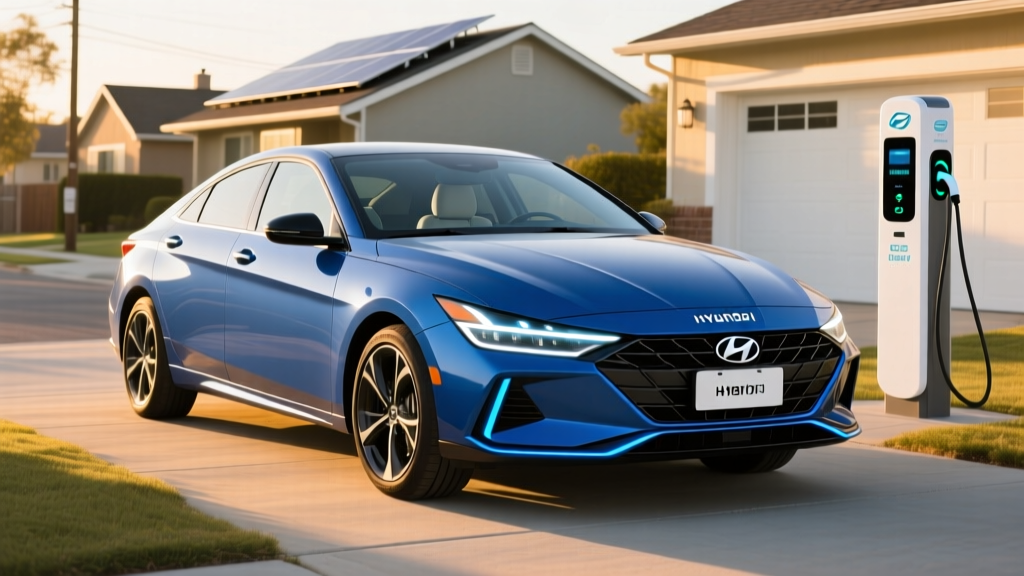
The 2026 Hyundai Elantra Blue Hybrid occupies a specific niche: maximum fuel economy without a plug. It is a conventional hybrid electric vehicle (HEV), not a plug-in hybrid (PHEV), meaning it recovers energy through regenerative braking and its gasoline engine — you never plug it in. For buyers who want Prius-rivaling efficiency in a more conventional sedan package, the Blue trim is Hyundai's efficiency-focused answer.
But how does the Elantra Blue Hybrid stack up against the Toyota Prius, Honda Civic Hybrid, and Hyundai's own PHEV and EV lineup? This guide breaks down every number that matters — EPA MPG, real-world fuel economy, powertrain specs, battery warranty, and total cost of ownership — so you can make an informed decision.
Elantra Blue Hybrid Fuel Economy: EPA vs. Real World
The headline number for the 2026 Elantra Blue Hybrid is its EPA-estimated fuel economy. The Blue trim, which uses lighter 16-inch alloy wheels and low-rolling-resistance tires to maximize efficiency, achieves the highest MPG in the Elantra Hybrid lineup.
| Metric | EPA Estimate | Real-World Expectation |
|---|---|---|
| City MPG | 56 MPG | 55–60 MPG (hybrids often exceed EPA in city) |
| Highway MPG | 51 MPG | 46–50 MPG (sustained 75+ mph reduces hybrid advantage) |
| Combined MPG | 54 MPG | 50–55 MPG depending on driving mix |
| Fuel Tank Capacity | 11.1 gallons | ~550–600 miles total range |
Why real-world city MPG often beats the sticker: Hybrids shine in stop-and-go traffic. Every brake application feeds energy back into the battery via regenerative braking, and the engine shuts off at stops. In our experience with Hyundai's hybrid system, city driving routinely returns 55–60 MPG because the electric motor handles low-speed propulsion while the engine operates only in its most efficient load range.
Where highway MPG drops: At sustained 70–80 mph, aerodynamic drag dominates and the engine must work continuously. The hybrid system provides minimal benefit at constant highway speed compared to a conventional efficient sedan. Expect 46–50 MPG on long highway cruises — still excellent, but below the combined sticker.
Cold-weather impact: In sub-freezing temperatures, expect a 5–10% MPG reduction (roughly 48–51 MPG combined). The engine runs more often to provide cabin heat and warm up the catalytic converter, reducing the time it can shut off.
Powertrain Specs: Engine, Motor, and Combined Output
The 2026 Elantra Blue Hybrid pairs a 1.6-liter naturally aspirated four-cylinder engine with a permanent-magnet synchronous electric motor, connected through Hyundai's 6-speed dual-clutch automatic transmission (DCT). Unlike Toyota's e-CVT hybrid system, Hyundai's DCT provides more direct, stepped gear changes that feel familiar to drivers accustomed to conventional automatics.
| Component | Specification |
|---|---|
| Gasoline Engine | 1.6L GDI 4-cylinder, 104 HP / 109 lb-ft torque |
| Electric Motor | 32 kW (43 HP) permanent-magnet synchronous |
| Combined System Output | 139 HP / 195 lb-ft torque |
| Transmission | 6-speed dual-clutch automatic (DCT) |
| Hybrid Battery | 1.32 kWh lithium-ion polymer (Li-ion) |
| Drivetrain | Front-wheel drive (FWD) |
| 0–60 mph | ~8.5 seconds (estimated) |
| Curb Weight | ~3,050 lbs |
The 1.32 kWh battery is small by EV standards — this is by design. A conventional hybrid battery doesn't store energy for plug-in charging; it acts as a buffer, capturing braking energy and releasing it for electric-assisted acceleration. The battery charges exclusively through regenerative braking and engine-driven generation. You do not and cannot plug in the Elantra Blue Hybrid.
Compared to the Elantra Hybrid SEL and Limited trims (which use 17- or 18-inch wheels and achieve 50–52 MPG combined), the Blue trim sacrifices some performance-oriented wheel and tire options for roughly 2–4 MPG of combined efficiency gains.
HEV vs. PHEV vs. EV: Which Elantra Fits You?
Hyundai offers the Elantra in three electrified forms: the conventional Hybrid (HEV), the Plug-in Hybrid (PHEV), and the fully electric Elantra Electric (where available). Understanding the differences is critical before committing to a purchase.
| Feature | Elantra Blue Hybrid (HEV) | Elantra PHEV | Elantra Electric (EV) |
|---|---|---|---|
| Plug-in Required? | No | Yes (Level 1/Level 2) | Yes (Level 2/DC fast) |
| Electric-Only Range | N/A (electric assist only) | ~29 miles (EPA est.) | ~250+ miles (EPA est.) |
| Combined MPG / MPGe | 54 MPG combined | ~117 MPGe (electric) / 50 MPG (gas) | ~120+ MPGe |
| Battery Capacity | 1.32 kWh | ~11.3 kWh | ~58–65 kWh |
| DC Fast Charging | Not applicable | No (AC only, Level 2 max) | Yes (up to ~150 kW) |
| Base MSRP (approx.) | ~$26,500 | ~$33,500 | ~$34,000 |
| Federal Tax Credit (§30D) | Not eligible | Up to $7,500 (if eligible) | Up to $7,500 (if eligible) |
| Total Range | ~550–610 miles | ~440+ miles (electric + gas) | ~250+ miles |
- You don't have access to home or workplace charging
- You want maximum MPG without changing your refueling habits
- Your budget is under $28,000 and you want the lowest upfront cost
- You drive mostly city and suburban routes where hybrid efficiency peaks
- You have Level 2 home charging and a commute under 30 miles
- You want electric-only daily driving with gas backup for road trips
- You qualify for the §30D federal tax credit, reducing effective price
- You have reliable home Level 2 charging
- Your daily driving is under 200 miles and you rarely take long road trips
- You want the lowest per-mile energy cost and minimal maintenance
Pricing, Trims, and Tax Credit Eligibility
The 2026 Hyundai Elantra Blue Hybrid starts at an MSRP of approximately $26,500 (including destination). This makes it one of the most affordable hybrid sedans on the market, undercutting the Toyota Prius LE (~$29,000) and sitting close to the Honda Civic Hybrid (~$28,500).
Standard equipment on the Blue trim typically includes:
- 8-inch touchscreen with wireless Apple CarPlay and Android Auto
- Hyundai SmartSense safety suite (forward collision avoidance, lane-keeping assist, blind-spot monitoring)
- 16-inch alloy wheels with low-rolling-resistance tires
- Automatic climate control
- LED headlights and daytime running lights
Federal Tax Credit Status
The Elantra Blue Hybrid, as a conventional HEV, does not qualify for the IRS §30D Clean Vehicle Credit. That credit applies only to plug-in electric vehicles (BEVs and PHEVs) with sufficient battery capacity and meeting critical-mineral and battery-component sourcing requirements.
However, if you're cross-shopping the Elantra PHEV or Elantra Electric, the §30D credit may apply — subject to these 2026 requirements:
- MSRP cap: Sedans must have an MSRP at or below $55,000
- Buyer income cap: Modified AGI ≤ $150,000 (single) / $300,000 (joint)
- Battery sourcing: Critical minerals and battery components must meet phased-in domestic/free-trade sourcing thresholds (increasing annually)
- Point-of-sale transfer: Eligible buyers can transfer the credit to the dealer for an immediate price reduction
- Filing requirement: Must file IRS Form 8936; vehicle VIN required
Always verify current-year eligibility on IRS.gov and consult a tax professional before relying on credit amounts, as sourcing rules and manufacturer eligibility can shift mid-year.
Battery Warranty, Lifespan, and Replacement Cost
Battery longevity is the number-one concern for hybrid buyers. Hyundai addresses this with one of the strongest hybrid battery warranties in the industry.
- Coverage: 10 years / 100,000 miles (whichever comes first)
- Capacity threshold: Hyundai covers the battery if it fails or drops below a specified state-of-health threshold under normal use
- Powertrain warranty: 10 years / 100,000 miles (engine, transmission, hybrid motor)
- Bumper-to-bumper: 5 years / 60,000 miles
How Long Will the Hybrid Battery Actually Last?
Hyundai's lithium-ion polymer hybrid batteries are engineered for the life of the vehicle. Unlike EV batteries that cycle through large depth-of-discharge ranges daily, the Elantra's 1.32 kWh battery operates in a narrow state-of-charge window (roughly 40–80%), managed by the hybrid control unit. This shallow cycling dramatically reduces degradation.
Based on data from Hyundai's hybrid fleet (Ioniq Hybrid, Sonata Hybrid, Elantra Hybrid) now reaching 150,000+ miles, hybrid battery failures before 10 years are uncommon. Most owners report no meaningful capacity loss within the warranty period.
Out-of-Warranty Replacement Cost
If the hybrid battery does fail outside the warranty window, replacement costs for Hyundai's 1.32 kWh hybrid battery pack typically range from $2,000 to $3,500 (parts and labor) at a dealership. Independent hybrid specialists may offer refurbished units for $1,200–$2,000. This is substantially less than an EV traction battery replacement ($8,000–$20,000+) because the hybrid battery is far smaller.
For context, a conventional gasoline car's transmission replacement often costs $3,000–$5,000 — so the hybrid battery is not an outsized financial risk relative to standard ICE repair costs.
Reliability, Safety Ratings, and Ownership Costs
Hyundai's hybrid system has proven reliable across multiple model lines. The Elantra Hybrid uses a carryover powertrain that debuted in the 2021 model year, meaning most early-production issues have been addressed by the 2026 model year.
Safety
The Elantra has earned strong safety marks. Check current ratings on IIHS.org and NHTSA.gov for the latest crash-test results. The Hyundai SmartSense suite includes:
- Forward Collision-Avoidance Assist with pedestrian detection
- Lane Keeping Assist and Lane Following Assist
- Blind-Spot Collision-Avoidance Assist
- Rear Cross-Traffic Collision-Avoidance Assist
- Driver Attention Warning
Important note on driver assistance: These features are SAE Level 1–2 driver-assist systems. They do not make the car self-driving. The driver must remain fully engaged, hands on the wheel, and eyes on the road at all times.
Five-Year Cost of Ownership Estimate
| Cost Category | Elantra Blue Hybrid (54 MPG) | Typical Gas Sedan (30 MPG) |
|---|---|---|
| Purchase Price (MSRP) | $26,500 | $24,000 |
| Fuel Cost (75,000 mi @ $3.30/gal) | ~$4,583 | ~$8,250 |
| Maintenance (5 yr) | ~$2,200 | ~$2,800 |
| Insurance (5 yr est.) | ~$7,500 | ~$7,000 |
| Depreciation (est.) | ~$11,000 | ~$11,500 |
| Total 5-Year Cost | ~$51,783 | ~$53,550 |
The hybrid's fuel savings — approximately $3,667 over five years — more than offset its higher purchase price. Hybrids also tend to have lower brake wear thanks to regenerative braking, which handles most deceleration without engaging the friction brakes.
Pros and Cons: The Honest Assessment
Pros
- 54 MPG combined EPA — among the best non-plug-in sedans available
- No charging infrastructure needed — refuel at any gas station
- Low starting MSRP (~$26,500) with strong standard equipment
- 10-year/100,000-mile hybrid battery and powertrain warranty
- Strong city MPG that often exceeds EPA estimates in real driving
- Hyundai SmartSense safety suite standard
- 550+ mile total range eliminates range anxiety entirely
Cons
- Highway MPG drops to 46–50 at sustained 75+ mph speeds
- Not eligible for the §30D federal tax credit (HEV, not PHEV/EV)
- Modest 139 HP — adequate for commuting, not sporty
- Blue trim lacks premium features available on SEL/Limited
- 6-speed DCT can feel slightly hesitant at low-speed takeoffs
- No spare tire — tire repair kit included instead
- Cabin noise on rough pavement compared to some competitors
Frequently Asked Questions
How many MPG does the Elantra Blue Hybrid get?
The 2026 Elantra Blue Hybrid achieves an EPA-estimated 56 city / 51 highway / 54 combined MPG. In real-world city driving, many owners report 55–60 MPG thanks to the hybrid system's regenerative braking efficiency. Highway driving at 75+ mph typically yields 46–50 MPG.
Does the Elantra Blue Hybrid need to be plugged in?
No. The Elantra Blue Hybrid is a conventional hybrid (HEV). Its 1.32 kWh battery charges through regenerative braking and the gasoline engine. There is no plug, no charging cable, and no need for any charging infrastructure. You refuel exclusively at gas stations.
Is the Elantra Blue Hybrid reliable?
Hyundai's hybrid system has been in production since the 2017 Ioniq Hybrid and has proven durable. The carryover powertrain in the 2026 Elantra benefits from nearly a decade of refinement. The 10-year/100,000-mile hybrid battery warranty provides strong peace of mind, and out-of-warranty battery replacement costs (~$2,000–$3,500) are manageable compared to major ICE repairs.
Does the Elantra Blue Hybrid qualify for a tax credit?
No. The federal §30D Clean Vehicle Credit applies only to plug-in vehicles (PHEVs and BEVs). The Elantra Blue Hybrid, as a conventional HEV, does not qualify. If tax credit eligibility is a priority, consider the Elantra PHEV or Elantra Electric, both of which may qualify for up to $7,500 depending on your income, the vehicle's MSRP, and battery sourcing requirements. Verify current rules at IRS.gov.
What is the hybrid battery replacement cost?
Out-of-warranty replacement for the Elantra Blue Hybrid's 1.32 kWh lithium-ion polymer battery typically costs $2,000–$3,500 at a dealership, or $1,200–$2,000 from an independent hybrid specialist using refurbished units. However, based on Hyundai's hybrid fleet data, most batteries last well beyond the 10-year/100,000-mile warranty period without significant degradation.
How does the Elantra Blue Hybrid compare to the Toyota Prius?
The Prius LE achieves 57 MPG combined (EPA), edging out the Elantra Blue Hybrid by 3 MPG. However, the Elantra typically starts at a lower MSRP and offers a more conventional sedan design with a larger trunk. The Prius uses Toyota's e-CVT system (smoother but less engaging), while the Elantra's 6-speed DCT provides more direct acceleration feel. Both are excellent choices — the decision often comes down to styling preference and dealer pricing in your area.
Can I get all-wheel drive with the Elantra Blue Hybrid?
No. The 2026 Elantra Blue Hybrid is front-wheel drive only. If AWD is a priority, the Toyota Prius AWD-e (54 MPG combined) offers all-weather capability with minimal efficiency penalty.