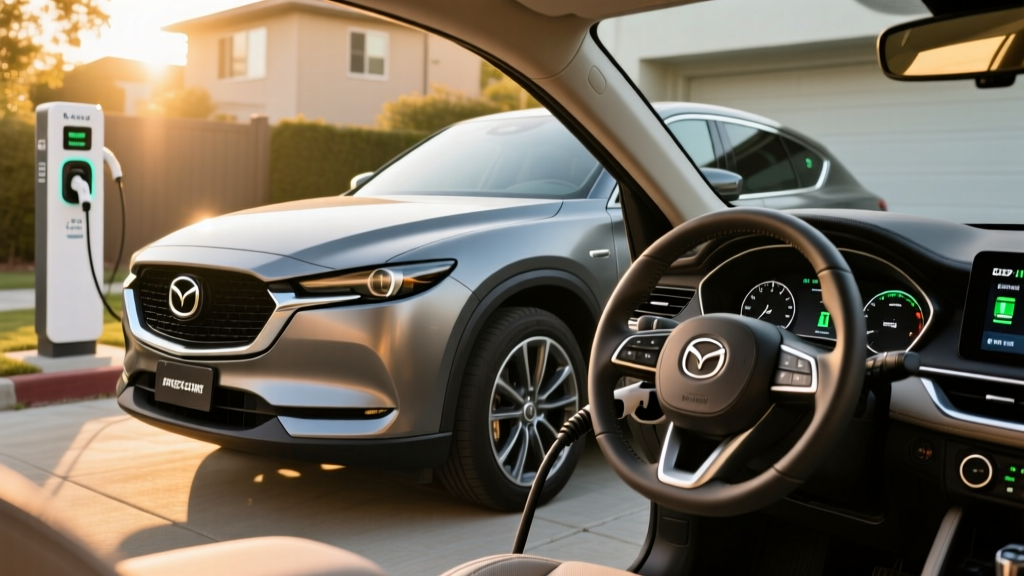
The 2026 Mazda CX-70 PHEV occupies a specific niche in Mazda's electrified lineup: a two-row, inline-six plug-in hybrid that prioritizes driving engagement over outright efficiency. It isn't the longest-range PHEV in the midsize SUV class, and it doesn't pretend to be. Instead, Mazda pairs a turbocharged 2.5-liter four-cylinder with a 17.8 kWh battery pack to deliver 327 combined horsepower, premium interior materials, and the kind of chassis tuning that makes you forget you're driving a plug-in hybrid. For buyers who want electric commuting capability without committing to a full battery-electric vehicle, the CX-70 PHEV warrants a serious look — but only if you understand exactly what you're getting.
First: The CX-70 PHEV Is Not a Conventional Hybrid
Mazda sells the CX-70 in two flavors, and confusing them is the most common buyer mistake. Here's the distinction:
| Feature | CX-70 PHEV (Plug-In Hybrid) | CX-70 MHEV (Mild Hybrid) |
|---|---|---|
| Powertrain | 2.5L turbo I-4 + electric motor | 3.3L turbo I-6 + 48V mild hybrid |
| Combined Output | 327 hp / 382 lb-ft | 284 hp (standard) or 340 hp (S trim) |
| Plug-in Charging | Yes — Level 1 & Level 2 | |
| Electric-Only Range | 26 miles (EPA) | None (48V assist only) |
| Battery | 17.8 kWh lithium-ion | Small 48V battery |
| Fuel Economy | 56 MPGe (combined) / 25 MPG gas-only | 24 MPG combined |
| Starting MSRP | $40,445 | $38,045 |
The CX-70 PHEV can be plugged into a wall outlet or Level 2 charger to fill its traction battery, giving you genuine electric-only driving for short commutes. The CX-70 MHEV uses a 48-volt mild-hybrid system that cannot be plugged in, cannot drive on electric power alone, and exists purely to smooth stop-start transitions and provide minor torque assist. This guide focuses on the PHEV variant.
EPA Range, MPGe, and What You'll Actually See
The EPA rates the 2026 CX-70 PHEV at 26 miles of electric-only range and 56 MPGe combined when operating in charge-depleting (EV-assisted) mode. Once the battery is exhausted and the vehicle operates as a conventional hybrid, the EPA estimates 25 MPG combined.
Real-World Range vs. EPA Sticker
EPA electric range: 26 miles
Real-world expectation: 20–24 miles in mixed driving with climate control active. In cold weather (below 32°F), expect 16–19 miles due to battery chemistry limitations and cabin heating demand. Highway-only electric range drops further to roughly 18–20 miles at 70 mph.
EPA gas-only MPG: 25 combined (city/highway breakdown below)
| Mode | City | Highway | Combined |
|---|---|---|---|
| Charge-Depleting (MPGe) | — | — | 56 MPGe |
| Charge-Sustaining (gas only) | 24 MPG | 27 MPG | 25 MPG |
The 26-mile electric range is on the shorter side for a PHEV in 2026. Competitors like the Toyota RAV4 Prime (42 miles) and Hyundai Tucson PHEV (33 miles) offer substantially more electric-only distance. However, Mazda's trade-off is a more powerful powertrain and a sportier driving character. If your daily commute is under 20 miles round-trip and you can charge at home, the CX-70 PHEV will cover most weekday driving on electricity alone.
Powertrain: 327 Horsepower and a Sport-Tuned Hybrid System
The CX-70 PHEV's powertrain is where Mazda differentiates itself from efficiency-focused rivals. The system pairs a 2.5-liter turbocharged inline-four engine producing 189 hp on its own with a 173-hp electric motor integrated into the 8-speed automatic transmission. Combined system output is 327 horsepower and 382 lb-ft of torque, routed through Mazda's i-Activ all-wheel-drive system.
| Engine | 2.5L turbocharged I-4 |
| Electric Motor | 173 hp (integrated in transmission) |
| Combined Output | 327 hp / 382 lb-ft |
| Battery (Usable) | 17.8 kWh lithium-ion |
| EV Range (EPA) | 26 miles |
| MPGe (EPA Combined) | 56 MPGe |
| Gas-Only MPG | 25 combined (24 city / 27 highway) |
| Transmission | 8-speed automatic (no CVT) |
| Drivetrain | i-Activ AWD (standard) |
| 0–60 mph | ~5.9 seconds (est.) |
| Towing Capacity | 3,500 lbs |
| Cargo Volume | 39.6 cu ft (rear seats up) |
Unlike many PHEVs that use a continuously variable transmission (CVT), Mazda retains a traditional 8-speed automatic with a torque converter. This gives the CX-70 PHEV a more natural acceleration feel — you get actual gear shifts rather than the rubber-band sensation common in CVT-equipped hybrids. The trade-off is marginally lower efficiency than a CVT could theoretically deliver, but for a vehicle positioned as a driver's SUV, the choice makes sense.
Charging: Level 1, Level 2, and No DC Fast Charging
The CX-70 PHEV supports AC charging at Level 1 (120V household outlet) and Level 2 (240V), but does not support DC fast charging. This is typical for PHEVs in this class — the battery is small enough that Level 2 charging fills it relatively quickly, making DC fast-charging hardware an unnecessary cost and weight addition.
| Charging Level | Power (kW) | Time to Full Charge | Connector |
|---|---|---|---|
| Level 1 (120V outlet) | ~1.4 kW | ~12–14 hours | Standard J1772 |
| Level 2 (240V, 32A) | ~7.7 kW | ~2.5 hours | J1772 |
| DC Fast Charge | Not supported | N/A | N/A |
For most PHEV owners, a standard 120V outlet is sufficient if the vehicle is parked overnight for 10+ hours — it will nearly refill the battery. However, a Level 2 home charger (240V) is strongly recommended if you want to top up during the day between an electric morning commute and an electric evening errand run. A Level 2 home installation typically costs $800–$2,000 depending on panel capacity and run length (source: U.S. Department of Energy). No electrical panel upgrade is usually required for a PHEV's modest 7.7 kW draw.
Battery Warranty and Longevity
Mazda covers the CX-70 PHEV's high-voltage battery with an 8-year / 100,000-mile warranty (extended to 10 years / 150,000 miles in California Air Resources Board states including CA, CO, CT, ME, MD, MA, NJ, NY, OR, RI, VT, and WA). The warranty guarantees the battery will retain a minimum capacity threshold — typically 70% of original capacity. If degradation falls below that threshold within the warranty period, Mazda will repair or replace the battery at no cost.
Based on data from similar Mazda PHEV powertrains, owners can expect the battery to retain roughly 85–90% capacity after 5 years of daily charge-deplete cycles. Full replacement cost out of warranty is estimated at $6,000–$9,000 including labor, though this figure is based on current parts pricing and may shift as battery costs continue to decline.
Pricing, Trims, and Federal Tax Credit Eligibility
The 2026 CX-70 PHEV starts at $40,445 MSRP for the Preferred trim and climbs through Premium ($45,445) and Premium Plus ($50,445), before destination charges.
| Trim | MSRP | Key Features |
|---|---|---|
| Preferred | $40,445 | Leatherette, power liftgate, 10.25" display, wireless CarPlay/Android Auto |
| Premium | $45,445 | Nappa leather, panoramic moonroof, 12-speaker Bose, head-up display |
| Premium Plus | $50,445 | Nappa leather (quilted), ventilated front seats, 360° camera, advanced lighting |
Does the CX-70 PHEV Qualify for a Federal Tax Credit?
Under current IRS §30D New Clean Vehicle Credit rules, the CX-70 PHEV may qualify for up to $3,750 — the partial credit amount — but eligibility depends on several factors that change frequently:
- MSRP cap: SUVs must be under $80,000 MSRP. All CX-70 PHEV trims qualify.
- Buyer income cap: Modified AGI must not exceed $150,000 (single), $225,000 (head of household), or $300,000 (joint filers).
- Battery sourcing requirements: The credit is split into two halves ($3,750 for critical minerals + $3,750 for battery components). As of the 2026 model year, the CX-70 PHEV's battery sourcing satisfies at least one of the two requirements, yielding a potential $3,750 credit. Full $7,500 eligibility has not been confirmed by Mazda for this model year.
- Point-of-sale transfer: Buyers can transfer the credit to the dealer at purchase for an immediate price reduction rather than waiting to claim it on their tax return.
Tax credit eligibility is subject to change based on Treasury Department guidance and battery supply-chain shifts. Always verify current eligibility on fueleconomy.gov and consult a tax professional before making a purchase decision based on credit assumptions.
Who Should Buy the CX-70 PHEV — And Who Shouldn't
Choose the CX-70 PHEV if:
- Your daily commute is under 25 miles round-trip and you can charge at home
- You want a premium two-row SUV with a sporty driving character and inline-six-level power
- You take regular road trips and don't want to plan around DC fast-charging infrastructure
- You value a traditional automatic transmission over a CVT
- You need 3,500-lb towing capacity with a plug-in powertrain
Consider a Full EV Instead if:
- You want zero gas-engine maintenance (no oil changes, no spark plugs, no turbo)
- Your state or utility offers strong EV-only incentives beyond the federal credit
- Your commute is longer than 26 miles and you'd want full electric coverage
- You want lower per-mile "fuel" cost — electricity at $0.14/kWh costs roughly $0.04/mile in the CX-70 PHEV's EV mode vs. $0.12–$0.15/mile on gas
Consider a Conventional Hybrid (HEV) Instead if:
- You cannot charge at home (apartment, street parking, no garage)
- You want maximum MPG without any plug-in behavior — a Toyota Highlander Hybrid delivers 35 MPG combined without ever plugging in
- You want a lower purchase price and don't care about electric-only driving
Pros
- 327 hp provides genuinely quick acceleration for a PHEV SUV
- Premium interior materials rival European competitors at this price point
- 8-speed automatic (no CVT) delivers a natural, engaging driving feel
- Standard AWD with 3,500-lb towing capacity
- Quiet, well-insulated cabin in EV mode
Cons
- 26-mile EV range trails class leaders (RAV4 Prime: 42 mi, Sportage PHEV: 33 mi)
- No DC fast charging
- Gas-only MPG of 25 combined is modest once the battery is depleted
- Rear seat and cargo space are tighter than some midsize rivals
- Partial ($3,750) federal tax credit, not the full $7,500
Reliability, Safety, and Long-Term Ownership Costs
Mazda's inline-four turbocharged engines have a strong reliability track record, and the PHEV system uses a proven motor/generator design shared with the CX-90 PHEV. The National Highway Traffic Safety Administration (NHTSA) and Insurance Institute for Highway Safety (IIHS) ratings for the 2026 CX-70 were not yet fully published at the time of writing, but the related CX-90 earned IIHS Top Safety Pick+ honors, suggesting strong crashworthiness.
Mazda's standard warranty covers 3 years / 36,000 miles bumper-to-bumper and 5 years / 60,000 miles powertrain. The hybrid-specific components (battery, motor, inverter) carry the 8-year / 100,000-mile coverage noted above. Scheduled maintenance costs are moderate — expect oil changes every 7,500–10,000 miles when the gas engine runs, plus standard brake, tire, and fluid service. Regenerative braking in the PHEV system reduces brake wear compared to a gas-only vehicle, often extending pad life to 60,000+ miles.
Frequently Asked Questions
How many MPG does the Mazda CX-70 PHEV get?
The EPA rates the 2026 CX-70 PHEV at 56 MPGe combined when using battery charge, and 25 MPG combined (24 city / 27 highway) when running on gasoline alone after the battery is depleted. Real-world gas-only MPG may reach 26–28 MPG in gentle city driving thanks to regenerative braking, but highway cruising at 75+ mph tends to return 23–25 MPG.
How far can the CX-70 PHEV go on electric only?
The EPA rates it at 26 miles of electric-only range. In real-world mixed driving with climate control, expect 20–24 miles. Cold weather (below freezing) reduces this to 16–19 miles. Total combined range (electric + full gas tank) is approximately 490 miles.
Hybrid vs PHEV vs EV — which should I choose?
Choose a conventional hybrid (HEV) if you can't charge at home and want better MPG without plugging in. Choose a PHEV like the CX-70 if you can charge at home, have a short commute, and want the option of gas-only road trips with no range anxiety. Choose a full EV (BEV) if you want the lowest per-mile cost, minimal maintenance, and have reliable charging access — either at home or via public DC fast chargers in your area.
Is the CX-70 PHEV reliable and what does battery replacement cost?
Mazda's turbocharged four-cylinder and PHEV system are based on proven architectures. The high-voltage battery is warrantied for 8 years / 100,000 miles (10/150,000 in CARB states). Out-of-warranty battery replacement is estimated at $6,000–$9,000, though degradation data from the CX-90 PHEV suggests most batteries will retain 85%+ capacity well past the warranty period.
Does the CX-70 PHEV qualify for a tax credit?
Under current 2026 IRS §30D rules, the CX-70 PHEV is eligible for a partial federal credit of up to $3,750, subject to buyer income limits ($150K single / $300K joint) and battery sourcing requirements. The credit can be applied as a point-of-sale rebate at the dealership. State and utility incentives vary — check AFDC's state incentive database for local programs.
Can I charge the CX-70 PHEV on a regular household outlet?
Yes. A standard 120V (Level 1) outlet will fully charge the 17.8 kWh battery in roughly 12–14 hours. For most owners who park overnight, this is sufficient to start each morning with a full battery. A Level 2 (240V) charger reduces this to approximately 2.5 hours.