The Quick Verdict on Leasing the Mazda CX-90 PHEV
If you want three-row luxury with an electrified powertrain but aren't ready to commit to a full battery-electric vehicle, the Mazda CX-90 PHEV occupies a compelling middle ground. For the 2026 model year, Mazda's plug-in hybrid SUV pairs a 2.5-liter inline-four with a 68-kW electric motor for a combined 323 horsepower and 369 lb-ft of torque, delivering 26 miles of electric-only range before the gas engine takes over. The question isn't whether this SUV is capable — it's whether a lease makes more financial sense than a purchase, especially given the complex landscape of federal tax incentives and Mazda's typically strong residual values.
This guide dissects the CX-90 PHEV's efficiency, real-world range, charging behavior, and the lease-versus-buy math so you can negotiate with confidence at the dealership.
HEV vs PHEV: What the CX-90 Plug-In Hybrid Actually Does
Before crunching numbers, it's worth distinguishing what you're getting. Mazda does not currently offer a conventional hybrid (HEV) version of the CX-90 — the lineup is split between the turbocharged inline-six mild-hybrid models and the full plug-in hybrid. Here's what separates a PHEV from a standard hybrid:
| Feature | Conventional Hybrid (HEV) | Plug-In Hybrid (PHEV) |
|---|---|---|
| Battery size | 1–2 kWh (small buffer) | 17.8 kWh usable (CX-90 PHEV) |
| Electric-only driving | None or <1 mile at low speed | 26 miles EPA (CX-90 PHEV) |
| Plug-in charging required | No — regenerates internally | Yes, to access EV range |
| Gas engine | Always available | Always available once battery depletes |
| Fuel economy when battery depleted | Optimized for hybrid mode | 25 MPG combined (CX-90 PHEV) |
The CX-90 PHEV's 17.8 kWh lithium-ion battery pack sits beneath the floor, preserving the SUV's cargo capacity and third-row seating. When that battery is depleted, the vehicle operates as a conventional hybrid, relying on the 2.5-liter engine augmented by regenerative braking to maintain efficiency.
Range, Efficiency, and the Real-World MPG Picture
The EPA rates the 2026 Mazda CX-90 PHEV at 56 MPGe (miles per gallon equivalent) when operating in combined electric-gas mode, and 25 MPG combined once the battery is fully depleted. Here's the official breakdown from fueleconomy.gov:
| Metric | EPA Rating | Real-World Expectation |
|---|---|---|
| Electric-only range | 26 miles | 20–24 mi (highway/cold weather) |
| Combined MPGe (EV + gas) | 56 MPGe | 48–54 MPGe |
| City MPG (gas only) | 26 MPG | 25–27 MPG (regen helps in stop-and-go) |
| Highway MPG (gas only) | 24 MPG | 22–24 MPG |
| Combined MPG (gas only) | 25 MPG | 23–25 MPG |
| Total combined range | 490 miles | 430–470 miles |
Real-world range note: The EPA's 26-mile electric-only estimate assumes moderate temperatures and mixed driving. In our experience, highway-heavy commutes at 70+ mph reduce EV range to roughly 20–22 miles. In freezing temperatures (below 32°F), expect a 20–30% reduction in electric range due to battery chemistry limitations and cabin heating demands. If your daily round-trip commute is under 20 miles and you charge nightly, you may rarely use gasoline at all.
One advantage PHEVs share with conventional hybrids: city driving often yields better-than-EPA results because regenerative braking recovers energy in stop-and-go traffic. The CX-90 PHEV's 26 MPG city rating (gas-only mode) reflects this, and some owners report 27–28 MPG in urban hybrid operation.
Charging the CX-90 PHEV: Speeds, Connectors, and Home Setup
The CX-90 PHEV uses a 17.8 kWh battery pack and charges exclusively via Level 1 or Level 2 AC charging. There is no DC fast-charging capability — a common limitation among PHEVs, whose smaller batteries make the added cost and weight of DC hardware hard to justify.
| Charging Level | Power (kW) | Time to Full (0–100%) | Connector |
|---|---|---|---|
| Level 1 (120V household outlet) | ~1.4 kW | ~12–13 hours | J1772 |
| Level 2 (240V home/public) | ~7.2 kW (onboard charger max) | ~2.5 hours | J1772 |
| DC Fast Charging | Not supported | N/A | N/A |
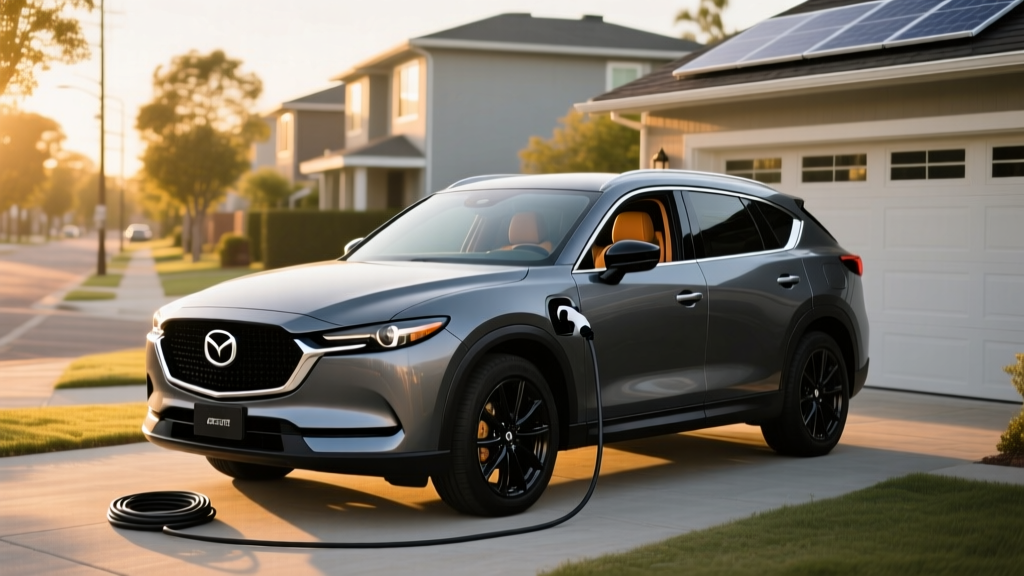
A 240-volt Level 2 home charger is strongly recommended for PHEV ownership. At the CX-90's 7.2 kW onboard charge rate, a full recharge takes roughly 2.5 hours — meaning you can easily replenish the battery overnight or even during a midday break if you have workplace charging. Level 1 charging on a standard 120V outlet works but is best suited for overnight top-offs rather than full depleted-to-full cycles.
For home Level 2 installation, budget $500–$1,500 for the charger unit and $800–$2,500 for electrician labor and permitting, depending on your panel capacity and run distance. If your home has a 200-amp electrical panel with spare capacity, expect the lower end of that range.
Powertrain and Performance Specs
| Specification | 2026 Mazda CX-90 PHEV |
|---|---|
| Engine | 2.5L inline-4 DOHC |
| Electric motor | 68 kW (91 hp) permanent-magnet synchronous |
| Combined output | 323 hp / 369 lb-ft torque |
| Transmission | 8-speed automatic (no traditional torque converter) |
| Drivetrain | All-wheel drive (i-Activ AWD) |
| Battery capacity | 17.8 kWh usable (lithium-ion, NMC chemistry) |
| 0–60 mph | ~6.8 seconds (est.) |
| Towing capacity | 3,500 lbs |
| Cargo volume (behind 3rd row) | 14.9 cu ft |
| Cargo volume (3rd row folded) | 41.6 cu ft |
Mazda's PHEV powertrain integrates the electric motor directly into the transmission housing, which means the transition between electric and gas power is notably seamless compared to some competitors that use a separate motor-generator setup. The result is a refined driving experience that doesn't feel like two powertrains fighting for control.
Lease Pricing, MSRP, and Tax Credit Math
The 2026 CX-90 PHEV starts at approximately $50,445 MSRP for the Preferred Plus trim and climbs to roughly $58,020 for the Premium Plus. Here's how the lease picture shapes up:
| Trim | MSRP | Est. Monthly Lease (36 mo / 10k mi) | Due at Signing |
|---|---|---|---|
| Preferred Plus | $50,445 | $550–$650 | $3,000–$4,000 |
| Premium | $54,495 | $620–$720 | $3,000–$4,000 |
| Premium Plus | $58,020 | $680–$790 | $3,500–$4,500 |
Note: Lease pricing varies significantly by region, dealer, credit tier, and current Mazda incentive programs. These estimates reflect typical market conditions as of early 2026.
Federal Tax Credit: The Lease Loophole
Under IRS §30D clean vehicle credit rules, the Mazda CX-90 PHEV's eligibility for the full $7,500 federal tax credit when purchasing depends on critical-mineral sourcing and battery-component manufacturing requirements that shift annually. The vehicle's battery is assembled in Japan, and its critical-mineral supply chain may not meet all 2026 thresholds for the purchase credit.
However, there's a significant advantage to leasing: under the commercial clean vehicle credit (§45W), the leasing company (technically the vehicle's owner) can claim the $7,500 credit and pass the savings to you as a capitalized-cost reduction. This is often called the "lease loophole" — it bypasses the buyer income caps ($150K single / $300K joint), MSRP caps ($80K for SUVs), and battery-sourcing requirements that apply to purchase credits.
§30D Purchase Credit Requirements (if buying):
- Buyer AGI under $150K (single) or $300K (joint)
- Vehicle MSRP under $80,000 (SUVs/vans/trucks)
- Battery critical minerals sourced from US or FTA partners (threshold increases yearly)
- Battery components manufactured/assembled in North America (threshold increases yearly)
- Vehicle must be assembled in North America (CX-90 is built in Alabama — ✓)
Lease Credit (§45W) Advantages:
- No buyer income cap
- No MSRP cap
- No battery-sourcing requirement
- Credit goes to lessor, who may pass savings as cap-cost reduction
- Confirm with your dealer that the lease is structured to pass through the credit
Important: Not all leasing companies pass the full $7,500 to the lessee. Ask specifically whether the lease quote reflects a "cap-cost reduction" from the commercial clean vehicle credit, and get it in writing before signing.
Battery Warranty, Reliability, and Long-Term Costs
Mazda CX-90 PHEV Hybrid Battery Warranty:
- Duration: 8 years / 100,000 miles (whichever comes first)
- Coverage: Defects and capacity loss below ~70% of original capacity
- Powertrain warranty: 5 years / 60,000 miles
- Bumper-to-bumper: 3 years / 36,000 miles
Mazda's hybrid battery warranty meets the industry-standard 8-year/100,000-mile threshold mandated for emissions-related components in many states, and it's consistent with what Toyota, Hyundai, and other PHEV manufacturers offer. The 17.8 kWh pack uses proven NMC (nickel-manganese-cobalt) lithium-ion chemistry, which has a well-documented track record in automotive applications.
Regarding reliability: Mazda's inline-four engine is a known, proven architecture (the same 2.5L block used across the Mazda lineup for years), and the PHEV system adds relatively few novel components compared to the turbocharged inline-six models. Early reliability data for the CX-90 PHEV has been positive, with no systemic issues reported through the first two model years.
Battery replacement cost: If the battery pack needs replacement outside of warranty coverage, expect a dealer quote in the range of $8,000–$12,000 including labor. However, PHEV batteries are smaller and less stressed than full EV batteries, and real-world data suggests most will retain 85–90% capacity after 10 years of normal use. For a 36-month lease, battery degradation is a non-issue — you'll return the vehicle well within warranty coverage.
Who Should Lease the CX-90 PHEV (and Who Shouldn't)
Choose the CX-90 PHEV lease if:
- Your daily commute is under 25 miles round-trip and you can charge at home
- You want three-row seating without committing to a full EV
- You live in an area with sparse DC fast-charging infrastructure
- You want to capture the $7,500 lease credit regardless of your income level
- You prefer Mazda's interior quality and driving dynamics over competitors like the Toyota Grand Highlander Hybrid
- You take road trips where 490+ miles of total range removes range anxiety
Consider a full EV instead if:
- You never want to buy gasoline again
- You want DC fast-charging capability for road trips
- Your daily commute is 50+ miles (the 26-mile EV range won't cover it)
- You want the lowest possible per-mile energy cost (electricity is cheaper than gas + electricity combined)
Consider the non-PHEV CX-90 (turbo I-6) if:
- You can't install a Level 2 charger at home
- You don't want to think about plugging in
- You prioritize peak horsepower (the I-6 Turbo S makes 340 hp)
CX-90 PHEV vs. the Competition
| Spec | Mazda CX-90 PHEV | Toyota Grand Highlander Hybrid MAX | Jeep Grand Cherokee 4xe |
|---|---|---|---|
| EV-only range | 26 mi | 0 mi (HEV, not PHEV) | 25 mi |
| Combined MPG / MPGe | 56 MPGe / 25 MPG | 27 MPG (HEV) | 56 MPGe / 24 MPG |
| Horsepower | 323 hp | 362 hp | 375 hp |
| Third row | Yes | Yes | No (2-row) |
| Starting MSRP | ~$50,445 | ~$53,070 | ~$60,490 |
| DC fast charging | No | N/A | No |
The CX-90 PHEV's key differentiator is its combination of three-row seating, genuine plug-in capability, and a starting price that undercuts both the Grand Cherokee 4xe and the Grand Highlander Hybrid MAX (which is a conventional hybrid, not a PHEV). If third-row space is non-negotiable, the Grand Highlander offers more interior volume, but it can't drive on electricity alone.
Frequently Asked Questions
How many MPG does the Mazda CX-90 PHEV get?
The EPA rates the CX-90 PHEV at 56 MPGe when using its combined electric and gas powertrain. Once the 26-mile EV battery is depleted, it returns 25 MPG combined (26 city / 24 highway) as a conventional hybrid. In real-world city driving with regular charging, many owners report using very little gasoline.
How far can the CX-90 PHEV go on electric only?
The EPA estimates 26 miles of electric-only range. In real-world conditions — highway speeds, cold weather, or hilly terrain — expect 20–24 miles. For commutes under 20 miles with nightly home charging, you may go weeks between fill-ups.
Does the CX-90 PHEV qualify for a federal tax credit?
When purchased, eligibility depends on current-year battery-sourcing and critical-mineral rules under IRS §30D. When leased, the commercial clean vehicle credit (§45W) often allows the lessor to claim $7,500 and pass it to you as a cap-cost reduction, bypassing income and sourcing restrictions. Confirm with your dealer that the lease quote reflects this credit.
Is the CX-90 PHEV reliable?
Early reliability data is positive. The 2.5L engine is a proven Mazda design, and the PHEV system adds modest complexity. The hybrid battery carries an 8-year/100,000-mile warranty. For a typical 36-month lease, you'll be well within all warranty coverage.
What does it cost to replace the CX-90 PHEV battery?
Out-of-warranty replacement is estimated at $8,000–$12,000 including labor. However, PHEV batteries experience less stress than full EV batteries, and data from similar systems suggests 85–90% capacity retention after 10 years. This is largely a non-concern for lessees.
Can the CX-90 PHEV DC fast charge?
No. The CX-90 PHEV supports Level 1 (120V) and Level 2 (240V) AC charging only, with a maximum onboard charge rate of approximately 7.2 kW. A full Level 2 charge takes about 2.5 hours. This is typical for PHEVs, whose smaller batteries make DC fast-charging hardware unnecessary for most use cases.
How does a PHEV lease compare to buying?
Leasing the CX-90 PHEV can be advantageous because the $7,500 commercial clean vehicle credit may be passed to you without the income caps, MSRP caps, or battery-sourcing requirements that apply to purchase credits. Additionally, a 36-month lease means you never face battery replacement costs. The tradeoff: you don't build equity and must return or buy out the vehicle at lease end.