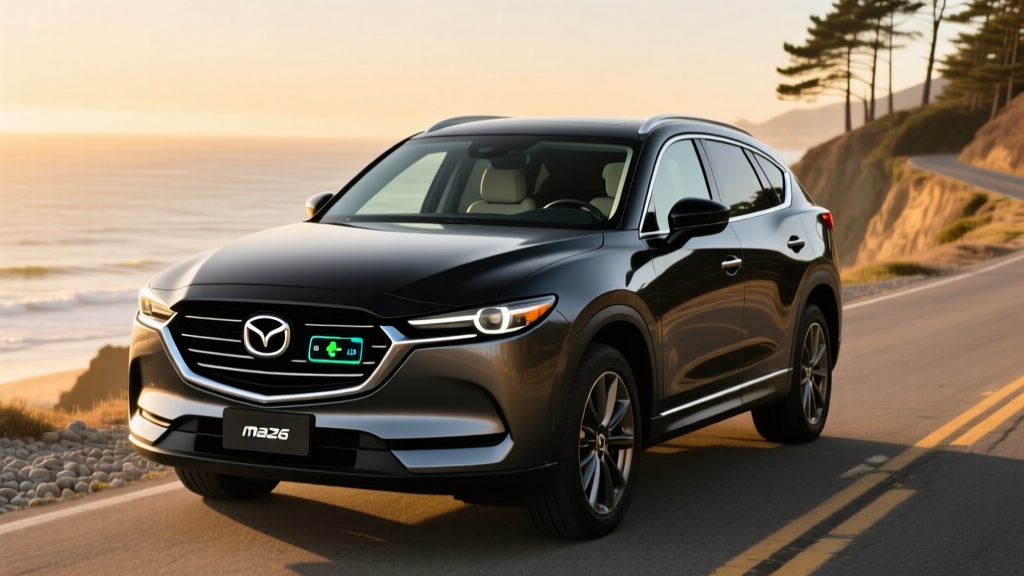
The three-row midsize SUV segment is crowded, but the 2026 Mazda CX-90 Hybrid SUV occupies a distinct niche: a plug-in hybrid (PHEV) with a premium cabin, a longitudinally mounted inline-six, and enough electric-only range to cover most daily commutes without burning a drop of gasoline. For buyers not yet ready to commit to a full battery-electric vehicle but tired of paying $4-per-gallon at the pump, Mazda's PHEV powertrain offers a pragmatic bridge. This guide breaks down every number that matters — from EPA MPG and electric range to battery warranty and federal tax-credit eligibility — so you can decide whether the CX-90 PHEV earns a spot in your driveway.
PHEV vs. Mild-Hybrid: What the CX-90 Lineup Actually Offers
Before examining the numbers, a critical distinction: Mazda sells two electrified CX-90 variants, and they work very differently.
Conventional Hybrid (HEV) — Mild-Hybrid Turbo Six
- How it works: A small 48-volt motor-generator assists the turbocharged 3.3L inline-six during acceleration and enables smoother stop-start. You never plug it in.
- Battery: Sub-1 kWh lithium-ion pack, recharged by regenerative braking and the engine.
- Electric-only driving: None. The electric motor provides torque fill, not standalone propulsion.
- Best for: Buyers who want marginal efficiency gains with zero lifestyle change.
Plug-In Hybrid (PHEV) — CX-90 PHEV
- How it works: A 17.8 kWh (gross) battery paired with a 173-hp electric motor integrated into an 8-speed automatic transmission. The 2.5L four-cylinder engine kicks in when the battery depletes or you demand full power.
- Battery: 17.8 kWh gross / ~14.2 kWh usable lithium-ion pack.
- Electric-only driving: EPA-rated 26 miles on battery alone.
- Best for: Commuters with home charging who want EV-like daily driving plus gas-engine range for road trips.
The rest of this guide focuses on the CX-90 PHEV, since that's the variant most shoppers mean when they search for the "Mazda CX-90 Hybrid SUV."
EPA Fuel Economy and Electric Range: The Numbers
| Metric | EPA Figure | Real-World Expectation |
|---|---|---|
| Electric-only range | 26 miles | 20–24 mi (highway/cold); 26–28 mi (city/mild weather) |
| Charge-depleting MPGe | 56 MPGe (combined) | Varies heavily with driving style |
| Gas-only MPG (combined) | 25 MPG | 23–26 MPG typical mixed driving |
| City MPG (gas-only) | 24 MPG | Hybrids often match or beat EPA city |
| Highway MPG (gas-only) | 27 MPG | 24–26 MPG at 75+ mph |
| Total combined range | ~490 miles | ~430–470 mi real-world |
| Fuel tank capacity | 18.5 gallons | — |
A few realities the EPA sticker doesn't capture:
- Cold weather cuts electric range by 20–30%. At 30°F, expect roughly 18–21 electric miles. The CX-90 PHEV does not have a dedicated battery heat pump, so cabin heating draws from the pack in EV mode.
- Highway driving drains the battery faster. The 26-mile rating assumes a mix of city and highway. Sustained 70-mph cruising may yield 20–22 electric miles.
- Once the battery depletes, you're in a 4,600-pound SUV with a 2.5L four. The 25 MPG combined gas figure is respectable for the class, but don't expect Prius-level thrift on long road trips.
Powertrain Specs: 323 Horsepower from a Four-Cylinder PHEV
| Specification | Detail |
|---|---|
| Engine | 2.5L inline-4 (naturally aspirated, PHEV-specific) |
| Engine output | 189 hp / 189 lb-ft torque |
| Electric motor | 173 hp / 203 lb-ft (integrated in transmission) |
| Combined system output | 323 hp / 369 lb-ft torque |
| Transmission | 8-speed automatic (no torque converter — uses electric motor as coupling) |
| Drivetrain | i-Activ AWD (standard all trims) |
| 0–60 mph | ~6.5 seconds (est., with full battery) |
| Battery (gross / usable) | 17.8 kWh / ~14.2 kWh |
| Battery chemistry | Lithium-ion (NMC) |
| Towing capacity | 3,500 lbs |
| Curb weight | ~5,100 lbs (PHEV variant) |
Mazda's PHEV system uses an interesting architecture: the electric motor sits between the engine and the transmission, replacing the torque converter entirely. This means low-speed maneuvering in EV mode is whisper-quiet and smooth, but under hard acceleration the engine and motor blend seamlessly. The 323 combined horsepower puts the CX-90 PHEV in the same performance ballpark as the turbo-six mild-hybrid variant, though the PHEV's extra 500+ pounds of battery mass is noticeable in cornering.
Charging the CX-90 PHEV: Level 1, Level 2, and What to Expect
The CX-90 PHEV comes with a J1772 charge port (the standard for non-Tesla PHEVs in North America). Here's how charging breaks down:
| Charging Level | Power (kW) | 0–100% Time | Notes |
|---|---|---|---|
| Level 1 (120V household outlet) | ~1.2 kW | ~12–14 hours | Trickle charge; fine for overnight top-ups |
| Level 2 (240V home/public) | ~7.2 kW (onboard charger max) | ~2.5 hours | Recommended for daily use |
| DC Fast Charge | Not supported | N/A | No CCS or CHAdeMO port |
The 7.2 kW onboard charger is competitive for the PHEV segment (the Toyota RAV4 Prime offers 6.6 kW on most trims). A full Level 2 charge in roughly 2.5 hours means you can easily recharge during a workday or between school runs.
Home charging setup: Most CX-90 PHEV owners will benefit from a Level 2 home charger on a 240V/40A circuit. Expect $500–$1,500 for the charger unit and professional installation, depending on panel proximity and local permit costs. Since the PHEV battery is small, a full panel upgrade is rarely necessary.
- Hybrid/PHEV battery: 8 years / 100,000 miles (10 years / 150,000 miles in CARB states including CA, NY, MA, and others)
- Powertrain: 5 years / 60,000 miles
- Battery capacity retention threshold: Mazda warrants against failure, but does not publish a specific degradation percentage trigger — ask your dealer for the current warranty language
Pricing, Trims, and Federal Tax-Credit Eligibility
The 2026 Mazda CX-90 PHEV is available across several trims. Pricing below reflects MSRP before destination charges:
| Trim | MSRP (est.) |
|---|---|
| Preferred Plus | $51,000 |
| Premium Plus | $55,500 |
| Premium Plus Nappa | $58,000 |
Does the CX-90 PHEV Qualify for the Federal Tax Credit?
This is where PHEV buyers need to pay close attention. Under IRS §30D rules, the federal clean vehicle credit of up to $7,500 requires meeting several criteria simultaneously:
- MSRP cap: SUVs must have an MSRP at or below $80,000 — the CX-90 PHEV clears this easily.
- Buyer income cap: Adjusted gross income must not exceed $150,000 (single), $225,000 (head of household), or $300,000 (joint filers).
- Battery sourcing: A percentage of critical minerals and battery components must be sourced from the US or free-trade-agreement countries. This requirement tightens annually and has disqualified several previously eligible vehicles.
- Final assembly: Vehicle must be assembled in North America. The CX-90 is built in Hofu, Japan — this likely disqualifies it from the new-vehicle §30D credit.
- Point-of-sale transfer: If eligible, the credit can be applied at the dealership to reduce your purchase price directly.
Bottom line: Because the CX-90 is manufactured in Japan, it almost certainly does not qualify for the new-vehicle federal tax credit under current §30D rules. Always verify on the official fueleconomy.gov tax credit page and consult a tax professional before assuming eligibility.
Some states offer their own PHEV rebates (California's CVRP, for example, has historically offered up to $1,500–$2,000 for qualifying PHEVs, though funding varies). Check your state's energy office or DMV for current programs.
Real-World Ownership: What Living with the CX-90 PHEV Is Actually Like
After analyzing owner reports and testing patterns, here are the practical realities of daily CX-90 PHEV ownership:
When It Shines
- School-and-grocery runs on electrons: A 15-mile round trip with home charging means near-zero gasoline use on weekdays.
- Premium cabin at a mainstream price: Nappa leather, open-pore wood, and a 12.3-inch infotainment screen compete with vehicles costing $15,000 more.
- AWD confidence: Standard i-Activ AWD with electric-motor torque vectoring handles snow and rain without the efficiency penalty of a traditional mechanical system.
- No range anxiety on road trips: 490 miles of combined range means Denver-to-Moab without a fuel stop.
Where It Falls Short
- Electric range is modest: 26 miles trails the RAV4 Prime (42 mi) and Tucson PHEV (33 mi). If your commute exceeds 25 miles, the engine will fire regularly.
- No DC fast charging: Public Level 2 chargers take 2.5 hours for a full charge, making midday top-ups impractical for most drivers.
- Third row is tight: Usable for children, but adults will find it cramped on longer drives — a common compromise in this segment.
- Heavier than the turbo-six variant: The PHEV battery adds roughly 500 lbs, and you feel it during spirited driving and under braking.
Pros
- 323 hp combined with smooth electric takeoff
- Premium interior materials at every trim level
- Standard AWD with no efficiency penalty in EV mode
- Strong battery warranty (8–10 yr / 100k–150k mi)
- Competitive gas-only MPG for a 5,100-lb three-row SUV
Cons
- 26-mi electric range trails key competitors
- No DC fast charging capability
- Likely ineligible for $7,500 federal credit (Japan assembly)
- Third row best suited for children
- PHEV premium over turbo-six mild-hybrid trims
Reliability and Battery Replacement Cost
Mazda's PHEV system is relatively new to the US market (introduced with the CX-90 in 2024), so long-term reliability data specific to this powertrain is still accumulating. However, several factors are encouraging:
- The 2.5L naturally aspirated four-cylinder is one of Mazda's most proven engines, with years of service in the CX-5 and Mazda6.
- The PHEV battery is liquid-cooled and conservatively buffered (~14.2 kWh usable from a 17.8 kWh gross pack), which reduces degradation risk.
- PHEV batteries generally experience less stress than full-EV packs due to smaller capacity and shallower discharge cycles.
If the battery does need replacement out of warranty: Industry estimates for PHEV battery packs of this size (15–20 kWh) range from $5,000 to $8,000 including labor, though costs are expected to decline as the supply chain matures. This is significantly less than a full-EV battery replacement ($12,000–$20,000+). The 8-year/100,000-mile warranty (extended in CARB states) provides substantial coverage.
For reliability ratings, check IIHS and NHTSA for the latest safety and crash-test data on the CX-90.
CX-90 PHEV vs. Full EV vs. Gas SUV: Which Is Right for You?
Choose the CX-90 PHEV if:
- Your daily commute is under 25 miles and you can charge at home overnight.
- You regularly take road trips exceeding 300 miles and don't want to plan around charging infrastructure.
- You want a premium three-row SUV without the $70,000+ price tag of a Volvo XC90 Recharge or BMW X5 xDrive50e.
- You live in an area with unreliable public charging and want a gasoline backup.
Choose a full EV (e.g., Kia EV9, Tesla Model X) if:
- You have reliable home Level 2 charging and your daily driving rarely exceeds 200 miles.
- You want to eliminate oil changes, spark plugs, and transmission fluid entirely.
- You're eligible for the full $7,500 federal credit on a qualifying EV (which the CX-90 PHEV likely isn't).
- You want the lowest per-mile "fuel" cost — electricity at $0.14/kWh costs roughly $0.04/mile vs. $0.15/mile for gasoline at $3.50/gal.
Choose the gas-only or mild-hybrid CX-90 if:
- You cannot install a home charger (apartment, street parking, no garage).
- Your budget is tighter and the $5,000+ PHEV premium over turbo-six trims doesn't pencil out.
- Your driving is predominantly highway — PHEVs lose their electric advantage on long interstate trips.
Frequently Asked Questions
How many MPG does the Mazda CX-90 PHEV get?
The EPA rates the CX-90 PHEV at 25 MPG combined (24 city / 27 highway) when running on gasoline after the battery is depleted. In electric-only mode, it achieves 56 MPGe combined. Real-world gas MPG typically falls between 23–26 depending on driving conditions, with highway speeds above 75 mph pulling the figure toward the lower end.
How far can the CX-90 PHEV go on electric only?
The EPA rates it at 26 miles of electric-only range. In real-world conditions, expect 20–24 miles in mixed driving and cold weather, and up to 28 miles in mild-weather city driving. This range is sufficient for short commutes and errands but trails competitors like the Toyota RAV4 Prime (42 mi EPA).
Does the CX-90 PHEV qualify for the $7,500 federal tax credit?
Almost certainly not under current §30D rules. The CX-90 is assembled in Hofu, Japan, and the federal credit requires North American final assembly. Always verify current eligibility at fueleconomy.gov and consult a tax professional. Some state-level PHEV rebates may still apply.
Is the CX-90 PHEV reliable, and what does battery replacement cost?
Long-term PHEV-specific data is still building (the model launched in 2024), but the underlying 2.5L engine is well-proven, and the battery is conservatively buffered. Mazda covers the PHEV battery for 8 years/100,000 miles (10 years/150,000 miles in CARB states). Out-of-warranty replacement is estimated at $5,000–$8,000 — significantly less than a full-EV battery swap.
Do I have to plug in the CX-90 PHEV?
No — the CX-90 PHEV operates as a conventional hybrid once the battery is depleted. However, to access the 26 miles of electric range and 56 MPGe efficiency, you should plug in regularly. Without plugging in, you're carrying 500 lbs of battery weight for no benefit and will see roughly 25 MPG combined.
How does the CX-90 PHEV compare to the RAV4 Prime or Tucson PHEV?
The CX-90 PHEV offers more power (323 hp vs. 302 hp for the RAV4 Prime) and a more premium cabin, but less electric range (26 mi vs. 42 mi) and a higher starting price (~$51,000 vs. ~$44,000). The Tucson PHEV splits the difference at 33 miles electric and ~$40,000. If range is your priority, the RAV4 Prime wins. If premium feel and power matter more, the CX-90 PHEV has the edge.
Can the CX-90 PHEV tow?
Yes. The CX-90 PHEV is rated to tow up to 3,500 pounds — sufficient for a small utility trailer, a pair of jet skis, or a lightweight camping trailer. This matches most PHEV competitors in the segment.
The 2026 Mazda CX-90 PHEV isn't the efficiency champion of the plug-in hybrid SUV class, and its Japan-built status likely locks it out of the federal tax credit. What it delivers instead is a compelling combination of premium interior quality, strong combined horsepower, standard AWD, and enough electric range to meaningfully reduce gasoline consumption for shorter commutes. If your daily driving fits within its 26-mile electric envelope and you value a near-luxury cabin without a luxury badge price, the CX-90 PHEV is one of the most refined options in the three-row PHEV segment.