Quick Verdict: The CX-70 PHEV in 30 Seconds
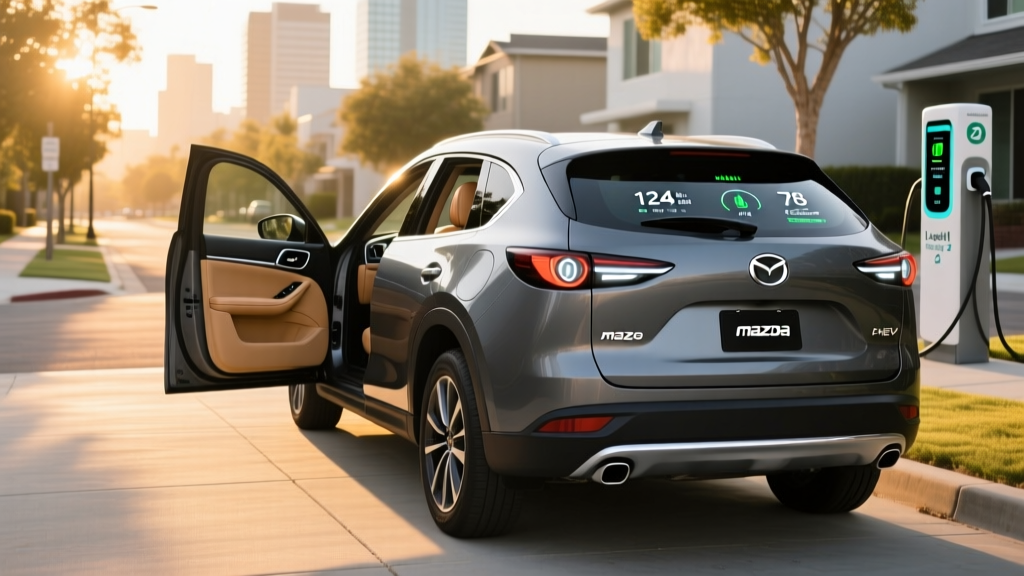
The 2026 Mazda CX-70 PHEV is a two-row midsize plug-in hybrid that pairs a 2.5-liter four-cylinder engine with a 17.8 kWh battery pack to produce 327 combined horsepower. It returns an EPA-estimated 26 miles of electric-only driving and 25 MPG combined once the battery depletes. Starting at $41,845, it occupies a narrow but compelling lane: premium-cabin SUV dynamics with the safety net of a gas engine for road trips. It does not qualify for the full $7,500 federal §30D tax credit under current IRS rules, which narrows its value proposition against rivals like the Hyundai Santa Fe PHEV or Toyota RAV4 Prime.
| Spec | Value |
|---|---|
| Powertrain | 2.5L 4-cyl + electric motor, 8-speed auto, AWD |
| Combined Output | 327 hp / 382 lb-ft torque |
| Battery (usable) | 17.8 kWh lithium-ion |
| EPA Electric Range | 26 miles |
| EPA MPG (gas, charge-depleted) | 25 combined (25 city / 24 highway) |
| EPA MPGe (charge-sustaining + EV) | 56 MPGe combined |
| Total Combined Range | ~430 miles |
| Level 2 Charge Time (0–100%) | ~2.5 hours (7.2 kW onboard charger) |
| DC Fast Charging | Not supported |
| 0–60 mph | 6.3 seconds (est.) |
| Towing Capacity | 3,500 lbs |
| Cargo Volume | 39.6 cu ft (rear seats up) |
| Base MSRP (Preferred) | $41,845 |
| Battery Warranty | 8 years / 100,000 miles |
HEV vs PHEV: What's the Difference in the CX-70 Lineup?
Mazda sells the CX-70 with two distinct powertrains, and confusing them is the most common buyer mistake:
| Feature | CX-70 MHEV (Turbo) | CX-70 PHEV |
|---|---|---|
| Plug-in charging? | No — gas only | Yes — J1772 / Type 1 port |
| Electric-only range | 0 miles | 26 miles (EPA) |
| EPA MPG (combined) | 24 MPG | 25 MPG (gas) / 56 MPGe (with EV) |
| Combined horsepower | 340 hp (Turbo S) | 327 hp |
| Drivetrain | Rear-biased AWD | AWD with electric rear axle |
| Base MSRP | $40,445 | $41,845 |
The mild-hybrid (MHEV) uses a 48-volt system to smooth stop-start and provide marginal torque assist. It cannot drive on electricity alone and never plugs in. The PHEV carries a much larger traction battery, a dedicated drive motor, and a charge port — enabling daily commutes under ~26 miles to happen entirely on grid electricity. If you cannot charge at home or work, the PHEV's advantage collapses, and you're carrying 400+ lbs of battery you never use.
Real-World MPG and Electric Range: What to Actually Expect
The EPA rates the CX-70 PHEV at 26 miles of electric range and 25 MPG combined in charge-depleted (hybrid) mode. But fueleconomy.gov numbers assume moderate temperatures and mixed driving. Here's what shifts those figures in practice:
Electric-Only Range Reality
Expect the full 26 miles in spring/fall conditions at city speeds (under 45 mph). On the highway at 70+ mph, that range drops to approximately 18–20 miles. In freezing weather with cabin heat engaged, plan for 15–18 miles. The CX-70 PHEV lacks a dedicated heat pump, relying on a resistive PTC heater and engine coolant loop — a meaningful hit to winter electric efficiency.
Gas-Mode MPG Reality
The EPA's 25 MPG combined breaks down as 25 city / 24 highway. In real-world mixed suburban driving with a depleted battery, owners commonly report 24–27 MPG — the mild electric assist and regenerative braking help in stop-and-go traffic. Highway-only driving at 75+ mph with a dead battery yields 22–23 MPG. This is a heavy, 4,700-lb SUV with a relatively small-displacement engine working hard; it won't match the RAV4 Prime's 38 MPG in hybrid mode.
| Scenario | EPA Estimate | Real-World Expectation |
|---|---|---|
| Electric range (mixed) | 26 miles | 20–26 miles |
| Electric range (highway, 70 mph) | — | 18–20 miles |
| Electric range (cold, 30°F) | — | 15–18 miles |
| Gas MPG (city) | 25 | 24–27 |
| Gas MPG (highway, 75 mph) | 24 | 22–23 |
| Gas MPG (combined) | 25 | 23–26 |
Charging the CX-70 PHEV: Speeds, Connectors, and Costs
The CX-70 PHEV uses a standard J1772 AC charge port with a 7.2 kW onboard charger. There is no DC fast-charging capability — a limitation shared with most PHEVs in this class but worth flagging if you expected quick public top-ups on road trips.
| Level | Source | Power | 0–100% Time | Miles Added/Hour |
|---|---|---|---|---|
| Level 1 | Standard 120V outlet | ~1.4 kW | ~12–14 hours | ~3–4 mi/hr |
| Level 2 | 240V home/public charger | 7.2 kW (max) | ~2.5 hours | ~10–12 mi/hr |
| DC Fast | — | Not supported | — | — |
Home charging setup: A dedicated Level 2 home charger (240V, 32A circuit minimum) is the practical baseline for PHEV ownership. Expect $500–$1,500 for a quality Level 2 EVSE (Emporia, ChargePoint, or Enel X) plus $400–$1,200 for electrician installation, depending on panel proximity and whether a 50-amp circuit needs running. If your panel is maxed out, a panel upgrade adds $1,500–$3,000.
Cost to charge: At the US average residential rate of ~$0.16/kWh, a full 17.8 kWh charge costs approximately $2.85 — yielding 26 miles for less than a gallon of gas. Over a year of daily 20-mile electric commutes, you'd spend roughly $400 in electricity versus $900+ in gasoline for the same distance.
Powertrain and Driving Dynamics
The PHEV powertrain pairs a naturally aspirated 2.5-liter inline-four (producing roughly 189 hp on its own) with a 173-hp electric motor integrated into the 8-speed automatic transmission. Combined system output peaks at 327 hp and 382 lb-ft of torque. The electric motor provides instant low-end thrust, making the CX-70 PHEV feel quicker off the line than its 6.3-second 0–60 time suggests — particularly in EV mode around town.
Mazda's rear-biased AWD architecture carries over to the PHEV, though the added mass of the battery pack (the PHEV weighs approximately 4,750 lbs — roughly 350 lbs more than the turbo MHEV) softens the handling edge slightly. Ride quality is firm but well-damped, and the cabin isolation is a class above the RAV4 Prime or Hyundai Santa Fe PHEV. This is where Mazda's premium aspirations show most clearly.
The 8-speed automatic is a conventional torque-converter unit — no CVT drone under acceleration. In charge-depleted hybrid mode, the engine engages seamlessly, though you'll hear it working harder under full-throttle highway merges than Mazda's inline-six turbo options.
Pricing, Trims, and Tax Credit Eligibility
The 2026 CX-70 PHEV is offered in three trims:
| Trim | MSRP | Key Additions |
|---|---|---|
| Preferred | $41,845 | Leatherette, 10.25" display, power liftgate |
| Premium | $47,395 | Nappa leather, 12-speaker Bose, panoramic roof |
| Premium Plus | $54,400 | Quilted Nappa, HUD, 360° camera, cooled seats |
Federal Tax Credit (§30D) — The Bad News
Under current IRS §30D rules, the CX-70 PHEV does not qualify for the full $7,500 federal tax credit. The primary disqualifier is the battery-component and critical-mineral sourcing requirement: Mazda's PHEV battery supply chain does not meet the North American manufacturing threshold for the $3,750 battery-component half of the credit. This may change as Mazda adjusts sourcing, but as of the 2026 model year, buyers should not budget around the federal credit.
§30D PHEV Eligibility Checklist (2026 rules):
- ✓ Battery capacity ≥ 7 kWh (CX-70 PHEV: 17.8 kWh — passes)
- ✓ Gross vehicle weight rating < 14,000 lbs (passes)
- ✓ MSRP cap: SUVs must be ≤ $80,000 (all trims pass)
- ✗ Battery components manufactured in North America (fails — loses $3,750)
- ✗ Critical minerals sourced from US/FTA partners (partial — loses up to $3,750)
- ⚠ Buyer income cap: $150K single / $300K joint (varies by buyer)
Some state-level incentives (California CVRP, Colorado, New York) may still apply. Check your state's energy office for current programs.
Battery Longevity, Warranty, and Replacement Cost
Mazda PHEV Battery Warranty: 8 years or 100,000 miles (whichever comes first), covering capacity loss below 70% of original. This aligns with the industry-standard CARB-mandated warranty that most manufacturers offer on hybrid and PHEV batteries. In California and states adopting CARB rules, coverage extends to 10 years / 150,000 miles.
Degradation expectations: PHEV batteries experience more charge cycles than full-EV packs because they cycle through a larger percentage of their capacity daily. Based on industry data from similar 15–20 kWh PHEV packs (Toyota, Hyundai/Kia), expect 8–12% capacity loss over the first 5 years under normal use. The CX-70 PHEV's battery management system includes a buffer — not all 17.8 kWh is user-accessible — which slows apparent degradation.
Replacement cost: Out-of-warranty PHEV battery replacement currently runs $4,000–$7,000 including labor, depending on the pack and dealer. This figure has been declining as the hybrid supply chain matures. For most owners trading in within 8 years, this cost is a non-issue.
General reliability: Mazda's 2.5-liter naturally aspirated engine is one of the most proven four-cylinders in the industry — no turbo complexity, no direct-injection carbon buildup issues on the port-injected variant. The 8-speed automatic is conventional and well-tested. The primary reliability unknown is long-term PHEV-specific electronics and the electric motor integration, though Mazda's hybrid system is derived from a Toyota-licensed architecture with deep production history.
CX-70 PHEV vs the Competition
| Spec | Mazda CX-70 PHEV | Toyota RAV4 Prime | Hyundai Santa Fe PHEV |
|---|---|---|---|
| EPA Electric Range | 26 mi | 42 mi | 30 mi |
| Combined HP | 327 | 302 | 261 |
| Gas MPG (combined) | 25 | 38 | 33 |
| Base MSRP | $41,845 | $44,815 | $42,900 |
| Federal Tax Credit | $0 (current) | $0 (phased) | Up to $7,500* |
| DC Fast Charge | No | No | No |
| Cargo (rear up) | 39.6 cu ft | 33.5 cu ft | 36.4 cu ft |
| Interior Quality | Premium | Mainstream | Mid-premium |
*Hyundai Santa Fe PHEV eligibility varies by sourcing year and buyer income. Verify at fueleconomy.gov.
The RAV4 Prime dominates on electric range and hybrid-mode efficiency but feels budget-grade inside and is frequently dealer-marked above MSRP. The Santa Fe PHEV offers the best tax-credit path and three-row availability. The CX-70 PHEV wins on cabin materials, driving dynamics, and towing — but trails on efficiency and credit eligibility.
Who Should Buy the CX-70 PHEV (And Who Shouldn't)
Pros
- Premium cabin with near-luxury materials at mainstream pricing
- 327 hp provides confident passing power and 6.3-sec 0–60
- Rear-biased AWD delivers engaging driving dynamics for the class
- 26-mile EV range covers most commutes under 20 miles round-trip
- 3,500-lb towing capacity beats most PHEV crossovers
- Conventional 8-speed automatic — no CVT drone
Cons
- No federal §30D tax credit under current sourcing rules
- 25 MPG in hybrid mode trails RAV4 Prime (38) and Santa Fe PHEV (33)
- No DC fast charging — road trips rely entirely on the gas engine
- 26-mile EV range is the shortest among current PHEV competitors
- Premium Plus trim pushes past $54K without luxury badge cachet
- No heat pump — cold-weather EV range drops significantly
Choose the CX-70 PHEV if:
- You prioritize interior quality and driving feel over maximum efficiency
- Your daily commute is under 20 miles and you can charge at home
- You need 3,500-lb towing and don't want a full-size SUV
- You want premium features without paying BMW/Audi pricing
Choose a full EV (e.g., Hyundai Ioniq 5, Tesla Model Y) if:
- You have reliable home charging and rarely drive over 250 miles in a day
- You want the lowest per-mile fuel cost and maximum federal tax credit
- You don't need towing capability
Choose a conventional hybrid (HEV) if:
- You cannot charge at home or at work
- You want zero behavior change from a gas car
- Lower purchase price is the priority (the CX-70 MHEV starts at $40,445)
Frequently Asked Questions
How many MPG does the CX-70 PHEV get?
The EPA rates it at 25 MPG combined (25 city / 24 highway) when operating as a hybrid with a depleted battery. When factoring in electric-only driving, the combined rating is 56 MPGe. Real-world gas-only driving typically yields 23–27 MPG depending on conditions.
How far can the CX-70 PHEV go on electric only?
The EPA estimates 26 miles of electric-only range. In real-world driving, expect 20–26 miles in mild conditions, 18–20 miles at highway speed, and 15–18 miles in freezing weather with cabin heat on.
Does the CX-70 PHEV qualify for the federal tax credit?
As of the 2026 model year, the CX-70 PHEV does not qualify for the $7,500 federal §30D credit due to battery-component sourcing requirements. Check IRS.gov for the latest eligible vehicle list, as sourcing changes can shift eligibility mid-year. State incentives may still apply.
Is the CX-70 PHEV reliable?
Mazda's 2.5L naturally aspirated engine and 8-speed automatic are well-proven components. The PHEV system draws from Toyota-licensed hybrid architecture with extensive production history. Mazda's predicted reliability ratings tend to rank above average. The battery is warrantied for 8 years / 100,000 miles.
What does a CX-70 PHEV battery replacement cost?
Out-of-warranty replacement runs $4,000–$7,000 including labor. Most owners will trade in or sell before the battery falls below the 70% capacity warranty threshold. PHEV battery costs have been declining steadily.
Can the CX-70 PHEV DC fast charge?
No. The CX-70 PHEV only supports AC charging via a J1772 port — Level 1 (120V, ~12–14 hours) or Level 2 (240V at 7.2 kW, ~2.5 hours). This is typical for PHEVs in this class but means road-trip charging relies on the gas engine, not public DC stations.
How does the CX-70 PHEV compare to a full EV?
A full EV like the Hyundai Ioniq 5 offers 300+ miles of range, DC fast charging, lower per-mile fuel costs, and full $7,500 tax-credit eligibility. The CX-70 PHEV trades those advantages for towing capability, premium cabin quality, and no range anxiety on long trips. If you can charge at home and rarely exceed 250 miles in a day, a full EV will cost less to operate. If you tow, road-trip frequently, or lack reliable charging access, the PHEV's gas backup has real value.