Quick Verdict: The 2025 Honda CR-V Hybrid Sport at a Glance
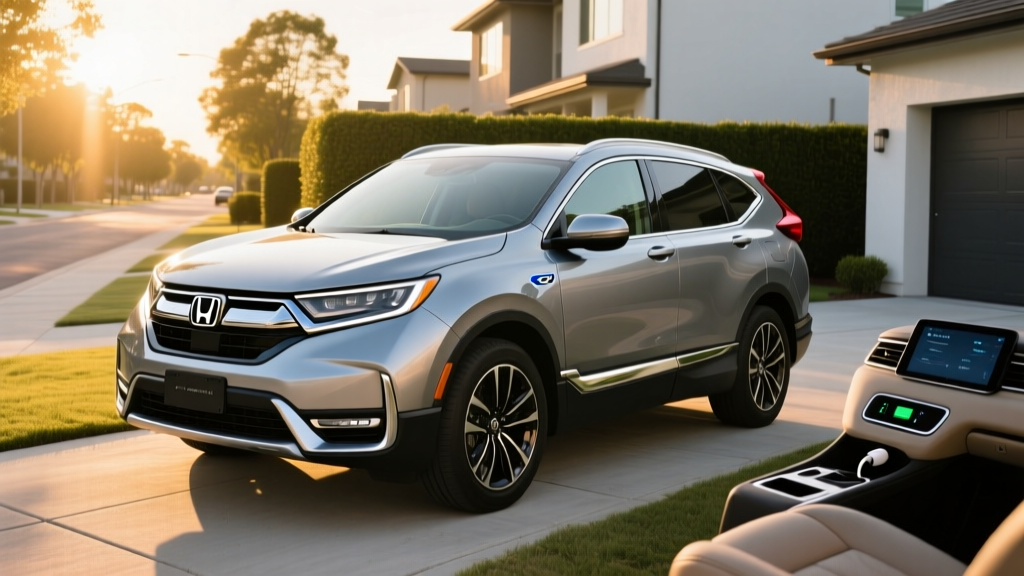
The 2025 Honda CR-V Hybrid Sport occupies a narrow but compelling lane in the compact crossover segment: it's a conventional hybrid (HEV) that requires zero plug-in charging, delivers EPA-rated 40 MPG combined, and starts at $36,400 including destination. For buyers who want meaningful fuel savings without changing their refueling habits, the Sport trim pairs Honda's two-motor hybrid system with sport-tuned styling and a well-equipped interior.
This is not a plug-in hybrid (PHEV) and not a battery-electric vehicle. There is no electric-only range to manage, no charging cable to deploy, and no range anxiety to confront. You fill it with gasoline, and the hybrid system handles the rest. That simplicity is precisely why the CR-V Hybrid continues to be one of the highest-volume hybrid crossovers sold in the United States.
A conventional hybrid (HEV) like the CR-V Hybrid Sport uses a small battery (roughly 1.1 kWh) recharged entirely through regenerative braking and the gasoline engine. You never plug it in. A plug-in hybrid (PHEV) carries a larger battery (typically 15–20 kWh) that you charge from a wall outlet or public station, enabling 25–45 miles of electric-only driving before the gas engine takes over. The CR-V lineup in the U.S. does not currently include a PHEV variant — Honda offers the CR-V Hybrid strictly as an HEV.
Fuel Economy: EPA Ratings vs. Real-World MPG
Fuel economy is the headline metric for any hybrid buyer, and the 2025 CR-V Hybrid Sport delivers competitive numbers for the segment. Here is the full EPA breakdown for both drivetrain configurations:
| Configuration | City MPG | Highway MPG | Combined MPG |
|---|---|---|---|
| FWD | 43 | 36 | 40 |
| AWD | 40 | 34 | 37 |
Source: fueleconomy.gov
Real-World MPG: What to Actually Expect
EPA hybrid ratings tend to reflect city driving accurately because regenerative braking recaptures energy during stop-and-go traffic. On the FWD model, 43 MPG city is achievable in moderate climates with a mix of suburban and urban driving. In real-world ownership, many CR-V Hybrid drivers report averaging 36–42 MPG in mixed driving on the FWD model and 33–38 MPG on the AWD variant.
Highway fuel economy is where hybrids lose their advantage relative to city driving. At sustained 70–80 mph speeds, the gasoline engine does most of the work, and aerodynamic drag dominates. Expect 32–35 MPG on long highway trips in the FWD model and 30–33 MPG in the AWD model. Cold weather further reduces efficiency — battery performance drops in freezing temperatures, and cabin heating demands more engine runtime. In sub-30°F conditions, plan for a 5–10% reduction in observed MPG.
Powertrain Specs: Engine, Motors, and Horsepower
The 2025 CR-V Hybrid Sport uses Honda's fourth-generation two-motor hybrid system, which pairs a 2.0-liter Atkinson-cycle four-cylinder engine with two electric motors mounted in the transaxle. Here are the key specifications:
| Specification | Value |
|---|---|
| Engine | 2.0L Atkinson-cycle inline-4 |
| Engine Output | 145 hp / 138 lb-ft torque |
| Combined System Horsepower | 204 hp |
| Combined System Torque | 247 lb-ft (motor peak) |
| Transmission | e-CVT (single-speed direct drive) |
| Drivetrain (Sport trim) | FWD standard / AWD available |
| Hybrid Battery | ~1.1 kWh lithium-ion (sealed) |
| 0–60 mph (est.) | ~7.8 seconds |
| Towing Capacity | 1,000 lbs |
The two-motor system operates in three primary modes: EV Drive (battery powers the propulsion motor at low speeds), Hybrid Drive (engine generates electricity to feed the propulsion motor), and Engine Drive (engine connects directly to the wheels via a lockup clutch at steady highway cruising speeds). The transitions between modes are seamless and largely imperceptible from the driver's seat.
The 204 combined horsepower figure is competitive with the Toyota RAV4 Hybrid (219 hp) and exceeds the Hyundai Tucson Hybrid (226 hp combined) only on paper — in practice, the CR-V Hybrid's torque delivery and e-CVT tuning prioritize smoothness over urgency. The 7.8-second 0–60 time is adequate for highway merging but not quick by any sporting standard, despite the "Sport" badge.
Pricing, Trims, and Tax Credit Eligibility
The 2025 Honda CR-V Hybrid Sport is positioned as the entry point into the CR-V Hybrid lineup. Here is the MSRP breakdown:
| Trim | MSRP (incl. destination) |
|---|---|
| CR-V Hybrid Sport (FWD) | $36,400 |
| CR-V Hybrid Sport (AWD) | $37,900 |
| CR-V Hybrid Sport-L (AWD) | $40,850 |
| CR-V Hybrid Sport Touring (AWD) | $43,350 |
Does the CR-V Hybrid Qualify for a Federal Tax Credit?
No. Under current IRS §30D rules, the federal clean vehicle tax credit (up to $7,500) applies only to battery-electric vehicles (BEVs) and plug-in hybrids (PHEVs) that meet battery sourcing, critical mineral, MSRP, and buyer income requirements. Conventional hybrids like the CR-V Hybrid Sport are not eligible for the §30D credit because they cannot be plugged in to charge.
Some states and municipalities offer rebates or reduced registration fees for hybrids, but these vary widely by jurisdiction. Check your state's energy office or department of environmental quality for current programs. A few states, such as Colorado, have historically offered state-level hybrid incentives — but availability and amounts change annually.
Reliability, Battery Warranty, and Long-Term Costs
Honda's hybrid system has accumulated over two decades of real-world deployment, dating back to the original Insight in 1999. The fourth-generation two-motor system in the 2025 CR-V Hybrid is the most refined iteration yet, and its architecture is fundamentally simpler than a conventional automatic transmission — there are no gear shifts, no torque converter, and fewer wear components.
Hybrid Battery: 8 years / 100,000 miles (10 years / 150,000 miles in CARB states including CA, NY, MA, and others)
Powertrain: 5 years / 60,000 miles
Bumper-to-Bumper: 3 years / 36,000 miles
Capacity Retention Threshold: Honda's warranty covers the hybrid battery if it fails or drops below functional capacity to operate the hybrid system. Unlike EVs, HEV batteries are small and are not rated by a specific SoH percentage — they either function or trigger a warranty claim.
Hybrid Battery Replacement Cost
Should the hybrid battery require replacement out of warranty, expect to pay between $2,000 and $4,000 for a new OEM battery pack, including labor at a Honda dealership. Third-party refurbished battery options exist for approximately $1,200–$2,000 installed. Given the small ~1.1 kWh capacity of an HEV battery compared to a 60–100 kWh EV battery, replacement costs are modest. In practice, Honda hybrid batteries routinely last 150,000+ miles with minimal degradation because the system never deeply cycles the battery — it operates within a narrow state-of-charge window to maximize longevity.
The NHTSA has not yet published full crash-test ratings for the 2025 CR-V Hybrid at the time of this writing, but the previous-generation CR-V earned IIHS Top Safety Pick honors, and Honda's hybrid components are positioned within the vehicle's structural protection zones.
Hybrid vs. PHEV vs. EV: Which Fits Your Situation?
The decision between a conventional hybrid, a plug-in hybrid, and a battery-electric vehicle comes down to three variables: your daily mileage, your access to charging, and your willingness to adapt your refueling routine.
| Factor | HEV (CR-V Hybrid) | PHEV (e.g., RAV4 Prime) | BEV (e.g., IONIQ 5) |
|---|---|---|---|
| Plug-in charging required? | No | Yes (recommended) | Yes (required) |
| Electric-only range | 0 miles | 25–42 miles | 200–350 miles |
| Home charger needed? | No | Recommended (Level 2) | Yes (Level 2 ideal) |
| Federal tax credit (§30D) | Not eligible | Up to $7,500* | Up to $7,500* |
| Fuel cost per mile (est.) | ~$0.09 | ~$0.04–$0.08 | ~$0.03–$0.05 |
| Road-trip convenience | Excellent | Excellent | Requires planning |
| Starting MSRP range | $36,400 | $43,000–$45,000 | $38,000–$52,000 |
*PHEV and BEV tax credit eligibility depends on battery sourcing, MSRP caps, and buyer income limits under current IRS rules. Verify at irs.gov.
Choose the CR-V Hybrid (HEV) if: You have no access to home charging, drive more than 40 miles per day, take frequent road trips, want the lowest upfront cost, and don't want to think about charging logistics.
Choose a PHEV if: You can install a Level 2 home charger, your daily commute is under 35 miles (enabling mostly electric driving), and you want the option of gas-engine road trips without range concern.
Choose a BEV if: You have reliable home charging, your daily driving is under 250 miles, you want the lowest per-mile fuel cost, and you're willing to plan charging stops on road trips.
What the Sport Trim Gets You
The Sport trim sits at the base of the CR-V Hybrid hierarchy but is far from stripped. Standard equipment includes:
- 18-inch Berlina Black alloy wheels
- Blacked-out grille, window trim, and roof rails
- 7-inch digital instrument cluster
- 7-inch touchscreen with wireless Apple CarPlay and Android Auto
- Honda Sensing suite (adaptive cruise control, lane-keeping assist, forward collision warning, automatic emergency braking, road departure mitigation)
- Dual-zone automatic climate control
- LED headlights and taillights
- Rear privacy glass
- Push-button start with smart entry
Notable omissions at this price point: no wireless phone charging, no heated seats (those arrive on the Sport-L), and no power liftgate (standard on Sport Touring). The 7-inch touchscreen is functional but undersized relative to competitors offering 10.25- or 12.3-inch displays. If infotainment screen real estate matters to you, the Sport-L or Sport Touring trims upgrade to a 9-inch unit with native navigation on the Touring.
Cargo, Interior Space, and Practicality
The hybrid battery is packaged beneath the cargo floor, which means no loss of passenger or cargo volume compared to the gas-only CR-V. Cargo capacity measures 36.3 cubic feet behind the rear seats and 76.5 cubic feet with the rear seats folded — competitive with the RAV4 Hybrid (37.5 / 69.8 cu ft) and meaningfully larger than the Tucson Hybrid (38.7 / 80.3 cu ft on paper, though real-world usability differs due to load floor shape).
Rear-seat legroom is generous at 41.0 inches, and the seat-back angle reclines slightly for long-trip comfort. The Sport trim uses cloth seat upholstery; leather-trimmed seats require stepping up to the Sport-L.
Pros and Cons
- 40 MPG combined (FWD) with no plug-in charging
- Strong standard safety suite (Honda Sensing)
- Competitive cargo volume with no hybrid battery penalty
- Proven hybrid system with 8–10 year battery warranty
- Low cost of entry for a hybrid compact SUV
- Smooth, quiet powertrain transitions
- No federal tax credit eligibility
- 7-inch touchscreen feels dated at this price
- AWD drops combined MPG to 37
- Modest 204 hp — Sport badge is cosmetic only
- 1,000-lb towing capacity limits utility
- No PHEV variant available in U.S. market
Frequently Asked Questions
How many MPG does the 2025 Honda CR-V Hybrid Sport get?
The FWD model is EPA-rated at 43 city / 36 highway / 40 combined MPG. The AWD model is rated at 40 city / 34 highway / 37 combined. In real-world mixed driving, expect 36–42 MPG for FWD and 33–38 MPG for AWD, with lower numbers in cold weather and sustained highway driving.
Can I plug in the CR-V Hybrid to charge?
No. The CR-V Hybrid is a conventional hybrid (HEV). Its ~1.1 kWh battery is recharged entirely through regenerative braking and the gasoline engine. There is no charge port and no electric-only driving mode. If you want plug-in capability, you would need to look at a PHEV such as the Toyota RAV4 Prime or Hyundai Tucson PHEV.
How far can the CR-V Hybrid go on electric only?
The CR-V Hybrid can operate in EV mode for very short distances at low speeds (typically under 1 mile at under 25 mph), but this is not a usable electric-only range. The system is designed to assist the gasoline engine, not replace it. For meaningful electric-only driving (25–42 miles), you need a PHEV.
Is the CR-V Hybrid reliable, and what does battery replacement cost?
Honda's hybrid system has a strong reliability track record spanning two decades. The hybrid battery is warranted for 8 years/100,000 miles (10 years/150,000 miles in CARB states). Out-of-warranty replacement costs $2,000–$4,000 for an OEM battery, or $1,200–$2,000 for a refurbished unit. In practice, most Honda hybrid batteries last 150,000+ miles without requiring replacement.
Does the 2025 CR-V Hybrid qualify for any tax credit?
Not the federal §30D clean vehicle credit, which is limited to plug-in vehicles (BEVs and PHEVs). Some states may offer hybrid-specific incentives, but these vary by jurisdiction and change frequently. Check your state's energy or environmental agency for current programs.
How does the CR-V Hybrid compare to the RAV4 Hybrid?
The Toyota RAV4 Hybrid offers slightly more combined horsepower (219 hp), standard AWD across all trims, and a comparable EPA rating of 41 MPG combined (XLE). The RAV4 Hybrid also starts slightly lower at approximately $33,000 for the base LE Hybrid. The CR-V Hybrid counters with more rear-seat legroom and a more refined ride quality. Both are strong choices — the decision often comes down to dealer availability and brand preference.
Is the Honda Sensing system self-driving?
No. Honda Sensing is an SAE Level 2 driver-assistance system. It provides adaptive cruise control, lane-centering, and automatic emergency braking, but the driver must remain fully engaged with hands on the wheel and eyes on the road at all times. It is not autonomous driving.